How to Sell a House As Is: Options, Disclosure and Real Net Numbers
Selling a house as is means you will not make repairs or pay for them, and the price reflects the condition. You still have to disclose the defects you know about, and the buyer can still inspect. What decides how much you keep is not the label. It is whether a lender and an insurer will accept the house, because that sets how many buyers can actually close.
This guide covers the basics every ranking page covers. It then answers the questions sellers keep asking in forums and video comments that those pages leave open: whether you even need to say “as is”, whether a dated house counts, why the “we buy houses” letters come in so low, and whether the price on an as-is offer is the price you get at closing.
What Selling a House As Is Actually Means
An as-is sale is a promise about repairs, not about information. You are telling the buyer three things:
- You will not fix anything before closing.
- You will not fix anything the buyer’s inspector finds.
- The price already reflects the condition, so you do not expect to renegotiate it.
It does not mean the buyer cannot inspect. It does not cancel your duty to disclose known defects. And in most contracts it does not stop the buyer from asking for a credit, or walking away during an inspection period. “As is” sets expectations. The purchase agreement sets the rules.
As is covers condition, not title
An as-is clause disclaims promises about the physical house. It does nothing to the title. If there is an old lien, an unreleased mortgage, or a missing heir’s signature, the deed and the title commitment still have to deal with it before anyone closes. Sellers sometimes expect “as is” to let them hand over a title problem along with the leaky roof. It does not. Our guide to title problems that delay a cash closing covers what those look like.
The Three Ways to Sell a House As Is
There are three routes, and they differ more on who can buy than on paperwork.
| Route | Who can buy | What you pay | Typical timeline | Main risk |
|---|---|---|---|---|
| List as is with an agent | Cash buyers, plus financed buyers if the house passes the lender’s standards | Commission and seller closing costs | Weeks to months on market, then 30 to 45 days to close with a loan | Inspection credit requests, appraisal or financing failure |
| Sell it yourself as is | Same pool, smaller reach | Closing costs, possibly a buyer agent fee | Depends on your marketing | Pricing it wrong without comparable sales data |
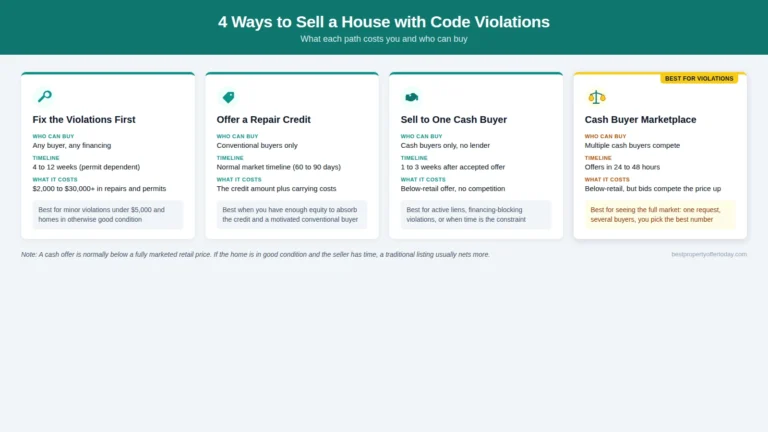
| Sell to a cash buyer | Investors, iBuyers, local and national cash buyers | Usually little or nothing beyond your own payoffs | 1 to 3 weeks, limited by title work | A low first number, or a number that drops after inspection |
Best Property Offers Today sits inside the third route. We do not buy houses. One request goes to a network of vetted cash buyers, they send competing offers, usually within 24 to 48 hours, and you compare them side by side. It is free and you are not obliged to accept any of them. The point of the comparison is the gap between buyers, which we come back to below.
Do You Have to Advertise a House as “As Is”?
No. Nothing in the law requires the words in a listing, and in some states they are already the default. Florida’s most widely used residential contract is an “AS IS” form. California’s standard purchase agreement says the property is sold in its present physical condition. In both places almost every house sells “as is” whether the listing says so or not.
What protects you is the contract and your disclosure form, not the listing description. The label does two things in the market, one good and one bad:
- Good: it filters out buyers who expect a move-in-ready house and would ask for a repair list after inspection.
- Bad: retail buyers read it as “something is wrong”, and some skip the listing entirely. Investors read it as an invitation to bid low.
If the house is basically sound and just dated, many sellers do better describing the condition plainly (“original kitchen, roof replaced 2016, furnace serviced last fall”), pricing for it, and putting the no-repairs term in the purchase agreement. If the house has a real problem, like a failed septic system, a foundation issue or an active leak, say it plainly and use the words. You want the buyers who can handle that problem, and you want the problem on the record.
Either way, you can always answer a repair request with no. The label just means fewer buyers are surprised when you do.
Dated but Working Is Not the Same as Broken
A house can be old without being defective. A 22-year-old furnace that heats the house is not a repair item. Replacing it would be an upgrade, and you are not obliged to buy the next owner an upgrade. The same goes for a dated kitchen, original bathrooms, or carpet a buyer does not like.
Age stops being your opinion in two places:
- The lender’s appraiser. Government-backed loans judge remaining life, not just whether something works today. FHA, for example, requires the appraiser to flag a roof with less than about two years of remaining life as a required repair. Our post on selling a house that needs a new roof walks through FHA, VA and USDA standards.
- The buyer’s insurer. Some insurers will not write a policy on an old roof or certain electrical panels and plumbing, and in some states insurers routinely ask for a four-point inspection on older homes. No insurance means no mortgage.
The practical move: write down the age and the last service or replacement date for the roof, furnace, air conditioning, water heater and electrical panel. Put it in the listing or hand it to every buyer. A working system with a dated receipt is a talking point. A working system with no history becomes a negotiation. For the broader question of which repairs are worth doing at all, see what not to fix when selling a house.
Can a Financed Buyer Close on Your House?
This is the question that decides your price, and few guides ask it. If a lender will finance the house as it stands, you have the whole market: first-time buyers, FHA and VA buyers, families, and investors. If no lender will, your only buyers are people paying cash, and cash buyers price in their risk.
Things that commonly stop a loan or an insurance policy:
- An active roof leak, or a roof at the end of its life
- No working heat, or a heating system that is unsafe
- Exposed or unsafe wiring, including some older wiring types
- Structural movement, or a foundation an engineer has flagged
- Missing kitchen or bathroom essentials, or a house that is not habitable
- Health and safety items such as peeling paint in older homes where FHA or VA rules apply
What about renovation loans?
They exist, and they are why “cash only” is not quite true. FHA 203(k) loans and Fannie Mae’s HomeStyle Renovation loan let a buyer borrow the purchase price and the repair budget in one mortgage. Freddie Mac has a similar program. They take longer to close and need contractor bids, so they suit a patient buyer more than a seller in a hurry. If your house is a sound structure with a long repair list, mentioning that it may qualify for renovation financing widens the pool.
“Does the buyer have to pay for repairs before closing?”
Sometimes the lender requires the repair to be done before it funds, and the buyer offers to pay for it. Be careful. A buyer paying to repair a house they do not own yet is taking a risk, and if the sale falls through the work is a gift to you that may come with a dispute attached. Better options are a repair escrow or holdback where the loan program allows it, a renovation loan, or a cash buyer who needs no lender at all.
Repair Credit or Price Cut: Which Costs You Less?
When a buyer comes back after inspection, take a price reduction over a credit if the amounts are the same. The reasons are mechanical:
- Commission and transfer taxes follow the price. They are usually calculated on the sale price, so a $10,000 price cut also trims what you pay on that $10,000. A $10,000 credit does not.
- Lenders cap seller credits. Fannie Mae limits what a seller can contribute based on the buyer’s down payment: 3 percent of the price when the buyer puts down less than 10 percent, 6 percent with 10 to just under 25 percent down, and 9 percent with 25 percent or more. FHA allows up to 6 percent. VA limits seller concessions to 4 percent, not counting normal closing costs.
- Credits pay closing costs, not contractors. In general a lender lets a seller credit cover the buyer’s closing costs and prepaid items. It cannot exceed those costs or be handed to the buyer as cash for the repair.
Here is how that bites. On a $255,000 sale where the buyer puts 5 percent down, the Fannie Mae cap is 3 percent, or $7,650. If you already agreed to cover $5,000 of their closing costs, you only have $2,650 of room. A $6,000 “repair credit” cannot fit, and the deal has to be rewritten as a price cut anyway, often days before closing.
If you had a pre-listing inspection, disclosed everything, and priced the house for it, you are entitled to say no to a credit request. A buyer who saw the report before offering has a weak case for more money. That is the single best argument for paying for the inspection first.
What You Still Have to Disclose When Selling As Is
As is limits your duty to repair. It does not limit your duty to disclose. Most states require sellers to tell buyers about known material defects, meaning problems that affect value, safety or the buyer’s decision, and many use a standard disclosure form. Concealing a known defect can support a fraud claim even when the contract says as is. The rules vary by state, so read your own form line by line. A few questions come up constantly.
Do I have to disclose a scratch in the floor or a chipped tile?
Generally no. Disclosure duties aim at defects a buyer could not reasonably see for themselves. A scratch in plain view is something the buyer can price on the walkthrough. The line moves when cosmetic damage is a symptom: a stain on the ceiling is cosmetic only if you know the leak behind it is fixed. If your state form asks a direct question, answer the question.
Do I have to disclose that someone died in the house?
It depends on the state, and many states protect sellers here. California is a useful example: its Civil Code says a seller is not liable for failing to disclose a death on the property that happened more than three years before the offer. Even there, you may not lie if a buyer asks you directly. Several states have similar “stigmatized property” laws. If the death caused physical damage, such as an unattended death that required remediation, the damage itself is a condition to disclose.
Haunting claims are usually not a disclosure item, with one famous exception. In a 1991 New York case, Stambovsky v. Ackley, a seller had publicized the house as haunted for years. The court let the buyer rescind the sale, because the seller had created the reputation and then stayed quiet about it.
I inherited the house and do not know its problems. What do I write?
Write what is true: “unknown” where you have no knowledge, never a guessed “no”. Some states exempt executors and trustees from the standard form. California, for example, exempts transfers by a fiduciary in the course of administering an estate, and several other states have similar carve-outs. An exemption from the form is not permission to hide something you have found. If clearing out the house turned up a water stain or a dead outlet, that is now something you know. Our guide to selling an inherited house covers the estate side.
What if I suspect a problem but have not confirmed it?
Disclose the observation, not a conclusion. If you found old 9-inch floor tiles under the carpet and wondered about asbestos, write that you found them and that they were never tested. You have told the truth without claiming expertise. The buyer can test them. That sentence protects you far better than silence. More on that case in selling a house with asbestos.
Why “We Buy Houses As Is” Letters Come In So Low
Because most of them start from a formula, not from your house. A common investor rule of thumb is to pay no more than about 70 percent of the after-repair value, minus the repair budget. The remaining margin covers holding costs, resale commission, closing costs, risk and profit.
Run it on a house worth $300,000 fixed up, needing $35,000 of work: 70 percent of $300,000 is $210,000, minus $35,000 is $175,000. That is $125,000 under the repaired value, which is exactly the size of gap people report when they test one of those mailers out of curiosity. It is not a scam in itself. It is a business model that only works if the seller does not compare.
Two things push the first number lower still:
- Wholesalers. Some mailers come from people who will not buy at all. They sign a contract and sell the contract to a real investor for a fee, so their offer has to leave room for that fee on top of the investor’s margin. See what a real estate wholesaler is for how to spot one.
- No competition. A buyer who knows nobody else is bidding has no reason to move off the formula.
Buyers do not all use the same percentage, the same repair estimate or the same resale price. A landlord who plans to keep the house can pay more than a flipper. That spread is the reason to collect several offers instead of answering one letter. Our breakdown of how cash buyers calculate their offer shows the full arithmetic.
Is the As-Is Offer the Price You Get at Closing?
Only if the contract makes it so. Plenty of as-is cash offers carry an inspection or due diligence period, and a small deposit that the buyer gets back if they cancel during it. That combination lets a buyer sign at a high number, inspect, and then “re-trade” lower once you have stopped talking to anyone else. The phrase “as is” on the first page does not prevent it.
Before you sign, find these four things in the contract:
- The inspection or due diligence period. How many days, and can the buyer cancel for any reason during it? On a house sold as is, a short window is reasonable. Three weeks is a free option for the buyer.
- The earnest money. How much, and on what day it stops being refundable. A deposit of a few hundred dollars on a six-figure house costs the buyer nothing to walk away from. See how much earnest money is enough.
- An assignment clause. Words like “and/or assigns” after the buyer’s name mean the contract can be sold to someone else.
- Escape phrases. “Subject to partner approval” or “subject to buyer’s satisfaction” let the buyer leave on a whim.
Ask every buyer the same question in writing: “Is this price subject to change after your walkthrough, and if so, under what conditions?” A buyer who has already seen the house should be able to say no. Then compare the answers. Our guide on how to compare cash offers lays out the rest of the checklist.
Worked Example: One House, Four Ways to Sell It
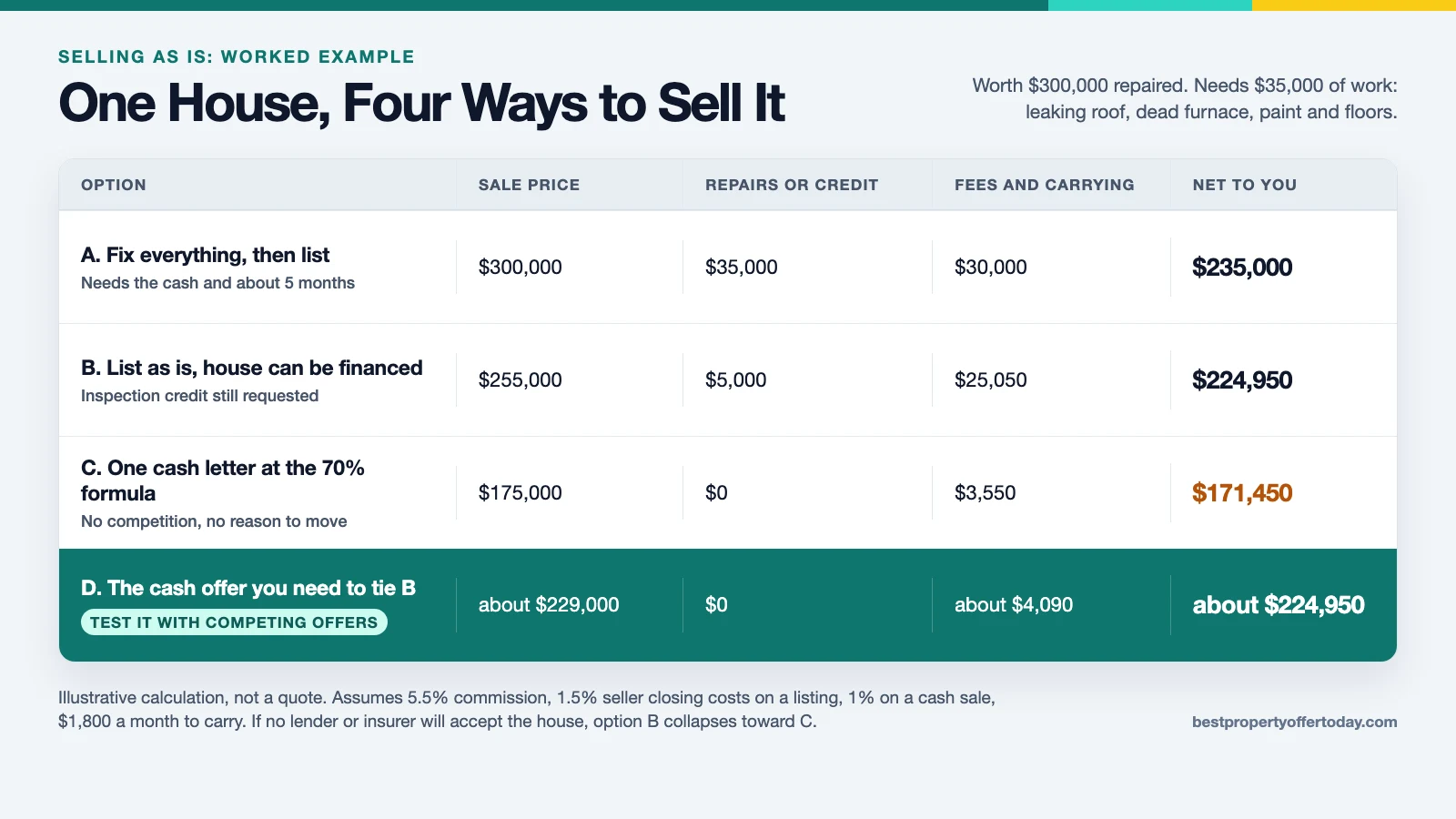
This is an illustrative calculation, not a quote or a promise about your house. Every number is an assumption, chosen to be round and plausible, so you can swap in your own.
The house: worth $300,000 fully repaired. It needs a roof that is leaking and at the end of its life ($14,000), a furnace that does not run ($8,000), and paint, flooring and fixtures ($13,000). Total: $35,000. Assumptions: a 5.5 percent commission (commissions are negotiable), 1.5 percent other seller closing costs on a listed sale, 1 percent on a cash sale, and $1,800 a month to carry the house in mortgage interest, taxes, insurance and utilities.
| Option | Sale price | Repairs or credits | Commission | Closing costs | Carrying | Net to you |
|---|---|---|---|---|---|---|
| A. Fix everything, then list | $300,000 | $35,000 | $16,500 | $4,500 | $9,000 (5 months) | $235,000 |
| B. List as is, financed buyers can close | $255,000 | $5,000 credit | $14,025 | $3,825 | $7,200 (4 months) | $224,950 |
| C. One cash offer at the 70 percent formula | $175,000 | $0 | $0 | $1,750 | $1,800 (1 month) | $171,450 |
| D. Cash offer that matches option B | about $229,000 | $0 | $0 | about $2,290 | $1,800 (1 month) | about $224,950 |
Read it honestly. On these numbers, if you have the cash and five months, fixing and listing nets the most. Option A also assumes the repairs come in on budget, and older houses often do not once walls are opened. Listing as is comes close behind. A single cash letter is far behind. To tie option B, a cash offer would need to be about $229,000, roughly 76 percent of the repaired value. That is a number one mailer will not give you. It is the number you are testing for when several buyers compete.
Now change one fact. The leak has stained two ceilings and the buyer’s insurer will not write a policy until the roof is replaced. FHA and VA buyers are gone, and so are most conventional buyers. Option B is now a cash-buyer sale with a commission and three extra months attached. If the best listed offer is the same $175,000, you pay $9,625 in commission, $2,625 in closing costs and four months of carrying costs, and net about $155,550 instead of $171,450. That is why the financing question above matters more than the as-is label. Run your own figures in the net proceeds calculator, and see cash offer vs listing with an agent for a longer comparison.
Light Prep That Still Pays on an As-Is Sale
As is does not have to mean full of furniture. Three low-cost steps change how buyers price a house, including cash buyers:
- Empty it, or agree in writing who will. Many purchase contracts expect the house delivered empty and broom clean unless they say otherwise. If you want to leave the contents, write “sold with contents” into the agreement. Most cash buyers will accept that, and some estate sale companies will clear a house and pay you for what sells.
- Clean and remove smells. Odor and grime make buyers assume hidden damage, and they price for the worst case.
- Gather the paper. Repair receipts, permits, the age of each major system, any old inspection reports, and the septic or well records if you have them. Some states require inspections at transfer, such as Massachusetts’ Title 5 septic inspection. Know before you list whether yours does.
A pre-listing inspection usually costs a few hundred dollars. It is worth it when you plan to list as is with an agent, because it moves the surprises to before the price is set. It matters less when you are collecting cash offers from buyers who will walk through and price the house themselves.
When Selling As Is Is the Wrong Call
Be straight with yourself about these cases:
- The work is cosmetic and you can fund it. Paint, flooring and fixtures in a house that will finance are the classic case where fixing first nets more.
- The house will finance as it stands and you have time. A traditional listing, even as is, usually beats cash. Option B above shows why.
- Only one problem blocks financing. If a $9,000 roof is the only thing between your house and the full market, fixing or crediting that one item can be worth far more than it costs.
- You are planning to take the first offer. Some cash buyers are bad at this. Offers that drop after “inspection”, contracts assigned more than once before closing, and token deposits are all common. If you will not compare, you are giving the margin away.
Selling as is makes the most sense when the house will not finance, when you cannot fund the repairs, or when the cost of waiting, such as a foreclosure date, a second mortgage payment or an estate that has to close, is bigger than the price gap.
Frequently Asked Questions
Can I get a cash offer just to see the number?
Yes. An offer does not bind you to anything. You are only committed once you sign a purchase agreement. Collecting several offers before deciding is the normal way to find out what the house is worth to cash buyers as it stands.
Do I need a realtor to sell as is to a neighbor or someone I know?
No. You need a written purchase agreement, a title company or closing attorney to handle the deed and payoffs, and a clear title. If the house came through probate, confirm the court or estate paperwork gives you authority to sell and that every heir who must sign will sign. The one thing an agent or a set of competing offers gives you is a check on whether the friendly price is a fair one. See do I need a lawyer to sell my house for cash.
Should I pay for an appraisal before selling as is?
Usually not. An appraisal tells you what a lender will lend against, which matters less if the buyers will be paying cash. Free valuations from two or three agents, plus real cash offers, give you a better read on as-is value for less money. Pay for an inspection instead if you want to know what is wrong.
How much less will I get for a house sold as is?
It depends on the repair bill and on whether the house can be financed. A sound, dated house listed as is may sell near market value minus the repairs. A house no lender will touch sells to cash buyers, and national franchise buyers typically land at 60 to 80 percent of market value, with local investors spread around that depending on their plans and the competition. If you want to see where yours falls, request competing cash offers or call 804-361-7460.