Selling a House with Asbestos: Disclosure, Remediation, and the Cash Offer Math
You can sell a house with asbestos. No law bars the transaction. What asbestos changes is your buyer pool, your disclosure duties, and how buyers price the property. Those three effects are worth understanding before you decide what to do.
Where asbestos turns up in homes built before 1980
Homes built before 1980 commonly contain asbestos in materials where heat or durability mattered during construction. The most frequent locations are floor tiles, ceiling tiles, pipe insulation in basements and crawl spaces, HVAC duct wrap, attic insulation, roofing felt, and textured coatings such as popcorn ceilings. Some homes have it in one area; others have it throughout.
Whether asbestos poses a concern depends on its condition. Material that is intact and undisturbed, what inspectors call non-friable, does not release fibres into the air. Material that is crumbling, deteriorating, or has been cut or sanded releases fibres. That distinction drives the disclosure requirement, the lender position, and ultimately the price.
What disclosure actually requires
There is no federal residential asbestos disclosure law equivalent to the 1992 lead paint rule. The federal lead paint statute requires mandatory disclosure for pre-1978 homes. Asbestos has no equivalent federal mandate for residential resale. However, that does not leave sellers free to stay silent.
Most states require disclosure of all known material defects. Known asbestos is a known material defect. Virginia, California, Colorado, and several other states name environmental hazards including asbestos directly on their standard seller disclosure forms. The specific form varies by state, but the underlying principle is consistent: if you know it is present, you disclose it.
Selling as-is does not eliminate the duty to disclose. It limits the duty to repair, not the duty to tell. A buyer who accepts an as-is property still has the right to know about conditions affecting its value or habitability. Concealed asbestos discovered after closing can support a fraud or misrepresentation claim regardless of any as-is language in the purchase contract.
If you are uncertain what your state requires, a one-hour consult with a real estate attorney is a small cost relative to the post-sale liability of getting it wrong. See how lead paint disclosure works as a comparison, since the two conditions involve similar state-level disclosure regimes.
Radon follows the same rule: disclose what you know, regardless of sale type. For properties that test positive for both conditions, see selling a house with radon for how elevated radon levels change the lender and cash-buyer calculus separately.
Why financed buyers face a harder road
FHA and VA appraisers work from property condition standards that require them to note deteriorating or friable asbestos as a material concern. If the appraiser flags it, the lender requires resolution before the loan closes. Resolution means either encapsulation (sealing the material so fibres cannot release) or abatement (licensed full removal). The buyer on a government-backed loan cannot waive this requirement.
Conventional loans do not carry the same mandatory trigger, but most conventional buyers commission a home inspection and negotiate on what it finds. Asbestos findings typically produce a repair request or a price reduction. If the seller declines both, the buyer usually walks.
Cash buyers operate outside the lender approval chain entirely. They set their own criteria. An investor who specialises in as-is condition properties will price in the remediation cost rather than conditioning the sale on your doing it first. This is why asbestos properties sell to cash buyers more often than the average house.
Remediation vs as-is: the net proceeds on a $250,000 house
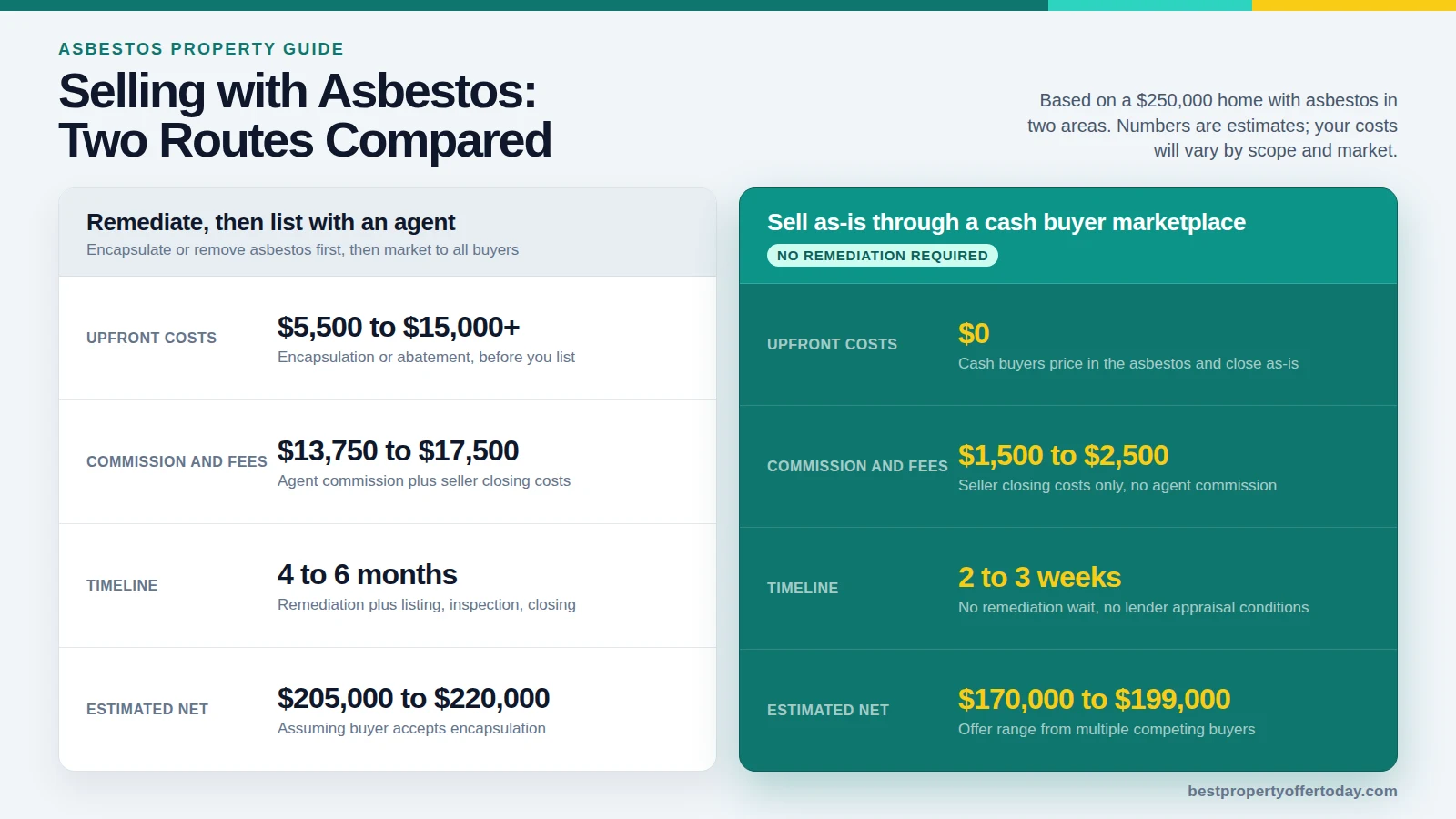
Here is what two routes look like with real numbers. The house has asbestos in the basement floor tiles and a bathroom ceiling. Retail value if fully remediated: $250,000.
Route 1: Encapsulate first, then list with an agent
| Item | Estimated cost |
|---|---|
| Professional encapsulation (two areas) | $5,500 |
| Agent commission (5.5%) | $13,750 |
| Seller closing costs (transfer tax, title, attorney) | $3,750 |
| Buyer inspection renegotiation (typical) | $3,000 |
| Carrying costs: 4 months at $1,800 per month | $7,200 |
| Total deductions | $33,200 |
| Estimated net proceeds | $216,800 |
Route 2: Sell as-is through a cash buyer marketplace
| Item | Range |
|---|---|
| Cash offer range (as-is, asbestos priced in) | $175,000 to $202,000 |
| Seller closing costs (no commission, no repairs) | $1,500 to $2,500 |
| Carrying costs: closes in 2 to 3 weeks | $1,200 to $1,800 |
| Estimated net proceeds | $170,700 to $199,300 |
On this house, the traditional route nets roughly $17,000 to $46,000 more, assuming encapsulation holds the price and no buyer demands full abatement instead. If the asbestos is more widespread, or if a buyer demands full removal, the gap narrows.
The net proceeds calculator can help you run both scenarios with your own numbers before you talk to any buyer.
What to watch for in a cash offer on an asbestos property
Any serious buyer making an as-is offer on a home with disclosed asbestos will have assessed the scope and condition before pricing it. These are the patterns that suggest they have not, or that they do not intend to close the deal themselves:
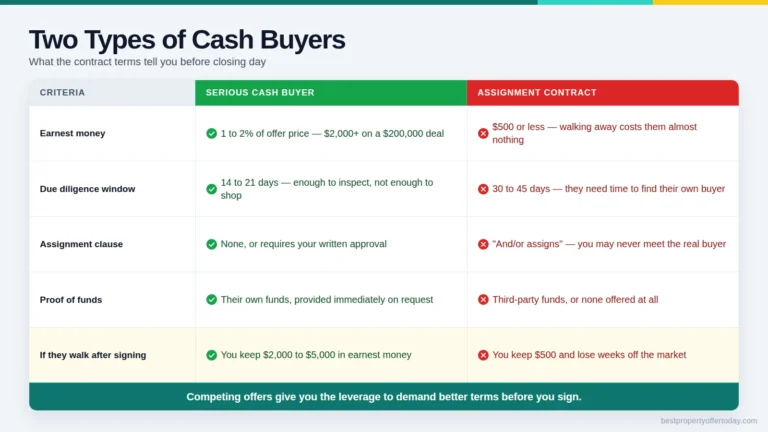
- An offer to close in 24 to 48 hours with no inspection period. Buyers who skip due diligence on a known environmental condition are often wholesalers who plan to assign the contract to another buyer before closing.
- Earnest money of $500 or less on a property priced over $180,000. At that deposit level, backing out after locking you in costs them almost nothing.
- Assignment language in the contract without requiring your written consent. Find out who is actually closing on your house before you sign.
- A price reduction of 15 to 20 percent after an inspection that supposedly found more asbestos. Buyers who price as-is properties accurately do not need to renegotiate significantly unless they can document something genuinely new.
- No questions about the location or condition of the asbestos before making an offer. A buyer pricing an environmental issue will ask.
The vetting guide covers what business documentation and history to check before engaging with any cash buyer.
Questions to ask a cash buyer before you sign
- Have you purchased homes with asbestos before, and how did you handle remediation during renovation?
- Will you close this transaction directly or will the contract be assigned to another buyer?
- How much earnest money are you depositing, and when does it become non-refundable?
- What specifically would cause you to lower the offer or exit during the inspection period?
- Which title company are you using, and can I contact them independently to confirm the order is open?
A buyer who cannot answer those questions clearly is not prepared to close. Call 804-361-7460 if you want to talk through the process before you submit a request.
Why getting more than one offer matters here
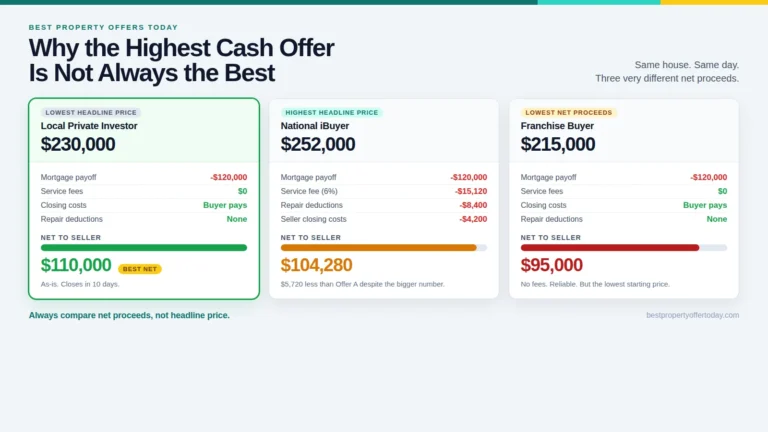
Different buyers price asbestos differently, and the spread between offers on the same property can run $20,000 to $30,000 on a $200,000 house. One investor treats encapsulation as a $6,000 cost and prices accordingly. Another demands full abatement and builds in $20,000. A third will not service your market at all.
Submitting your property to a marketplace that routes the request to multiple vetted buyers gives you actual data on where the range sits. Accepting the first offer you receive leaves you no reference point for whether it reflects the market or just that one buyer’s risk tolerance.
Competing offers also create leverage. If one buyer comes in at $185,000 and another at $198,000, the lower offer either adjusts or loses the deal. That leverage only exists when you have something to compare against.
Who should not take the cash route
A cash sale on an asbestos property costs you price. The trade is certainty, zero upfront remediation cost, and a closing measured in weeks rather than months. That trade is not always worth making.
If the asbestos is limited to one material in one area, the encapsulation estimate is below $5,000, the house is otherwise in good condition, and you have four to six months available, a traditional listing will almost certainly net you more. Many asbestos properties sell successfully on the retail market. The condition is common enough in pre-1980 housing that experienced agents and buyers know how to handle it.
The seller who benefits most from the cash route is one facing a combination of factors: asbestos that is extensive or deteriorating, a property needing significant other work, a timeline under two months, or a financial situation that does not support carrying the home through a listing cycle. If that is your situation, the offer request takes about five minutes and carries no obligation to accept anything.
Does a seller have to disclose asbestos when selling a house?
In most states, yes. There is no federal residential asbestos disclosure law, but most states require disclosure of all known material defects, and asbestos qualifies. States including Virginia, California, and Colorado list environmental hazards on their standard disclosure forms. Selling as-is limits the duty to repair, not the duty to disclose. Concealing known asbestos can result in post-sale liability regardless of contract language.
Can you sell a house with asbestos as-is?
Yes. Selling as-is means you will not remediate as a condition of closing. You still disclose what you know. Cash buyers regularly purchase as-is properties with asbestos because they are not subject to FHA or VA appraisal conditions that block financed deals. The offer price reflects the remediation cost the buyer expects to carry.
How much does asbestos reduce a home sale price?
The reduction varies by scope and buyer type. A limited encapsulation job costing $4,000 to $6,000 might reduce a retail offer by $5,000 to $12,000 through buyer concessions and renegotiation. More extensive asbestos requiring full abatement can reduce a cash as-is offer by $20,000 to $40,000 on a $250,000 property. Getting competing offers is the most reliable way to determine where the range actually sits for your specific house.
What is the difference between asbestos encapsulation and abatement?
Encapsulation seals the asbestos material with a coating or barrier so fibres cannot release into the air. It does not remove the asbestos from the property. Abatement is full licensed removal by a certified contractor. Encapsulation typically runs $2,000 to $8,000 for residential applications and is appropriate when the material is intact and non-friable. Abatement is required when the material is deteriorating or when planned renovation would disturb it. A licensed asbestos inspector can assess which approach fits your situation and provide a cost estimate before you commit to either route.