How to Compare Cash Offers on Your House: What the Numbers Mean
The headline number is almost never the right number to compare.
When multiple cash offers come in on your house, three things determine which one puts more money in your pocket: net proceeds after all deductions, who is actually making the purchase, and whether the number you see today is the number you will see at closing. A $252,000 offer can net less than a $230,000 offer, and that is not a coincidence. It is how some buyers price their margins.
Start with net proceeds, not the headline price
Net proceeds is what you walk away with after the mortgage payoff, closing costs, buyer fees, and any repair credits the contract requires. Cash offers come packaged differently, and the differences are rarely explained upfront.
Here is what each deduction category looks like in practice:
- Service fees: iBuyers charge 4 to 8 percent, labeled as a “program fee” or “service fee” on the addendum, not on the front page
- Post-inspection repair deductions: an iBuyer may start at $252,000, then reduce to $243,600 after their internal walkthrough
- Closing costs allocated to the seller: in some states, the owner’s title policy alone runs 0.5 to 1 percent of the sale price. For a full breakdown of what each line item costs and which ones are negotiable, see closing costs in a cash home sale: what the seller actually pays
- Prorated property taxes, HOA dues, and utility credits calculated to the day of closing
- Your mortgage payoff: the same number regardless of which offer you accept
Our free net proceeds calculator runs this math against your specific situation, including carrying costs if you are weighing a cash sale against a traditional listed sale.
A worked example: three offers on the same house
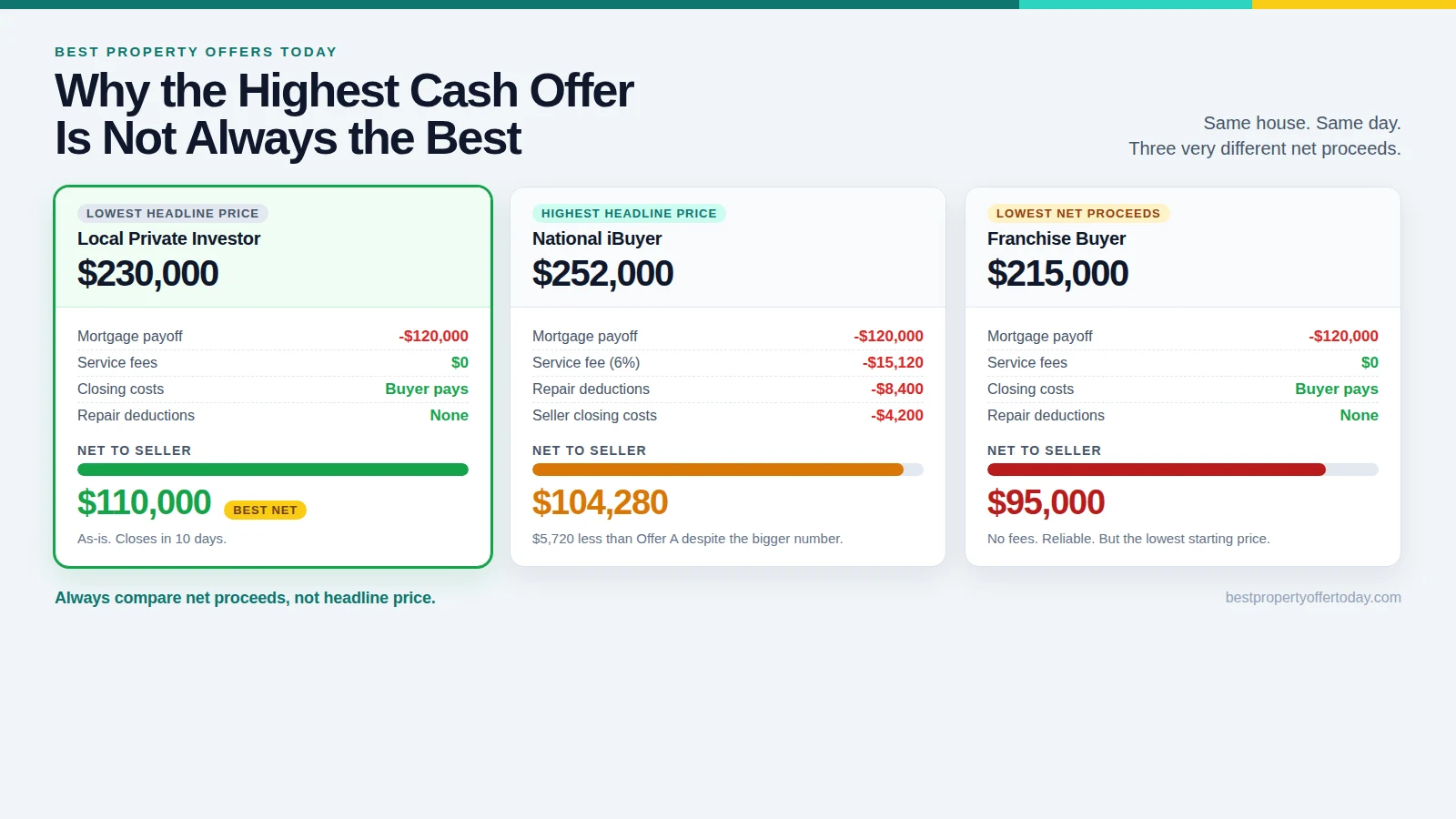
Take a house with a fair market value of $280,000. The seller has a $120,000 mortgage balance and receives three cash offers on the same day.
Offer A: Local private investor, $230,000
No fees. Buyer covers all closing costs. As-is, no repairs. Closes in 10 days.
Net to seller: $230,000 minus $120,000 mortgage = $110,000
Offer B: National iBuyer, $252,000
6 percent service fee: $15,120. Post-inspection repair deduction: $8,400. Seller pays closing costs: $4,200.
Net to seller: $252,000 minus $15,120 minus $8,400 minus $4,200 minus $120,000 = $104,280
Offer C: Franchised buyer, $215,000
No fees. Buyer covers closing costs. As-is.
Net to seller: $215,000 minus $120,000 = $95,000
Offer B looks best on the front page. After fees and deductions, it is the middle outcome. Offer A nets $5,720 more than Offer B despite a $22,000 lower headline price. This math is not always this dramatic, but the pattern is common enough that comparing offers by purchase price alone is a reliable way to choose the wrong deal. For a breakdown of how each buyer type arrives at their number in the first place, including the ARV formula and the margin each type targets, see our post on how cash buyers calculate their offer.
Who is actually buying your house
Cash offers come from several categories of buyer. Knowing which type is in front of you tells you whether the contract terms are normal for that category, or whether something is off.
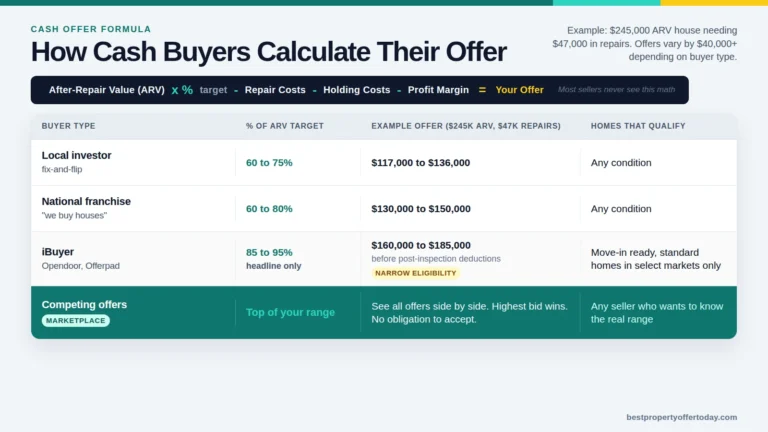
Private investors. Individuals or small LLCs who use their own cash or a private credit line. Often the fastest to close and the least bureaucratic. Offer quality varies widely: some are genuinely competitive, and some are fishing for a seller in a difficult situation at 55 cents on the dollar.
iBuyers. Technology platforms that generate algorithmic offers based on comparable sales data. Their headline prices come closer to market value, but the service fees and post-inspection deductions close that gap. They also have condition and geography limits: most will not buy houses outside their active service cities, older than a certain construction year, or with structural problems. A direct breakdown of their fee structures is in our Opendoor vs. Offerpad comparison.
Franchised buyers. “We Buy Houses” franchisees operate under a national brand but are locally owned. Their offers typically land at 60 to 80 percent of market value, no fees, fully as-is terms. The discount is real, but so is the reliability and speed.
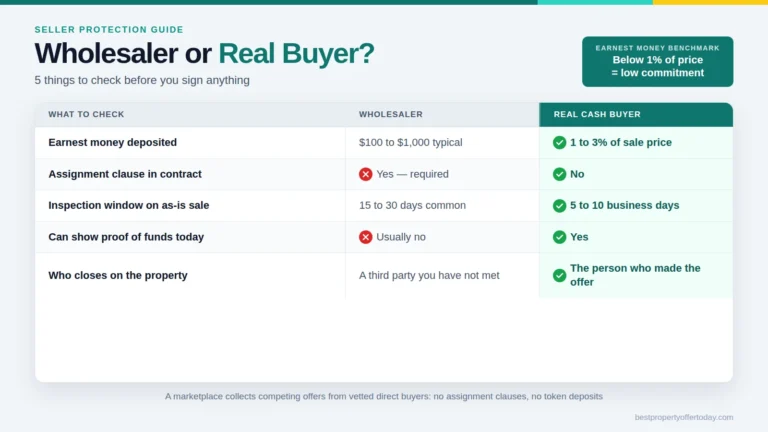
Wholesalers. They sign a contract with you, then assign it to a third-party buyer before closing. This is legal, but it introduces a real risk: if they cannot find a buyer, the deal falls apart. Watch for very low earnest money, long inspection windows on an as-is purchase, and contract language permitting assignment of the agreement. More detail on identifying them is in our guide to vetting cash buyers.
Normalizing for closing costs
Closing costs on the seller’s side typically run 1 to 3 percent of the purchase price, though this varies by state. When a buyer says they cover closing costs, verify which ones specifically. Some cover the lender’s title policy (which protects them, not you) but leave the settlement fee, state transfer taxes, and recording fees on your side of the ledger.
When normalizing offers, add any closing costs the buyer is not covering to your cost column, not to their price. Here is how the typical items break down:
| Cost item | Typical range | Usually paid by |
|---|---|---|
| Owner’s title insurance | 0.5 to 1.0% of price | Seller (most states) |
| Title search and settlement fee | $500 to $1,200 | Negotiated |
| State transfer or excise tax | 0 to 2.0% of price | Varies by state |
| Recording fees | $50 to $200 | Buyer |
| Prorated property taxes | Depends on closing date | Split at closing |
Red flags in a cash offer
A number that looks solid on offer day can deteriorate before closing. The warning signs are usually buried in the contract, not in the price.
- Earnest money under 1 percent. A serious cash buyer deposits $2,000 to $5,000 or more on a $200,000 purchase. A $100 or $500 deposit means walking away costs the buyer almost nothing, so you carry all the scheduling and opportunity risk.
- Long inspection window on an as-is purchase. A contract that says as-is but allows 14 days to inspect and cancel for any reason is effectively a contingent contract. A genuine cash buyer taking the house as-is needs three to five days to walk the property, not two weeks.
- Assignment language. A clause permitting the buyer to assign the contract to a third party is a wholesaler indicator. The person who signed may not be the person who closes, and the original number may not survive the reassignment.
- Post-inspection price reductions on an as-is sale. Some buyers offer high, then return with an inspection report demanding $15,000 to $25,000 in credits. On a genuine as-is purchase, the buyer accepts the property’s condition before signing. Renegotiating downward afterward is not a normal part of the process.
- Proof of funds delayed or vague. Any legitimate cash buyer can produce a bank statement or private lender letter within 24 hours. Extended delays usually mean the money is not actually in place.
Cash buyer types compared
| Buyer type | Offer (% of value) | Typical fees | Closing costs | Best for |
|---|---|---|---|---|
| Private investor | 65 to 80% | None | Buyer usually covers | Speed, as-is, hard-to-sell properties |
| National iBuyer | 90 to 98% before fees | 4 to 8% plus repair deductions | Split or buyer covers | Cosmetically clean homes, flexible timeline |
| Franchise buyer | 60 to 80% | None | Buyer usually covers | Reliability, national brand backing |
| Multiple bids via marketplace | Varies by network buyer | None to seller | Varies by buyer | Competitive pressure across buyer types |
A marketplace like Best Property Offers Today collects bids from buyers across these categories so you can compare them on a normalized basis, rather than negotiating one at a time and guessing at what else might be out there.
The honest caveat every seller should read
A cash offer is normally below a fully marketed retail price. What you are buying with the difference is speed, certainty, no repair obligation, and no carrying costs while the house sits on the market waiting for a qualified financed buyer.
If your house is in good condition, you have 60 to 90 days available, and you are not facing a financial or logistical deadline, a traditional listing with a real estate agent will almost always produce a higher net sale price. That is true, and saying otherwise would cost you trust immediately.
A cash sale makes economic sense when the discount is smaller than the cost of waiting: mortgage payments, taxes, insurance, and utilities continuing through a 45 to 60 day marketing period; repairs you would need to make to satisfy an inspection contingency; and the real possibility that a financed buyer falls out of contract 45 days in and you start the process over.
What should earnest money look like in a cash sale?
One to two percent of the purchase price is standard. Below 1 percent, ask why. Below $500 on any purchase above $100,000, treat the contract as one the buyer can and likely will exit without meaningful cost to them if something better comes along.
Can I counter a cash offer or negotiate terms?
Yes. The offer is a starting point. You can counter on price, on who covers which closing costs, on the close date, and on earnest money. Even large iBuyers accept counters within a range. A buyer who presents every term as non-negotiable is usually telling you something about how the rest of the transaction will go. For a detailed look at what actually moves the number, which buyer types have room, and red flags to watch for before signing, see can you negotiate a cash offer on your house.
How long do I have to decide on a cash offer?
Most cash offers expire in 24 to 72 hours. iBuyers typically give three to five days. If you are waiting on a second offer to arrive, say so. A serious buyer will grant a short extension. A buyer who pressures you to sign immediately, before you have had a chance to see alternatives, is telling you that the comparison would not favor them.
Do I need an attorney to review a cash offer?
In roughly 21 states, a real estate attorney is required to be present at closing regardless of how the sale is structured. In the remaining states, a contract review runs $300 to $500 and is worth having if you see assignment language, non-standard deduction clauses, or anything you cannot parse clearly. The fee is small against what getting it wrong costs.
Before you commit to a closing date, it also helps to know what actually controls the timeline. Title work is the real variable on any cash sale, not the buyer’s money, and a title problem can add weeks even when the buyer is ready. The post on how long a cash home sale actually takes covers what delays closings and what to ask before you sign anything.
To receive competing offers from multiple vetted buyers and compare them side by side on one request, submit your property details at Best Property Offers Today or call 804-361-7460. The submission is free and carries no obligation to accept any offer.