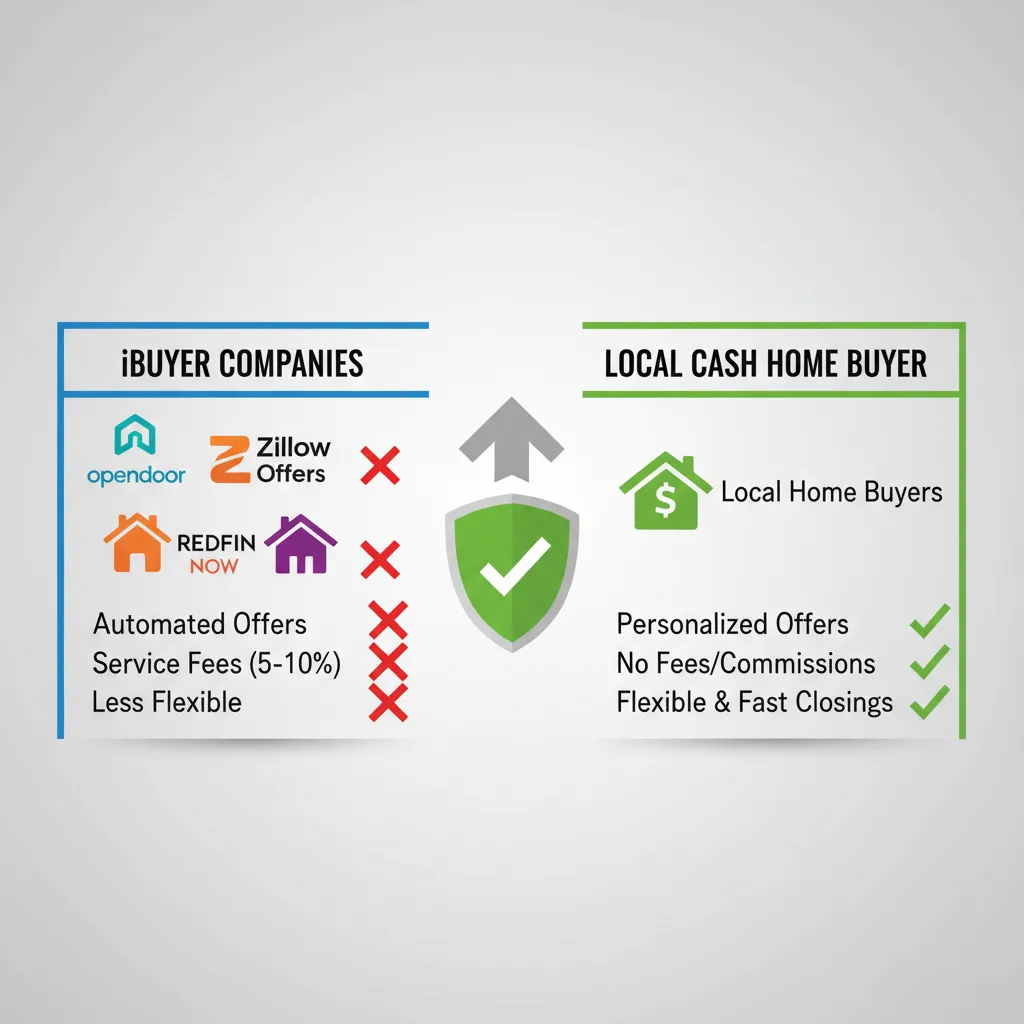
Both Opendoor and Offerpad advertise a 5% service fee as of 2026, but that number is the starting point, not the total cost. Add closing costs, repair deductions that arrive after the inspection, and an offer price that typically runs 5 to 15% below what a fully marketed sale would bring, and many sellers find a large gap between what they expected and what they actually received at closing.
Comparing Opendoor or Offerpad? See what cash buyers would offer first.
Enter your property address to get competing offers from verified cash buyers. No repairs, no agent fees, and you pick the closing date.
Prefer to talk? Call (804) 361-7460
What Opendoor and Offerpad Charge in 2026
Both companies have settled on a 5% service fee for most transactions. That is a notable change from prior years, when Offerpad charged up to 7% in some markets. The convergence to 5% makes them easier to compare head-to-head, but it also means the real difference is now in repair deductions and the offer price itself, not in the headline fee.
On top of the 5% service fee, both iBuyers charge standard closing costs of roughly 1% and assess repair credits after their inspection. Those credits typically run 1 to 3% of the sale price, though homes with significant deferred maintenance often see higher numbers. The total seller cost lands between 7% and 9% of the agreed sale price in most cases.
On a $320,000 home, that range works out to $22,400 at the low end and $28,800 at the high end, before factoring in the offer-price gap covered in the next section.
The Offer Gap: The Cost Nobody Lists
iBuyers make offers below market value. That is the business model. The fee covers the service; the offer discount covers the risk the iBuyer takes on by holding the house before reselling it. Most sellers understand there is a discount. Fewer understand how large it tends to be.
Multiple analyses of Opendoor and Offerpad transactions place offer prices at 5 to 15% below what a comparable home would achieve on the open market in a normal sale. On a home with a retail value of $350,000, a 10% gap is $35,000. Add the 7% to 9% in fees on top of that reduced base, and the all-in cost of choosing an iBuyer can reach $55,000 to $65,000 compared with a well-priced traditional listing.
That is not an argument against using an iBuyer. Some sellers need certainty, a fixed close date, and no showings, and that combination has real dollar value. It is an argument for running the actual numbers before signing.
Comparing Opendoor, Offerpad, and a Cash Buyer Marketplace
The table below uses verified 2026 data. The third column describes the experience through a marketplace like Best Property Offers Today, where one free request generates competing offers from multiple vetted cash buyers rather than a single corporate quote.
| Opendoor | Offerpad | Cash Buyer Marketplace | |
|---|---|---|---|
| Service fee | 5% | 5% | $0 to seller |
| Closing costs | ~1% | ~1% | Often paid by buyer |
| Repair deductions | 1% to 3% post-inspection | Varies post-inspection | None (buyers bid as-is) |
| Total seller cost | 7% to 9% | 6% to 9% | 0% to 2% |
| Closing timeline | 10 to 60 days | 8 to 60 days | 1 to 3 weeks |
| Markets covered | 50+ US metros | 26 metros, 8 states | All 50 states |
| Free local move | No | Yes, select markets | No |
| Number of offers | One | One | Multiple, competing |
The key structural difference is competition. Both iBuyers give you one number and one path. A marketplace gives you several buyers bidding against each other for your business. That competition does not guarantee a higher number in every case, but it removes the take-it-or-leave-it dynamic that defines the single-buyer model.
What the Numbers Look Like on a Real Sale
A seller in Phoenix holds a 3-bedroom house with an assessed retail value around $310,000. She needs to close within 30 days and wants to skip repairs and showings after a divorce.
Opendoor path: Offer comes in at $278,000, roughly 10% below assessed value. Service fee: $13,900. Closing costs: $2,780. Repair deduction after inspection: $6,200. Net proceeds: approximately $255,100.
Marketplace path: Request submitted one morning. Three competing bids arrive within 48 hours, ranging from $265,000 to $284,000. She picks the highest. No service fee charged to her. Closing costs covered by the buyer. Net proceeds: approximately $284,000.
The gap is $28,900. The timeline is the same. The seller still avoided repairs and showings. The difference is that one model creates competition and the other does not. That gap will not always be this large, and it can run the other way in unusual conditions, but it represents the structural advantage of requesting competing bids rather than accepting one offer.
Use the net proceeds calculator to run your own numbers against different fee structures before committing to any offer.
The Repair Deduction Problem
The 5% service fee is disclosed upfront. The repair credit is not, because it is assessed after the post-offer inspection. For a seller who budgeted around the headline offer, a $9,000 or $14,000 repair credit changes the math significantly.
This is the most common complaint in real seller accounts of both iBuyer experiences: the number moves after the inspection, and declining the repair credit means walking away from the contract and starting over. It is not deceptive, but sellers who expect the headline offer to be the final closing number are routinely surprised.
A vetted cash buyer outside the iBuyer model buys as-is with the condition baked into the offer from the start. The initial offer may be lower than an iBuyer headline, but it does not change after the fact.
Is Offerpad Still in Business in 2026?
Yes. Offerpad operates in 26 metro markets across eight states: Arizona, Florida, Georgia, Indiana, Nevada, North Carolina, Ohio, South Carolina, and Texas. The company contracted significantly from its peak but continues buying homes in those markets as of 2026. If you are outside those eight states, Offerpad cannot make you an offer.
Why Has Opendoor Been Struggling?
Opendoor bought a large volume of homes at 2021 and 2022 peak prices and sold them into a falling market. The losses per home were significant, and the company has worked through the financial aftermath since. The iBuyer model also depends on reading short-term price direction accurately, which is hard in a high-rate environment. In 2026, Opendoor continues to buy in its active markets but applies a tighter buy-box. Homes with substantial deferred maintenance, non-standard layouts, or rural locations are more likely to fall outside their criteria than they were three years ago.
When an iBuyer Actually Makes Sense
Three situations where paying the iBuyer premium is defensible: a simultaneous purchase where you need a firm, guaranteed close date so you do not lose your next house; a contentious estate or divorce where removing one variable from the process is worth money; or a relocating seller who cannot manage showings from across the country.
In those cases, the certainty is real and the fee is the price of that certainty. A marketplace can often match that timeline at lower cost, but the iBuyer model eliminates more unknowns, which matters for sellers in those specific situations.
If none of those apply and the goal is simply a fast, fair sale, a side-by-side comparison of multiple cash offers will almost always produce better net proceeds than a single iBuyer quote. A cash sale through any channel typically nets less than a fully marketed retail listing, so if the home is in good condition and time is not a constraint, a traditional agent listing remains the highest-net option.
Ready to see real numbers for your house?
Enter your property address to get competing offers from verified cash buyers. No repairs, no agent fees, and you pick the closing date.
Prefer to talk? Call (804) 361-7460
Frequently Asked Questions
Does Opendoor charge closing costs on top of the 5% fee?
Yes. The 5% service fee and the approximately 1% closing costs are separate line items. A seller pays both, plus any repair credits that emerge from the post-offer inspection. The combined total typically runs 7% to 9% of the sale price.
Is Offerpad cheaper than Opendoor in 2026?
The headline service fees are identical at 5%, so neither has an advantage there. The difference shows up in repair deductions, which vary by home condition, and in market coverage. Offerpad provides a free local move within 50 miles in select markets, which has real dollar value for sellers who would otherwise hire a moving company.
Does Opendoor lowball you?
Opendoor offers below retail market value because that discount is how they manage the risk of holding the property. The typical range is 5 to 15% below what an agent-led sale might achieve, though the spread varies by market and home condition. The 5% service fee is charged on top of that already-reduced offer price. For current offer activity by market, see the 2026 iBuyer market update.
What is better than Opendoor for sellers who need speed?
A marketplace that routes your request to multiple cash buyers can close in the same 1 to 3 week window without a service fee. You receive several bids instead of one, which gives you real market information and the ability to pick the best terms. The absence of a repair-credit negotiation also removes a common sticking point in the iBuyer process.
Can you negotiate with Opendoor or Offerpad?
The initial offer has limited room to negotiate. The repair deduction, which arrives after the inspection, is typically presented as a credit you accept or decline. Some sellers push back on individual line items in the repair report and succeed, but the dynamic is different from a standard buyer-seller negotiation. You are negotiating with a pricing algorithm, not a person who wants the house.