Both Opendoor and Offerpad are still buying houses in 2026, but the picture for each company looks different than it did two or three years ago. Opendoor has expanded to cover every postal code in the contiguous United States. Offerpad contracted sharply, hit back-to-back NYSE delisting warnings, and is now rebuilding: its CEO described 2026 as a year of ramping purchasing activity after sustained losses. Whether either one is the right fit for your home depends on where you live, what the property is worth, and how their buy boxes actually apply to your situation.
Opendoor in 2026: Nationwide, But Buying Less Volume
Opendoor updated its coverage page in March 2026 to confirm it buys single-family homes across every postal code in the contiguous 48 states. The reach is real. The catch is that the company is being more selective about which homes it bids on and at what price: Opendoor purchased 8,241 homes in full-year 2025, down from 14,684 in 2024. The company has said publicly it is targeting profitability by the end of 2026, which means it will pass on more borderline properties than it would have in the high-volume years.
For sellers, that selectivity has a practical effect. Opendoor has a defined buy box. It generally focuses on single-family homes and condos built after 1930, in good enough condition to resell without major structural work. Manufactured homes, properties on large acreage, and homes with significant foundation or systemic issues typically do not qualify. Getting a quote does not mean the offer holds: the process includes a post-quote inspection, and downward adjustments from that inspection are common.
The service fee runs around 5 percent of the offer price. On a $300,000 home, that is $15,000 off before any repair credits from the walkthrough. The closing window is flexible at 14 to 60 days from signing.
Offerpad in 2026: Smaller Footprint, Rebuilding
Offerpad tells a more complicated story. The company posted Q1 2026 revenue of $80.1 million, down 50 percent from $160.7 million in Q1 2025, with a net loss of $10.1 million for the quarter. It received a second NYSE delisting warning in March 2026 for its stock price falling below the exchange minimum. HousingWire reported in August 2026 that CEO Brian Bair is positioning the company as actively back in buying mode, adding four products and refining the buy box after years of contraction.
Offerpad currently operates in more than 23 markets. That is a much smaller footprint than Opendoor. If you are in a secondary market or a smaller metro, Offerpad may simply not be available. Its service fee runs 6 to 10 percent, higher than Opendoor’s. Typical initial offers have landed at 70 to 80 percent of market value before that fee applies. On a $300,000 home at 8 percent, the fee alone is $24,000 off an offer that may already be below full market value.
The financial fragility is worth naming plainly. A company that has received two stock delisting warnings in under a year carries a different counterparty risk than one with a stronger balance sheet. That is not a reason to rule out Offerpad, but it is a reason to read the earnest money clause carefully before signing. If the company hits a cash crunch before your scheduled close, what are you actually entitled to?
What Each iBuyer Will and Will Not Buy
Neither iBuyer works for every property. The table below reflects known buy box criteria as of mid-2026. Details vary by market and change as each company adjusts its risk tolerance.
| Criterion | Opendoor | Offerpad |
|---|---|---|
| Coverage | Every zip code, contiguous US | 23+ markets |
| Property types | Single-family, most condos | Single-family, some condos |
| Age minimum | Built after 1930 | Varies by market |
| Manufactured homes | No | No |
| Homes on large acreage | Generally excluded | Generally excluded |
| Service fee | Around 5% | 6 to 10% |
| Post-quote inspection | Yes, with repair adjustments | Yes, with repair adjustments |
| Closing timeline | 14 to 60 days | 8 to 90 days |
A Worked Example: What the Numbers Actually Look Like
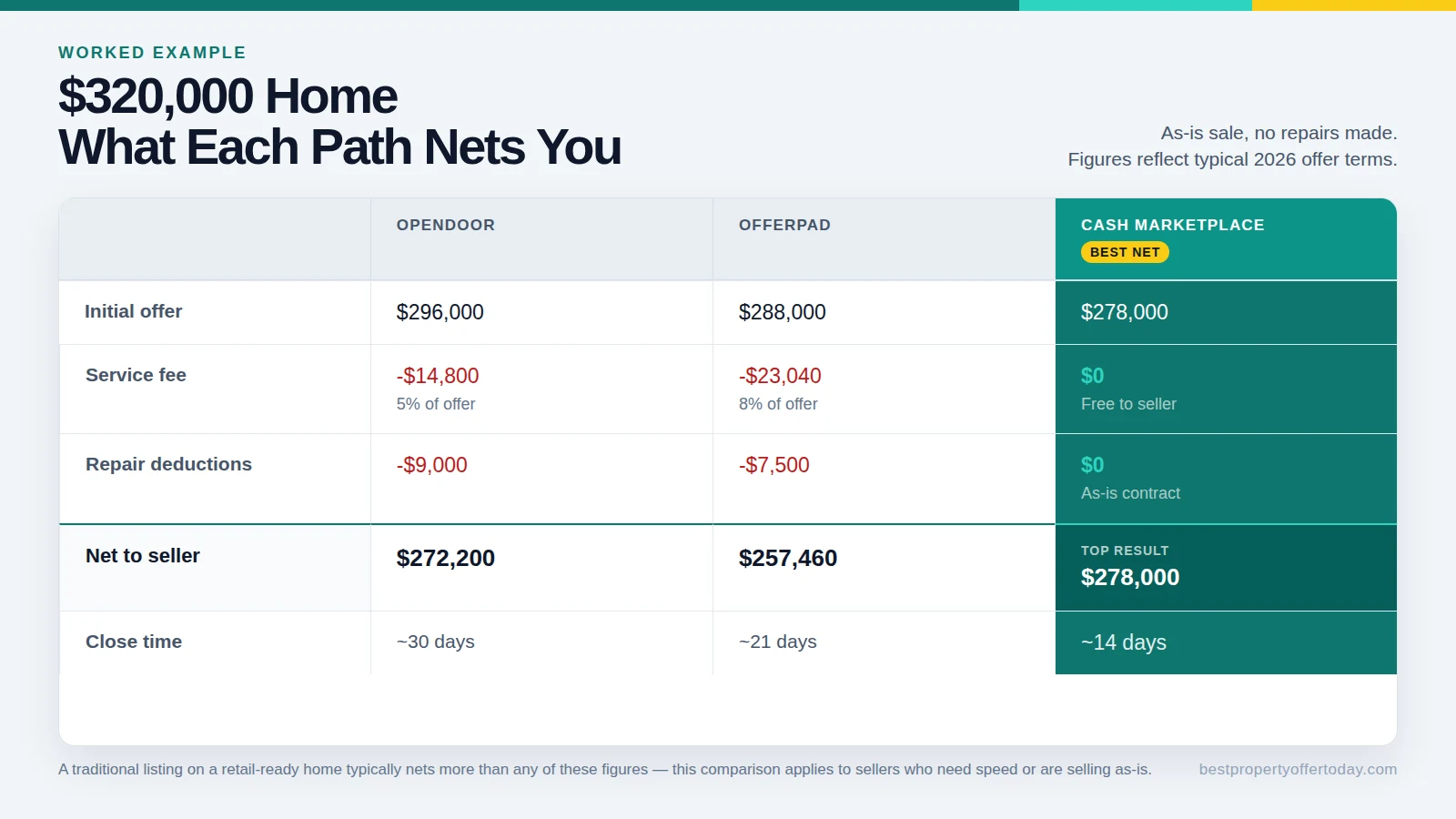
Walk a $320,000 home through three paths: Opendoor, Offerpad, and a cash marketplace where competing buyers submit offers with no service fee to the seller.
Opendoor. Initial quote: $296,000 (about 92.5 percent of market). Post-inspection repair request: $9,000. Service fee at 5 percent: $14,800. Net to seller: $272,200. Close in 30 days.
Offerpad. Initial quote: $288,000 (90 percent of market). Repair request after inspection: $7,500. Service fee at 8 percent: $23,040. Net to seller: $257,460. Close in 21 days.
Cash marketplace. Three buyers submit competing as-is offers. Best offer: $278,000. No repair requests. No seller fee. Net to seller: $278,000. Close in 14 days.
The marketplace result lands above both iBuyers on net and closes faster. The specific numbers shift with every property and every market, and none of them approach what a retail-listed sale produces on a well-maintained home. You can model your own numbers with the net proceeds calculator before contacting anyone.
The Post-Inspection Adjustment: Where Sellers Get Surprised
Both Opendoor and Offerpad operate on a two-step offer process. Step one is the initial quote you see on the screen or in the email. Step two comes after the company sends an inspector or contractor through the property. The gap between step one and step two is where frustration is most likely to concentrate.
Repair requests are real dollar deductions, not estimates. If the inspector flags the HVAC system as past its expected life, the roof as having fewer than five years remaining, or the electrical panel as not meeting current standards, those items come off the offer. The seller can dispute specific line items, accept the revised figure, or cancel. But cancelling at that point means starting over, often weeks into a transaction they had been counting on.
A private cash buyer who has already seen the property and made an as-is offer with no inspection contingency operates differently. Understanding what gives a cash buyer the right to back out helps set realistic expectations before you sign anything.
The Honest Case for Not Using an iBuyer
Both iBuyers pay below a fully marketed retail price. That is not a criticism, it is the structure of the trade. What the seller receives in exchange is a firm close date, no repair obligations, no showings, and certainty about the number at closing.
If your house is in good condition and you have two to three months, a traditional listing with an agent will almost certainly net more than either iBuyer. This is arithmetic, not a matter of opinion. An open-market listing produces competing buyer offers, which drives price up. A single-buyer negotiation with an iBuyer does not. The convenience has a real cost, and for sellers who do not actually need what iBuyers offer, that cost is hard to justify.
iBuyers and cash buyers generally make the most sense for sellers who need a firm close date, cannot fund repairs out of pocket, want to avoid the disruption of showings and open houses, or are working against a deadline that a 90-day listing process cannot accommodate. Outside those conditions, the full comparison between a cash offer and a listed sale is worth running before deciding.
Red Flags to Watch in Any iBuyer Transaction
- The initial quote is not a binding offer. Treat it as an estimate until the inspection is complete
- The inspection is done by a contractor the iBuyer chose. Ask for a copy of the full report before agreeing to any deductions
- Repair deductions are negotiable, but sellers often do not know this until after they have already agreed
- Closing extensions can happen. Read the contract for language on how many days the company can push the date without your approval
- Check the earnest money clause. If the iBuyer cancels, how much do you receive and within how many days?
- Offerpad’s financial situation in 2026 is a real variable. Confirm that the title company is independent and holds earnest money in escrow, not with the buyer
For more on how to screen any cash buyer before signing, the guide to verifying whether a cash home buyer is legitimate covers the signals that separate credible buyers from ones who are not.
Questions to Ask Before Accepting Any iBuyer Offer
- Is the service fee calculated on the initial offer or the final adjusted offer?
- When does the inspection occur, and how many days do I have to respond to the adjustment?
- What is the maximum the company can request in repairs without my approval?
- What happens to my earnest money if you cancel?
- Is the closing date firm, or can you extend it unilaterally?
- Which title company handles the transaction, and who holds the escrow deposit?
What does Opendoor charge in 2026?
The service fee is approximately 5 percent of the offer price. On top of that, repair deductions from the post-quote inspection can range from a few hundred dollars to several thousand, depending on the property’s condition. Both figures come off the seller’s net. The headline offer number on the screen is not the number you will see on the settlement statement.
Does Offerpad buy in my area?
As of mid-2026, Offerpad operates in more than 23 U.S. markets, concentrated in Sun Belt metros. That is a much smaller geographic footprint than Opendoor, which now covers every zip code in the contiguous 48 states. If you are not in a major metro served by Offerpad, the company is not an option for you. Check their website directly, or request competing offers through a marketplace that includes both iBuyers and local cash buyers in its network.
What if Opendoor’s offer drops after the inspection?
You have three options: accept the adjusted figure, counter on specific line items (some sellers successfully negotiate individual repair requests down), or decline and cancel the contract. Cancelling is free within the response window and your deposit is returned. The best leverage you can have at that point is a competing offer from another buyer already in hand. If you have that, the iBuyer adjustment becomes a number to beat, not a take-it-or-leave-it position.
Should I use Opendoor, Offerpad, or submit to a cash marketplace?
Getting offers from more than one source costs nothing and takes a few minutes. Submit a request to Opendoor, check Offerpad’s availability in your market, and request competing bids from a marketplace that collects offers from vetted buyers and charges the seller no fee. Compare the net figures after fees and any repair requests, not the initial quotes. The offer with the highest headline number is not always the one that puts the most money in your pocket. Call 804-361-7460 if you want to talk through the numbers before committing to any path.