A cash buyer backed out. Now you have an empty contract, a timeline that slipped, and a question: what does any of this actually entitle you to?
The answer depends on three things: how much earnest money they put down, whether the contingency windows had already closed, and whether the contract contained an assignment clause that let someone else walk in their shoes. Here is how each one works in practice.
The earnest money is the first thing to check
Earnest money is the deposit the buyer puts down when the purchase agreement is signed. It sits in an escrow account held by a title company or closing attorney until closing. If the deal closes, it credits toward the purchase price. If the buyer walks, what happens to it depends on when they left and why.
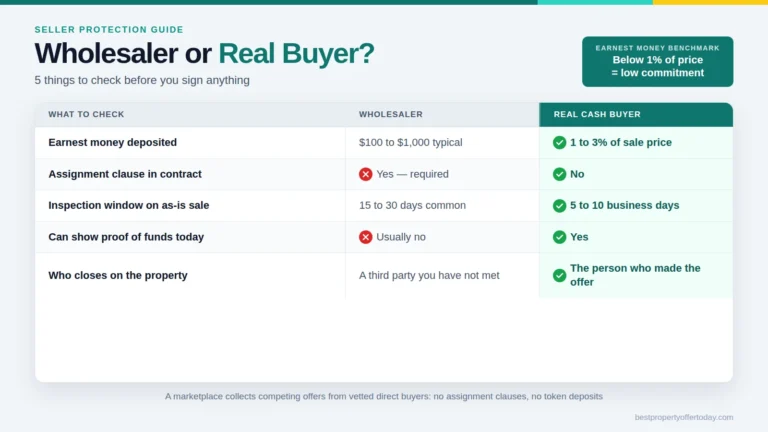
A conventional financed sale typically carries earnest money of 1 to 2 percent of the purchase price. On a $220,000 house, that is $2,200 to $4,400. Cash sales from serious individual investors often land in the same range. Cash offers from wholesalers are different.
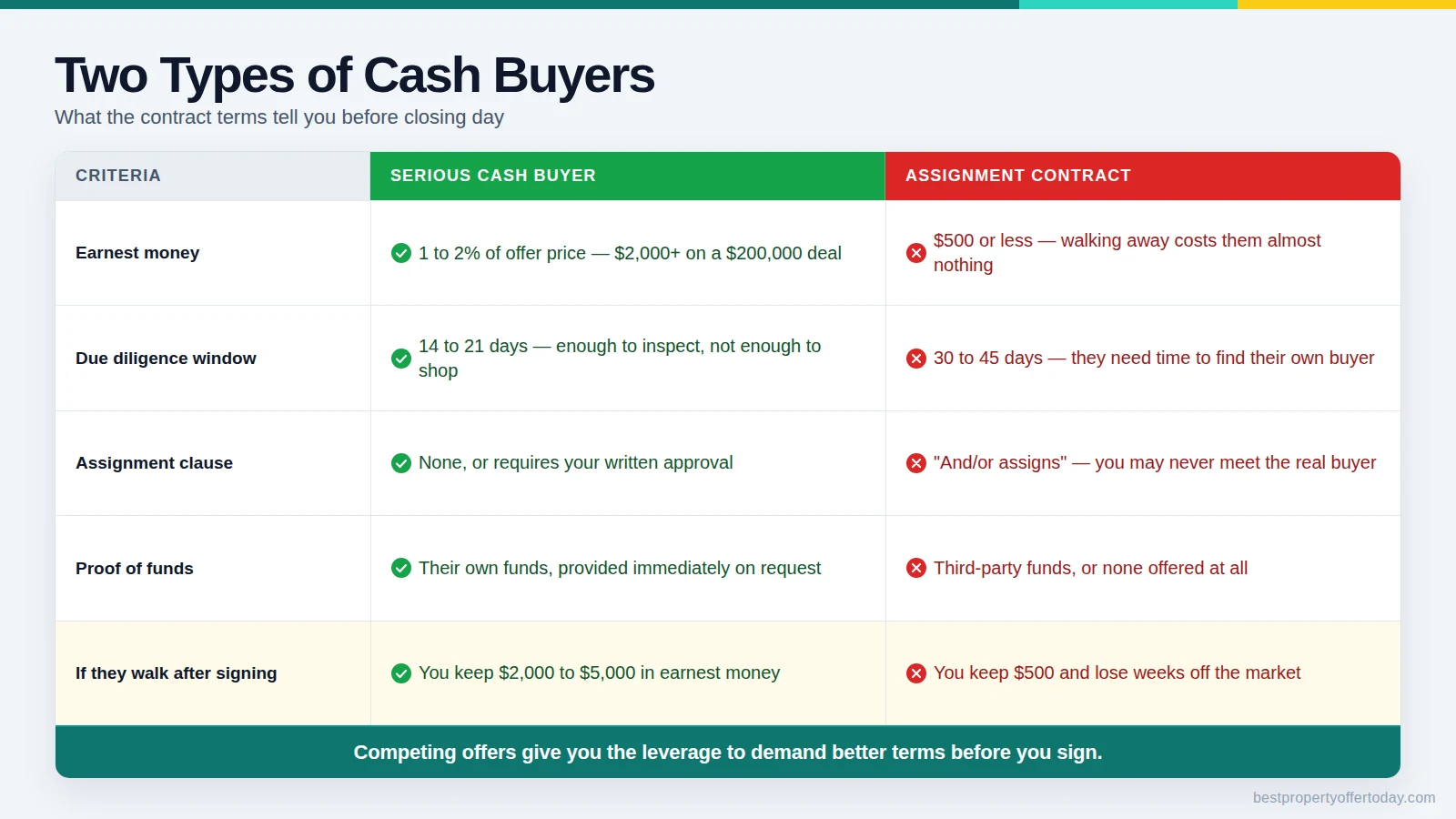
A legitimate fix-and-flip investor making an offer on a $220,000 house should put down $2,000 to $5,000 without being asked. A wholesale assignment contract often shows $500 or $1,000, sometimes less. At that level, walking away costs the buyer almost nothing. The deposit is not a commitment. It is closer to an option fee. See our guide on how much earnest money is enough in a cash sale for what each buyer type typically offers and how to negotiate a higher deposit before signing.
Why contingencies matter even when there is no lender
Cash sales do not have a financing contingency, because there is no lender involved. But they often include other contingencies, and these are the contractual exits the buyer uses to leave with their deposit intact.
The two most common are an inspection contingency and a general due diligence period. During this window, the buyer can terminate for almost any reason and receive a full refund. This is standard and legitimate. A serious buyer uses the window to confirm what they already know about the property. An opportunist uses it to hold the property off the market while they find someone to assign the contract to.
Once the contingency windows close and the buyer removes contingencies in writing, their position changes. Walking away now means forfeiting the earnest money, assuming the contract does not provide another exit.
Check the contingency expiration dates before you sign. A 30-day due diligence window on an as-is cash sale is long. Fourteen to 21 days is normal for a local investor who already knows the market. A 45-day window is a sign the buyer needs time to find their own end buyer before they can commit.
What the contract actually gives you after a walkaway
If the buyer left after the contingency period closed, you are entitled to the earnest money as liquidated damages. That remedy is written into most purchase agreements. To receive it, the title company needs a signed mutual release from both parties, a court order, or enough time under your state’s abandoned-deposit rules.
If the buyer refuses to sign a release, the money can sit in escrow for months. You cannot demand it from the title company without the buyer’s written agreement or a legal order. This is a real problem when the deposit is large enough that the buyer decides to contest it.
You also have a second option in most states: specific performance. This is a lawsuit asking the court to force the buyer to close. In practice, it is almost never worth pursuing on a cash deal. Litigation runs months to years, costs legal fees that often exceed the deposit amount, and you cannot freely relist while the case is pending. Most sellers take the deposit and move on.
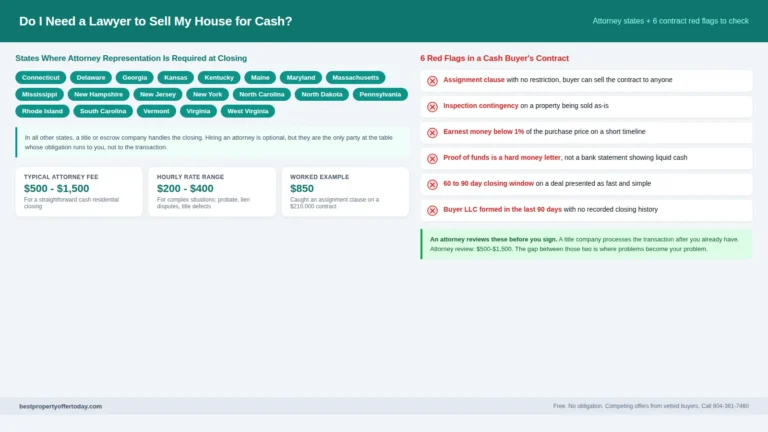
If you are in an attorney state (Alabama, Connecticut, Delaware, Georgia, Massachusetts, New York, North Carolina, South Carolina, Virginia, and West Virginia require a closing attorney), get yours involved before you sign a large cash deal. The cost of a contract review is usually $200 to $400. That is cheap relative to a disputed deposit or a clouded title.
A worked example: two buyers, same house, different outcomes
A seller lists a $240,000 house as-is. Two offers come in the same week.
Buyer A is a local fix-and-flip investor. Offer: $195,000 cash. Earnest money: $3,900. Due diligence window: 14 days. No assignment clause. Closes in 18 days.
Buyer B presents as a cash buyer but operates as a wholesaler. Offer: $198,500. Earnest money: $500. Due diligence window: 30 days. Contract includes “and/or assigns” after the buyer name, allowing them to transfer purchase rights to a third party without the seller’s approval.
Buyer A closes on day 18. Buyer B cannot find an end buyer at the spread they need, exits on day 27 of their due diligence window, and leaves with their $500 returned per the contract terms. The seller has now lost six weeks off the market plus roughly $1,400 in carrying costs: prorated taxes, utilities, and insurance during a period that should have been closing preparation. The net loss from choosing the higher number on paper: $1,400 in time and cost, plus the months it may take to relist and find a second buyer in the same season.
The $3,400 gap in earnest money between those two offers is what that six-week option actually cost.
Assignment clauses: the mechanism that makes backing out cheap
An assignment clause lets the buyer transfer their purchase rights to a third party before closing. You signed a contract with one person or entity, but someone else may show up to close, or no one shows up if the assignment cannot be placed.
Assignment is not inherently predatory. Investors use it for legitimate tax and liability reasons. But in a cash-buyer context, a contract combining a small earnest deposit and an assignment clause with no approval requirement is a strong sign that the buyer is marketing your property without your knowledge. You become part of their deal, not just the person selling to them.
You can negotiate around it. Ask the buyer to remove the assignment clause, or require written seller approval before any transfer. If they resist hard, that is worth knowing before you sign. A buyer who cannot close without assigning has no interest in your timeline. See our post on what a wholesaler is and how to tell one from a real buyer for the full pattern.
Red flags before signing
- Earnest money below 1 percent of the offer price on a deal under $500,000
- Due diligence window longer than 21 days on an as-is, cash-only sale
- Assignment clause with no seller approval requirement
- Buyer wants to choose the title company, especially one you have not heard of
- No proof of funds, or proof showing a third party’s funds rather than the buyer’s
- “And/or assigns” language after the buyer name in the contract
- Closing date set more than 30 days out when the property has no known title complications
- Buyer asks for an extension on the inspection window before the window has even closed
How multiple competing offers change what you can demand
With a single cash offer, you are negotiating from a weak position. The buyer knows you have no alternative lined up. Earnest money stays low, contingency windows stretch, and assignment clauses go unchallenged because the seller does not want to start a search from zero.
With three or four competing offers, the terms tighten. Buyers who want to win do not lead with a $500 deposit. Competition is the only reliable mechanism that shifts those terms in the seller’s direction, because the buyer is no longer negotiating against nothing. A marketplace that generates multiple offers gives you standing to insist on a higher deposit and a shorter due diligence period before you sign anything.
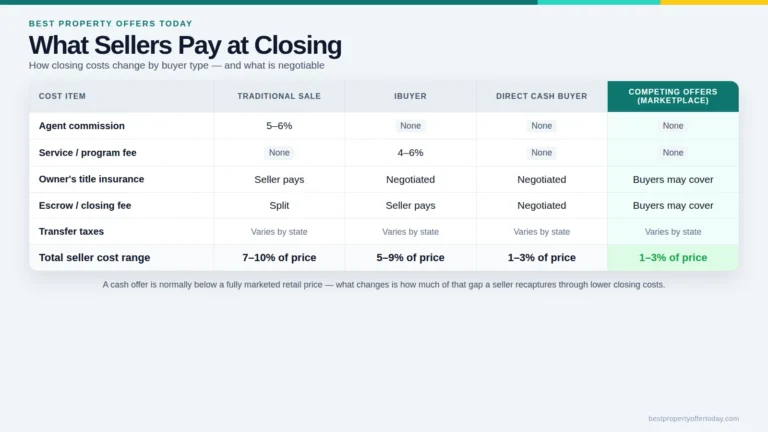
Our net proceeds calculator lets you model what each competing offer actually leaves after closing costs, so the comparison is not just headline price versus headline price.
The honest limits of a cash sale
A cash offer, even a firm one from a serious buyer, is usually below what a fully marketed retail sale would produce. What you trade for that gap is speed, certainty, no repair requirements, and no risk of a financed buyer’s loan falling apart at the last minute. If the house is in good condition and you have time to list with an agent and wait out the market, a traditional sale will almost certainly net more. A cash marketplace makes sense when speed, condition, or circumstance makes a retail listing impractical.
A failed cash deal, the kind where a buyer backs out after a month on the sidelines, combines the lower price of a cash sale with none of the speed. That is the outcome a higher earnest deposit and shorter contingency window are meant to prevent. To understand how legitimate buyers check out before you sign with anyone, read how to tell whether a cash home buyer is legitimate.
Questions to ask before you sign
- How much earnest money are you putting down, and who holds it?
- What is the length of your inspection or due diligence window?
- Does this contract include an assignment clause?
- Can you provide proof of funds today, in your name or your entity’s name?
- Who will actually hold title at closing?
- What is the planned closing date, and what would delay it?
Can a seller keep the earnest money without going to court?
Not immediately in most cases. The title company or escrow agent needs either a signed release from both parties or a court order before releasing funds. If the buyer disputes the forfeit, the money can sit for months. Some states have abandoned-deposit statutes that eventually allow release without a release agreement, but the timelines vary and are not fast. Get an attorney to send a written demand before you relist, because a disputed contract can complicate your ability to close with the next buyer.
Does the seller have to take the property off the market while the first buyer is still in contract?
Yes. Once a purchase agreement is fully executed, the seller is bound to that buyer until the contract is properly terminated. You cannot sign a second contract simultaneously, and listing with another buyer while the first contract is still active creates legal exposure. The exception is a kick-out clause or first-right-of-refusal provision negotiated into the original contract, which are uncommon in cash deals but worth raising if you have a backup buyer waiting.
What should a seller do the day a cash buyer backs out?
Get the termination in writing before anything else. A signed termination agreement releases both parties and starts the earnest money release process. Then call the title company to confirm the deposit is still in escrow and has not been moved. If the buyer simply stops responding, have an attorney send a formal demand letter before you relist, because a contract that is not cleanly terminated can cloud the chain of title and slow or kill your next deal.
Are wholesale-style cash buyers more likely to back out than direct buyers?
Yes, significantly. A buyer with their own funds and no assignment intent backs out at rates lower than a financed buyer. Their only risk is the deal itself. An assignment-style contract depends on finding a third party who wants the property at the price that makes the math work for everyone in the chain. When that third party does not materialize or the spread does not work, the contract terminates. The small earnest deposit makes that exit essentially free.
For the other side of this question, see our post on whether a seller can back out of a cash offer after accepting, which covers the legal exposure a seller faces when they change their mind after signing.
Call 804-361-7460 if you want to talk through what happened with a specific deal, or submit your property at the link above to start collecting competing offers from vetted buyers on your timeline.