Whether a lawyer is required depends on where the house is. Roughly 20 states mandate attorney involvement in real estate closings. In those states, the deal cannot close without one, cash or not. In the other 30 states, an attorney is optional, but that does not mean the question is settled.
States where an attorney is required at closing
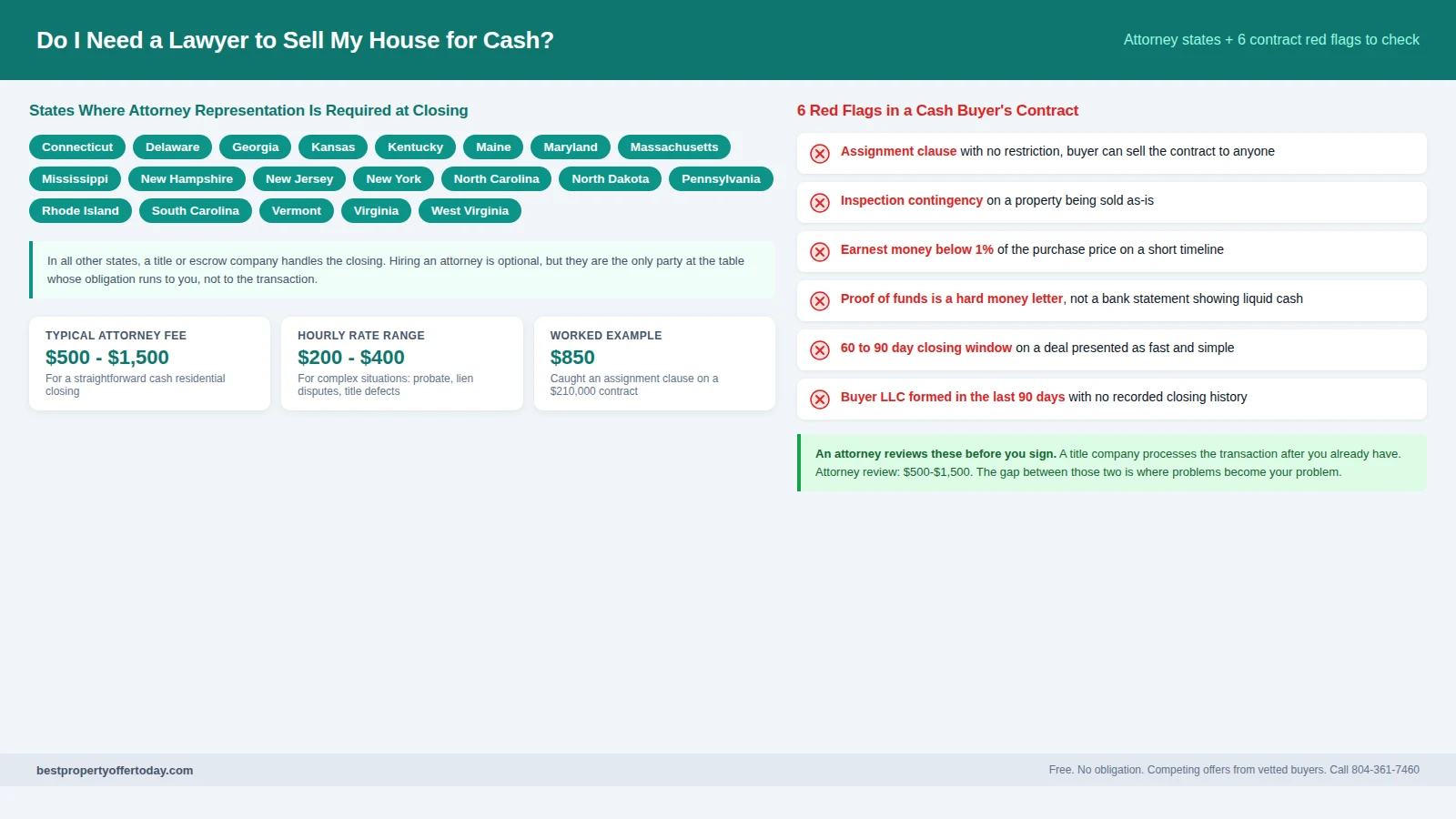
Real estate attorneys are required at closings in Connecticut, Delaware, Georgia, Kansas, Kentucky, Maine, Maryland, Massachusetts, Mississippi, New Hampshire, New Jersey, New York, North Carolina, North Dakota, Pennsylvania, Rhode Island, South Carolina, Vermont, Virginia, and West Virginia. The exact rules vary by state. In Georgia, the closing must be supervised by a licensed Georgia attorney. In New York, separate attorneys for buyer and seller is standard practice. In Massachusetts, an attorney conducts the title search, certifies it, and runs the closing.
If your property is in any of those states, you will need an attorney at closing regardless of whether the buyer is paying cash. Cash removes the lender from the transaction. It does not remove the legal requirement.
What happens in states that do not require one
In most other states, the closing is handled by a title company or an escrow company. The title company issues insurance, coordinates the paperwork, and disburses the funds. For a straightforward transaction, that process works.
The gap is that a title company represents no one. It processes the transaction. It does not review the purchase contract on your behalf, flag an assignment clause that allows the buyer to sell the contract to someone else before closing, or tell you whether the figures on the settlement statement match what you agreed to. Those are legal questions, and a title officer is not there to answer them.
What a cash closing attorney actually does
The work splits into two parts: reviewing the contract before you sign, and managing the closing itself.
Before signing, an attorney reads the purchase and sale agreement and tells you what it obligates you to. A cash contract from an investor often contains language the seller does not notice on first read: an inspection contingency on an as-is deal, a financing contingency that was supposed to have been removed, an assignment clause that lets the buyer transfer the contract to a third party before closing, or a closing date with penalties if you cannot vacate on time. The attorney identifies those before you are bound by them.
At the closing itself, the attorney prepares or reviews the deed, confirms the payoff amounts for any mortgages or liens are correct, reviews the settlement statement line by line, and ensures the title transfers cleanly. After closing, they handle recording the deed with the county.
What does a real estate attorney cost for a cash sale
Most real estate attorneys charge between $500 and $1,500 for a straightforward cash residential closing. Complex situations cost more: probate with multiple heirs, a lien dispute, or a title defect that needs resolving before the sale can proceed. Some attorneys charge a flat fee; others bill hourly at $200 to $400 per hour.
In attorney states, the cost is typically negotiated as part of the deal. In states where hiring one is optional, the cost comes out of seller proceeds. Most sellers who hire a reviewing attorney pay between $700 and $1,000 for a clean transaction.
That fee covers a title opinion, a document review, and someone whose professional obligation runs to you, not to the deal. Compare that to the cost of signing a contract with an assignment clause you missed, or a settlement statement that overcharged you on closing costs.
What an attorney catches that a title company might not
Title companies insure against title defects, but insurance is different from prevention. A reviewing attorney looks for specific problems before they become your problem after closing:
- Old liens and judgments that did not appear on the preliminary title search, including mechanic's liens from unpaid contractors recorded months after the work was done
- A prior heir who never signed a deed of distribution from an estate, leaving their interest legally unresolved
- A deed from 20 years ago with a boundary description that conflicts with the current survey
- Unpermitted additions that appear in property records and could affect the title commitment
- An assignment clause in the buyer's contract allowing them to sell the contract to a different buyer before closing, without your knowledge or approval
- Proof of funds that is a letter from a private lender rather than documentation of actual liquid cash
That last point matters in a cash deal specifically. A cash offer is only as solid as the money behind it. An attorney can request a genuine proof of funds document and tell you what it actually shows. For more on vetting buyers, see our guide to spotting legitimate cash buyers.
When to hire an attorney even if your state does not require one
Some situations make attorney review worth the cost regardless of location:
- The buyer is an investor or company you have not dealt with before and the contract is in their standard form, not a state-approved form
- The property has a complicated title: an old mortgage paid off without a formal release, an inherited property where probate was handled informally, or a prior owner whose estate was never fully settled
- The contract structure is unusual: a subject-to deal, a seller-financed arrangement, or a rent-back agreement after closing
- The closing date is aggressive and penalties for missing it are written into the contract
- The deal involves multiple properties or a 1031 exchange
In those situations, spending $800 to confirm the contract says what you think it says is reasonable against a six-figure transaction.
A worked example: what a contract review found
A seller accepts a $210,000 cash offer on an inherited house. The buyer's contract is three pages and looks clean on first read. An attorney reviews it two days before signing and finds two problems: an unrestricted assignment clause that lets the buyer transfer the contract to any third party for a profit before closing, and a clause giving the buyer 20 days to terminate for any reason with a full refund of their deposit. The deposit is $1,000 on a $210,000 deal.
That combination means the buyer has 20 free days to shop the contract to another investor at a markup. If no one bites, they walk away having lost nothing. The attorney flags both clauses. The seller negotiates the assignment clause out of the contract and shortens the exit window to five days, with the deposit raised to $5,000 and made non-refundable after inspection. The deal closes at the same price.
Attorney cost: $850. What it prevented: a buyer using a signed contract as a free option with no real intention to close.
The same dynamic shows up in deposit disputes when deals fall apart. Our post on what happens when a cash buyer backs out covers what the contract actually entitles you to recover when a buyer walks after signing.
A note on what a cash sale means for your net proceeds
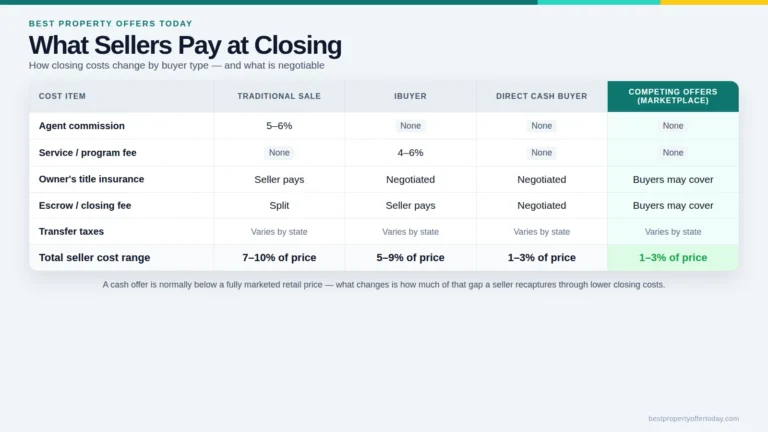
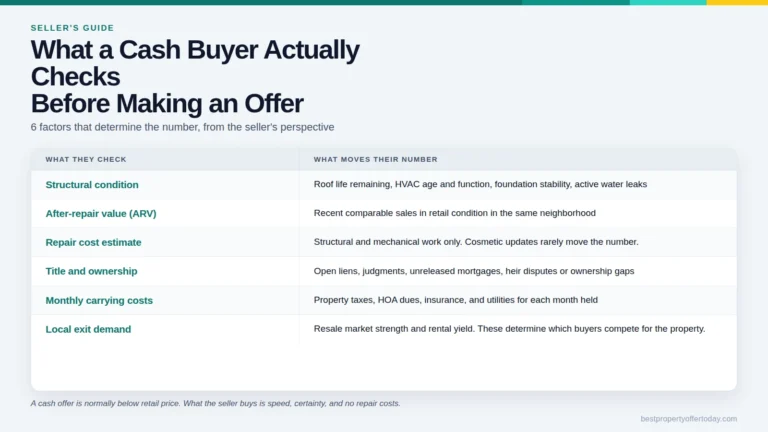
A cash offer is normally below the price you would get from a fully marketed retail listing. What you trade for that lower number is speed, certainty, no repairs, and no carrying costs while the house sits on the market. If the house is in good condition and you have the time to list it, a traditional sale with an agent will usually net more after commissions, repairs, and holding costs than a cash offer will. That comparison belongs in your decision, not just the headline number on the buyer's letter.
Our net proceeds calculator runs both scenarios side by side so you can see the actual difference before committing to a path.
Red flags in a cash buyer's contract
Before signing anything from a cash buyer, look for these:
- An unrestricted assignment clause with no notice requirement
- An inspection contingency on a property being sold as-is
- Earnest money below 1 percent of the purchase price on a short timeline
- Proof of funds presented as a hard money lender letter rather than a bank statement
- Closing windows of 60 to 90 days on a deal presented as fast and simple
- Buyer name is an LLC formed within the last 90 days with no recorded closing history
An attorney reviews these before you sign. A title company processes the transaction after you already have. For a fuller picture of buyer vetting before you reach the contract stage, see our guide to telling a real cash buyer from a wholesaler.
Does involving an attorney slow down a cash sale
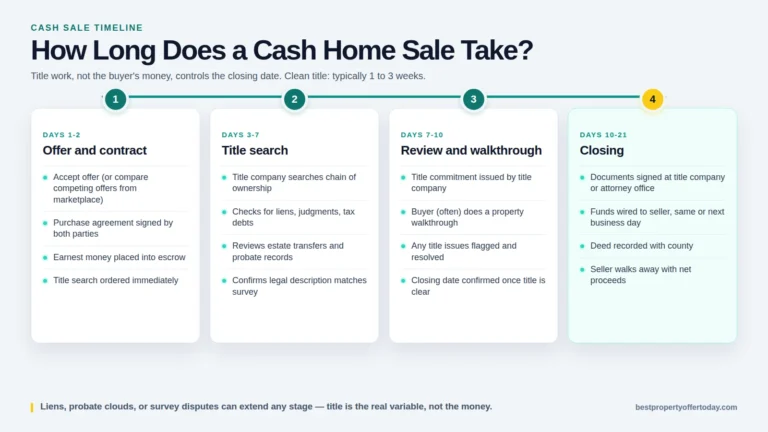
Not significantly. A contract review adds one to three business days before you sign. The closing itself is not extended. Cash deals still run one to three weeks once the contract is signed, and the limiting factor is the title search and whatever it uncovers, not the attorney.
Can the buyer's attorney represent both sides at closing
No. An attorney represents the client who retained them. If the cash buyer sends their own attorney to manage the closing, that attorney's duty runs to the buyer, not to you. In attorney states where a single attorney sometimes handles both sides, the practice is called dual representation and is restricted or prohibited in most of those states. You need your own counsel reviewing documents on your behalf.
What does the attorney need from you before closing
For a basic cash deal the list is short: a copy of the signed purchase contract, the deed or the property address and county so they can pull the public record, your existing mortgage payoff information if there is a balance, and the name of the title company if one has already been chosen. If there are known title issues such as an old lien or a deceased co-owner, share that upfront so the attorney can factor resolution time into the schedule.
How do you find a real estate attorney for a cash sale
Your state bar association maintains a referral directory. For a cash residential closing, look for attorneys who handle real estate transactions regularly, not a general practice attorney who does one or two deals per year. Ask for the fee upfront, confirm they have reviewed investor contracts before, and ask whether they have a closing coordinator who handles the scheduling. In attorney states, the title company often works with a short list of local real estate attorneys and can refer you directly.
If you want to compare cash offers before deciding whether to hire an attorney to review one of them, call us at 804-361-7460 or submit your address through our site. We collect competing offers from vetted buyers and the comparison is free with no obligation to accept anything.