A cash buyer is not doing a favor when they make an offer. They are running a business. Every number they put in front of you traces back to a specific calculation, and understanding that calculation is the fastest way to evaluate whether a given offer is reasonable.
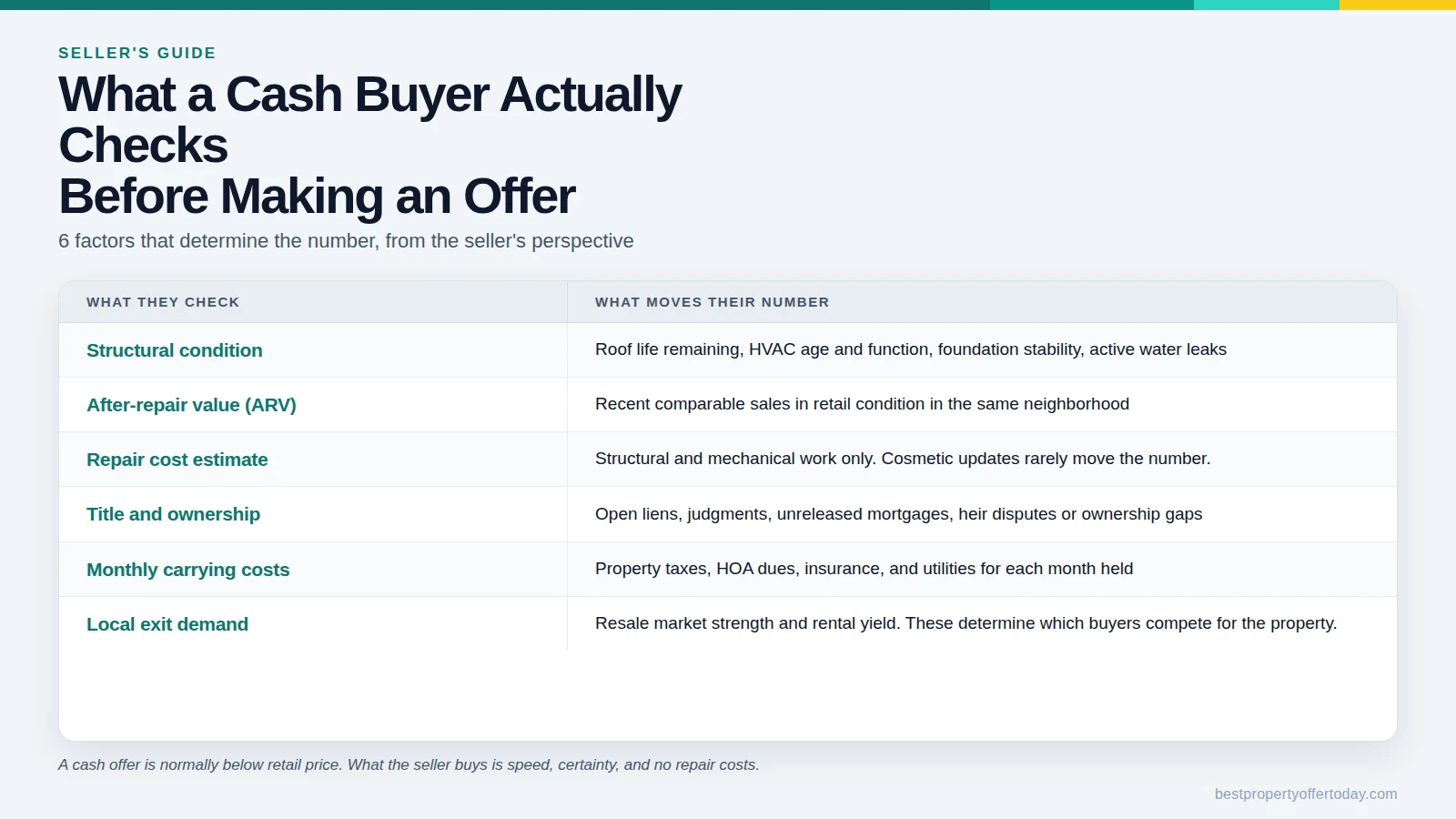
Here is what is on that checklist, in the order it usually matters.
The condition of the structure, not the finishes
Most sellers focus on cosmetics: fresh paint, clean carpets, tidy landscaping. Cash buyers largely ignore that list. What they are looking at is the structure and the systems. Roof condition, foundation stability, whether the HVAC runs, whether there are active leaks, and what the electrical panel looks like. These are the items that determine whether the house is safe to hold, rent, or resell. They are also the items that most directly affect what the buyer will spend before they can do anything else with the property.
Cosmetic updates rarely appear in a cash offer calculation. A dated kitchen does not move the number by much. A roof with three years of life left does.
Comparables, but not the ones you are thinking of
Cash buyers do not price off Zillow estimates. They pull recent sales data for the same area and run their own adjusted value, which is called ARV: after-repair value. This is what the house could sell for on the open market once it is in retail condition. From that number, they work backwards.
A rough version of the calculation: ARV minus the cost of repairs, minus the buyer’s intended profit, minus carrying costs like property taxes and insurance for the months they will hold the house. What is left is roughly what they can pay and still make the deal work.
If you want to understand why a cash offer is lower than what you expected, that subtraction is the answer. It is not a negotiating tactic. It is arithmetic.
Title and ownership status
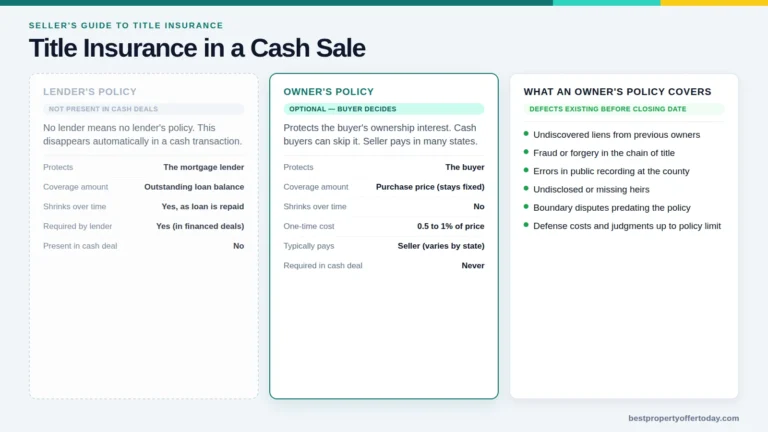
Before any serious buyer commits to a price, someone runs a title search, or at least a preliminary one. They are looking for open liens, judgments, HOA arrears, unreleased mortgages, and any ownership disputes. A house with a clean title closes cleanly. A house with an old mechanic’s lien from a contractor dispute, or a deceased co-owner who was never removed from the deed, requires extra work before closing. That work costs time and often money.
A buyer who spots a title problem at the offer stage will either price it in or walk. A buyer who misses it and finds it at closing will often renegotiate. This is one of the reasons it is worth knowing your own title status before you take offers. Your lender should have a copy of the title policy from when you bought; that is a reasonable starting point.
For more on what title problems look like and what they cost to resolve, the detail is in our post on title problems that delay a cash closing.
Carrying costs after the closing
Property taxes, utility costs, HOA dues, insurance: these accrue for every month the buyer holds the property before reselling or renting it. A house in a high-tax county, or in an HOA that charges substantial monthly fees, is a less attractive buy than a structurally identical house without those costs. Buyers factor this in before they name a number.
A house that carries $900 a month in taxes, insurance, and HOA while sitting on the market costs the buyer around $10,800 for a year. That comes out of the offer before it reaches you. Flood insurance is one of the bigger single-line additions in this category: a property in a FEMA Special Flood Hazard Area can add $900 to $2,400 per year to a buyer’s holding costs. For more on how flood zone status affects offers and which exit makes sense, see our guide on selling a house in a flood zone.
What they plan to do with it after
Cash buyers are not a single type. Some intend to renovate and resell. Some want to rent it. Some are wholesalers who will assign the contract to another buyer before closing. Each of those exit strategies has a different ceiling on what they can pay, and the house either fits the strategy or it does not.
A three-bedroom house in a rental-strong neighborhood is more attractive to a buy-and-hold investor than the same house in an area where rents do not cover the purchase price and taxes. An investor who plans to renovate and resell cares more about structural cost than a wholesaler who plans to assign the contract and never swing a hammer.
This is also where the marketplace model matters. When a single buyer evaluates your property, their particular exit strategy is the only one in play. When you submit to a marketplace and receive offers from several buyers, different exit strategies compete with each other, and you see the top of the range rather than one buyer’s perspective. You can learn more about how that comparison works in our post on how to compare cash offers side by side.
A worked example: the subtraction from ARV to offer
Take a house worth $280,000 in retail condition after standard updates.
The buyer estimates $40,000 in repairs: a roof replacement, HVAC service, updated electrical panel, and cosmetic work throughout.
Carrying costs while the work is done and the house is listed: around $4,500 for four months of taxes, insurance, and utilities.
Intended profit for the buyer: $28,000, or 10 percent of ARV. This is typical for a flip. Some buyers work at higher margins, some lower.
That gives $280,000 minus $40,000 minus $4,500 minus $28,000, which works out to $207,500. A buyer operating near that model would likely offer somewhere in the $195,000 to $215,000 range, depending on how conservatively they estimated each of those lines.
This is not the number you would net from a traditional listing. It is the number that reflects the buyer absorbing the repair cost, the holding cost, and the sale risk that you are not carrying. Our net proceeds calculator lets you run the comparison between a cash sale and a traditional listing, including what you would net after commission, repairs, and carrying costs.
What a serious buyer looks like, and what one does not
A buyer who is running through the checklist above is doing genuine due diligence. A buyer who skips it and makes a fast offer without looking at comparable sales, without asking about the title, and without inspecting the structure is either new to this or is running a different play. The most common version of that play is a bait-and-switch: the number comes in high, and gets revised sharply after a later walkthrough or during the inspection period.
Red flags to watch for: an offer made within minutes of your request, no mention of a property walkthrough, earnest money below $1,000, and a contract that assigns the deal to a third party without your consent. Our post on what a wholesaler is and how to spot one goes into detail on that last point. For the checklist of questions to put to any cash buyer before you sign, covering proof of funds, earnest money depth, and assignment risk, see questions to ask a cash home buyer before you sign.
The honest trade-off
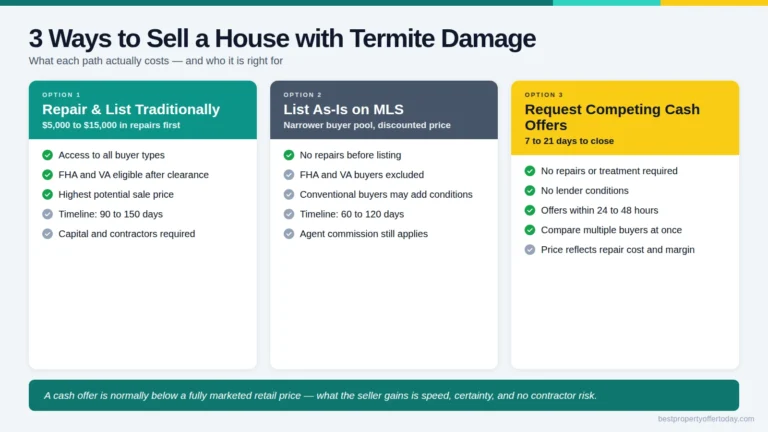
A cash offer reflects a calculation, not an appraisal. The calculation tends to produce a number below what you would net on the open market, because the buyer is absorbing costs and risks that a traditional sale would place on you. That trade is explicit: speed and certainty in exchange for a lower net price.
If your house is in good shape and you have three to six months to run a proper listing campaign, a traditional sale with a licensed agent will almost certainly produce a higher price. That is true, and it is worth saying plainly. The cash route earns its value for sellers who cannot afford the time or the upfront repair costs, or who need to close by a specific date, not as a default for every situation.
Does a cash buyer always inspect the property?
Most serious buyers will walk the property or send an inspector before finalizing the number. Some submit a preliminary offer based on photos and publicly available information, then adjust after a walkthrough. The preliminary number is not the final offer. Any contract that prevents further due diligence by the buyer before closing is unusual and worth scrutinizing before you sign.
How does a buyer decide which repairs to count?
They focus on items that affect habitability, that a lender or insurer would flag on resale, or that would surface on a buyer’s inspection when they go to sell the property later. Cosmetic issues are generally discounted or ignored. Structural, mechanical, and roof issues are counted at full estimated replacement cost, often with a buffer for unknowns behind walls or under flooring.
Will fixing things before listing get me a higher cash offer?
Sometimes, but the math rarely works in your favor. If you spend $15,000 on a roof to get $12,000 more on a cash offer, you have lost $3,000 and absorbed the work. The exception is small, high-visibility items: a broken HVAC unit that buyers tend to overestimate the replacement cost of, or a plumbing issue that reads as more serious than it is. Get two contractor quotes before deciding to fix anything.
What if the offer is far below what the ARV calculation suggests?
Then the buyer is using a higher profit margin than average, has estimated repairs at a steeper number than you expect, or is testing to see whether you will accept it. Submitting to a marketplace rather than negotiating with one buyer is the most direct way to resolve this question: you see the range of offers, and the spread tells you what the market for your house actually is. Call 804-361-7460 if you want to talk through the numbers before submitting a request.