Radon turns up in about one in 15 U.S. homes at levels the EPA considers actionable. If you are selling, that number matters because it shapes what your buyer can and cannot do. A financed buyer’s lender may require mitigation as a condition of the loan. A cash buyer has no lender and no such requirement. The two types of buyers treat the same test result very differently.
This post covers what the EPA threshold means in practice, what disclosure requires you to say, who pays for mitigation in a negotiated sale, and when selling to a cash buyer is the faster path.
What the EPA action level actually means
The EPA recommends mitigation when indoor radon levels reach 4 picocuries per liter (pCi/L) or higher. That threshold is a public health recommendation, not a legal limit. About one in 15 homes in the United States tests above 4 pCi/L, with higher rates in the midwest and mountain west, where uranium-rich soils are common.
A reading between 2 and 4 pCi/L falls in what the EPA calls the “consider fixing” range. Below 2 pCi/L is generally considered acceptable. The national median indoor level is around 1.3 pCi/L.
For sellers, the number matters because buyers ask for it, lenders see it in inspection reports, and in many states you are required to disclose known results. A test result sitting in your records is still a known result once you have read it.
Do sellers have to fix radon before closing?
No federal law requires a seller to install a mitigation system before closing. The legal obligation in almost every state stops at disclosure, not remediation. If you know the levels, you tell the buyer. What happens next is a negotiation, not a mandate.
The complication is lenders.
FHA, VA, and USDA loans all allow the lender or appraiser to require repairs as a condition of underwriting. Radon at or above 4 pCi/L often triggers a repair requirement on government-backed loans. The loan typically does not close until the work is done and a post-mitigation test confirms the level has dropped below the action threshold.
Conventional loans through Fannie Mae or Freddie Mac do not have an automatic radon requirement, but individual lenders and appraisers have discretion. A reading significantly above 4 pCi/L can still generate an underwriting condition on a conventional file.
Cash buyers have no lender. No lender means no underwriting conditions, no required inspection results, and no post-mitigation test required to close. A cash buyer decides on their own terms whether the radon result changes their offer and by how much.
Who pays for radon mitigation
Sub-slab depressurization is the standard fix for most homes. A contractor installs one or more pipes through the foundation slab and a small fan that vents radon from below the house up through and above the roofline. The system runs continuously on a modest amount of electricity.
Typical cost range: $800 to $2,500, depending on the number of suction points needed, whether the home has a basement or crawl space, and labor rates in the local market. Complex jobs with multiple sub-slabs, finished basements, or difficult access can run higher. Post-mitigation testing adds another $100 to $200.
In a traditional sale, the negotiation usually lands in one of three places:
- Seller installs the system before closing, buyer accepts the post-test result
- Seller provides a credit at closing, buyer handles mitigation after purchase
- Buyer accepts the house at the existing radon level with no compensation
The third outcome happens more often than sellers expect. Mitigation cost is low enough that some buyers simply absorb it, particularly when the home otherwise fits their needs. What sellers often do not anticipate is the renegotiation risk: a buyer who finds 7 pCi/L during inspection may return asking for a $3,000 credit on a $1,500 job. The seller then faces the choice of agreeing, refusing and hoping the deal holds, or watching the buyer walk.
What a cash sale means for a house with elevated radon
A cash buyer making an offer on a house with known radon levels will price that into the offer. They will not refuse to close because the level is above 4 pCi/L. They will adjust their numbers to account for what the fix costs.
That sounds like a discount, and it is. The question is whether the discount is proportionate to actual mitigation cost, or whether the seller can do better by installing the system and listing to a broader pool of buyers that includes financed purchasers.
The answer depends on how much else the home needs, what the local market looks like, and how much time the seller has. The cash path makes more sense when radon is one of several issues, when the seller cannot front the mitigation cost, or when carrying costs make a two-month wait genuinely expensive.
The numbers: three options compared
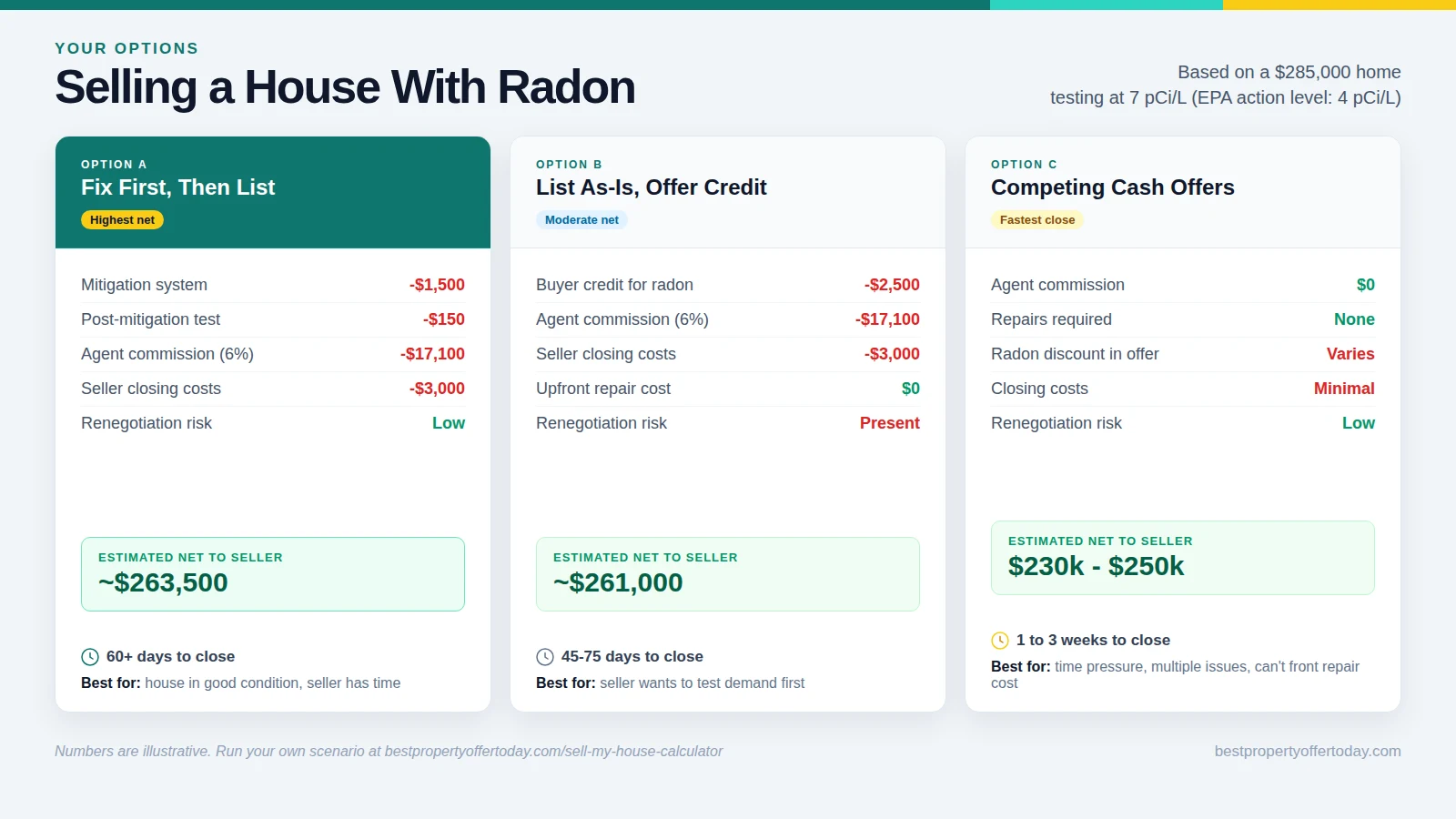
Take a house priced at $285,000 with a test result of 7 pCi/L. The table below uses round numbers to show how the three main paths compare. Your actual figures will vary based on local commission rates, your carrying costs, and what cash buyers bid in your market.
| Option | Costs and timeline | Rough net to seller |
|---|---|---|
| Fix radon, list traditionally | $1,500 mitigation plus $150 post-test, 6% commission, $3,000 closing costs, 60-day close | Around $263,500 |
| List as-is, offer buyer credit | Full commission, $2,500 credit at closing, still carries renegotiation risk | Around $261,000 |
| Competing cash offers via marketplace | No commission, no repairs required, 1 to 3 week close, offer reflects radon discount | Varies: roughly $230,000 to $250,000 depending on buyers |
The traditional sale nets more if the home is otherwise in good condition and the seller has time to front the mitigation cost and carry the property through a standard close. The cash route closes that gap when the radon problem is one of several deferred items, when upfront cash for mitigation is tight, or when carrying costs add up fast.
Run the numbers against your own situation with the free net proceeds calculator before deciding.
Radon disclosure requirements: what the law actually says
There is no single federal radon disclosure statute for residential real estate. The EPA recommends testing and disclosure at the point of sale, but a recommendation carries no legal weight on its own.
State-level requirements vary:
- Some states require sellers to disclose any known radon test results. If you have results in your records, they must be shared.
- A smaller number of states require testing as a condition of sale in certain transaction types.
- Most states include a radon question on standard property condition disclosure forms. Leaving it blank when you have a result is a problem regardless of whether the state has a specific radon statute.
One point that surprises sellers: selling as-is limits your obligation to repair, not your obligation to disclose. An as-is sale does not let you hide a result you already have. The buyer accepts the condition without a repair credit, but you still tell them what you know.
If you are unsure what your state requires, the safest move is always disclosure. The cost is zero. The cost of a non-disclosure claim, especially given how easily radon levels can be independently verified, is much higher. For more on what cash buyers expect during this process, see what a cash buyer actually checks before making an offer.
Red flags to watch for when a buyer raises radon
A buyer who finds elevated radon during inspection is not automatically a problem. Watch for these specific patterns:
- Mitigation demand priced far above actual contractor quotes in your area, presented as a safety concern rather than a negotiation
- A short-term test run during closed-house conditions or bad weather that inflates the reading beyond what an open-house measurement would show
- Radon used as a pretext to renegotiate unrelated items that came up in the same inspection report
- Pressure from the buyer’s agent to mitigate before closing when no lender requirement exists on the offer type
Buyers who genuinely want the house price the issue and move forward. Buyers who plan to use it as a lever often have broader problems with the transaction. For more on protecting yourself during this stage, see questions to ask a cash home buyer before you sign.
How radon compares to other environmental disclosures
Sellers who have dealt with mold, lead paint, or asbestos sometimes ask how radon fits alongside those issues. A few useful distinctions:
Radon is invisible and odorless. A seller can live in a house for years without knowing the levels are elevated, and that genuinely matters for disclosure purposes: you disclose what you know. Unlike lead paint, there is no federal rule that requires testing before sale, just disclosure of known results.
Radon is also more fixable than many sellers expect. A properly installed sub-slab system typically brings readings below 2 pCi/L. Post-mitigation, the house is measurably safer than most untested homes. That is a selling point, not a liability, and sophisticated buyers recognize it.
The disclosure document a seller signs does not require testing. It requires honesty about results you already have. If you have never tested, you disclose that.
Common questions
Does radon kill a house sale?
Not usually. Mitigation is inexpensive relative to most other repair conditions, and most buyers treat a tested, mitigated home as more reassuring than one that has never been tested. The real risk is a financed buyer whose lender imposes a repair condition, which adds time and uncertainty. Cash buyers bypass that entirely.
What radon level is too high to sell a house?
There is no level that legally prevents a sale in most states. Even readings of 20 or 30 pCi/L are fixable with a properly designed mitigation system. The issue is not whether you can sell at that level; it is whether a financed buyer’s lender will close without mitigation complete and a passing post-test on file.
Do you have to disclose radon after a mitigation system is installed?
Yes. If you have a pre-mitigation test result on record, you disclose it along with the work done and the post-mitigation result. A mitigated house is actually a selling point: the problem was identified, measured, and fixed, and you have documentation to prove it. That is more reassuring to a buyer than a house that has never been tested.
Can you sell a house with radon without fixing it?
Yes, as long as you disclose known results. Cash buyers evaluate the mitigation cost and factor it into their offer. Some retail buyers will accept an as-is deal or a credit. The harder cases are financed buyers whose lenders require remediation as a loan condition, which eliminates that group unless the seller is willing to front the mitigation work before closing.
The honest trade-off
A cash offer on a house with elevated radon will reflect a discount that is often larger than the actual mitigation cost. What the seller buys with that discount is speed, certainty, and no repair to manage. If radon is the only issue, the house is in otherwise good condition, and you have four to six weeks to spare, installing the system and listing traditionally will probably net you more. If time is the problem, or if the radon is part of a longer list of deferred maintenance, the cash path may be the cleaner exit.
To see what competing cash buyers would offer on your specific property, submit one request at BestPropertyOfferToday.com. The service is free to the seller, there is no obligation to accept anything, and offers typically come back within 24 to 48 hours. Call us at 804-361-7460 if you want to talk through your options first.