Questions to Ask a Cash Home Buyer Before You Sign (And What Bad Answers Sound Like)
You have a cash offer on your house. Before you sign anything, there are questions that separate a buyer who closes from one who stalls, reprices, or disappears. Most sellers never ask them.
A cash offer can be real, or it can be a placeholder from someone who does not yet have the money. The contract language, the earnest money amount, and a few direct answers reveal which one you are dealing with. This checklist gives you that information before you are locked in.
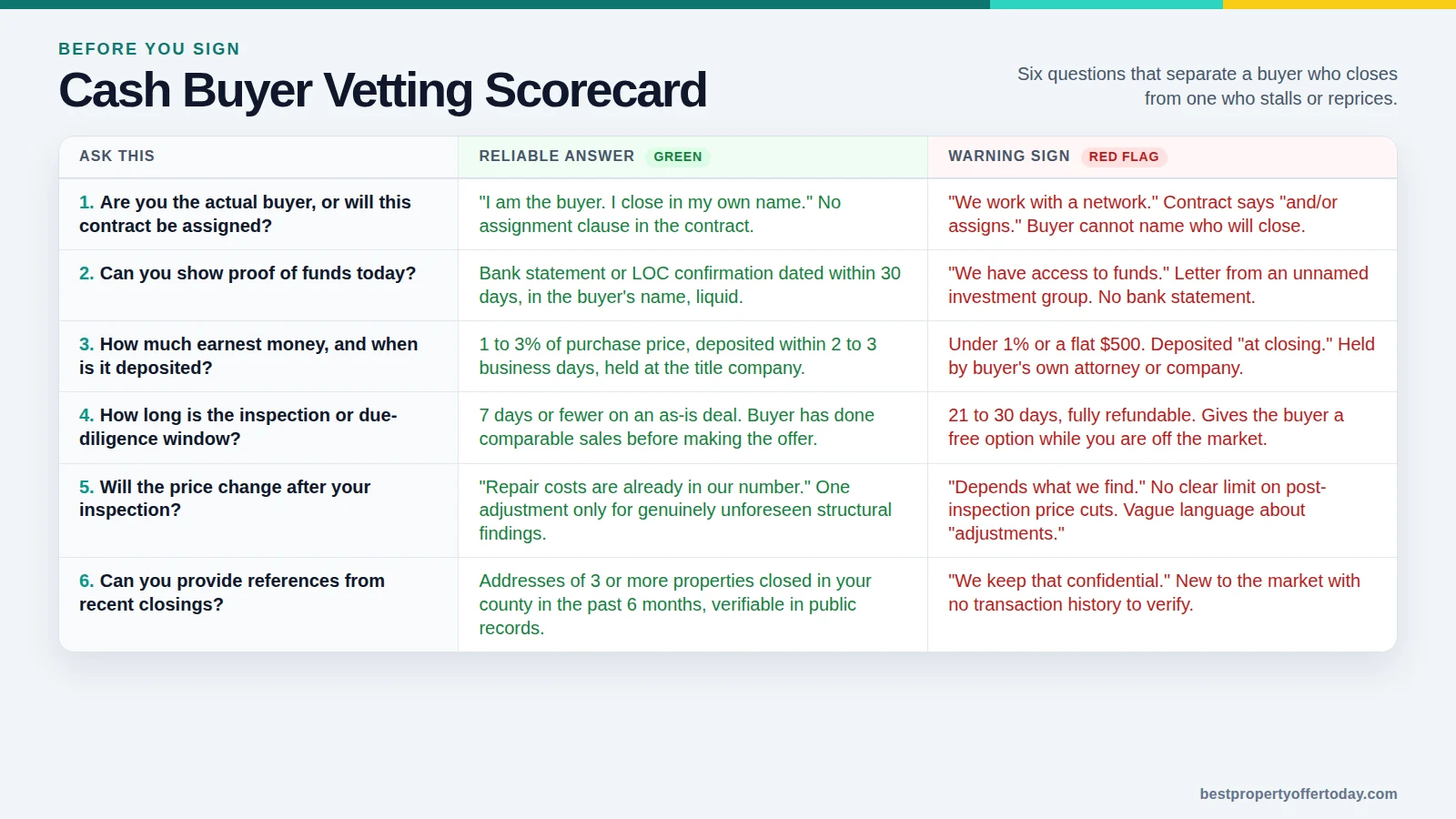
1. Are you the actual buyer, or are you assigning this contract?
This is the single most important question. A cash buyer who intends to close personally will say yes, I am the buyer. A wholesaler will say something about “finding the right partner” or “we work with a network of investors” or, if they are being honest, they will tell you the contract can be assigned.
An assignment clause means the person signing your contract has the right to sell that contract to someone else before closing. You may end up closing with a buyer you have never met, who has reviewed your property for fifteen minutes, and who may or may not have the funds to close. Ask specifically: does this contract contain an assignment clause? If you cannot get a straight answer, read the contract yourself before signing. The phrase to look for is “and/or assigns.” See also how to tell a wholesaler from a real cash buyer for more on how that arrangement works and why it raises the seller's risk.
2. Can you show proof of funds today?
A cash buyer should have a bank statement, a line of credit confirmation, or a proof-of-funds letter ready within a day or two. “We have access to funds” is not proof of funds. Neither is a letter from a hard-money lender who has not yet committed to the deal.
Ask for documentation dated within the last 30 days showing the funds are liquid and in the buyer's name. A serious buyer expects this request and prepares for it. A wholesaler who has not yet lined up their end buyer cannot provide it. For a full breakdown of which documents are acceptable and which red flags to watch for, see the post on proof of funds from a cash buyer.
3. How much earnest money are you putting down, and when?
Earnest money on a cash deal is usually 1 to 3 percent of the purchase price. On a $250,000 house, that is $2,500 to $7,500, deposited within a few business days of signing. A buyer offering $500 in earnest money on a $200,000 purchase has very little at risk if they walk away.
Ask when the deposit is due and where it is held. Earnest money held by the title company is safer than money held by the buyer's own attorney or company. Also ask what happens to it if they back out for reasons not specified in the contract. If they cannot name a clear default scenario where you keep the deposit, the earnest money is not a real commitment. The earnest money post covers how to evaluate a deposit amount and what makes it hard versus soft.
4. What is your timeline to close, and what could delay it?
Cash deals typically close in 1 to 3 weeks once a clear title is confirmed. The timeline is set by title work, not by the buyer's money. If a buyer is quoting 7 to 10 days with no caveats, ask whether they have ordered the title search already or whether they plan to use the title company you specify.
Also ask what would push the date out. A good buyer will mention things like an open lien, a probate matter on the title, or a survey discrepancy. A buyer who says “nothing, we always close on time” either has not thought it through or is not being straight about what happens when title problems surface. The limiting factor in a cash sale is almost always title, not money.
5. What inspection or due-diligence period does the contract allow?
An as-is cash sale does not mean no inspection. It means the seller is not obligated to make repairs. The buyer usually still has an inspection window, sometimes called a due-diligence or feasibility period, during which they can walk away and take their earnest money with them.
A 7-day inspection window on an as-is deal is normal. A 30-day inspection window is a red flag, particularly if the earnest money is fully refundable during that whole period. That combination gives the buyer a month of exclusivity at essentially no cost to them. They can shop your property to other investors, adjust their number after their own internal review, or simply walk away with no penalty.
6. Will the offer price change after your inspection?
Ask this directly. Bait-and-switch repricing is one of the most common complaints in the cash buyer market. A buyer quotes a number to get you under contract, runs an inspection, and then returns with a lower number citing repair costs you already knew about when you accepted the original offer.
A reputable buyer builds their repair cost estimate into the initial offer. If they inspect and find something genuinely unexpected, a one-time renegotiation request is defensible. A pattern of inspecting and then cutting the price is not. Before you sign, ask: “If your inspection turns up deferred maintenance I have already described to you, will the offer change?” The answer tells you a great deal about how this buyer operates.
7. Who handles closing, and who pays which closing costs?
A cash sale still has closing costs. On the seller's side, these typically include prorated property taxes, recording fees, and any outstanding liens or judgments that must be paid from proceeds. Title insurance for the buyer is common. Transfer taxes vary by state and are sometimes split.
Some buyers advertise that they pay all closing costs. That can be genuine, or it can mean they have built an inflated estimate of those costs into a lower purchase price. Ask for a preliminary settlement statement before you sign. Most title companies will produce one. It shows what you will actually net at closing, which is the only number that matters.
8. Can you provide references from sellers you have closed with recently?
A buyer who has closed multiple deals recently will have references. They may not share personal contact information for past sellers, but they can give you addresses of properties they have purchased, which you can verify in county property records. If a buyer has closed a dozen deals in your county, those transactions are findable in public data.
A wholesaler who is new, or who has not actually closed a deal themselves, will not have these. That does not automatically disqualify them, but it changes your risk profile. If you are accepting a below-retail price for speed and certainty, the buyer has to actually deliver the close.
What these offers actually look like side by side
Not all cash offers are the same. Here is a worked example using a house worth roughly $300,000 in its current condition.
| Buyer type | Typical offer | Earnest money | Inspection window | Assignment risk |
|---|---|---|---|---|
| Established local investor | $225,000 to $255,000 | $5,000 to $7,500, hard | 5 to 7 days | None: closes in investor's name |
| iBuyer (Opendoor, Offerpad) | $258,000 before deductions | Platform holds funds | Post-offer inspection with deductions applied after | None, but post-inspection price cut is common |
| Wholesaler | $215,000 to $235,000 | $500 to $1,000, often refundable | 21 to 30 days | Yes: contract typically assignable |
| Competing marketplace offers | Range depends on buyer competition | Varies by buyer: vet each offer separately | Varies by buyer | Vet each buyer using the questions above |
The iBuyer number looks best before the inspection. After deductions for repairs, the actual net to the seller is often lower than the local investor number. The point of comparing multiple offers through a marketplace is to find the best combination of price, earnest money, and close certainty, not just the headline number. Use the net proceeds calculator to run each offer against each path and see what you actually keep.
Red flags that should stop you before you sign
- Pressure to sign today, or the offer expires in 24 to 48 hours
- Earnest money under 1 percent of the purchase price
- Inspection or due-diligence window longer than 10 days on an as-is deal
- Proof of funds is a letter from an “investment group” with no bank name
- Contract says “and/or assigns” and the buyer cannot name who will actually close
- Buyer insists on using their own title company rather than one you choose or agree on jointly
- Any verbal promise that is not in the written contract
The honest comparison worth making
A cash offer from any buyer, vetted or not, is almost always below what a fully marketed retail sale would produce. What you buy with the difference is a certain close date, no repair obligation, and no carrying costs during a 60 to 90 day listing period. If your house is in good condition and you have time, a traditional listing with an agent usually nets more. Say that plainly to anyone you talk to, and be skeptical of any buyer or service that suggests otherwise.
The right question is not “how do I get the most money” in the abstract. It is “what is the total net cost of each path, including repairs, time, and the risk that a financed buyer walks at inspection.” Sellers who run that comparison honestly sometimes choose the cash path even when the headline number is lower.
If you want to receive competing cash offers and apply these questions to more than one buyer at a time, submit your address at BestPropertyOfferToday.com. The service is free, carries no obligation, and connects you with vetted buyers in your area. You compare. You decide.
What happens if you ask these questions and a buyer refuses to answer?
Walk away. A buyer who will not confirm whether the contract is assignable, or who cannot produce proof of funds, is not a buyer you want to close with. The contract may give you legal recourse if something goes wrong, but recourse costs time and money and does not put a closed deal on the table. The vetting happens before you sign, not after.
Can you negotiate after accepting a cash offer?
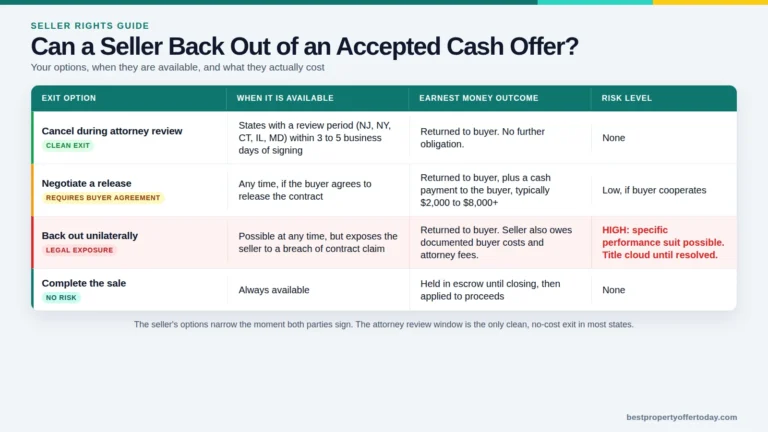
Yes, within limits. Once you sign a purchase agreement, renegotiation requires both parties to agree in writing. If a buyer comes back with a lower price after inspection, you can accept, counter, or reject. Rejecting usually means they invoke their inspection contingency, take their earnest money back, and you restart. That is why earnest money amount matters at the front end: a buyer with $500 at stake will walk easily. A buyer with $6,000 at stake is more likely to honor the agreed price. See how negotiating a cash offer actually works for a full breakdown of leverage and timing.
Is a cash offer through a marketplace the same as one from a direct buyer?
No. A marketplace collects competing offers from vetted buyers. You receive individual offers from individual buyers, and you should still apply every question on this list to each one. What the marketplace vetting does is reduce your risk of dealing with completely unknown buyers and gives you multiple numbers to compare rather than one take-it-or-leave-it figure. Apply the same scrutiny to any offer regardless of where it came from.
Do I need to do all of this in writing?
The questions can be asked verbally. The answers should be in the contract. Earnest money amount, who holds it, the inspection window duration, and whether assignment is permitted should all appear in writing before you sign anything. If a buyer says “trust me, we always close” but the contract reflects none of that, the contract is what governs. A real estate attorney in your state can review the contract for under $300 in most markets and will flag the clauses that matter. In the states that require attorney representation at closing anyway, this is standard practice. See whether you need a lawyer in your state.