Delinquent HOA dues do not block a sale, but they show up on every title search and must be cleared before the deed transfers. In almost every case that means the payoff comes out of your closing proceeds. The part sellers most often underestimate is how much larger that payoff is than the original balance they stopped paying.
How an HOA Lien Gets Filed
Most HOA governing documents authorize the association to record a lien against a unit after dues have been delinquent for 30 to 90 days. No court order is required in most states. The association’s attorney files the lien directly with the county recorder’s office, it becomes a matter of public record, and it attaches to the property itself, not to the owner personally.
Because the lien attaches to the property, it survives a sale. A new buyer inherits any lien the seller did not clear. Title companies flag it at closing, and the payoff is deducted from proceeds before the remaining balance goes to the seller.
This automatic filing process is a key difference from judgment liens, which require a lawsuit and a court finding first. HOA liens can appear on your title faster and with fewer procedural steps, and once filed they start accumulating attorney fees immediately.
What the Full Payoff Actually Includes
The delinquent dues are the starting line, not the finish. By the time an HOA records a lien, the payoff demand typically includes:
- The unpaid dues themselves
- Late fees, often $10 to $25 per month starting the day each payment was missed
- Interest on the delinquent balance, often 8 to 18 percent per year under the CC&Rs
- The attorney fee for drafting and recording the lien, typically $500 to $1,500
- A lien recording fee charged by the county, usually $50 to $200
Then, separately, most HOA sales trigger a resale or transfer package fee: the administrative charge for issuing the disclosure package the new owner needs to review. This is not part of the lien payoff. It is charged regardless of whether dues are delinquent and typically runs $200 to $500.
A worked example with real numbers
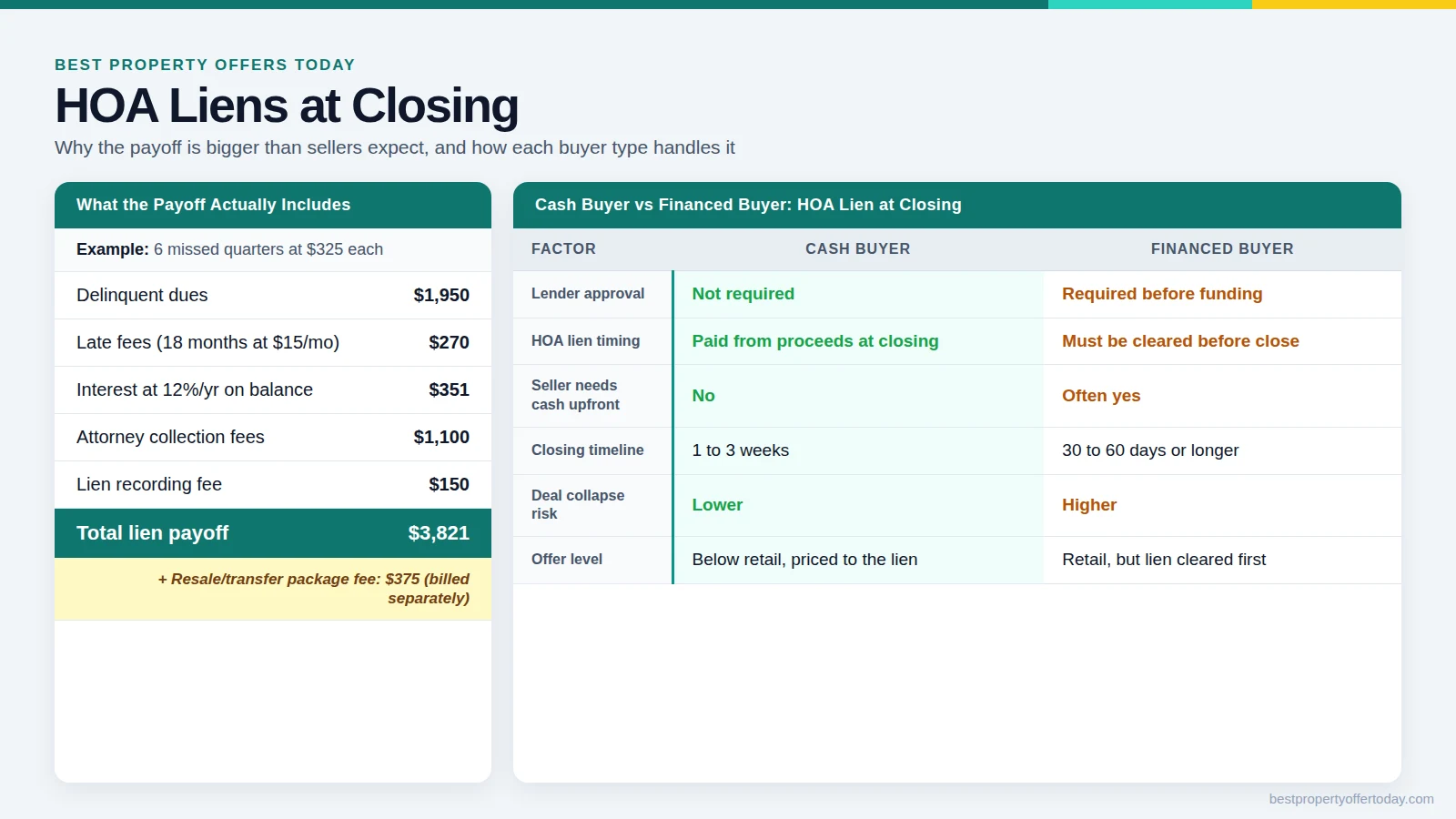
Suppose quarterly dues are $325 and an owner fell behind six quarters ago, for a total of $1,950 in missed payments. The HOA sent notices for three months, then engaged a collections attorney. Here is how the demand grows by closing:
| Item | Amount |
|---|---|
| Delinquent dues (6 quarters at $325) | $1,950 |
| Late fees ($15/month for 18 months) | $270 |
| Interest at 12% per year on delinquent balance (18 months) | $351 |
| Attorney collection fees | $1,100 |
| Lien recording fee | $150 |
| Total lien payoff | $3,821 |
| Resale/transfer package fee (billed separately) | $375 |
| Total HOA-related closing deductions | $4,196 |
A seller who thought the problem was $1,950 faces a demand more than twice that size. The attorney fees and interest are the difference, and they keep accumulating the longer the lien sits unresolved.
Super-Lien States and Why Lenders Take HOA Liens Seriously
In most states, an HOA lien sits behind a first mortgage in priority. A handful of states, however, give HOAs a partial super-lien position: the association can collect a defined number of months of unpaid dues ahead of the first mortgage holder in foreclosure.
States that currently provide some form of HOA super-lien status include Florida, Nevada, Colorado, Washington, Utah, Connecticut, Massachusetts, and Maryland, among others. The rules vary. Florida caps the super-priority at 12 months of assessments. Nevada’s was broader until court decisions in 2015 narrowed it significantly.
For sellers, the practical consequence is not the priority ranking itself but what it means for buyers with financing. Lenders in super-lien states are particularly attentive to HOA delinquencies because the association could foreclose and extinguish the lender’s security interest. That is why mortgage underwriters require clear title before funding, and why an unresolved HOA lien is more than a paperwork problem for a seller relying on a financed buyer to close.
Cash Buyers vs Financed Buyers When an HOA Lien Is on Title
The single biggest practical difference is whether a lender is involved.
A mortgage lender requires clear title before it will fund. If an HOA lien is on record, the underwriter flags it, and the loan does not close until the lien is resolved. That means the seller must either pay off the HOA balance out of pocket before closing, or the sale falls apart. Borrowing against the equity to pay the HOA first adds another step and often another delay.
A cash buyer has no lender. The lien still appears in the title search and must be cleared, but the parties can structure the resolution directly on the closing statement. The title company holds the payoff amount from proceeds, pays the HOA at closing, receives the lien release, and disbursements go to the seller, all in a single transaction. No advance cash required from the seller.
| Factor | Cash buyer | Financed buyer |
|---|---|---|
| Lender approval required | No | Yes, before funding |
| HOA lien timing | Paid from proceeds at closing | Seller must clear before close |
| Seller needs cash upfront | No | Often yes |
| Closing timeline | 1 to 3 weeks | 30 to 60 days or longer |
| Deal collapse risk from lien | Lower | Higher |
This is why sellers with HOA liens frequently find that requesting competing cash offers from multiple vetted buyers is a more reliable path than listing and hoping a financed buyer can work around the title issue. Cash buyers with experience closing on liened properties know how to structure the disbursement correctly.
Keep in mind that a cash offer on a property with an HOA lien will typically reflect the payoff amount. The buyer prices in the resolution cost. What sellers receive in exchange is a closing that does not depend on them producing cash before the date.
Can You Negotiate the HOA Payoff Down?
Sometimes. HOAs are not banks, and most boards would rather receive payment than manage an ongoing legal standoff. A few options worth trying before accepting any demand at face value:
Request a formal payoff statement in writing first. Errors appear: dues periods charged twice, late fee rates that exceed what the CC&Rs actually authorize, interest calculated on the wrong balance. A real estate attorney who handles HOA matters can review the itemized statement and identify amounts worth contesting. The review typically costs $300 to $600 and can save several times that.
Contact the board directly about penalty waivers. Most HOAs cannot reduce principal dues by law and governing documents, because equal treatment of members is required. But attorney fees and accumulated penalties are sometimes negotiable, particularly if you can demonstrate hardship and propose immediate payment from closing proceeds. Get any agreed reduction in writing, confirmed by the HOA’s attorney, before signing a purchase agreement that relies on it.
The Foreclosure Risk Is Real
HOA foreclosures move faster than most homeowners expect. The timeline depends on state law and governing documents, but common sequences look like this: a lien is filed after 60 days of delinquency, a foreclosure lawsuit is filed 60 to 90 days later, and an auction can be set within months after that. Some states allow non-judicial HOA foreclosure, which shortens the timeline further.
The relevant point for sellers is that once a foreclosure filing appears, the window to close a sale and cut off the process narrows. A sale that closes before the auction date pays off the HOA from proceeds and ends the foreclosure. A sale that misses the auction date may not. If an HOA foreclosure is already in motion, speed is the central constraint, and a cash buyer who can close in one to three weeks is often the only realistic option.
Red Flags When a Buyer Mentions Handling the Lien
If a buyer says something like “don’t worry about the HOA, we will take care of it,” that phrase needs to appear in the purchase contract before it means anything to you.
A buyer who is taking responsibility for clearing an HOA lien should specify the obligation in writing, with a dollar cap and a closing structure that pays the HOA directly from the title company’s disbursement. A verbal assurance is not binding. An assignment clause that lets the buyer flip the contract to a third party before closing shifts the risk back to you if the replacement buyer cannot or will not cover the lien.
Verify through the closing statement. The title company’s disbursement record, showing payment from proceeds to the HOA and the recorded lien release, is the only documentation that actually clears the title. Any other form of assurance leaves you exposed.
The Honest Trade-Off
A cash offer on a house with an HOA lien is normally below what a fully marketed retail sale would bring, and that gap is real. The buyer prices in the lien payoff, the title complexity, and the compressed timeline. What the seller receives in exchange is a closing that does not require advance cash, does not depend on underwriting, and can happen before the lien balance grows further.
If the house is in good condition, the delinquent dues are relatively small, and you have time to pay off the HOA before listing, a traditional sale with a financed buyer will usually net more. Say that plainly to yourself before deciding. Use the net proceeds calculator to run the numbers both ways, using the full HOA payoff figure, not just the missed dues. The honest comparison sometimes points toward paying the HOA and listing retail. Sometimes it does not.
Can I sell if the HOA has already started foreclosure proceedings?
Yes, but the window is narrowing. A sale that closes before the foreclosure auction pays the HOA from proceeds and cuts off the process. Once the auction date passes and the property is sold by the HOA, the option to close a regular sale is gone. If a foreclosure filing is on record, confirm the auction date, then work backward to determine whether a closing is achievable in time. A vetted cash buyer who can close in one to three weeks is often the only path when the timeline is that compressed.
Does the buyer inherit my unpaid HOA balance after closing?
No. The lien payoff clears your specific delinquency. Once the closing statement shows the disbursement to the HOA and the lien is released, the new owner starts with a clean account and is responsible only for future assessments. The HOA cannot collect your pre-sale arrears from the incoming owner, provided the payoff was completed correctly at closing.
What is an HOA resale certificate and who pays for it?
A resale or disclosure certificate is the document package the HOA provides to a buyer, covering the association’s financial health, meeting minutes, rules, pending special assessments, and current dues schedule. Most state HOA statutes require it. The fee for issuing it is separate from any lien payoff and is typically the seller’s cost. Budget $200 to $500 and request the certificate early, since many management companies take 7 to 14 days to prepare it. A buyer who cannot review the certificate before closing has the right to cancel in most states.
Will the title search always catch an HOA lien?
A standard title search covers publicly recorded documents, and most HOA liens are recorded with the county recorder. However, some smaller associations handle collections informally for a period before filing, which means a delinquency may not yet appear on a title search even though you owe money. The HOA’s own records are the authoritative source. Request a written payoff statement directly from the management company before relying on a title report alone. A surprise payoff demand at the closing table costs time and sometimes deals.