When co-heirs cannot agree on selling an inherited house, three legal paths exist: negotiate a shared sale, buy each other out, or go to court under a partition action. None of them are fast, and one of them is expensive. Knowing which one applies to your situation before a lawyer sends a bill is worth the time it takes to read this.
What Co-Heirs Actually Own
When two or more people inherit a property, they typically become tenants in common. Each heir owns a fractional interest in the whole property, not a physical section of it. A sibling who inherits a one-third share cannot fence off a third of the backyard. They own one-third of every square inch.
That matters because no single heir can sell the property without the others. A buyer needs a deed signed by all owners. If one owner refuses to sign, the sale does not happen. The remedy for that impasse is a partition action, which courts have handled for over a century.
Option 1: Agree to Sell and Split the Proceeds
This is the fastest option and the one that nets the most money per heir. One sale, one closing, proceeds divided by ownership share.
A worked example: a house worth $320,000 is inherited equally by three siblings. After a standard retail sale, the estate might net $280,000 after commission (around 5 to 6 percent), minor concessions, and closing costs. Each sibling receives about $93,000.
The same house sold to a cash buyer typically comes in at $240,000 to $270,000 at the offer stage, depending on condition and market. After the cash closing, each sibling receives $80,000 to $90,000. The trade-off for the lower gross is speed (1 to 3 weeks instead of 60 to 90 days on market), no repair costs, and no agent commission. Use the net proceeds calculator to run the actual numbers on your property before deciding which path nets more after carrying costs.
Option 2: One Sibling Buys the Others Out
A sibling who wants to keep the house can buy out the others at fair market value. This requires the buying sibling to qualify for financing or have cash available, and it requires all parties to agree on what fair market value actually is. That last part is usually where it breaks down.
The standard approach: hire an independent appraiser. An appraisal costs $400 to $600, and both sides should agree in writing to treat it as binding before they pay for it. If one sibling commissions the appraisal and the others reject the number, the cost is wasted and the dispute continues.
If the buying sibling needs a mortgage, lenders treat the transaction as a purchase, not a refinance. They require title insurance, a full appraisal, and the same underwriting as a standard home purchase. A conventional loan on a property held jointly in an estate will also require the estate to be settled first in most states, which means probate must close before the deed can transfer.
Option 3: Partition Action
If siblings cannot agree, any co-owner can file a partition action in the local court where the property sits. The court will either order a partition in kind (physically dividing the property) or a partition by sale (forced sale with proceeds divided).
For a single-family house, partition in kind is almost never ordered. Courts default to partition by sale.
A partition by sale means the court appoints a referee or commissioner who markets the property, accepts offers, and presents the sale to the court for approval. The property is typically sold at auction or through a commissioner-selected listing agent. Proceeds are divided after legal fees, which can run $5,000 to $15,000 or more depending on how contested the case becomes.
Timeline: a contested partition action takes 6 to 18 months in most states. An uncontested one, where all parties accept the court process once the action is filed, can move faster. Either way, this is the most expensive resolution, and the estate pays the legal costs before proceeds are split among the heirs.
Any probate-adjacent sale can also surface title issues you were not expecting. Title problems that delay a cash closing covers the liens, old judgments, and boundary issues that a title search will find once a sale is in motion.
The Problem of a Sibling Living in the House
One of the more difficult situations: one heir is living in the property, often without paying rent to the other owners, and has no interest in selling. The other heirs are not receiving income from the property and cannot use it.
Under most state laws, a co-owner who lives in a property is not automatically required to pay rent to the other co-owners, unless the other owners have been excluded from the property or a prior agreement exists. This is the doctrine of ouster. If the occupying sibling has not changed the locks or prevented the others from entering, ouster is hard to prove in court.
The occupying sibling can, however, be required to reimburse the estate for carrying costs such as mortgage payments, property taxes, and insurance, in proportion to their ownership share. In many states, those credits are settled at partition. The occupying heir gets credit for improvements they paid for; the others get credit for carrying costs they covered.
A buyout is usually the cleanest resolution. If the occupying sibling wants to stay, they need to come up with the money. If they cannot, a partition action is the only legal tool that forces the property into a sale.
Where a Cash Buyer Fits
A cash buyer is attractive in these situations for one specific reason: they can close quickly once all heirs sign. They do not need the property appraised for a lender, they do not require repairs, and they do not renegotiate after an inspection. The offer is the number that goes on the settlement statement, minus any deductions disclosed upfront.
A cash offer is normally below a fully marketed retail price. A seller who has time, a house in decent condition, and siblings who all agree is usually better off listing traditionally. The cash route makes sense when speed matters more than the last 8 to 12 percent of value, when the house needs work no heir wants to manage, or when one co-heir has a financial deadline and the group wants to be done.
Submitting one request to a marketplace that collects competing offers from multiple vetted buyers is worth doing before accepting any single offer. How to compare cash offers side by side walks through what to normalize before you pick one: net to seller, not headline price, and who pays which closing costs.
Comparing Your Options
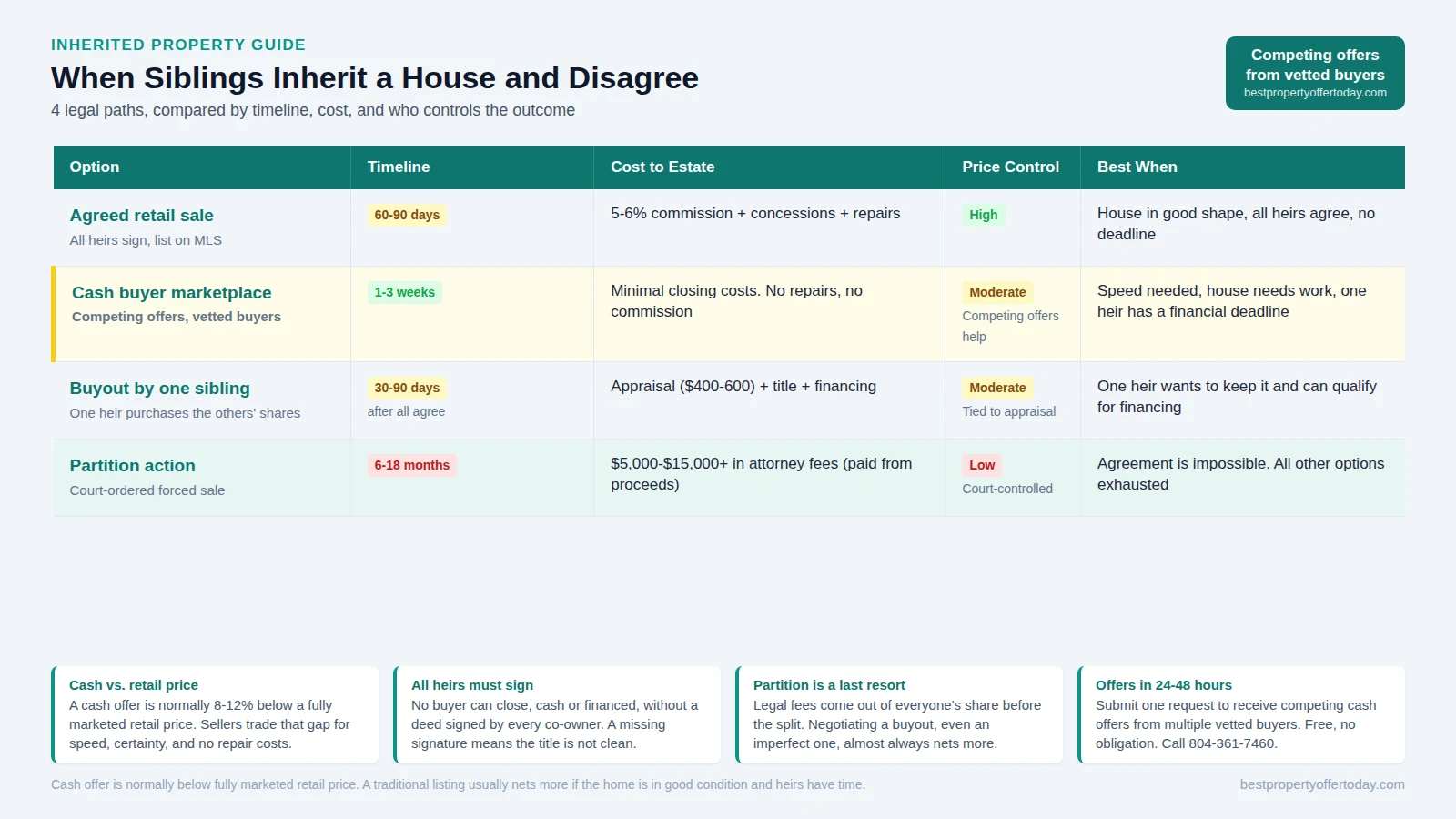
| Option | Typical timeline | Cost to estate | Control over price | Best when |
|---|---|---|---|---|
| Agreed retail sale | 60 to 90 days | 5 to 6% commission plus concessions | High | House in good shape, all heirs agree, no deadline |
| Cash buyer marketplace | 1 to 3 weeks | Minimal closing costs, no repairs | Moderate (competing offers help) | Heirs want speed, house needs work, financial deadline exists |
| Buyout by one sibling | 30 to 90 days after agreement | Appraisal, title, financing costs | Depends on appraisal | One heir wants to keep it and can qualify for financing |
| Partition action | 6 to 18 months | $5,000 to $15,000 or more in legal fees | Low, court-controlled | Agreement is impossible and all other options are exhausted |
Red Flags in Inherited Property Disputes
- An occupying sibling who has changed locks or access codes without the consent of other heirs may be creating a legal ouster claim
- A cash buyer who approaches one heir privately, without involving the others, is trying to secure a deal before all co-owners can compare their options
- Any contract containing an assignment clause, where the buyer can transfer their purchase rights to a third party, needs review before anyone signs
- An attorney hired by one heir to help the estate is not representing the other heirs; each heir should understand who is actually representing their interests
- Inspection periods of 30 to 45 days on an as-is cash deal are a wholesaler signal, not a direct buyer signal
- A buyer who claims they can close without all heirs signing is telling you the title will not be clean
For a fuller test of whether a buyer is operating legitimately, how to tell if a cash home buyer is legitimate covers the specific checklist.
Questions to Ask Before Signing Anything
- Has probate closed, and does the executor or personal representative have authority to sign on behalf of the estate?
- Are all heirs identified and accounted for, including anyone who may not know about the property?
- Is there a will that has been admitted to probate, or is the property passing by intestacy?
- Does any heir have a right of first refusal written into the will or a prior family agreement?
- What does the title search show, specifically liens, judgments, or mortgages against the property or the deceased person’s estate?
- If one heir is living in the property, what carrying costs have they paid, and what have the other heirs paid?
- Has any heir made improvements to the property that they will claim credit for at partition?
An estate attorney in the state where the property sits can answer these in about an hour. Do you need a lawyer to sell a house for cash covers what that review typically costs and what it catches.
Do all siblings have to agree to sell an inherited property?
Yes, in most cases. Co-owners who are tenants in common each hold a fractional interest, and a buyer needs all owners to sign the deed. One unwilling co-owner blocks a voluntary sale. The legal remedy for a permanent impasse is a partition action, where a court orders the sale and divides the proceeds regardless of whether all heirs agree.
Can one sibling force the sale of an inherited property?
Any co-owner can file a partition action in the state where the property is located. The court does not require all owners to agree. It will order the sale over the objection of any individual owner. Partition by sale is the standard outcome for a single-family house because a house cannot be practically divided. The filing party pays attorney fees upfront, and those fees are deducted from the proceeds before the split.
What happens when a sibling is living in the inherited house and refuses to sell?
The occupying sibling cannot prevent a partition action from being filed. Courts will still order the sale. Before that point, the other heirs can demand a formal buyout at appraised value or a rental agreement. If the occupying sibling has prevented the others from accessing the property, that is ouster, and they may owe the other heirs occupancy compensation. The cleaner path is usually a negotiated buyout, because partition takes time and the legal fees come out of everyone’s share.
Does a cash buyer need all heirs to sign?
Yes. A cash buyer needs a deed signed by all co-owners or by the executor of the estate with proper legal authority. If probate has not closed and no executor has been appointed, no sale can close. A buyer who says they can work around a missing heir signature is telling you the title will not be clean, and that creates a problem the next time the house changes hands.
If you want to see what competing offers from vetted cash buyers look like on your property, submit a request at BestPropertyOffersToday.com. The service is free, there is no obligation to accept any offer, and offers typically come back within 24 to 48 hours. Call 804-361-7460 if you prefer to talk through the situation first.
Related reading: Can I Sell My Parents House After They Die? A Simple Guide