Selling a House With Mold: Disclosure, Lenders, and Net Proceeds
Mold does not prevent you from selling. It narrows your buyer pool and changes the math on every path. The question is not whether you can sell, but which route makes sense given the location of the mold, the remediation cost, and how much time you have.
What disclosure actually requires
Selling a house as-is does not erase your disclosure obligations. That is the point most sellers miss. An as-is clause limits your duty to repair, not your duty to disclose. If you know about mold, you are required in most states to tell the buyer before they sign.
The obligation covers current mold and, in many states, past mold problems and the water intrusion that caused them. If you had a roof leak three years ago that produced visible mold, and you cleaned it up, disclosure rules in states like California, Texas, and New York still require you to report it.
Sellers who hide known mold face post-closing fraud claims and rescission demands. Courts generally allow buyers to sue for concealment even years after closing if the seller knew and said nothing. The cost of that litigation will exceed any remediation bill you were trying to avoid.
Keep documentation of everything: inspection reports, remediation receipts, clearance certificates. A buyer’s lender or inspector will ask, and having the paperwork shortens the negotiation instead of prolonging it.
Why lenders reject mold-affected houses
FHA and VA loans require an appraiser to flag mold as a health and safety condition. That flag becomes a mandatory repair before the loan can close. The buyer cannot waive it, the lender cannot ignore it, and the appraiser has no discretion once mold is visible. The loan dies unless the mold is remediated and cleared by a certified inspector.
Conventional loans follow Fannie Mae and Freddie Mac guidelines. Both treat visible mold as a condition that impairs habitability and can trigger the same repair requirement as FHA. The threshold varies by lender, but surface mold in a basement or attic will often fail an appraisal even on a conventional file.
The practical result is that a house with known, unaddressed mold can only be purchased by cash buyers or buyers using portfolio lenders willing to carry the risk. That is a smaller pool, and a smaller pool means lower offers. The same lender logic applies to other health-and-safety conditions: a failed septic system triggers the same FHA and VA repair requirements, and the buyer pool shrinks in the same way. Lead paint in pre-1978 homes triggers the same FHA and VA repair requirements; see selling a house with lead paint for how the federal disclosure rules and lender conditions play out.
What remediation actually costs
Surface mold on drywall or joists in a limited area typically runs $500 to $6,000. A professional crew removes the affected material, treats the framing, and issues a clearance certificate after a post-remediation air test. A 200 to 500 square foot problem in a basement or crawl space is usually on the lower end of that range.
Structural mold is different. When moisture has saturated framing, floor joists, or roof sheathing across a wide area, the remediation bill often runs $10,000 to $30,000 or more, and that is before any reconstruction. Mold behind walls in a finished living space almost always requires opening walls, which adds labor and material cost on top of the remediation itself.
Whether to remediate before listing is a financial question, not a moral one. If the remediation cost is $3,000 and it reopens the market to financed buyers, it likely pays. If the cost is $25,000 and the house needs other work, putting $25,000 into it to recover $20,000 in value is not a sound trade.
A worked example with real numbers
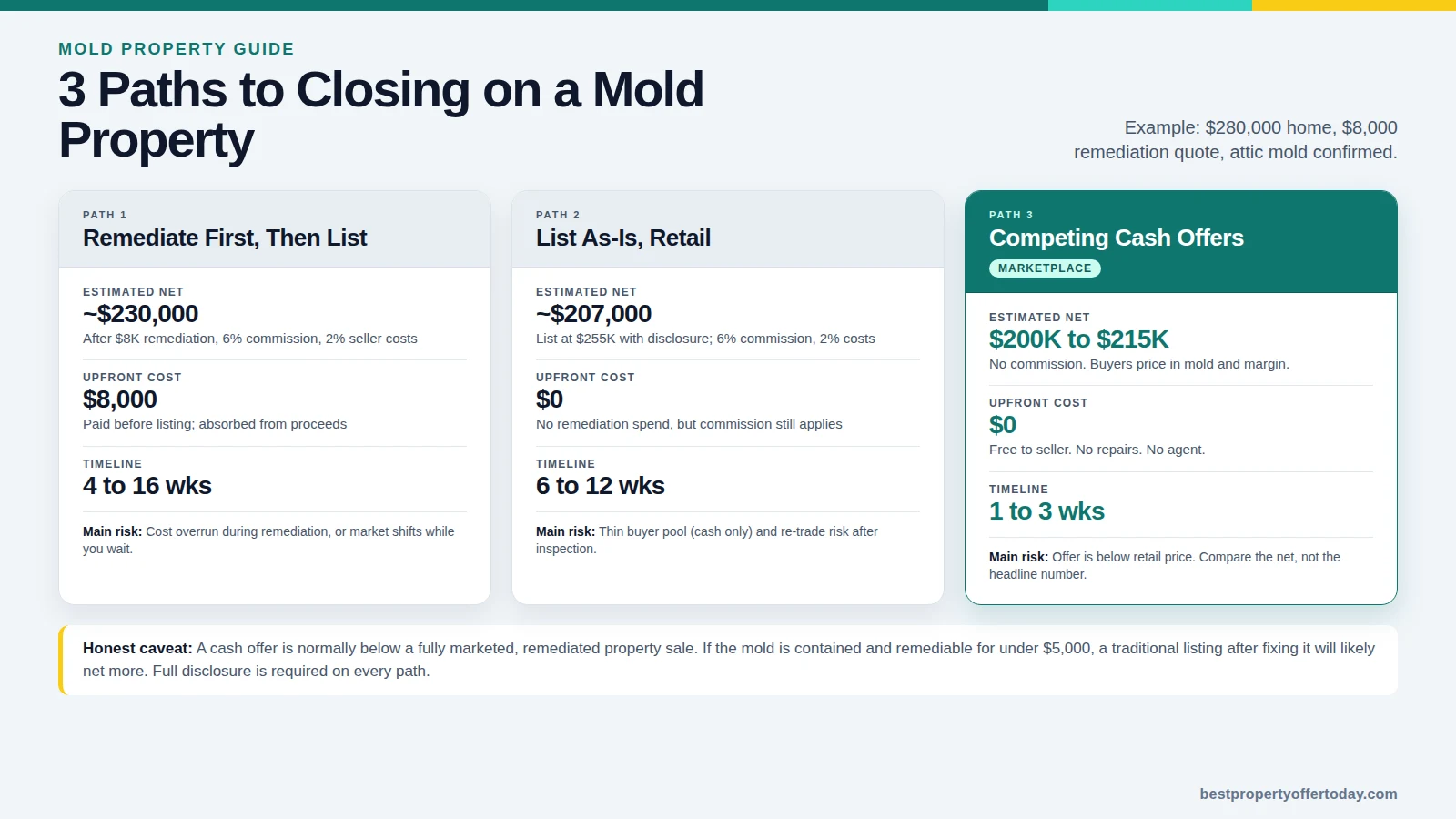
Take a house worth $280,000 in retail condition, with confirmed attic mold. A remediation contractor quotes $8,000. The seller has three paths.
Path one: remediate first, then list. The seller spends $8,000 and gets a clearance certificate. The house goes to market at $280,000. With a 6 percent agent commission, seller closing costs of about 2 percent, and no further repair negotiation, the seller nets roughly $230,000. The remediation cost is absorbed into the proceeds.
Path two: list as-is, disclose, accept a retail offer. The seller discloses the mold, prices at $255,000 to reflect the work needed, and markets to cash buyers and investors through retail channels. After a 6 percent commission and closing costs, the net is around $207,000. No remediation spend upfront, but the commission and carrying costs eat into the savings.
Path three: request competing cash offers through a marketplace. With full disclosure, the seller submits one request through bestpropertyoffertoday.com and receives competing offers from multiple vetted buyers. Because cash buyers build remediation cost and margin into their number, the offer will be below retail. In this example, competing offers might cluster around $200,000 to $215,000. No commission, no repairs, a close in one to three weeks limited only by title work. There is no agent fee and no inspection renegotiation risk. Use the net proceeds calculator to run your own numbers for each scenario.
The right path depends on how much time you have, what you owe, and whether certainty or maximum proceeds matters more.
The three paths compared
| Option | Upfront cost | Est. net (example) | Timeline | Main risk |
|---|---|---|---|---|
| Remediate, then list | $8,000 remediation | ~$230,000 | 4 to 16 weeks | Cost overrun, market shift during remediation |
| List as-is, retail | None | ~$207,000 | 6 to 12 weeks | Inspection renegotiation, thin buyer pool |
| Competing cash offers | None | ~$200,000 to $215,000 | 1 to 3 weeks | Offer is below retail; compare the net, not the price |
Net figures are illustrative. Actual results depend on location, loan balance, local market conditions, and remediation scope.
Red flags to watch for when a cash buyer makes an offer
Not every cash buyer handles mold properties the same way. Some use the mold as a lever to cut the price after signing. Before you accept any offer, watch for these patterns.
- A buyer requesting a long inspection window on a stated as-is cash deal. Cash buyers who plan to close generally do not need 21 days to inspect an as-is property. Long windows sometimes signal a wholesaler who intends to assign the contract to a third party before closing.
- Token earnest money, often $500 or $1,000 on a $200,000 transaction. A serious buyer who risks losing the deposit will think twice about walking. A small deposit means walking is essentially free if the mold turns out to be more extensive than stated.
- A price reduction request after inspection on a house already priced to reflect disclosed mold. If you disclosed and priced accordingly, a re-trade on the same finding is a negotiating tactic, not a legitimate new discovery.
- Language about “our buyers” or “our network” in a single-offer contract. That phrasing often signals a wholesaler. Check whether the contract has an assignment clause, which lets the buyer transfer the contract to someone else without your approval.
Our post on how to spot a wholesaler versus a real buyer covers the specific contract language to look for, including assignment clauses and how earnest money from closing-ready buyers compares. Before accepting any offer, it is also worth reviewing how to check whether a cash home buyer is legitimate so you know what questions to ask before signing.
The honest limits of a cash sale on a mold property
A cash offer on a house with mold will normally be below what a fully marketed, remediated property would sell for. That gap represents the remediation cost, the uncertainty the buyer absorbs, and their required margin. A traditional listing after remediation will usually net more if the mold problem is manageable and you have six to twelve weeks to run the process.
A cash sale through a competitive marketplace makes the most sense when the remediation cost is large relative to the home’s value, you cannot fund the remediation upfront, or the priority is speed and certainty over the last several thousand dollars of proceeds.
Does selling as-is mean I do not have to disclose the mold?
No. As-is limits the buyer’s right to demand repairs, not your obligation to disclose what you know. In most states, mold is a material defect that must be disclosed before signing. Selling as-is without disclosing known mold exposes you to fraud claims after closing, and courts have allowed those claims years later when concealment is documented in inspection reports or communications.
How much does mold reduce a home’s value?
The impact depends on scope and location. Surface mold with a $3,000 remediation cost in a $300,000 house typically reduces offers by $5,000 to $10,000, reflecting the cost plus negotiating friction. Structural mold requiring $25,000 in remediation can shave 15 to 20 percent from the price and eliminates all financed buyers. Mold in a finished basement or behind living-area walls costs more to remediate than attic mold, and buyers price the uncertainty accordingly.
Can I sell before remediating if I make full disclosure?
Yes. Full disclosure is required regardless of whether you remediate. Your buyer pool will be limited to cash buyers and investors, because FHA, VA, and most conventional loans require the mold to be cleared before closing. Price accordingly: the offer will reflect the remediation cost and the buyer’s risk of the work coming in higher than quoted.
What if I discovered the mold right before closing?
If an inspection turns up mold you genuinely did not know about, your disclosure obligation is triggered at that point. You have three options: remediate before closing, amend the disclosure and adjust the price so the buyer can decide with full information, or allow the buyer to walk. Hiding it once it appears in an inspection report creates a clear paper trail. Call 804-361-7460 if you need to understand your options for a fast close after a late mold discovery.