Selling a House With Knob and Tube Wiring: Your Three Options
Knob and tube wiring creates a specific problem most sellers do not fully understand until the buyer’s lender or insurer gets involved. The wiring itself is legal to sell. What it does is limit who can buy the house and on what terms, and that narrowing shows up in the price.
There are three ways to sell a house with knob and tube wiring. Each has a different cost, a different timeline, and a different buyer pool. Understanding the trade-offs before you list is the only way to avoid an unpleasant surprise after you are already under contract.
Chicago area owners of older homes with this wiring can ask Chicago Sell My House Fast for a cash offer.
What knob and tube wiring actually is, and why it matters now
Knob and tube wiring was the standard method used in American homes built roughly from the 1880s through the late 1940s. The system uses ceramic knobs to hold wire away from framing, and ceramic tubes to pass wire through framing members. The insulation is rubber covered with cloth, and it degrades over time as it dries out and becomes brittle.
The system has three problems that matter specifically to sellers in 2026.
First, there is no ground wire. Modern electrical codes require grounding as a safety feature. Knob and tube has none. You cannot install a three-prong grounded outlet on an ungrounded circuit without either replacing the wiring or adding a GFCI outlet downstream, which resolves the shock hazard but not the underlying system.
Second, the insulation fails. Cloth-covered rubber insulation from the 1920s and 1930s was not designed to last indefinitely. Where someone has added insulation over the wiring in an attic or wall cavity, the problem is worse: knob and tube requires open air circulation to dissipate heat, and burying it in blown-in insulation creates a fire risk that most inspectors will note explicitly.
Third, insurance underwriters know this. Many carriers will not write a homeowner’s policy on a house with active knob and tube wiring at all. Others will write it but with a surcharge or a condition that the wiring be inspected and certified. A buyer who cannot insure the house cannot get a mortgage, and even a cash buyer still needs to insure the property.
How insurance underwriting actually works on knob and tube homes
Insurance is where knob and tube creates the most friction in a sale, and most sellers do not understand the mechanism until it shows up in an inspection contingency.
When a buyer’s agent writes a standard purchase contract, it often includes an insurance contingency: the buyer has a window, typically 10 to 14 days, to obtain a homeowner’s insurance commitment. If the buyer submits the address to their insurance broker and the underwriter either declines or comes back with a surcharge that makes coverage unaffordable, the buyer can use that contingency to exit the contract and recover their earnest money.
This is separate from the lender’s appraisal and inspection. A buyer can clear the home inspection, be approved for the loan, and still lose the deal because the insurer will not write the policy.
Not all carriers handle knob and tube the same way. Specialty insurers and surplus lines carriers sometimes write policies on older homes with knob and tube, often at a higher premium and with conditions attached. An independent insurance broker who works with multiple carriers can shop the market in a way that a direct-to-consumer carrier cannot. But the seller has almost no control over this process: it is the buyer’s broker, the buyer’s insurer, and the buyer’s decision.
Why FHA and VA loans are essentially unavailable
FHA and VA loans follow HUD underwriting standards, which require that the property’s electrical system is adequate and does not present safety hazards. HUD appraisers are trained to flag knob and tube wiring as a safety condition requiring correction before the loan can close.
In practice, this means FHA and VA buyers are largely off the table unless the seller agrees to rewire the house before closing, which is a significant cost and timeline commitment. Conventional loans backed by Fannie Mae and Freddie Mac do not have the same explicit prohibition, but lenders still require the property to be insurable, which brings you back to the insurance problem above.
The net effect: a house with active knob and tube wiring sells mostly to cash buyers, to conventional buyers who can obtain insurance coverage, or after rewiring. Each path has a different cost structure. For a wider look at how knob and tube compares to aluminum wiring, Federal Pacific panels, and other electrical conditions that affect sales, see the overview at selling a house with electrical problems.
Three paths, with real numbers
The right path depends on how much of the wiring remains active, what the house is worth, and how much time the seller has.
Path 1: Rewire before listing
Full rewiring replaces all knob and tube circuits with modern sheathed cable, grounded at the panel. A licensed electrician pulls the old wiring, runs new, installs new outlets and switches, and patches the walls and ceilings that were opened.
Cost ranges by house size: roughly $8,000 to $16,000 for a 1,200 to 1,500 square foot house, $15,000 to $25,000 for 1,800 to 2,500 square feet, and $25,000 or more for larger or more complex homes. Add $3,000 to $6,000 for drywall patching and paint afterward, because the electrician does not patch. The total package on a typical 1,500 square foot house runs $11,000 to $22,000.
A rewired house opens the full buyer pool, including FHA and VA buyers, and removes the insurance friction entirely. The premium buyers pay for a clean house typically recovers some but not all of the rewire cost. Expect 4 to 8 weeks for a full rewire on a lived-in house, plus the time to list and close.
Path 2: List with disclosure and a seller credit
The seller discloses the knob and tube wiring upfront and prices the house to reflect the rewire cost. At closing, the seller provides a credit equal to an agreed portion of the rewire estimate. The buyer uses that credit to fund the rewire after closing.
This approach works with conventional buyers who can obtain insurance coverage. It does not work with FHA or VA buyers unless the lender agrees to escrow the repair funds and complete the work before closing, which most lenders will not do for a project of this size. The credit also needs to cover the buyer’s actual cost: get two or three contractor quotes before the listing goes live, because an under-estimated credit is a renegotiation waiting to happen.
Path 3: Sell as-is to cash buyers
Cash buyers skip the lender entirely, which removes the FHA and VA restrictions. They still need to insure the property, so the insurance problem is not gone, but a cash buyer with experience in older properties is more likely to have an insurance solution already in place or to price the insurance cost into their offer.
Cash buyers who buy houses as-is price in the cost of every known problem, including the rewire. On a house worth $350,000 after rewiring, a cash buyer might offer $280,000 to $295,000, reflecting a $20,000 rewire budget, three months of holding costs, and a margin that makes the risk worth taking.
That is a meaningful discount from retail. What the seller gets in return is speed, certainty, and no carrying costs during a renovation and relisting process. Whether that trade-off makes sense depends on the seller’s situation.
It is worth getting competing offers from multiple cash buyers rather than accepting the first one. The spread between offers on a house with a known defect can be $20,000 to $40,000, because buyers differ significantly in how they estimate repair costs and how much margin they need. Sending the request to multiple buyers lets the seller see that range rather than guessing at it.
Worked example: 1938 Colonial, 1,500 square feet
Consider a 1,500 square foot Colonial built in 1938, with active knob and tube wiring throughout. Comparable homes in the area with updated electrical sell for $380,000.
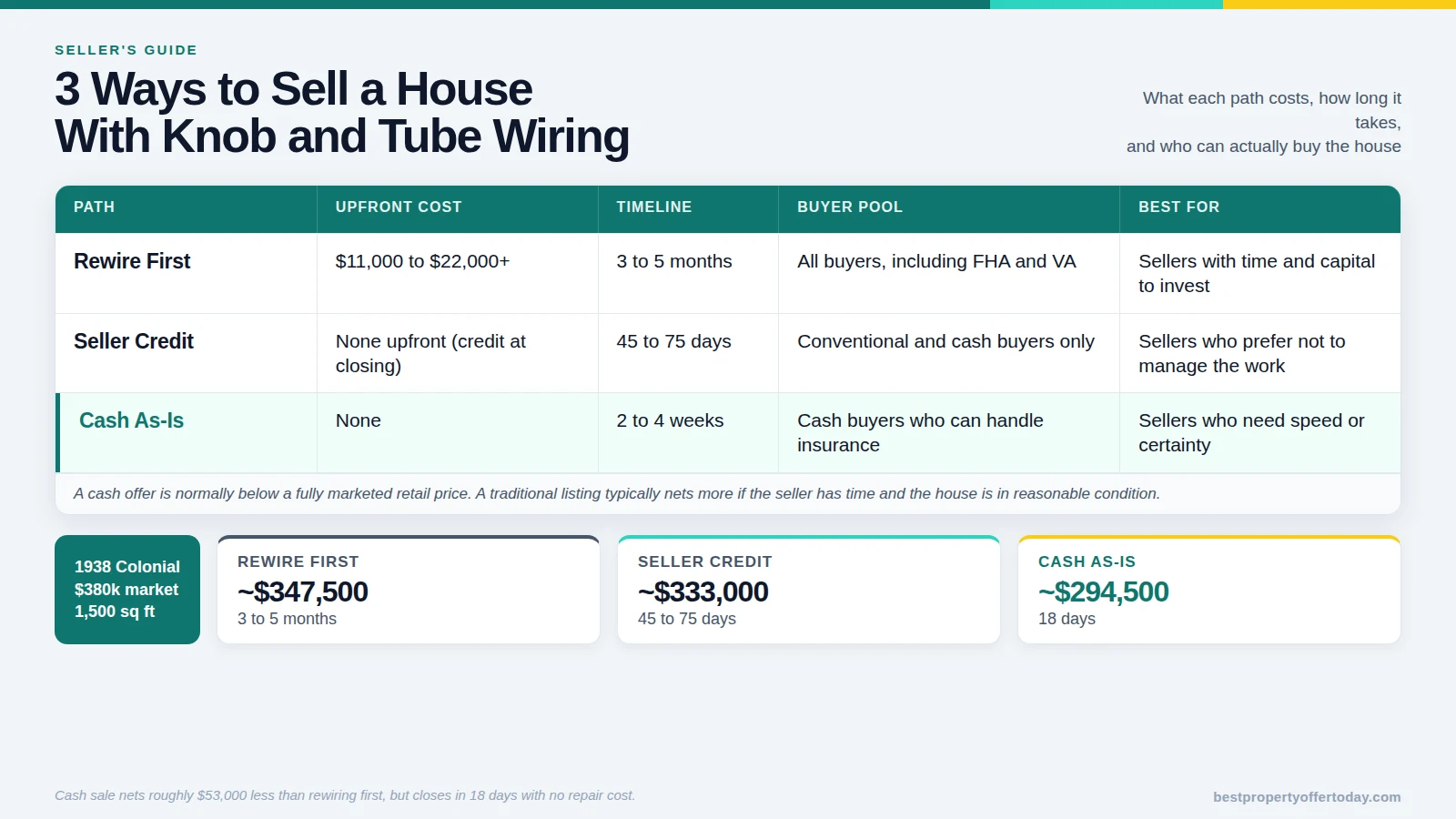
Rewire first: Electrical work costs $14,000. Drywall and paint runs $4,500. Total out of pocket: $18,500. The house lists at $380,000 after rewiring. After a 3 percent commission and $6,000 in closing costs, the seller nets roughly $347,500. Timeline: 6 to 10 weeks for the work, then 30 to 60 days to close after listing. Total time from today to proceeds: 3 to 5 months.
Seller credit path: The house lists at $362,000 with a disclosed $18,000 credit. After a 3 percent commission and closing costs, the seller nets roughly $330,000 to $337,000. The buyer pool is smaller and days-on-market may be longer. No upfront repair cost, but the net is lower.
Cash as-is: Three buyers submit offers of $282,000, $291,000, and $298,000. The seller accepts $298,000. No commission on a direct cash sale, closing costs of approximately $3,500. Net: roughly $294,500. Closed in 18 days.
The cash path nets roughly $53,000 less than rewiring first. What it buys is 3 to 5 months of time and $18,500 in up-front repair cost not spent. The right answer depends on the seller’s financial position, their timeline, and whether carrying the house for another several months is feasible.
Selling path comparison
| Path | Upfront cost | Timeline to close | Buyer pool | Best for |
|---|---|---|---|---|
| Rewire first | $11,000 to $22,000+ | 3 to 5 months | All buyers, including FHA and VA | Sellers with time and capital |
| Seller credit | None upfront (credit at closing) | 45 to 75 days | Conventional and cash buyers | Sellers who prefer not to manage the work |
| Cash as-is | None | 2 to 4 weeks | Cash buyers only | Sellers who need speed or certainty |
Red flags from cash buyers on knob and tube homes
Not all cash buyers price knob and tube the same way, and some use the wiring as leverage to renegotiate after signing. Watch for these:
- A buyer who makes an offer before conducting any inspection and then drops the price significantly “after reviewing costs” is using the inspection window as a second negotiation
- Assignment clauses in the contract allow the buyer to sell the contract to a third party rather than closing themselves. The third party has no obligation to honor the original price
- A very long inspection window on an as-is cash deal, typically more than 10 to 14 days, gives the buyer time to find another property while keeping the seller off the market
- Proof of funds documentation that shows a recent deposit or a credit line rather than liquid funds already available
These behaviors are not specific to knob and tube transactions, but a house with a disclosed defect invites this kind of maneuvering more than a clean listing does. Getting multiple offers at the same time is the most effective protection: a buyer who knows others have submitted is less likely to renegotiate on the back end. See our guide on what proof of funds documents to ask for before signing any contract.
When a cash sale is and is not the right answer
A cash offer for a house with knob and tube wiring will almost always come in below what a rewired house would sell for on the open market. That discount is real and not negotiable: cash buyers price in the cost and risk of the work they are taking on.
For a seller with time and capital, rewiring first is likely the better financial outcome. For a seller who needs to close in 30 days, who does not have $15,000 to $20,000 available for the repair, or who cannot carry the house for another three to five months, a cash sale is a reasonable trade.
A traditional listing usually nets more, but only if the seller either completes the rewire or the buyer pool can get insurance coverage and the seller credit is correctly sized. Sellers who go to market before resolving the insurance problem often end up with a contract that falls apart during the insurance contingency window, and they have to restart the process.
Use the net proceeds calculator at /sell-my-house-calculator to run your specific numbers before deciding. The difference between paths in your market may be larger or smaller than the example above, and the right answer depends on those actual figures.
Will FHA approve a house with knob and tube wiring?
In practice, almost never without the seller rewiring first. HUD appraisers are trained to flag knob and tube as a safety condition requiring correction, and FHA lenders must follow the appraiser’s requirements before funding. There is no formal categorical ban written into the regulations, but the field standard is to require replacement before the loan closes.
Can a cash buyer insure a house with knob and tube wiring?
Some can and some cannot, depending on the insurer and the condition of the wiring. Experienced buyers who work with older properties typically have relationships with surplus lines carriers who will insure houses that standard carriers decline. A first-time cash buyer may face the same insurance problem a financed buyer does, which is why asking a potential buyer how they plan to insure the property is a reasonable question before accepting an offer.
Does knob and tube wiring need to be disclosed?
Yes, in every state. Knob and tube wiring is a known material defect that affects value, insurability, and the buyer pool. A seller who knows the wiring exists and does not disclose it faces fraud and misrepresentation exposure after closing. Disclosure does not prevent a sale. It prevents a lawsuit.
How much does a full rewire add to a sale price?
It rarely produces a dollar-for-dollar return. A $20,000 rewire on a $350,000 house typically recovers $12,000 to $16,000 in sale price, because buyers do not pay full value for repairs that were already overdue. The real value of rewiring is access to the full buyer pool, including FHA and VA buyers, which increases competition and shortens time on market. That increased competition often makes up more of the difference than the direct price premium does.