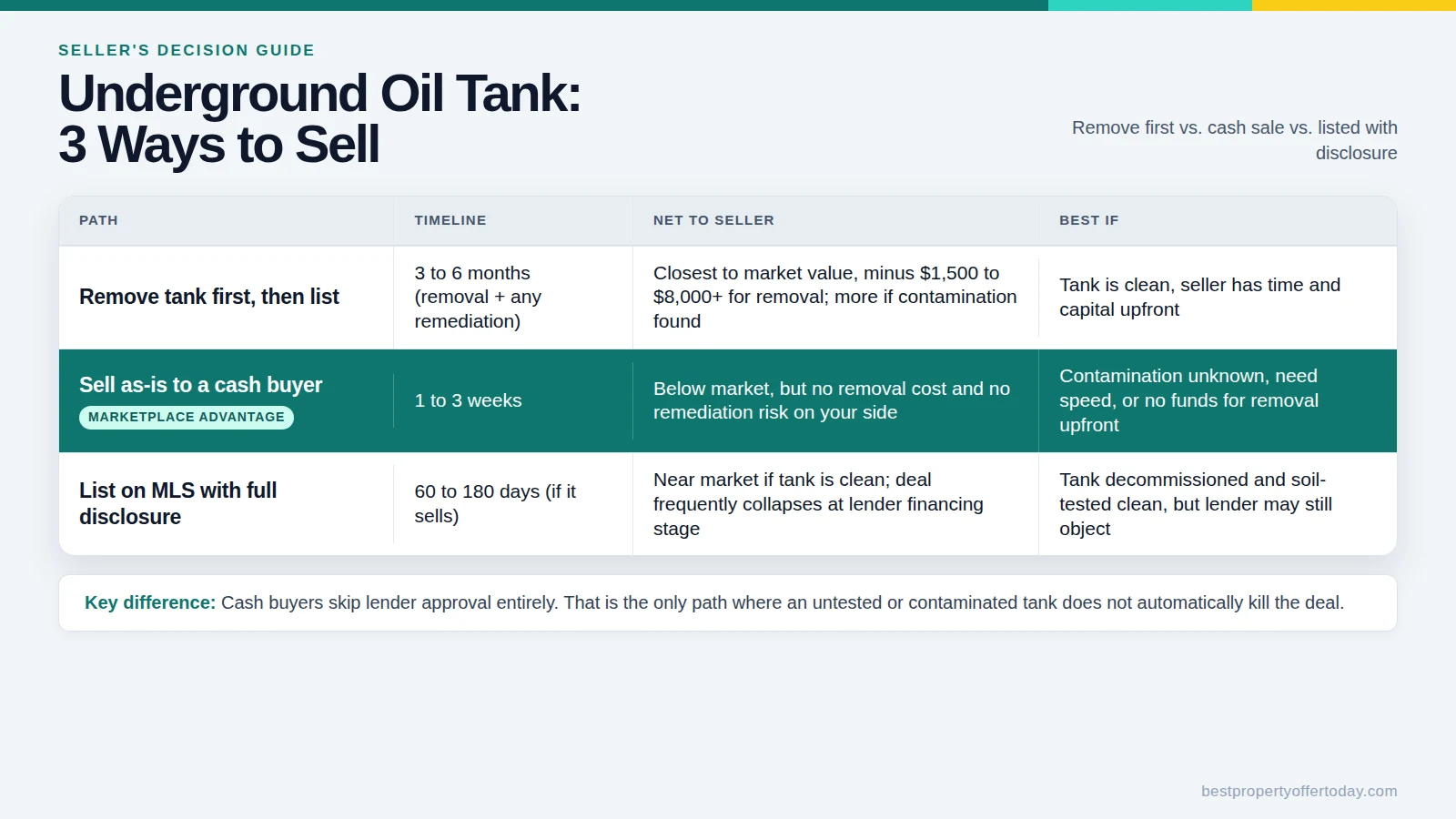
An underground oil tank does not make a house unsellable. It does make it harder to sell to a buyer using a mortgage, and it creates a disclosure obligation in almost every state. The realistic question is not whether you can sell but which path costs you the least: remove the tank first, sell as-is to a cash buyer, or list it with full disclosure and see who shows up.
What an underground oil tank actually is
From the 1930s through the 1980s, oil-heated homes in the Northeast and Midwest were commonly built with steel storage tanks buried in the yard or under the basement floor. When those homes converted to gas or electric heat, the tanks were often left in place. Abandoning in place was legal and common. The problem is that steel corrodes over decades, and a corroded tank leaks heating oil into the surrounding soil and sometimes into groundwater.
The industry term is underground storage tank, abbreviated UST. Regulators use that term. Environmental assessors use it. Your buyer’s lender will use it in the loan conditions when they flag a problem.
A tank that has never leaked and is still holding oil is a different situation from a tank that has been “decommissioned” (cleaned and filled with sand or concrete) but was leaking for years before anyone noticed. Both need to be disclosed. Only one carries open-ended remediation liability.
Why lenders routinely block financing on UST properties
Conventional lenders, FHA, VA, and USDA all follow guidance that treats an active or abandoned underground storage tank as an environmental hazard requiring resolution before they will fund a loan. The mechanism varies by lender, but the outcome is consistent: a buyer who needs financing either must provide a Phase I environmental site assessment showing no evidence of a release, or must show proof of tank removal and a site clearance letter from the relevant state agency.
A Phase I assessment costs $1,500 to $3,000 and takes two to four weeks. If the Phase I identifies a recognized environmental condition, the lender will require a Phase II, which involves soil borings and lab testing. Phase II costs $3,000 to $10,000 or more, depending on site size and how many borings are needed. If the Phase II finds contamination, the lender will not fund until remediation is complete and the state has issued a no-further-action letter.
Remediation is where costs become unpredictable. A clean removal with no contamination runs $1,500 to $4,000 for the excavation and disposal. If the soil is contaminated, remediation can run from $10,000 for a small, localized spill to $100,000 or more when the plume has migrated toward a property line or water supply. There is no way to know what you are dealing with until the tank is out of the ground.
That uncertainty is exactly why most financed deals collapse. The buyer’s lender sees “underground storage tank” on a preliminary title report or inspection disclosure and adds a condition the seller cannot easily satisfy within a normal closing window. The deal dies or the seller renegotiates down to cover the unknown risk.
Disclosure requirements for sellers
Selling as-is does not eliminate your duty to disclose. It limits your obligation to repair, not to inform. In most states with a seller disclosure statute, a known underground storage tank must be disclosed on the disclosure form. Failure to disclose a known defect that materially affects value exposes you to liability after closing, even when the deed says “as is.”
The specific form and language vary by state. States with the highest concentration of residential USTs, including New Jersey, New York, Connecticut, Massachusetts, Pennsylvania, and Maryland, tend to have the clearest disclosure requirements and the most active environmental regulators. Some of those states maintain public UST databases where buyers and their agents can search by address. If the tank shows up in the database, pretending it does not exist is not an option.
The honest approach, and the legally safer one, is to disclose what you know, document what you do not know, and let buyers price the risk accordingly.
The three paths and what each actually nets
There is no single right answer. The best path depends on whether the tank has already been tested, whether you have capital to front the removal cost, and how much time you can afford to spend.
Path 1: Remove the tank before listing
This is the cleanest approach for buyers using financing and typically produces the highest sale price, net of removal costs. You hire a licensed environmental contractor, pull the necessary permits, excavate the tank, and have the surrounding soil sampled. If the soil comes back clean, you get a closure letter from the state agency and list the property without the UST cloud hanging over it.
Total cost for a straightforward removal with clean soil: $1,500 to $4,000 in most markets. Timeline from contractor hire to state clearance letter: four to twelve weeks in most states, longer if the agency is backlogged. If contamination is found, the range widens dramatically and the timeline stretches accordingly.
The risk in this path is that you are opening the tank before you know what is inside it. If there is contamination, you are now legally the responsible party for remediation, and you will need to disclose that to buyers regardless of whether you complete the cleanup before selling.
Path 2: Sell as-is to a cash buyer
Cash buyers do not have lenders dictating conditions. They can price the unknown risk of the tank into their offer and close without waiting for environmental reports or state clearance letters. For a seller who needs speed, cannot front the removal cost, or simply does not want to open that box before selling, this is often the most practical exit.
The tradeoff is real. A cash offer on a property with an untested tank will be lower than what the property would fetch with a clean bill of environmental health. The buyer is pricing in the worst-case scenario because they do not know what the soil looks like either. That discount can range from a few thousand dollars to more than $50,000 depending on the age of the tank, the property’s location, and whether there are any visible signs of prior leakage.
Getting offers from more than one cash buyer matters here, because different buyers price environmental risk differently. A local investor who has handled dozens of UST properties will typically price it more accurately than a national iBuyer running it through an algorithm. Comparing cash offers side by side is how you find who is giving you a realistic number rather than a punishing one.
Path 3: List on the open market with full disclosure
This works when the tank has already been decommissioned, tested, and cleared by the state, but some residual buyer concern remains. The disclosure is complete, the documentation is in hand, and most lenders can be satisfied with the paper trail. Deals still occasionally fall apart over lender discretion, but this path carries the highest probability of a retail buyer completing financing.
If the tank is active, untested, or has a known spill history, listing on the MLS produces a parade of offers that die at the financing contingency. You spend months going under contract and falling out before ending up back where you started, now with public market history showing the property failed to sell.
What the numbers look like: a worked example
A house in suburban Connecticut, market value $380,000 with a 1,000-gallon steel tank last serviced in the 1990s. The seller does not know whether it is leaking.
If the seller removes the tank first and soil comes back clean: removal cost $3,200, state clearance letter in eight weeks, then lists at $380,000. After a typical agent commission of 5 to 6 percent ($19,000 to $22,800), normal closing costs, and the removal bill, net proceeds land somewhere near $350,000. Timeline from today to close: five to seven months.
If the seller takes competing cash offers as-is: offers come in around $310,000 to $330,000, reflecting the unknown tank risk. No removal cost, no Phase I or Phase II, no remediation uncertainty. Net proceeds: $310,000 to $330,000. Timeline: two to four weeks.
The gap between those outcomes is $20,000 to $40,000. What the seller is buying with that gap is speed, certainty, and the elimination of open-ended environmental liability. For some sellers that tradeoff is worth it. For others, the higher number justifies the wait and the cost. Use the net proceeds calculator to model both scenarios against your actual carrying costs before deciding.
Red flags from buyers who know UST properties
Not every cash buyer who says they handle environmental properties actually does. A few things to watch for when you are reviewing offers:
- A buyer who does not ask for any documentation about the tank and is not reducing their price to reflect the risk is either misinformed or planning to re-trade the price after they get their own inspection
- Assignment clauses in the purchase contract, meaning the buyer can sell their rights to another buyer before closing, are a red flag on any as-is sale but especially on one with an environmental issue. See the full rundown on how to spot a wholesaler versus a real buyer
- Token earnest money, typically under $500 to $1,000 on a six-figure purchase, means it costs the buyer almost nothing to walk away. They may be using the inspection period to shop your property to other investors
- A buyer who cannot provide proof of funds within 48 hours of request is not a cash buyer in the functional sense. Verified funds are the whole point
The honest caveat about cash offers
A cash offer on a property with an underground oil tank will almost always be below what a fully marketed, remediated property would sell for at retail. That is not an opinion; it is the math of unknown risk. The buyer is taking on a liability you are exiting. They price that appropriately for their own business.
If the tank is clean, documented, and you have time, removing it before listing is likely to net you more money. If you have contamination, limited time, limited capital, or simply want a definite outcome with no remediation surprises after closing, the cash path is worth understanding clearly before you decide.
Call 804-361-7460 to start a no-obligation request. Competing offers come back within 24 to 48 hours and there is no requirement to accept any of them.
Questions sellers ask about underground oil tanks
Do I have to disclose an underground oil tank I did not know about?
You are only required to disclose what you know. If you genuinely did not know the tank was there, your disclosure obligation is limited to what you discover during the sale process. However, once you learn about it, you must disclose. Ordering a tank search from an environmental company or reviewing a prior inspection report creates knowledge, which creates the duty.
Can a buyer back out if they find a tank during inspection?
Yes, if the purchase contract has an inspection contingency. Most standard real estate contracts include one. A buyer who discovers an undisclosed tank during inspection typically has the right to renegotiate, request remediation, or terminate the contract and recover their earnest money. What happens when a cash buyer backs out depends heavily on what is in the contract and how much earnest money was at stake.
Is it better to decommission the tank or remove it?
Decommissioning (draining and filling with inert material) is cheaper and faster than removal, but it does not end the conversation. Many lenders still treat a decommissioned tank as an unresolved environmental risk without a soil clearance letter. Removal with clean soil testing produces the clearest paper trail and the highest acceptance rate from buyers using financing. If the goal is to maximize your pool of potential buyers, removal is the better choice.
What if the tank is shared with a neighbor?
Shared fuel oil tanks, typically a single large tank serving two homes, carry the same disclosure obligation and lender concerns as a single-property tank. Remediation responsibility in a contamination scenario depends on the applicable state environmental law and any agreements between property owners. This situation almost always requires an attorney review before you execute a purchase contract. The additional complexity is one reason sellers with shared tanks tend to attract cash buyers who can move without lender involvement.