Polybutylene pipe was installed in roughly 6 to 10 million American homes between 1978 and 1995. If your house was built during that window, there is a meaningful chance the original plumbing is still in place. And if you are selling, that pipe creates a specific set of problems: some lenders will not fund a buyer, some insurers will not write a new policy, and a conventional sale can fall apart at the inspection even when everything else looks fine.
This post covers what polybutylene actually is, why it creates friction in a sale, what it costs to fix, and what your realistic options look like, including selling to a cash buyer without touching the plumbing at all.
What polybutylene pipe is and why it became a problem
Polybutylene is a flexible plastic pipe, usually gray, blue, or black, stamped with the code “PB2110” or sold under the brand name “Quest.” Manufacturers marketed it as a cheaper alternative to copper during the 1980s and early 1990s, and it was widely used in new construction across the South, Southwest, and Pacific Northwest.
The problem is chlorine. Municipal water systems add chlorine and chloramines to drinking water to keep it safe. Over time, those chemicals oxidize the fittings on polybutylene pipe, causing micro-fractures that eventually become leaks or sudden bursts. The failures happen at the fittings, not the pipe itself, which makes them hard to spot before they cause serious water damage inside a wall or ceiling.
A class action lawsuit, Cox v. Shell Oil Company, resulted in a roughly $950 million settlement starting in 1995. That fund compensated affected homeowners for replacement costs. The claims window closed in 2009. There is no active settlement now. Sellers today simply have an aging material that the industry moved away from, and that the insurance and lending markets have not forgotten.
How polybutylene affects your sale before you list
The pipe causes problems in three separate channels, and sellers often do not discover all three until after a buyer is already under contract.
Insurance. Some carriers refuse to write a new homeowner’s policy on a property with polybutylene plumbing. Others will write it but add a rider or a surcharge, often $300 to $600 per year, contingent on replacement within a set time frame. A buyer who cannot get affordable insurance cannot close on a financed loan. This is frequently what kills a conventional sale, even when the lender has raised no flags.
Financing. FHA, VA, and USDA loan programs require appraisers to note deferred maintenance. An appraiser who flags polybutylene pipe can make the property ineligible for that loan until the issue is remediated. Conventional lenders vary: some require replacement before funding, others do not. What typically happens is that the lender approves the buyer initially, the home inspection reveals the pipe, and the buyer’s insurer then adds a large surcharge that changes their monthly payment. At that point the buyer either walks, renegotiates for a repipe credit, or asks for a price reduction. You are having that conversation 60 days into the transaction.
Inspection reports. Any thorough home inspector will identify polybutylene and flag it. Most buyers see that flag and immediately ask what it costs to fix. If you have not gotten ahead of it before listing, the buyer is going in with a repair estimate their inspector gave them, which is often higher than what you could have obtained upfront.
The three realistic paths for sellers
There is no single right answer. The best path depends on your timeline, your cash position, and whether the house has other issues that already limit your buyer pool.
Repipe the house before listing
Replacing polybutylene with PEX pipe typically costs $4,000 to $15,000 depending on the size of the house and how accessible the plumbing is. A slab foundation requires cutting into the concrete to reach pipes, which adds labor. A crawlspace or basement gives plumbers easier access. A 1,800 to 2,200 square foot house with two full bathrooms usually runs $5,500 to $9,000, including permits and patching the drywall.
Repiping before listing removes all three problems at once: the insurance issue, the lender condition, and the inspection flag. The house becomes accessible to conventional, FHA, VA, and USDA buyers. You get permits documenting that licensed work was done and inspected. You remove the main negotiating chip a buyer will use after the inspection report.
The tradeoff is cash and time. Getting permits, scheduling a licensed plumber, and completing the drywall patching typically adds two to six weeks before you can list. You also need the money to pay for the work before you see any proceeds from the sale.
List with full disclosure and a credit or price reduction
You can disclose the polybutylene pipe upfront and offer a credit at closing equal to the repipe estimate. This attracts buyers who can get conventional financing without a lender condition on the plumbing, or buyers who are paying cash and do not need a lender at all.
The risk here is renegotiation. Even when a buyer accepts the credit terms upfront, the inspection report often prompts a second conversation. If the buyer’s lender then requires a repipe before funding, the deal stalls while the parties figure out who is arranging the contractor and who is holding the escrow. Some deals survive that conversation. Others do not, and you restart the listing after 60 days off market.
If you go this route, get a firm estimate from a licensed plumber before you list. A quote in hand prevents the buyer from coming back with a number two or three times what the repipe actually costs.
Sell as-is to a cash buyer
A cash buyer does not need a lender or an insurer to approve the transaction. They price the repipe cost into their offer, factor it against what the house is worth after the work is done, and make a number. There is no renegotiation after inspection because the buyer already knows about the pipe and has already built it into their math.
Cash buyers vary considerably in what they factor. An investor planning to flip the house uses a stricter return formula than a landlord buying a rental, who in turn is stricter than a primary residence buyer paying cash. Getting competing offers from multiple buyers is how you find out which type of buyer values your specific property most. A single off-market offer from one investor tells you nothing about whether that is the best number available. Our request form at bestpropertyoffertoday.com sends your property to a network of vetted cash buyers and collects competing offers at no charge to you.
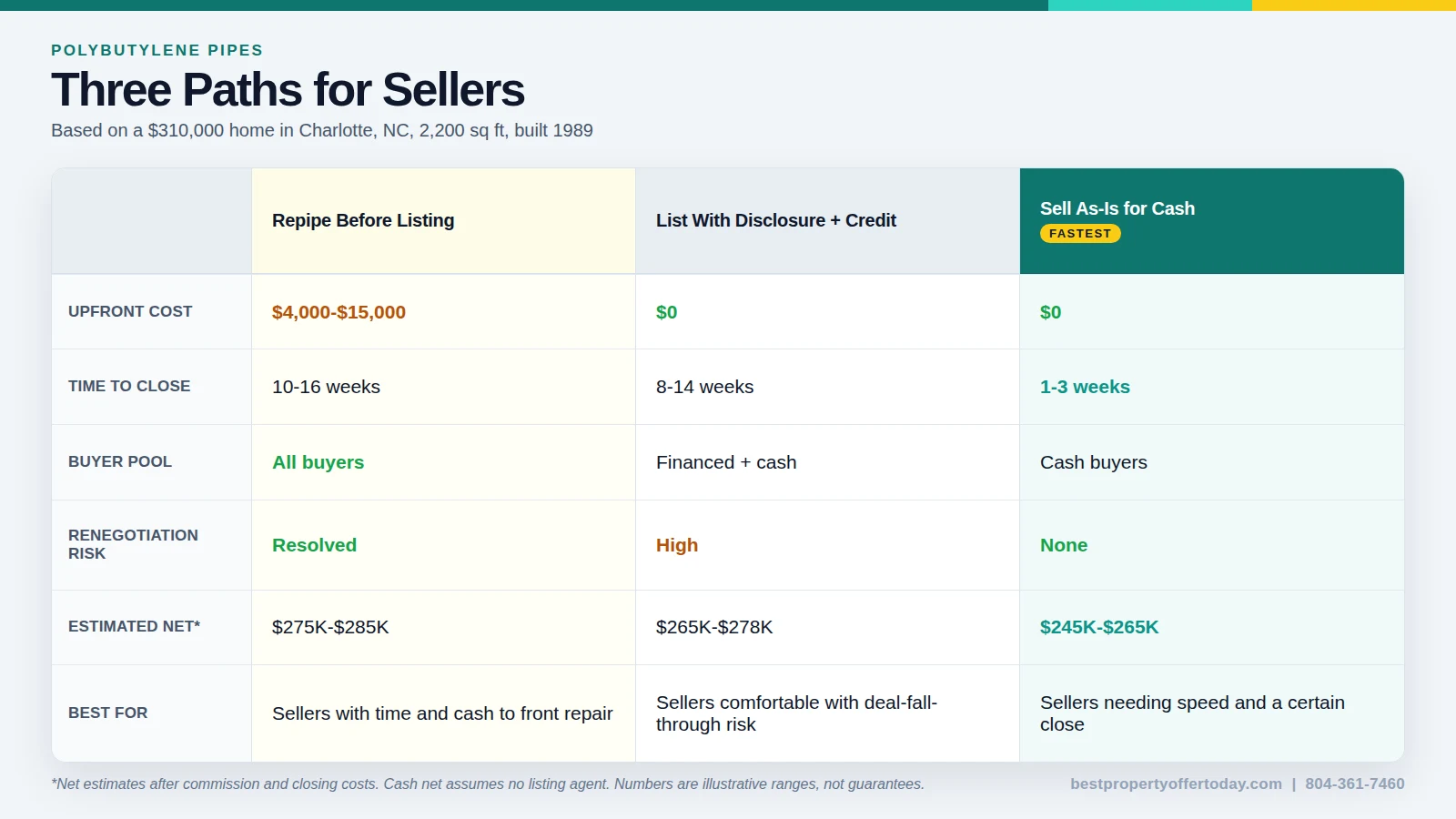
Worked example: Charlotte, NC, 2,200 sq ft, built 1989
The house has polybutylene pipe throughout. Estimated market value with conventional plumbing: $310,000. Repipe estimate from a licensed plumber: $8,500 including permits and drywall patching.
| Path | Upfront cost | Time to close | Estimated net | Main risk |
|---|---|---|---|---|
| Repipe, then list | $8,500 | 10 to 16 weeks | $275,000 to $285,000 | Contractor delays; carrying costs |
| List as-is, $10K credit | $0 | 8 to 14 weeks | $265,000 to $278,000 | Lender conditions; deal falls apart at 60 days |
| Cash buyer, no repipe | $0 | 1 to 3 weeks | $245,000 to $265,000 | Offer spread varies widely by buyer type |
The gap between the repipe path and the cash path is roughly $10,000 to $40,000. What the cash path buys is certainty and speed: no contractor to coordinate, no lender condition risk, no deal falling through six weeks in. Whether that tradeoff makes sense depends on the seller’s situation.
Use the net proceeds calculator on this site to model the numbers for your specific house.
What cash buyers actually factor when there is polybutylene
Most cash buyers who flip properties work from a version of the 70 percent rule: they target buying at 70 percent of what the house is worth fully repaired, minus their estimated repair costs. Applied to the Charlotte example:
- After-repair value: $310,000
- 70 percent of ARV: $217,000
- Minus repipe cost: $8,500
- Flipper target offer: around $208,500
That is the low end of what a seller will see. A landlord or buy-and-hold investor has a lower required return, and will often offer $240,000 to $260,000 on the same house, because they are not factoring in a renovation profit margin. The spread between those two numbers, $30,000 to $50,000, is exactly why getting multiple competing offers matters. See our breakdown of how cash buyers calculate their offer price for a fuller explanation of the formulas.
Red flags when selling a polybutylene house to a cash buyer
Not every cash offer is from a serious or straightforward buyer. These behaviors are worth watching for:
- An offer that comes in without any questions about the plumbing, followed by a price cut after “inspection” citing the pipe. You disclosed it upfront. The information is not new. The cut is a renegotiation play, not a genuine discovery.
- A very low earnest money deposit relative to the offer price. On a $255,000 offer, $500 in earnest money means the buyer can walk for free. There is no cost to backing out. Read our post on how much earnest money is reasonable in a cash sale.
- An assignment clause in the purchase agreement, meaning the buyer can sell the contract to a third party before closing. You accepted an offer from the person in front of you, but an unknown investor shows up at the table.
- A request for a 30 to 45 day inspection period on a property with no financing contingency. A serious cash buyer does not need a month to inspect. Long inspection windows are used to market the property to end buyers before the original buyer commits. See our full breakdown of what wholesalers do and how to spot one.
Disclosure requirements for polybutylene pipe
In most states, polybutylene pipe is a material defect and must be disclosed if the seller knows it is present. The fact that the pipe has not failed yet does not change the disclosure obligation. Selling a house as-is limits your duty to repair. It does not limit your duty to tell a buyer what you know.
Several states use a specific seller’s disclosure form where plumbing system condition is a line item. Others apply a general standard for material defects. In either case, getting the disclosure in writing and having the buyer sign it protects you from a claim that they were not told.
An attorney review before closing typically costs $300 to $600 and is worth it when a known defect like this is part of the transaction. Our post on whether you need a lawyer to sell a house for cash covers what a review typically catches in a sale like this.
A cash sale is not the right call for everyone
Cash offers on properties with polybutylene pipe run below what a fully marketed retail sale would produce, even after factoring in the repipe cost and carrying time. The honest comparison on a house like the Charlotte example is roughly $25,000 to $40,000 less on the cash path than on the repipe-and-list path.
If you have the cash to fund a repipe upfront and the time to wait for a conventional closing, a traditional listing will almost certainly net you more. The cash path makes the most sense when the seller cannot fund the repair before closing, needs to close quickly for financial or personal reasons, or is dealing with multiple issues that already limit the buyer pool.
Do I have to repipe before selling?
No. You can sell a house with polybutylene pipe as-is. What you cannot do is hide it. Most states require written disclosure of known material defects. The pipe affects how many buyers can finance the purchase and whether their insurer will write a policy at a reasonable rate, so it will come up. Addressing it upfront, either by repiping or by disclosing and pricing accordingly, puts you in a much stronger negotiating position than waiting for the inspection report to surface it.
How do I identify polybutylene pipe in my house?
Look at the pipe coming out of the water meter, under sinks, at the water heater, and at any exposed plumbing in the basement or crawlspace. Polybutylene is gray, blue, or black and is usually stamped “PB2110” or labeled “Quest.” It is flexible plastic, unlike copper which is rigid and has an orange-brown color. Some houses have mixed plumbing, with copper in the main supply lines and polybutylene in the branch runs. A plumber who is bidding the repipe will typically do a walk-through at no charge to confirm the scope.
Can a financed buyer purchase a house with polybutylene pipe?
Sometimes, depending on the lender and the insurer. Conventional loans at lower loan-to-value ratios sometimes go through without a lender condition on the plumbing. FHA and VA loans are more likely to require remediation before the appraisal is approved, because their guidelines flag deferred maintenance explicitly. What often happens in practice is that the lender does not raise the issue, the insurer does, and suddenly the buyer’s monthly cost has changed. Whether the deal survives that conversation depends on whether the credit negotiated upfront is enough to cover the repair.
What is the difference between PEX and polybutylene?
PEX, or cross-linked polyethylene, is the standard replacement material when repiping a house with polybutylene. Both are flexible plastic pipe, which is why they look similar to an untrained eye. The difference is that PEX is resistant to chlorine degradation and does not carry the insurance and lending flags that polybutylene does. If a listing says the plumbing was “recently updated,” confirm it was replaced with PEX, copper, or CPVC, not a partial repipe that still leaves polybutylene in the branch runs to the fixtures. If your house predates the polybutylene era, built before 1978, and still has the original supply lines, the issue is more likely galvanized pipes, which create similar barriers with lenders and insurers through a different failure mechanism.