How Cash Buyers Calculate Their Offer: The Formula Sellers Should Know
Cash buyers do not set a number based on what a house is worth to you or what you paid for it. They apply a formula: the home’s value after repairs, minus the cost of those repairs, minus their profit margin, minus their overhead. Understanding how that arithmetic works helps you evaluate any offer you receive and decide whether it is reasonable or low even by cash-buyer standards.
The Starting Point: After-Repair Value
The first number in every cash buyer’s calculation is the After-Repair Value, or ARV. This is what the property would sell for on the open market if it were fully repaired, updated, and listed through an agent. Cash buyers estimate ARV by pulling recent comparable sales in the neighborhood, often called comps, and adjusting for condition, square footage, and lot size.
ARV is not what the house is worth as it sits today. It is a forward-looking estimate of what the property could be worth after someone spends money on it. That distinction matters because the entire offer structure flows from this number.
If a buyer’s ARV estimate is off, the offer will be off. Buyers can underestimate ARV on a house with good bones in a strong market, or overestimate it on a house in a neighborhood with soft demand. Neither mistake shows up on the offer letter itself, which is one reason getting multiple offers is more useful than asking one buyer to justify their number.
The 70 Percent Rule and What Comes Off the Top
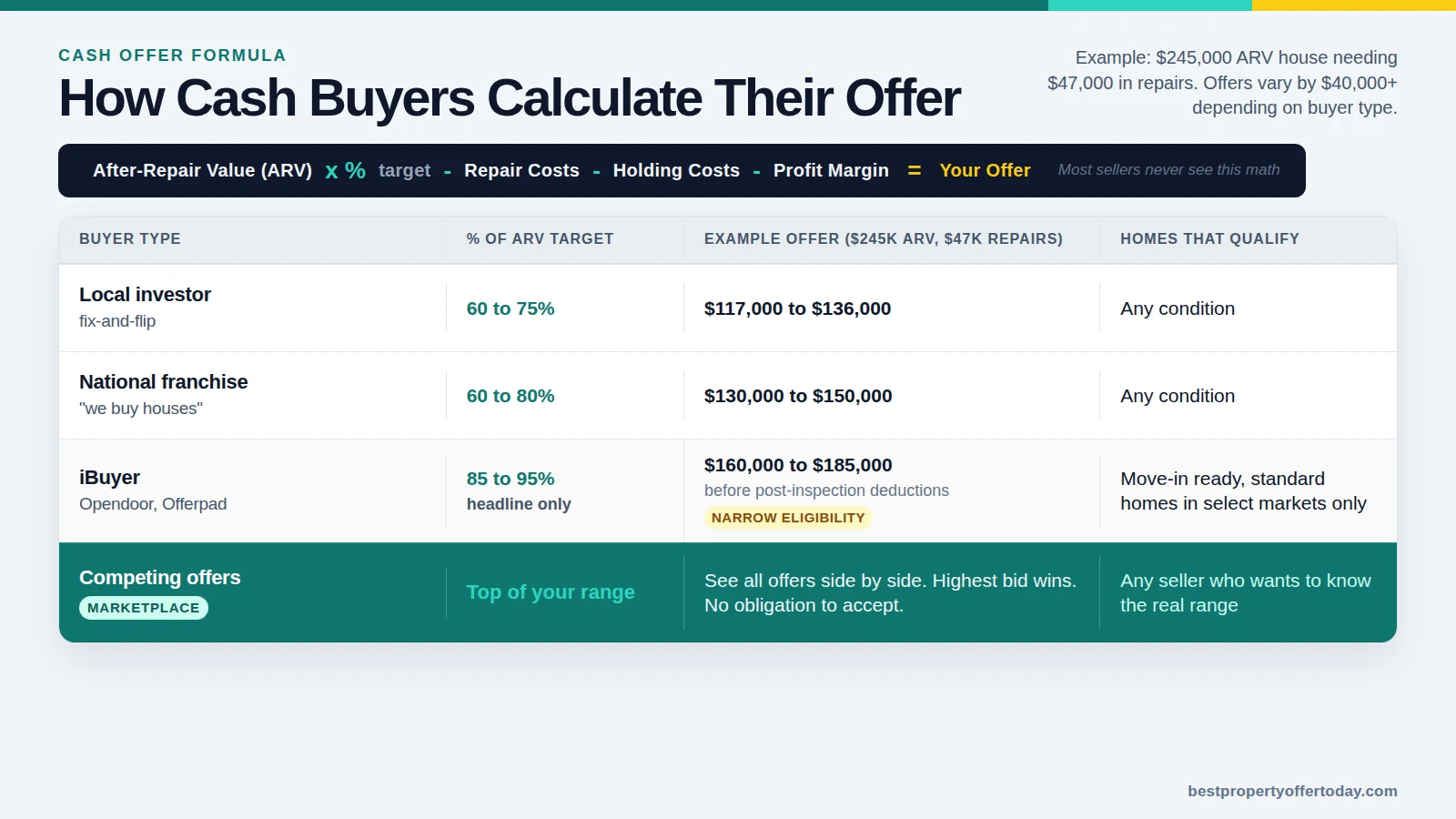
Local investors and fix-and-flip buyers typically target offers in the range of 60 to 75 percent of ARV, then subtract estimated repair costs. The 70 percent figure you often hear is a general target for the maximum they will pay before repairs, not a floor or a guarantee.
The formula works like this: ARV multiplied by target percentage, then minus estimated repairs, equals the maximum offer.
On a house with an ARV of $245,000 that needs $47,000 in repairs, a buyer targeting 70 percent of ARV starts at $171,500 and subtracts $47,000, arriving at roughly $124,500.
That number can look alarming on paper. But the buyer still has to carry the property while repairs happen, typically three to six months. That adds financing costs, taxes, insurance, and utilities. They also have to pay agent commissions when they resell, usually five to six percent of the resale price. The difference between $245,000 and $124,500 is not pure profit. It is the budget for everything that happens between buying your house and selling it again.
What a Cash Buyer Deducts Before Settling on a Number
The space between ARV and the offer letter contains several layers of costs. They vary by buyer type, but these categories appear on almost every deal:
| Cost category | Typical range | Notes |
|---|---|---|
| Repair and renovation budget | Varies by property | Cosmetic updates and a full structural gut are priced very differently |
| Holding costs | 1 to 3% of purchase price per month | Property taxes, insurance, utilities, loan interest while the property sits before resale |
| Selling costs at resale | 6 to 8% of ARV | Agent commissions, title, transfer taxes, staging when they sell |
| Profit margin | 10 to 20% of ARV | The return the buyer needs to justify the risk and the capital tied up |
| Contingency buffer | 5 to 10% of repair estimate | Scope creep, permit delays, market softness during the hold period |
None of these line items is hidden from sellers who ask. A legitimate investor can walk through their ARV estimate, their repair scope, and their target margin. If a buyer will not explain the math, that is itself useful information.
How Different Buyer Types Calculate Differently
Not every cash buyer uses the same formula or the same target margin. The type of buyer shapes the offer as much as the condition of the house.
| Buyer type | Typical offer range | How they calculate | Best fit for |
|---|---|---|---|
| Local investor, fix-and-flip | 60 to 75% of ARV, minus repairs | ARV formula, usually funded with hard money or private capital | Houses needing significant work |
| National franchise | 60 to 80% of ARV | Similar to local investor but with corporate overhead included | Any condition, nationwide coverage |
| iBuyer (Opendoor, Offerpad) | 85 to 95% of ARV before deductions | Algorithm-driven valuation, then post-inspection deductions of 1 to 3% | Move-in ready, standard homes in active markets only |
| Buy-and-hold investor | 70 to 85% of ARV | Rental income projections rather than resale ARV; the rent-to-price ratio matters more than resale upside | Markets with strong rental demand |
iBuyers offer closer to retail value but cover a narrower slice of homes and markets. Local investors offer less but can often close on houses that iBuyers will not touch. The ranges overlap in the middle, which is why looking at offers side by side reveals more than trusting any single buyer’s claim about what your house is worth. For more detail on how these buyer types compare beyond price, see our breakdown of how to tell whether a cash buyer is legitimate.
A Worked Example With Real Numbers
Consider a three-bedroom, two-bathroom house built in 1972, 1,450 square feet, in a mid-size metro where comparable remodeled homes sell for $245,000. The house needs a new roof at $14,000, a kitchen update at $18,000, bathroom work at $9,000, and various cosmetic items at $6,000. Total repair estimate: $47,000.
Here is what a seller might receive from three different buyer types:
| Buyer type | ARV estimate | Target percentage | Minus repairs | Offer |
|---|---|---|---|---|
| Local investor | $245,000 | 70% | $47,000 | $124,500 |
| National franchise | $240,000 | 75% | $47,000 | $133,000 |
| iBuyer (if eligible) | $248,000 | 90% headline | $47,000 in post-inspection deductions | $176,000 headline, roughly $158,000 net after deductions |
The range here, from roughly $124,500 to $158,000, is real even on the same property. A seller who receives only one offer has no way to know where on that range they landed. A seller who receives three offers can see the spread and make a genuinely informed decision.
For reference, listing this same house through an agent after completing the repairs might net $215,000 to $230,000 after commissions and typical seller closing costs, on a timeline of four to seven months and requiring a capital outlay of $47,000 upfront plus carrying costs. The right path depends entirely on what the seller needs from the transaction.
Our net proceeds calculator lets you run a side-by-side comparison of a cash sale and a traditional listing using your own numbers.
What the Offer Letter Does Not Show You
Cash offer letters rarely show the buyer’s math. They show a number, a close date, and a list of terms. A few things worth knowing before you sign:
- The headline number may not be the net number. Some buyers, particularly iBuyers, price high on paper and adjust after inspection. Ask specifically what deductions are possible and what triggers them.
- The ARV estimate drives everything. If a buyer is working from a low ARV, every other number in the formula produces a lower result. You can check this yourself by pulling recently sold comps in your area through Zillow or Redfin.
- Repair estimates vary significantly between buyers. One buyer may quote $40,000 in repairs; another may quote $55,000 on the same property. Both may be working in good faith from different assumptions about scope and local labor costs.
- The close date and earnest money are part of the offer. A low deposit on an as-is cash deal means walking away costs the buyer almost nothing. That matters before you remove the house from the market.
Red Flags in How a Cash Offer Is Presented
Most cash buyers price honestly using a formula similar to the one above. A few do not. These patterns are worth watching:
- The buyer will not explain the calculation. A legitimate investor can walk through their ARV, their repair estimate, and their target margin. If they cannot or will not, ask why.
- The offer arrives within minutes of receiving your address. A real ARV analysis takes time. Instant offers are based on rough algorithms and typically come with a wide range of post-inspection adjustments that eat into the headline number.
- The repair deduction after inspection is much larger than the original offer implied. Some buyers use a low headline to get a signed contract, then find reasons to reduce the price after they have access to the property.
- The earnest money deposit is $500 or less on a six-figure deal. The practical range for cash-sale earnest money is 1 to 3 percent of the purchase price. Anything under $1,000 on a $150,000 deal deserves a direct question about why.
- The contract contains an assignment clause. This allows the buyer to sell the contract to a third party before closing. It does not automatically mean something is wrong, but it does mean the person who made the offer may not be the person who shows up at closing. You have the right to ask whether that is possible and to negotiate a no-assignment clause.
For a checklist of questions to run through with any cash buyer before signing, see our post on questions to ask a cash buyer before you sign.
What You Give Up When You Take a Cash Offer
A cash offer is normally below a fully marketed retail price. That gap exists because the buyer is taking on the cost, risk, and time of getting the property to market condition. A seller who can afford to make repairs, carry the house for several months, and pay for an agent will typically net more through a traditional listing in most markets and conditions. This is not a criticism of cash offers. It is just true, and pretending otherwise helps nobody.
The right question is not whether the cash offer is below retail value. It will be. The question is whether the gap is worth what you receive in exchange: speed, certainty, no repairs, no showings, no financing contingency falling apart two weeks before a scheduled closing, and no renegotiation after a buyer’s inspection report arrives.
Sellers in a genuinely difficult situation, facing foreclosure, dealing with a property in poor condition, managing an estate from out of state, or simply needing to close in a specific window, often find the difference worthwhile. Sellers who have time and resources often do not.
Can I negotiate a cash offer once I understand the formula?
Yes, and understanding the math makes negotiation more concrete. If you can show a buyer that their repair estimate is off, or that their ARV comps are outdated, that is a real basis for a counter. Pointing to a comparable sale that closed last month at $260,000 is more effective than asking vaguely for a higher number. Buyers adjust offers when sellers bring specific data.
Should I get multiple offers before accepting one?
This is the most useful thing you can do. A single offer gives you one buyer’s version of the formula. Multiple offers show you the range. The spread between the highest and lowest offer on the same house often runs $15,000 to $40,000, and the gap reflects different ARV assumptions and repair estimates, not negotiating theater. Submitting one request through a marketplace like BestPropertyOffersToday.com lets multiple vetted buyers run their own numbers independently and compete for your listing, free to you with no obligation to accept anything.
When does the formula work in a seller’s favor?
When the repair estimate is low relative to the home’s potential value. A house that needs only cosmetic work, fresh paint, new flooring, and updated appliances, in a neighborhood where comps are strong, may carry a $300,000 ARV with a repair estimate of $18,000. That math produces a meaningfully higher offer than a house in the same price range that needs a new roof and foundation work. The formula rewards sellers whose properties are in better condition, even in a cash transaction.
What should I do if two offers are far apart?
Ask both buyers to walk through their ARV estimate and their repair number. The gap between two offers almost always comes down to one or both of those figures. If one buyer’s ARV is $30,000 lower than the other’s, ask the lower-offer buyer why, and ask the higher-offer buyer whether their estimate accounts for the same conditions you disclosed. You may find that one is working from outdated comps, or that one has underestimated the repair scope. Either way, the comparison gives you real information that a single offer never would. For more on how to read offers side by side, see our post on how to compare cash offers.