Selling a Rental With Section 8 Tenants: What the HAP Contract Means at Closing
You can sell a Section 8 rental property with the tenant in place. The question is not whether you can do it, but what exactly happens to the Housing Assistance Payment contract at closing, what the new owner is required to do, and which sale path nets you the most money after carrying costs and fees. This post answers all three.
What Section 8 Actually Means for Your Property
The term “Section 8” covers two distinct programs, and getting them mixed up is the source of most landlord confusion at sale time.
Tenant-based Housing Choice Vouchers (HCV). The voucher belongs to the tenant, not the property. If your tenant has a standard Housing Choice Voucher and moves out, the voucher goes with them. This is the program most landlords who contact us are working with.
Project-based Section 8. The subsidy is attached to the unit itself through a long-term HAP contract between the owner and the local public housing authority (PHA). The tenant’s right to stay is stronger, and the obligations on the new owner are more significant. Project-based contracts appear mainly in multi-unit or purpose-built affordable housing, not in single-family rentals. If you are unsure which type you have, call your PHA and ask before you list.
The rest of this post focuses on tenant-based HCVs, which is the program most residential landlords are in.
The HAP Contract: What It Is and What Happens at Closing
If you participate in the Housing Choice Voucher program, you signed a Housing Assistance Payment (HAP) contract with your local PHA. That contract is the mechanism through which HUD sends money to you each month. It is between you and the PHA, not between the tenant and the PHA.
When you sell the property, the HAP contract does not automatically transfer to the new owner. It terminates on the date of transfer. The new owner is not your successor under that contract. They are a new potential landlord who must apply to the PHA separately if they want to continue receiving the subsidy.
What does survive the sale is the lease. Under 42 U.S.C. 1437f and the standard HUD lease addendum, a tenant’s lease runs with the property regardless of who owns it. The new owner steps into your position as landlord and inherits the lease terms. They cannot remove the tenant simply because they bought the building.
Here is the practical sequence when you sell:
- You notify your PHA in writing that you are selling, with the expected closing date
- The HAP contract terminates on the date of transfer
- The new owner, if they want to continue receiving the HUD subsidy, submits a new owner application to the PHA, passes an inspection under Housing Quality Standards (HQS), and signs a new HAP contract
- The tenant’s voucher is unaffected; the subsidy continues once the new contract is in place
- If the new owner declines to participate in the program, the tenant retains their voucher and can use it elsewhere, but they have the right to stay in the unit under the existing lease until it expires
Three Paths to Selling a Section 8 Rental
Path 1: Sell to an investor who continues the program
This is the simplest path and causes the least disruption to everyone involved. A landlord-investor who buys the property, passes the HQS inspection, and signs a new HAP contract with the PHA simply takes over as landlord. The tenant stays. The subsidy continues. You close, collect your proceeds, and exit cleanly.
Buyers who target Section 8 rentals see reliable, government-backed rent as an asset, not a complication. The discount you take on price is typically smaller than you expect, because the guaranteed income stream justifies a higher offer than a vacant property of the same condition would attract from a speculative buyer.
Path 2: Sell to an investor who will not continue the program
An investor who wants to convert the unit to market-rate must still honor the existing lease until it expires. They cannot force the tenant out before then. What changes is that once the lease ends, they are under no obligation to renew, and the tenant will need to find housing where their voucher is accepted.
The price on this path is often lower than path 1, because the buyer is acquiring a property they cannot immediately use as planned. How much lower depends on how many months are left on the lease.
Path 3: Sell vacant
You could wait for the lease to expire naturally, give the tenant proper notice under your state’s landlord-tenant law, and sell a vacant property. Or you could offer the tenant a cash-for-keys agreement to leave early. Both approaches take longer and introduce friction with a tenant who has done nothing wrong and has a protected right to stay.
Vacant possession opens the property to retail buyers and owner-occupants, which can push the gross price up. But you carry the property during the vacancy, and you pay to make it showable. Factor those costs in before assuming this path nets more.
Worked Example: What Each Path Actually Nets
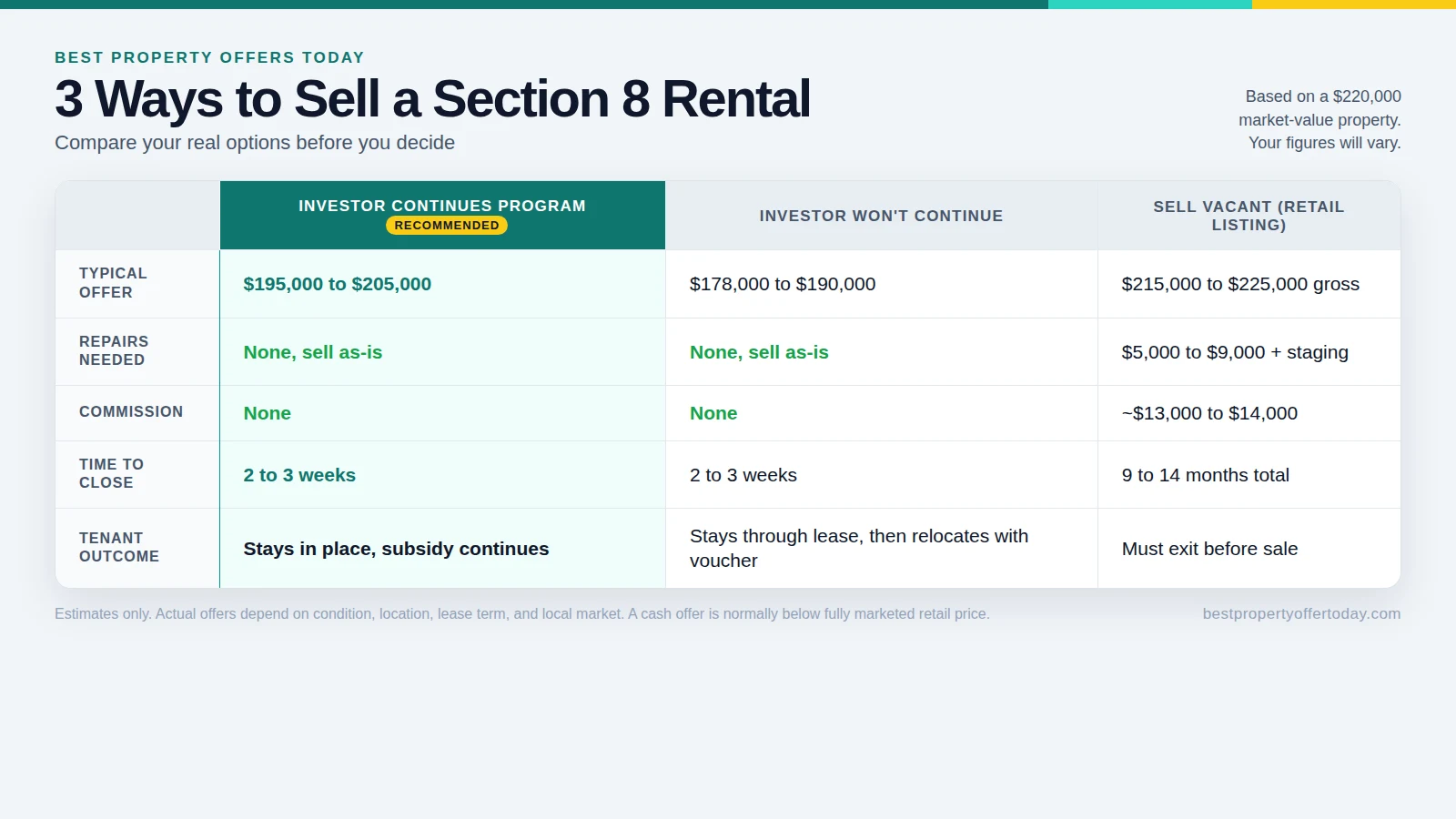
Take a Section 8 rental in a mid-tier market. Market value is roughly $220,000. The tenant pays $350 per month, with HUD covering $1,150, for a total monthly rent of $1,500. The lease has nine months remaining.
| Path | Gross offer | Costs before closing | Wait time | Estimated net to seller |
|---|---|---|---|---|
| Investor continues program | $195,000 to $205,000 | Minimal, as-is | 2 to 3 weeks | $193,000 to $203,000 |
| Investor won’t continue | $178,000 to $190,000 | Minimal, as-is | 2 to 3 weeks | $176,000 to $188,000 |
| Traditional listing, vacant | $215,000 to $225,000 | $6,000 repairs, $13,500 commission, $4,500 carrying (9 months) | 9 to 14 months total | $191,000 to $201,000 |
The path-1 investor offer and the traditional listing end up within a few thousand dollars of each other on net proceeds. The investor path takes nine to twelve fewer months and requires no repairs, no staging, and no coordination of showings around a tenant who has every right to stay put. You can run both scenarios side by side using our net proceeds calculator with your actual numbers.
Notices and Timing: What You Must Actually Do
Most PHAs require written notice before closing. The exact window varies by agency. Thirty days is the most common minimum; sixty days is a safe target. Call your PHA’s landlord services line as soon as you have a signed purchase agreement.
You are also required to give the tenant notice under your state’s landlord-tenant law. In most states, a sale does not give the tenant new termination rights, but the tenant must know the property is changing hands. Some states require written notice within a specified window after closing. Check your state law or talk to a local real estate attorney before assuming a generic timeline applies.
Red Flags When Selling a Section 8 Rental
Most cash buyers who buy Section 8 properties are straightforward. A small number are not. Before you sign a contract, check for the markers that separate a legitimate cash buyer from a wholesaler who has no intention of closing themselves.
- A buyer who promises to “handle the tenant” without explaining how: ask specifically what their plan is if the lease does not expire before they want possession
- A buyer who claims the HAP contract transfers automatically: it does not, and a buyer who believes this is either uninformed or planning to collect the subsidy improperly
- A contract with a vacant-possession contingency on a property where the lease runs past closing: a seller who agrees to that condition without a realistic way to satisfy it faces a broken deal or litigation
- Any timeline that depends on the tenant leaving voluntarily without a cash-for-keys agreement signed and in hand before closing
- Earnest money under $2,000 on a purchase above $150,000: a token deposit means walking away is free for the buyer, which is how assignment deals work
The Honest Limits of a Cash Sale on a Section 8 Property
A cash offer on a Section 8 rental is normally below what a fully marketed, vacant property would fetch at retail. The investors who specialize in this transaction type are pricing for cap rates and risk, not paying emotional premiums. The gap between the cash offer and retail value is real, and what it buys you is speed, certainty, no repair negotiations, no months of carrying costs, and no legal exposure if a lease dispute develops.
If the property is in good condition and the lease is almost up, waiting for vacant possession and listing on the open market usually nets more. The right path depends on how much time you have and what the real cost of carrying the property for nine to twelve additional months actually is. Tax treatment (capital gains, depreciation recapture, 1031 eligibility) does not change because the buyer pays cash or because the property was Section 8; talk to a CPA who handles investment property disposals before you close.
If you want competing cash offers from buyers who know how to close on occupied Section 8 properties, submit one request and the offers come back within 24 to 48 hours. No obligation to accept any of them. Phone: 804-361-7460. For more on how the general mechanics of selling with a tenant in place work, see our guide to selling a rental property with tenants still in it.
Does the new owner have to accept Section 8?
Federal law does not require a buyer to participate in the HCV program. Several states and cities do have source-of-income protection laws that effectively require landlord participation while a lease is active, including California, New York, Illinois, Oregon, and the District of Columbia, among others. Check your state’s landlord-tenant statute before assuming the buyer can simply refuse the voucher. If you are in a protected jurisdiction, the new owner cannot refuse to honor the tenant’s lease because of the Section 8 status.
What happens to the tenant’s voucher if the new owner won’t participate?
The tenant’s voucher belongs to them, not to the property. If the new owner declines to sign a HAP contract, the tenant can take their voucher and use it to rent elsewhere once the current lease expires. The PHA may grant the tenant additional time to find a new unit. The tenant’s housing benefit does not disappear because the landlord sold.
Can I sell a Section 8 property as-is?
Yes. The HQS inspection requirement applies to the new owner’s decision to continue the program, not to the sale itself. You can sell the property in its current condition. If the property fails HQS at the time of the new owner’s inspection, the PHA will not approve a new HAP contract until repairs are made. That is the new owner’s problem to resolve, unless the purchase agreement places the repair obligation on you.
How much notice does the tenant get when a Section 8 property sells?
The tenant’s notice rights come from two sources: the lease terms and state landlord-tenant law. The sale itself does not cut the lease short. The new owner is the tenant’s new landlord from the day of closing. If the new owner eventually chooses not to renew the lease when it expires, they must give the notice required by state law, which ranges from 30 to 90 days depending on the state and the type of tenancy.