Selling a House in a Flood Zone: Your Options When the Buyer Pool Shrinks
You can sell a house in a flood zone. The harder truth is that a FEMA Special Flood Hazard Area designation shrinks your financed buyer pool, adds a mandatory insurance cost that changes the math on every offer, and creates real risk that a deal falls apart at the loan-approval stage. Understanding why that happens, and who still buys flood zone properties, gives you better options than most sellers realise they have.
What FEMA flood zone designations actually mean for your sale
FEMA classifies flood risk through Flood Insurance Rate Maps. The designations that matter most to sellers are:
- Zone AE: high-risk, with a 1 percent annual chance of flooding and a Base Flood Elevation established. This is the most common Special Flood Hazard Area zone for residential properties.
- Zone VE: high-risk coastal with wave action. Premiums run higher than AE because the damage model is more severe.
- Zone A: high-risk but no Base Flood Elevation established yet. Insurance underwriting is less precise, which can mean higher premiums or longer delays for buyers trying to get quotes.
- Zone X shaded: moderate risk, 0.2 percent annual chance of flooding. Insurance is not mandatory but is advisable and often inexpensive.
- Zone X unshaded: minimal risk. No mandatory insurance requirement. Most financed sales close without issue.
Zones AE, VE, and A are all Special Flood Hazard Areas. That designation triggers a federal law that directly affects who can buy your property.
The mandatory purchase requirement: why it cuts your buyer pool
Under the National Flood Insurance Act, any property in a Special Flood Hazard Area that carries a federally backed mortgage must maintain flood insurance. A federally backed mortgage means Fannie Mae, Freddie Mac, FHA, VA, or USDA. Those programs cover roughly 70 percent of US mortgages. At closing, the lender orders a standard flood zone determination certificate, which confirms whether the property falls in a Special Flood Hazard Area. If it does, the transaction cannot close without proof of flood insurance in force.
Flood insurance through FEMA’s National Flood Insurance Program costs a national average of roughly $900 to $2,400 per year for residential properties in AE zones, but the Risk Rating 2.0 methodology introduced in October 2021 now prices each property individually. The formula uses distance to the flood source, frequency of past flooding, property elevation relative to the Base Flood Elevation, and construction type. A property sitting 2 feet below the Base Flood Elevation in coastal Louisiana will pay far more than a property sitting 1 foot above it in central Texas. Before buyers can commit to a price, they need an actual insurance quote, and obtaining one takes several business days.
When flood insurance adds $150 per month to a buyer’s carrying costs, it affects their qualifying payment. A buyer approved for a $280,000 loan without flood insurance may only qualify for around $250,000 once that cost factors into their debt-to-income ratio. That alone can kill offers that looked solid before the insurance quote came back.
One mechanism most posts skip: some communities participate in the NFIP Community Rating System. A higher-rated community earns premium discounts of up to 45 percent for its policyholders. If your city or county participates, check the discount level before quoting buyers an insurance cost estimate. A community at CRS Class 5 gives policyholders a 25 percent discount on National Flood Insurance Program premiums, which can meaningfully change the math for financed buyers.
The elevation certificate: what it costs and when to get one
An elevation certificate is a FEMA form that documents your structure’s elevation relative to the Base Flood Elevation for your zone. A licensed land surveyor, civil engineer, or architect completes it. Cost ranges from $300 to $800 depending on region and lot complexity.
The elevation certificate lets an insurance underwriter calculate an accurate premium instead of a worst-case estimate. If your first floor is above the Base Flood Elevation, your buyer’s premium will be significantly lower than if you are below it. A property 2 feet above in an AE zone might pay around $400 per year. A property 1 foot below in the same zone might pay $2,200. Getting the certificate before listing removes that uncertainty for buyers. Without it, a buyer’s insurance quote may come back high enough to end the deal.
If you already have an elevation certificate from a prior insurance application, pull it out. It may be years old, but if FEMA has not remapped your area since it was completed, a flood insurance underwriter can still use it. If FEMA has issued a new map panel for your community since then, you will need a fresh one.
Can you challenge the flood zone designation?
Sometimes. If your property sits in a Special Flood Hazard Area on the current map but the actual ground elevation is at or above the Base Flood Elevation, you may qualify for a Letter of Map Amendment. FEMA reviews the application, which requires an elevation certificate, and if approved, removes the property from the Special Flood Hazard Area. The mandatory insurance requirement disappears. Your financed buyer pool reopens to include buyers who could not or would not carry the extra cost.
The FEMA application fee for a Letter of Map Amendment is $325. Processing takes 60 to 90 days. Many owners also hire a licensed surveyor or attorney familiar with FEMA procedures to prepare the packet, adding $500 to $1,500 in professional fees. That investment makes sense if the property is genuinely above the Base Flood Elevation and the correction would materially improve what buyers are willing to pay. Not every property qualifies: the natural ground elevation, not a filled or elevated slab, must be at or above the Base Flood Elevation.
Flood zone disclosure: what your state requires
Disclosure law on flood zones varies by state. Florida requires sellers to disclose flood zone status and insurance requirements on the standard residential seller disclosure form. Texas requires disclosure of whether the property sits in a 100-year flood plain on the residential property condition statement. Louisiana, South Carolina, and several other states have specific flood disclosure requirements written into their statutes.
Some states have no specific flood zone disclosure law. That does not mean silence is safe. A seller who knows the property has flooded before and does not disclose it faces fraud exposure in every state. The legal standard is actual knowledge of flood history, not just the FEMA map designation. If the basement took on water twice and you knew it, that needs to appear on the disclosure form regardless of what your state technically requires you to check.
An as-is sale limits the duty to repair, not the duty to disclose. A cash buyer who accepts the property in its current condition still has the right to accurate information about its flood history.
How cash buyers handle flood zone properties differently
A cash buyer has no lender. No lender means no flood zone determination requirement, no mandatory insurance at closing, and no qualifying payment calculation that collapses because of a $1,800 annual premium. The buyer still sees the flood risk and prices it into their offer. The decision to carry insurance afterward is theirs to make.
For a seller in an AE or VE zone, this changes the practical options. Submitting the property to a marketplace that collects competing offers from vetted cash buyers gets you concrete numbers from buyers who have already decided they can underwrite the flood risk. You are not waiting for one financed buyer to survive the insurance approval process, the appraisal, and the lender’s flood certification. You are comparing offers from buyers who understand what the zone means and have priced it into what they are willing to pay.
Use our net proceeds calculator to run your specific numbers before accepting anything.
The honest trade-off: what a cash sale actually nets on a flood zone property
Cash offers on flood zone properties land below what a financed buyer would pay on a clean property. Buyers price the flood risk, and they price the cap on their future resale audience. If your house is in good condition, elevated well above the Base Flood Elevation, and shows a low insurance quote, a traditional listing may still net more. If the zone is high-risk, the insurance quote is expensive, or the property has prior flood history, the gap between a cash offer and what a financed buyer would pay narrows considerably. When the deal-fall-through risk on the financed path is high, the certainty of a clean close has real dollar value.
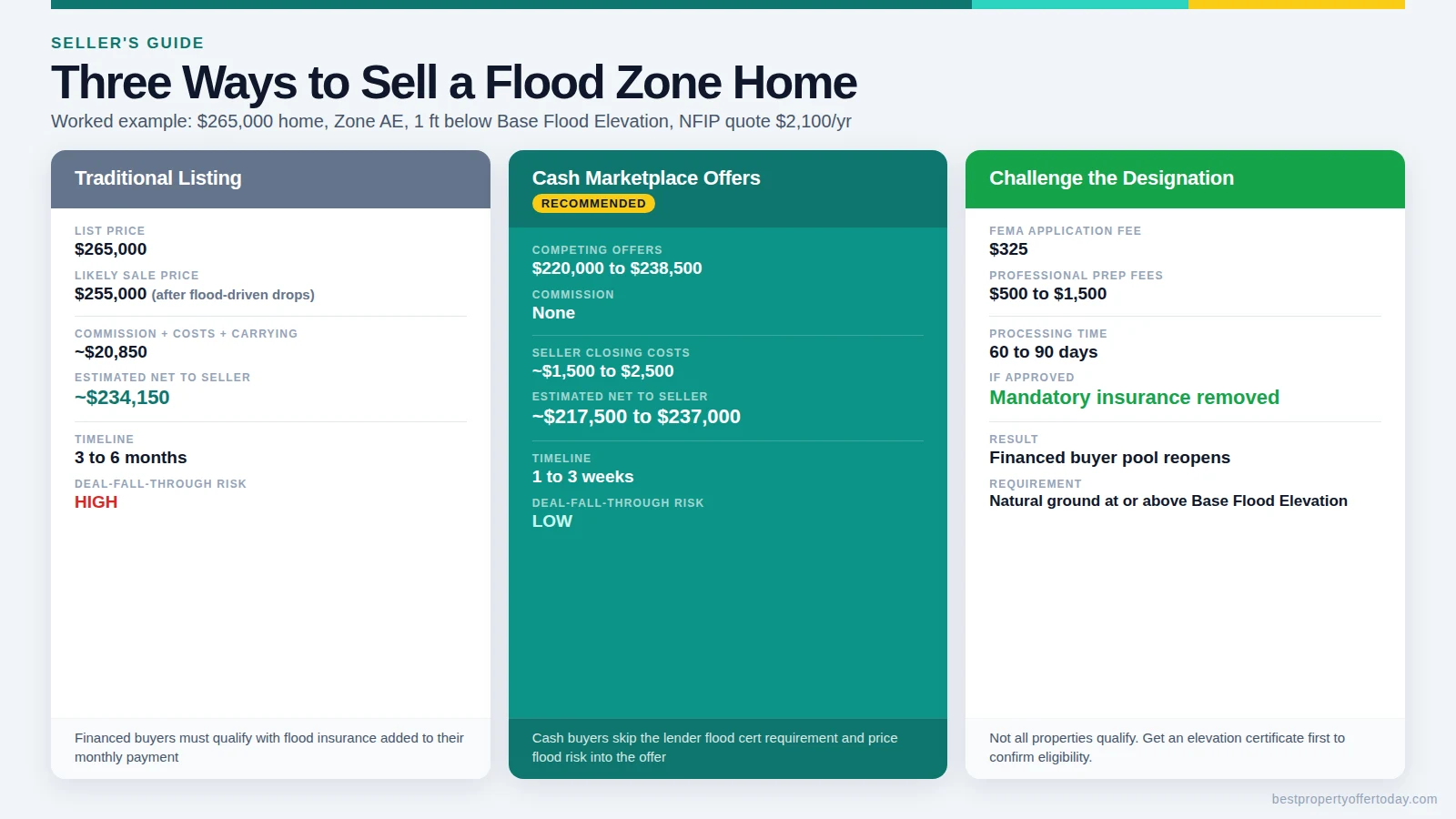
Here is a worked example using a $265,000 home in Zone AE, sitting 1 foot below the Base Flood Elevation, with a current NFIP quote of $2,100 per year:
| Path | Likely sale price | Fees and costs | Estimated net | Timeline | Deal-fall-through risk |
|---|---|---|---|---|---|
| Traditional listing | $255,000 after flood-driven price drops | ~$20,850 commission plus costs plus 3 months carrying | ~$234,150 | 3 to 6 months | High |
| Cash marketplace offers | $220,000 to $238,500 | ~$1,500 to $2,500 title and document prep | ~$217,500 to $237,000 | 1 to 3 weeks | Low |
The gap between paths is real but smaller than the headline numbers suggest. What the cash path removes is the risk of the deal falling through at the insurance approval stage, three months of carrying costs while you wait for a financed buyer to qualify, and the uncertainty about which buyer can actually close. If you want to compare multiple cash offers before deciding, see our guide on how to compare cash offers side by side.
Red flags when selling a flood zone property
- A buyer who never asks about flood insurance or zone designation. Anyone serious about purchasing in a Special Flood Hazard Area already knows the mandatory insurance question. Silence on that topic is often a sign they plan to assign the contract rather than fund the purchase. See our guide to identifying wholesalers versus real cash buyers.
- A cash offer that arrives at near market price with no mention of flood zone status. That gap in diligence almost always means the offer will drop after a walk-through.
- An earnest money deposit under $1,000 on a $200,000 purchase. A buyer who puts down a token deposit has very little cost to walk away if they cannot find a downstream buyer for the contract. Read more about how much earnest money a serious cash buyer should put down.
- Pressure to sign quickly without seeing proof of funds. In a flood zone sale where the buyer pool is thinner, that pressure deserves extra scrutiny.
Questions to ask before choosing your exit strategy
- What zone is the property in, and what is the current flood insurance quote through the National Flood Insurance Program? Run a quote at floodsmart.gov or call an independent flood insurance agent before pricing the home.
- Does the property have an elevation certificate? If so, is it current against the most recent Flood Insurance Rate Map panel for your community?
- Has the property ever flooded, taken on water through the foundation, or had a flood-related insurance claim? This is a disclosure obligation and a pricing factor for every buyer.
- Does your state require specific flood zone disclosure on the seller property condition form?
- Is the property above or below the Base Flood Elevation, and by how much? A property 2 feet above carries meaningfully lower insurance costs than one at the Base Flood Elevation.
- Does your community participate in the NFIP Community Rating System? A higher CRS rating means lower premiums for buyers, which helps your sale.
- Is the property potentially eligible for a Letter of Map Amendment? If natural ground elevation is at or above the Base Flood Elevation, a $325 FEMA application could remove the mandatory insurance requirement entirely.
Frequently asked questions
Does a flood zone designation require the seller to make repairs before listing?
No repair requirement exists under federal flood law. What it requires in most states is disclosure: the zone designation, any prior flood history, and any open insurance claims. Getting an elevation certificate before listing is optional but often worthwhile because it gives buyers concrete insurance cost information rather than an estimate that may come back higher than expected.
Will a cash buyer accept a flood zone property as-is?
Generally yes. Cash buyers do not face the lender-mandated flood insurance requirement, so they evaluate flood risk as a pricing variable rather than a closing condition. A property in Zone AE below the Base Flood Elevation will draw lower offers than an identical property in Zone X, because buyers price in their own future resale audience and insurance costs if they hold the property. The as-is acceptance does not mean they ignore the zone: it means they have already accounted for it in what they are willing to pay.
How much does a flood zone designation reduce property value?
Research from Stanford University found that Special Flood Hazard Area designation correlates with roughly a 2 to 4 percent discount in transaction prices on average nationally, but that figure understates the effect in high-risk coastal markets where insurance costs are steep. The real impact on what a buyer can pay depends on the zone, how far the structure sits above or below the Base Flood Elevation, the current National Flood Insurance Program premium, and whether private flood insurance is available and cheaper in that market. The most reliable way to know is to get an actual insurance quote before pricing the property.
What happens to flood insurance when a property sells?
National Flood Insurance Program policies are not automatically transferred to a new owner, but they are assignable. A seller can assign an existing policy to the buyer at closing. If the policy predates a map revision, assigning it may preserve a grandfathered rate that is meaningfully lower than a new policy priced under Risk Rating 2.0. Ask your flood insurance agent whether the policy is assignable before cancelling it. Private flood insurance policies vary by carrier on assignability, so check the specific policy terms before assuming anything transfers.