What Is a Real Estate Wholesaler? Tell One from a Real Cash Buyer
A real estate wholesaler is not a cash buyer. They are someone who gets your home under contract and then sells that contract to someone else before closing. If you are shopping for a cash offer on your house, this distinction matters a great deal before you sign anything.
Wholesalers operate in the same space as legitimate cash buyers. They show up on the same postcard campaigns, respond to the same online ads, and open with the same pitch: quick close, no repairs, cash. The mechanics of what happens next are completely different, and the contract you sign determines your leverage once you have put your name on it.
How Wholesaling Actually Works
A wholesaler signs a purchase contract with you at a below-market price. That contract includes an assignment clause, usually buried in the standard text, that allows them to transfer their position as buyer to a third party. They then market the deal to investors who pay more than the wholesaler agreed to pay you. The difference between those two numbers is called the assignment fee, and it is the wholesaler's profit.
A worked example: a wholesaler contracts to buy your house for $140,000. They find an investor willing to pay $158,000. The wholesaler assigns the contract, collects $18,000, and never owns the property. You receive $140,000. You agreed to $140,000, so the contract has been fulfilled. The $18,000 spread is not disclosed to you and you have no contractual claim to it.
This is legal in most states. It is not fraudulent by itself. The problem for sellers is that it creates two specific risks. First, the person you are dealing with is under no obligation to close, because their only investment is the time they spent on the phone with you. Second, if they cannot find an investor to take the assignment, the deal falls apart and you start over, having lost weeks of time and possibly passed up other offers.
The Four Red Flags of a Wholesale Deal
Most sellers do not find out they are dealing with a wholesaler until they are already in contract. These four things appear in nearly every wholesale transaction, and you can check for all of them before you sign anything.
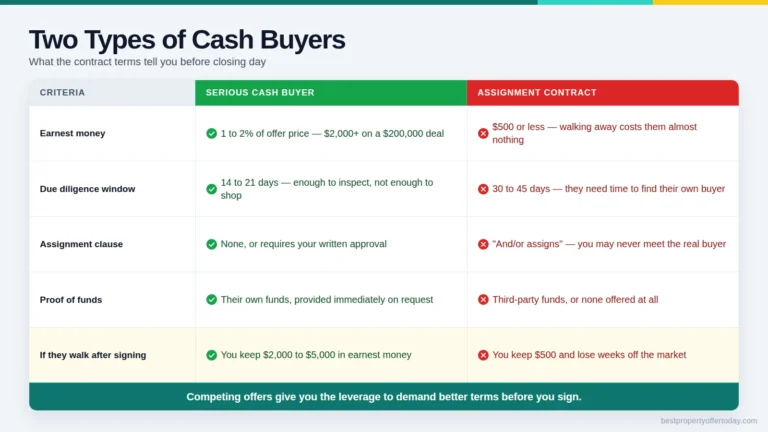
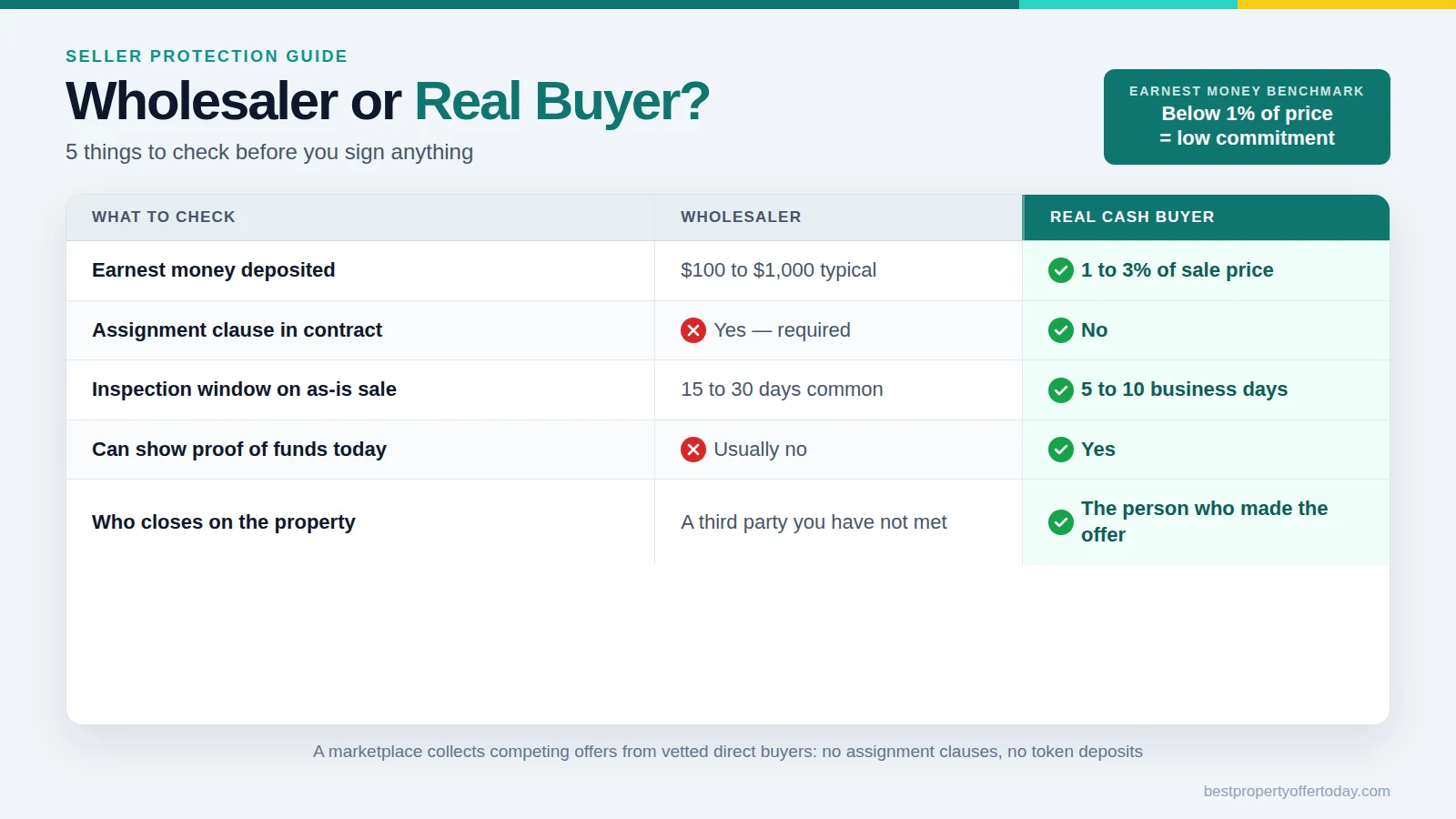
The earnest money is unusually low. A real cash buyer who intends to close puts down meaningful earnest money, typically 1 to 3 percent of the purchase price. On a $150,000 sale, that is $1,500 to $4,500. A wholesaler often deposits $100, $500, or $1,000. The lower the deposit, the lower the cost of walking away. If the inspection turns up something or they cannot find an investor, they lose only the deposit when they cancel.
The contract contains an assignment clause. Look for language that says the buyer may assign this contract, or that the buyer is identified as “[Name] and/or assigns.” A standard cash buyer contract has no reason for this language. If you see it, ask why. A legitimate buyer can remove it without losing anything. A wholesaler cannot close without it. If you are uncertain what an assignment clause obligates you to, a real estate attorney can review the contract before you sign, typically for $500 to $1,500. Our post on whether you need a lawyer for a cash sale covers what that review actually costs and what it catches.
The inspection window is unusually long on an as-is sale. You are selling as-is. You have already said no repairs. A real cash buyer who has done this before needs 5 to 10 business days to do their due diligence. A wholesaler who still needs to find their end buyer often negotiates 15 to 30 days or more. That window is time for them to market the deal to investors. If the inspection period is longer than two weeks on an as-is sale, ask what they are inspecting and when the window ends.
They say “we will find a buyer” or “our team is reviewing this.” A direct cash buyer already knows whether they want your house when they make the offer. A wholesaler needs to verify demand first. Phrases like “we will get this to our buyer network,” “our acquisitions team is reviewing,” or “we can close as soon as we confirm the numbers” are signals that no funds are committed. Compare those phrases to a direct buyer who can show proof of funds the same day.
Wholesaler vs. Real Cash Buyer vs. iBuyer: A Side-by-Side
| Factor | Wholesaler | Direct cash buyer | iBuyer (Opendoor, Offerpad) |
|---|---|---|---|
| Closes with own funds | No | Yes | Yes |
| Earnest money | $100 to $1,000 typical | 1 to 3 percent typical | 1 percent or a fixed amount |
| Assignment clause in contract | Yes, required | No | No |
| Inspection window on as-is | 15 to 30 days common | 5 to 10 days typical | 7 to 14 days; deductions follow |
| Can show proof of funds immediately | Usually no | Yes | Yes |
| Who closes | A third party you have not met | The person who made the offer | The iBuyer company |
Why Earnest Money Is the Fastest Test
Earnest money is not just a tradition. It is the mechanism that makes a buyer bear some risk if they cancel. When a wholesaler deposits $500 on a $175,000 sale, their breakeven is $500. The seller's cost of a failed closing is weeks of lost time, a house back on the market with a fell-through history, and carrying costs during the dead period.
Ask for the earnest money amount before you discuss anything else. If the number is below 1 percent, negotiate it up or ask why it is so low. You can also ask that the earnest money be held in escrow by a title company rather than by the buyer's own attorney, which protects you if there is a dispute about whether cancellation was legitimate.
A useful benchmark: if the buyer is unwilling to put down 1 percent in earnest money, they are telling you something about their confidence in closing.
What Happens If They Cannot Find a Buyer
This is the scenario sellers almost never ask about before signing. A wholesaler who cannot find an investor has two options. They can cancel during the inspection period and lose their deposit. Or, if they are less scrupulous, they can try to renegotiate the price with you on the theory that you have already waited several weeks and may accept less to get out of the process.
This situation, sometimes called a price reduction after inspection, is how wholesalers who find themselves stuck sometimes extract value they were not offered at signing. The contract you signed probably allows some form of cancellation based on inspection findings. Read that clause before you sign it. Know how long it runs, what triggers it, and whether there is a provision for the seller to cancel if the buyer does not deposit earnest money on time.
For a fuller picture of what happens when any cash buyer backs out after signing, including how earnest money disputes work and what specific performance actually means in practice, see the post on what happens if a cash buyer backs out.
Questions to Ask Before Signing with Any Cash Buyer
These work equally well whether you are dealing with a wholesaler, a local investor, or a national iBuyer. The answers tell you who you are actually dealing with.
- Are you the one closing on this property, or will someone else be on the title at closing?
- Can you send proof of funds or a bank statement today?
- Does this contract contain an assignment clause?
- What is the earnest money amount, and which title company holds it?
- What is the length of the inspection period, and what specifically are you inspecting?
- Under what conditions can you cancel after the inspection window opens?
- How many houses have you closed in this county in the past 12 months? (A direct buyer has deed records to back this up.)
None of these questions are confrontational. Any legitimate buyer answers all of them quickly.
The Honest Trade-Off on Cash Sales
Whether you sell to a wholesaler's end buyer, a direct cash buyer, or through a marketplace that collects competing offers, cash sales settle at below retail prices. The gap depends on the property's condition, the local market, and how motivated the buyer is. In most markets, cash offers come in somewhere between 70 and 90 percent of what a fully marketed listing might achieve, and the seller is essentially paying the difference for speed, certainty, and the ability to skip repairs.
If the house is in good condition and the seller has time, a traditional listing with a real estate agent typically nets more. The math usually favors the listing when the seller can wait 30 to 90 days and absorb agent commission. It is worth running the numbers through a net proceeds calculator before committing to any offer.
What sellers should protect against is not wholesaling itself but wholesaling without transparency. A wholesaler who discloses what they are doing and offers a fair price is not a problem. The issue is when the assignment clause, the token deposit, and the extended inspection window are used to tie up a house without genuine commitment to close.
How a Marketplace Differs from Both
A marketplace collects competing offers from multiple vetted buyers rather than presenting you with a single take-it-or-leave-it number. The buyers in a vetted network are closing with their own funds, not assigning contracts, which means the earnest money and the closing timeline are real. The competition between buyers also means the seller is more likely to see the top of their local cash offer range rather than whatever a single buyer decides to put on paper.
The vetting matters here. A platform that sends your address to anyone who signs up is not much protection. The value is in who has been admitted to the network and whether the platform takes responsibility for buyer quality. You can read more about what separates a legitimate cash buyer from a bad actor in the post on how to tell if a cash home buyer is legitimate. If you are ready to see competing offers on your property with no obligation to accept any of them, you can submit a request here. Phone is 804-361-7460 if you prefer to talk through your situation first.
Can a wholesaler sometimes give me a better offer than a direct buyer?
Sometimes, yes. A wholesaler's offer is capped by what their end buyer will pay, minus the assignment fee. A direct buyer's offer is capped by what they think the property is worth to them. Neither type guarantees the highest price. The way to see the best available cash offer is to get multiple offers from multiple buyers at the same time, which is exactly what a marketplace is built to do.
Is it illegal for a wholesaler to not disclose that they are wholesaling?
This depends on the state. Illinois, Oklahoma, and a growing number of other states have passed laws requiring wholesalers to disclose their role in the transaction or obtain a real estate license. In states without these rules, non-disclosure is not automatically fraudulent, but it can raise issues if material facts are concealed. The safest position as a seller is to ask the assignment question directly and get the answer in writing before you sign the contract.
If a contract has an assignment clause, can I remove it?
Yes. You can counter any contract by striking the assignment clause before signing. A direct buyer with funds committed will accept this without issue. A wholesaler cannot accept it because the assignment is the mechanism their business model depends on. The response to that counter tells you exactly what you need to know about who you are dealing with.
How much does a wholesaler typically make on a house?
Assignment fees range from a few thousand dollars to $20,000 or more, depending on the market and the spread between the contracted price and what an investor will pay. In high-demand markets, those fees can be higher. From the seller's perspective, the assignment fee is money that stays between the wholesaler and their investor. Your negotiating leverage is at the time of signing, not after the contract has been assigned to someone you have never spoken to.