Short sale and cash sale describe two different situations. A cash sale closes in 1 to 3 weeks with no lender involvement. A short sale takes 3 to 12 months and only happens when the lender agrees to accept less than the loan balance. Which path is open to you depends on one number: whether the sale price will cover what you owe.
What you are actually deciding
Most sellers comparing these two options are underwater, or close to it. They owe more on the mortgage than the house will sell for. They are not choosing between a quick sale and a slow one out of preference. They are choosing between two exits from a bad financial position, each with different costs to their credit, their timeline, and their legal exposure.
If your house is worth more than your loan balance, a short sale does not apply to your situation. A cash buyer can close the deal in 1 to 3 weeks, pay off the mortgage at closing, and hand you the remaining equity. No lender approval is needed. The rest of this post is written for sellers who are underwater or borderline.
How a short sale actually works
A short sale is not a type of buyer. It is a lender-approved transaction where your bank or servicer agrees to accept a payoff that is less than the outstanding loan balance. The lender controls whether the sale happens at all.
The process, in order:
- You find a buyer willing to purchase the property at or near its current market value
- Your lender opens a short sale review. You submit a hardship letter, recent bank statements, tax returns, and a comparative market analysis
- The lender orders its own appraisal or broker price opinion to establish what it believes the property is worth
- If the lender accepts the offered price, it issues an approval letter specifying the minimum net proceeds it will accept
- The sale closes, the lender is paid, and the remaining balance is either forgiven or it becomes a deficiency judgment the lender can pursue separately
The review takes 3 to 6 months on average. In more complex cases, including second mortgages, private mortgage insurance, or investor-owned loans, it can run past 12 months. The buyer can walk away at any point. So can the lender. Short sales fall out of contract at a substantially higher rate than conventional sales.
What a cash buyer changes, and what it does not
A cash buyer eliminates the financing contingency. Title work and closing still take 1 to 3 weeks. If the sale price clears your mortgage payoff, a cash offer is faster and cleaner than listing with an agent and waiting for a financed buyer to get approved.
Here is where sellers get confused: if you are underwater, bringing in a cash buyer does not eliminate the short sale requirement. The lender still needs to approve a payoff below the loan balance, whether the buyer is paying cash or using a loan. What a cash buyer provides is certainty that the funds exist and the deal will not collapse at the financing stage. That matters to the lender too, because it reduces the number of attempts before a deal closes.
Where competing cash offers make a real difference is in closing the gap. If you owe $295,000 and one buyer offers $265,000, you still need a short sale approved. If competing buyers push the highest offer to $298,000, the loan is paid off in full and there is no short sale at all. Whether that gap is closeable depends on how far underwater you are and what your local market will actually produce.
Worked example: three outcomes for the same house
Take a house in a softening market with a current market value of $310,000 and a mortgage balance of $325,000. The seller is $15,000 underwater.
| Scenario | Sale price | Net to lender after costs | Gap | Short sale needed? |
|---|---|---|---|---|
| Single cash offer | $278,000 | $278,000 | $47,000 | Yes |
| Competing marketplace offers, highest bid | $313,000 | $313,000 | None | No, mortgage paid in full |
| Traditional listing, financed buyer at asking | $318,000 | $300,000 after 5% commission plus typical closing costs | $25,000 | Yes, lender approval still required |
In the second scenario, competing offers generated a price above the payoff amount and the short sale question disappears. In the first, even the cash buyer is $47,000 short and the lender controls the outcome. In the third, the headline price looks adequate but the net after commission and selling costs falls below the payoff amount. The net proceeds calculator will run this against your actual numbers in a few minutes.
Credit damage: the real numbers
A short sale typically drops a credit score by 100 to 150 points, depending on the starting score and how many mortgage payments were missed before closing. The notation stays on the credit report for 7 years.
Foreclosure typically costs 150 points or more and carries the same 7-year reporting period. Mortgage lenders generally view a short sale more favourably than a foreclosure when evaluating a future application, but the gap is smaller than most sellers expect, particularly when the short sale was preceded by months of missed payments.
A cash sale where the mortgage is paid in full at closing leaves the credit report untouched. That is the outcome to pursue if the numbers allow it.
For future mortgage eligibility, the typical waiting periods are: 2 to 4 years after a short sale before most conventional lenders will approve a new purchase loan; 3 to 7 years after a foreclosure, depending on the loan program. FHA requires 3 years after a short sale if you were in default at the time of sale.
Deficiency judgment: the risk that arrives after closing
When a lender approves a short sale for $270,000 on a $320,000 loan, $50,000 of debt does not automatically disappear. In many states, the lender can pursue the seller for that balance through a deficiency judgment. This is a separate legal action, filed after the sale has already closed, and it can arrive months later.
Anti-deficiency statutes exist in some states but their scope is narrow. California’s Code of Civil Procedure 580b prohibits a deficiency judgment after the sale of a purchase money loan on a one-to-four unit property the borrower occupied, but it does not cover refinanced loans or investment property. Arizona’s ARS 33-814 limits deficiency actions on residential property after a trustee’s sale, not after a voluntary short sale. Most states have no broad prohibition at all.
The protection a seller can actually rely on is a written deficiency waiver in the lender’s short sale approval letter. Before accepting any approval, confirm that the language says “full satisfaction of the debt” or “without recourse to the borrower for any deficiency.” If those words are not present, ask for them. If the lender refuses, get legal advice before proceeding. An attorney review of a short sale approval letter typically costs $300 to $600 and can save you from a judgment that follows you for years.
Option comparison
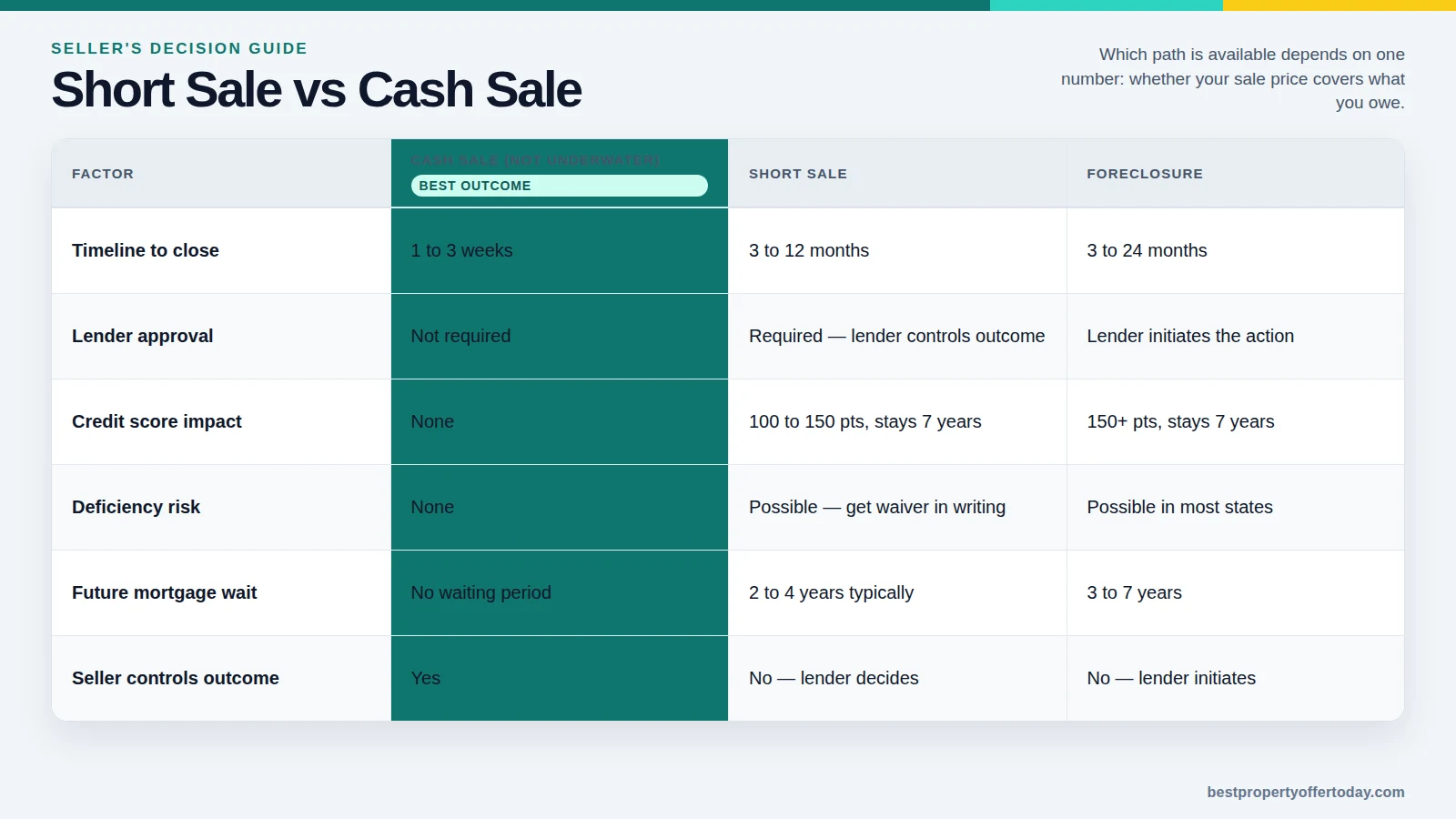
| Factor | Cash sale (not underwater) | Short sale | Foreclosure |
|---|---|---|---|
| Lender approval required | None | Yes, 3 to 12 months | None, lender initiates |
| Time to resolution | 1 to 3 weeks | 3 to 12 months | 3 to 24 months |
| Credit score impact | None | 100 to 150 points, 7 years | 150+ points, 7 years |
| Deficiency risk | None | Possible unless waived in writing | Possible in most states |
| Future mortgage waiting period | None | 2 to 4 years typically | 3 to 7 years |
| Seller controls the outcome | Yes | No, lender decides | No, lender initiates |
Who should take which path
If the house will sell for more than the loan balance, a cash sale closes faster, costs less, and avoids the legal and credit risks described above. A traditional listing will usually net more than a cash offer if the house is in good condition and the seller has several months to spare. Both are better than a short sale if the numbers support them.
If you are significantly underwater, no sale clears the loan without lender involvement. You are in short sale territory regardless of who the buyer is. The questions then shift to how quickly the servicer will move, whether you can negotiate a deficiency waiver, and what credit damage is likely compared to letting the property go to foreclosure.
If you are borderline, meaning the gap between what the house is worth and what you owe is relatively small, bringing in multiple competing buyers is worth doing before concluding that a short sale is necessary. Call 804-361-7460 to find out whether your numbers are in range.
A cash offer is normally below what a fully marketed retail sale would produce. What the seller gains is speed, certainty, and no repair costs or carrying costs during a long listing period. If the house is in good condition and the seller has time, a traditional listing usually nets more. Say so plainly, because the decision is theirs to make with accurate information.
Red flags on a short sale
Not every buyer or agent who offers to help with a short sale is working in your interest. Watch for these.
- An investor who submits a very low offer, gets lender approval, then flips the contract to another buyer before closing. This is called a double-close or same-day flip and it has been the subject of litigation in several states
- An agent who says the lender is about to approve without having documentation to show
- A servicer who drags approval past the foreclosure sale date and then claims the property was already in the foreclosure pipeline. This can be contested but it costs time and legal fees
- An approval letter that waives the deficiency for the first mortgage but says nothing about a second mortgage or HELOC. Both lienholders must release their claims in writing
- Anyone who suggests the seller can stay in the property after closing without a formal leaseback agreement. Staying without one creates legal exposure and may be treated as unlawful detainer
The vetting guide covers what to check before signing with any cash buyer or short sale facilitator. The guide on backing out covers your rights if a buyer walks away mid-process.
Does a cash buyer still need lender approval for a short sale?
Yes. Cash buyer status eliminates the financing contingency but it does not affect the lender’s right to approve or reject a sale price below the loan balance. If the property is underwater, any buyer paying less than the payoff amount needs the lender’s written consent before the transaction can close.
How long does a short sale actually take from start to close?
Three to six months is typical for a single-lender case with a straightforward hardship package. Add two to four months if there is a second mortgage, PMI coverage, or if the loan is serviced by one company but owned by another investor. Loans owned by Fannie Mae or Freddie Mac have their own approval track through their servicers. Cases with multiple liens or contested BPO values have run past 12 months.
Can you negotiate a deficiency waiver before the lender approves the sale?
Yes, and you should attempt it early. The lender’s approval letter is the place to secure it. Language reading “accepted as full satisfaction of the debt” or “lender waives any deficiency claim” extinguishes the right to pursue you later. Many lenders include this for owner-occupied properties with documented hardship. It is not automatic, and it is worth having a real estate attorney or HUD-approved housing counsellor review the letter before you sign.
What happens if the lender rejects the short sale offer?
The transaction does not close. The lender may counter with a minimum net it will accept, or it may reject outright because its broker price opinion came in above the offered price. Sellers can submit a new offer, dispute the BPO valuation with supporting comparables, or escalate through the servicer’s formal escalation process. If the lender will not move and the seller cannot bring cash to close the gap, foreclosure becomes the likely outcome. Contact a HUD-approved housing counsellor before that point, since there may be loss mitigation options the servicer has not offered unprompted.