A roof that has five years left stops most conventional buyers in their tracks, and it stops FHA, VA and USDA buyers entirely. The lender’s appraiser flags it, the underwriter conditions on repair, and the deal falls apart because neither side has $12,000 to $18,000 available before closing. Cash buyers do not have a lender in the picture. They price the roof in and move on.
Here is what actually happens in each scenario, so you can decide which path makes financial sense before committing to anything.
Why a Bad Roof Matters More to Some Buyers Than Others
A cash buyer has no lender. No appraiser with a condition checklist, no underwriter reviewing property requirements, no repair contingency written into the loan commitment. The buyer looks at the roof themselves, estimates the cost, and deducts it from what they offer. The sale can still close.
A buyer using a conventional mortgage faces a softer standard. Fannie Mae and Freddie Mac guidelines require the property to be in good condition, but the appraiser has discretion. A roof with a few years left and no active leaks may pass. One that is visibly deteriorated, sagging, or already leaking typically will not.
Government-backed loans are the most restrictive:
- FHA requires the appraiser to note any roof with less than two years of remaining useful life and flag it as a required repair. The loan does not close until the repair is done or escrowed.
- VA minimum property requirements call for “adequate” roof condition. Active leaks and visible structural damage trigger a mandatory repair before the appraiser signs off.
- USDA follows a similar standard: the roof must be structurally sound and weatherproof, and the appraiser flags anything that falls short as a prior-to-close condition.
First-time buyers frequently use FHA loans. Buyers in rural and suburban areas often use USDA. Veterans use VA. If your house is priced in a range where any of those loan types are common, a roof problem narrows your buyer pool significantly and often kills deals that have already gone under contract.
What Disclosure Law Requires You to Say
Selling as-is limits what you are obligated to repair. It does not limit what you are obligated to disclose. In most states, a known material defect, which includes a roof you know is at end of life, must appear on the seller disclosure form. Silence is not protection. In many states, a buyer who discovers the problem after closing can bring a claim against you even on an as-is sale.
If you had a roof inspection in the last two to three years, that report is typically discoverable in litigation. Disclose what you know. A cash buyer absorbs the cost; a retail buyer’s lender may not let the deal close regardless, so disclosure is not what kills those sales. The condition is what kills them.
The Three Paths: Replace, Credit, or Sell As-Is
Replace the roof before listing
A full asphalt shingle replacement on a typical 2,000 square foot house runs $8,000 to $15,000, depending on pitch, the number of existing layers to tear off, and local labor costs. Metal, tile and slate cost significantly more. Replacing the roof opens the property to every buyer type and removes the appraiser’s condition entirely.
The problem is that you spend the money upfront and recover only a portion of it in the sale price. National data on renovation cost recovery puts a midrange asphalt roof replacement at roughly 55 to 65 percent return at resale in most markets. Spend $12,000 and you may add $7,000 to $8,000 in sale price. The rest is a cost of selling, not an investment.
Offer a seller’s credit
A seller’s credit reduces the purchase price, which reduces what the buyer finances. The buyer takes the house in current condition and handles the roof after closing using the credit. This keeps the deal financed and avoids your upfront repair cost.
The catch: the lender still has to approve. For conventional loans, a credit covering documented repair costs usually works. For FHA, VA and USDA, the appraiser has already flagged the condition as a required repair. A credit does not satisfy that flag. The repair itself, or an escrow holdback for the repair, has to happen before the loan funds. Escrow holdbacks for roof work are permitted by some lenders but not all, they add coordination complexity, and many FHA lenders will not approve a holdback specifically for roof replacement.
Sell as-is to a cash buyer
A cash buyer prices the roof cost into their offer. If the replacement is $12,000, something close to that comes off the offer. You spend nothing upfront, negotiate no credit, and wait for no appraiser to sign off. The sale moves on the buyer’s timeline, typically one to three weeks from contract to close, with title work setting the date rather than financing.
The tradeoff is straightforward: a cash offer is nearly always below what a retail buyer on the open market would pay, assuming a retail buyer can actually get the deal funded. The buyer prices in the cost of the roof plus a return for taking the property as-is. That is an honest tradeoff, not a penalty, and knowing the number before deciding which path to take is the whole point of getting multiple offers rather than accepting the first one.
Worked Example: Three Paths, Same House
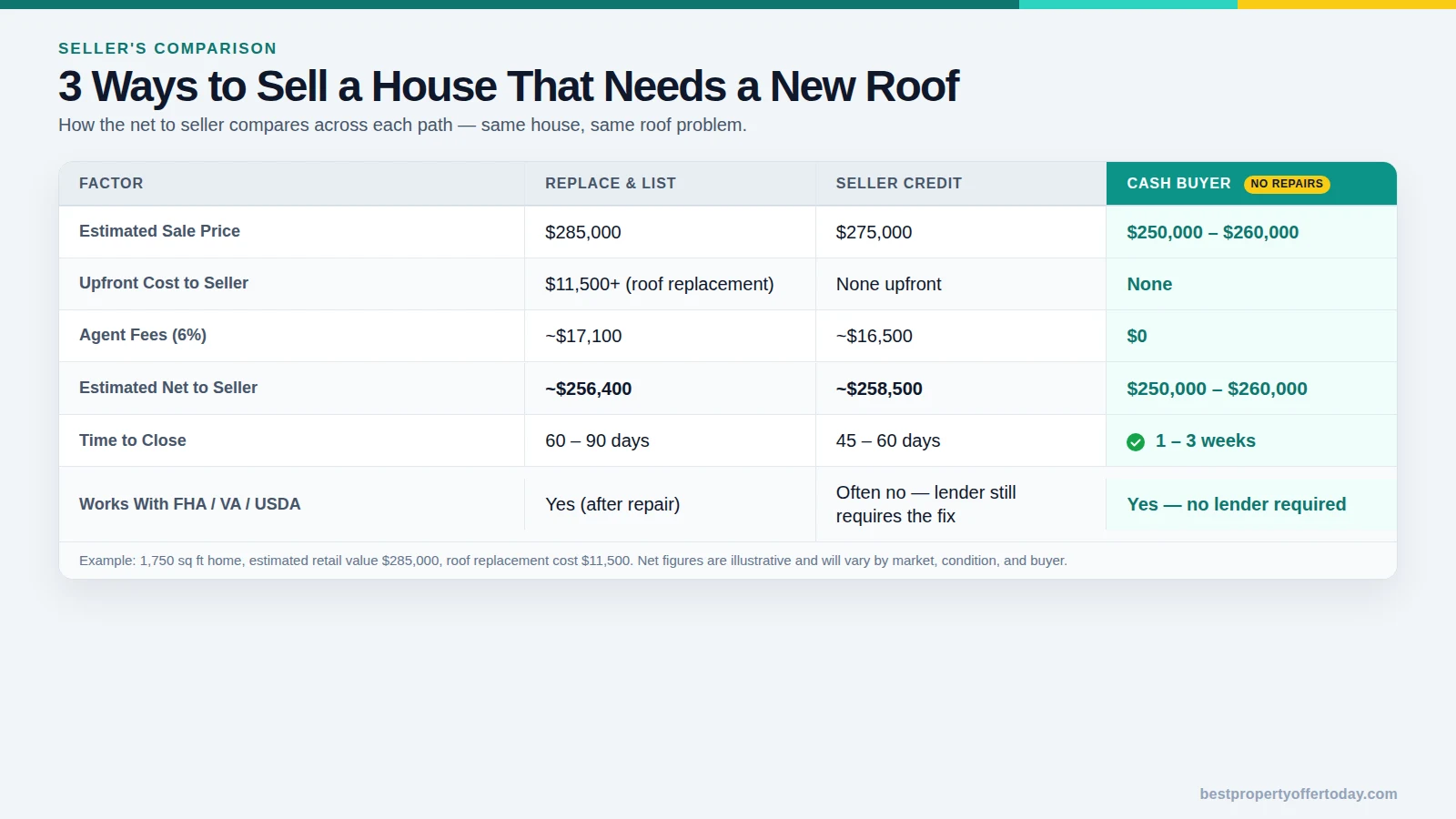
House: 1,750 square feet, three bedrooms. Roof is 22 years old, no active leaks, but the inspection report shows two to three years of remaining useful life. Estimated roof replacement cost: $11,500. Estimated retail value with a sound roof: $285,000.
| Path | Sale price | Upfront cost | Agent fees | Estimated net | Timeline |
|---|---|---|---|---|---|
| Replace roof, list with agent | $285,000 | $11,500 | ~$17,100 (6%) | ~$256,400 | 60 to 90 days |
| Seller credit, conventional buyer | $275,000 | None | ~$16,500 (6%) | ~$258,500 | 45 to 60 days |
| Sell as-is, cash buyer | $250,000 to $260,000 | None | $0 | $250,000 to $260,000 | 1 to 3 weeks |
These figures are illustrative. They will differ based on your market, the condition of the rest of the house, and how competitive the buyer pool is for your property. Use the net proceeds calculator to run your actual numbers before committing to any path.
The three paths are often closer together in net outcome than they first appear. If your house is otherwise in good shape and you have time, a seller credit to a conventional buyer frequently nets the most after you account for the cost of replacing the roof yourself. If the house has other deferred maintenance that would surface at inspection, if you need to close within a month, or if the roof is actively leaking and FHA buyers are likely in your price range, a cash offer may protect more of your equity when all costs are counted.
A cash offer is normally below what a fully marketed listing would achieve if a retail buyer could get the deal financed. What you give up in price you recover in time, avoided carrying costs, and certainty of close. If you are not in a hurry and the house shows well, a traditional listing usually nets more. That is worth saying plainly.
What a Cash Buyer Does With Your Roof Information
When a cash buyer from our network looks at a house with a roof near end of life, they pull a local contractor estimate, they factor in whether the decking needs replacement, and they deduct a number from their offer. That number is typically close to the actual replacement cost. They are not marking up the repair to extract extra margin on a single item. They need the roof repaired to protect the asset they are buying, and they price it accordingly.
What this means for you: the discount on the offer is usually close to the real repair cost. You are not being penalized twice. You are skipping the work, the financing risk, and the possibility that a retail buyer’s deal falls through at inspection after you have already taken the house off the market for 60 days.
To see what competing buyers will pay on your specific house, submit one request and get offers from multiple vetted cash buyers. The service is free, there is no obligation to accept any offer, and offers typically come back within 24 to 48 hours.
Red Flags to Watch For
A roof problem attracts some buyers who take advantage of sellers who feel they have no options. A few concrete signs that an offer is not what it looks like:
- The number drops after the inspection. A legitimate buyer prices the roof before making an offer, not after. If the agreed price changes significantly once they “take a closer look,” that is a bait-and-switch pattern, not a discovery.
- Earnest money below $1,000 on a six-figure transaction. A deposit that small costs the buyer nothing to walk away from. Serious buyers put meaningful money down.
- An assignment clause in the contract. This allows the buyer to sell the contract to a third party before closing. The person who shows up at the closing table may not be who you negotiated with. That is not illegal, but it changes your counterparty and introduces risk.
- No proof of funds before signing. A legitimate cash buyer can produce a bank statement, a line of credit confirmation, or documentation of a dedicated purchase account. If they cannot, they may not actually have the money.
The full vetting checklist for cash buyers covers how to check whether a buyer is real before you sign anything.
Common Questions at This Point
Can I sell my house if it needs a new roof?
Yes. A cash buyer will purchase it as-is. A conventional buyer can often do the same if the roof is not actively failing. The buyers who cannot close on a house with a worn-out roof are those using FHA, VA and USDA financing, because those programs require the appraiser to call the condition and block the loan until it is resolved. Knowing your buyer’s financing type early in a negotiation is worth the conversation.
Does the age of the roof matter if it is not leaking?
For financed buyers, yes. FHA appraisers look at remaining useful life, not just whether the roof is currently leaking. An asphalt shingle roof that is 22 years old with no visible damage can still fail the FHA two-year remaining-life test if the appraiser judges it to be at end of life. A cash buyer cares about current condition and what replacement will cost; a roof that has not started failing yet may receive a smaller deduction than one actively deteriorating.
Is a seller credit good enough to satisfy an FHA or VA loan?
Typically, no. FHA requires the appraiser’s flagged conditions to be resolved before the loan closes. A credit satisfies many cosmetic or deferred-maintenance items, but a roof that fails the remaining-life test is usually a required-repair condition rather than a credit-eligible one. Escrow holdbacks for roof replacement exist as a workaround, but lender approval is required, and many FHA and VA lenders will not approve a holdback specifically for a major structural component like a roof.
What should I ask a cash buyer before accepting?
Ask for proof of funds, confirm whether they intend to close in their own name or assign the contract, ask what the earnest money amount is, and ask exactly what happens to the offer after their due diligence period ends. Get the answers in writing before signing. A buyer who pushes back on any of these questions is telling you something. For the full list of what to check before accepting a cash offer, see the as-is selling guide.
If your roof needs replacement because of storm or hail damage, an open insurance claim changes the transaction. The insurance payout, what the adjuster approved, and the gap between that figure and real contractor costs all affect which path makes financial sense. See the guide on selling a house with storm damage for how insurance proceeds interact with a cash sale and what to watch for when a buyer asks to have the claim assigned to them.