The question most sellers ask about code violations is whether they can sell at all. In most cases they can. The real question is which options stay open once a code violation is on record, and what each path costs. The answer depends heavily on what type of violation you have and how a buyer plans to finance the purchase.
Code violations complicate a sale in three distinct ways: they can block the buyer’s financing, they can become liens recorded against the title, and they require disclosure in nearly every state regardless of whether you are selling as-is. Each of those three problems works differently and resolves differently.
What Counts as a Code Violation
A code violation is an official determination, usually from a municipal code enforcement office or building department, that something about the property does not meet the current adopted standards. That determination can come from a neighbour complaint, a routine inspection, or a permit pulled for unrelated work that triggers a broader review of the property.
Common violations fall into a few categories:
- Unpermitted additions or conversions (a garage turned into living space without a permit). For the specific dynamics of selling a house with an unpermitted addition, including appraisal impact and the retroactive permit process, see this guide.
- Electrical deficiencies (missing ground-fault protection in kitchens and bathrooms, outdated wiring systems such as knob-and-tube or aluminum branch wiring)
- Structural problems such as a deteriorated foundation or failing retaining wall
- Missing or incorrectly placed smoke and carbon monoxide detectors
- Improper plumbing venting or drainage
- Missing handrails on stairs or elevated decks
- Zoning violations (operating a business in a residential zone, more dwelling units than the lot allows)
Some of these are minor and correctable for a few hundred dollars. Others require permits, licensed contractors, and in some cases a retroactive engineering review. The cost gap between fixing a missing GFCI outlet and demolishing an unpermitted addition can be $200 versus $30,000. That gap is what determines your realistic options.
Which Violations Block a Financed Sale
Government-backed loans are the main financing obstacle. FHA, VA, and USDA loans all require an appraisal, and appraisers on those loan types follow minimum property standards. Any condition that creates a health or safety risk must be noted in the appraisal report. If the appraiser flags a violation, the lender requires it to be corrected before the loan funds.
The mechanism matters. Appraisers are not code enforcement officers. They are not checking municipal databases. But if they observe what looks like unpermitted work, exposed wiring, a structurally compromised addition, or anything that appears unsafe, they flag it as a property condition. The lender acts on the flag. The mortgage cannot close until the condition is cleared to the appraiser’s satisfaction on a reinspection.
Conventional loans through Fannie Mae and Freddie Mac are less restrictive, but the appraiser still must note anything that materially affects value or habitability. A serious violation, or one that has been converted into an active recorded lien, will surface in title work regardless of loan type and will need resolution before most lenders fund. Cash buyers face none of this. No appraisal, no minimum property standards, no lender approval. They price the violation in and make an offer accordingly. This is the single main reason code violations push transactions toward cash.
When a Code Violation Becomes a Lien
A municipal code violation starts as a notice. If the owner does not respond and correct it, most jurisdictions schedule an administrative hearing. After the hearing, unpaid fines can be recorded as a lien against the property. Once recorded, the lien attaches to the title and must be satisfied at closing. A title search will find it. No conventional lender will close over an active code enforcement lien.
Lien amounts compound. A municipality fining a property $100 per day for six months of non-compliance has generated an $18,000 lien before a seller gets around to calling anyone. Some jurisdictions allow negotiation through the code enforcement office before or during a pending sale. Others do not. In most cases the lien is paid from closing proceeds, which reduces what you walk away with.
For more on how title problems interact with your closing timeline, see the post on title problems that delay a cash closing. The mechanics of a code enforcement lien are similar to a judgment lien, with one important difference: some municipalities must be formally named in the closing documents or the lien survives the transfer.
The Four Paths for a Seller with Code Violations
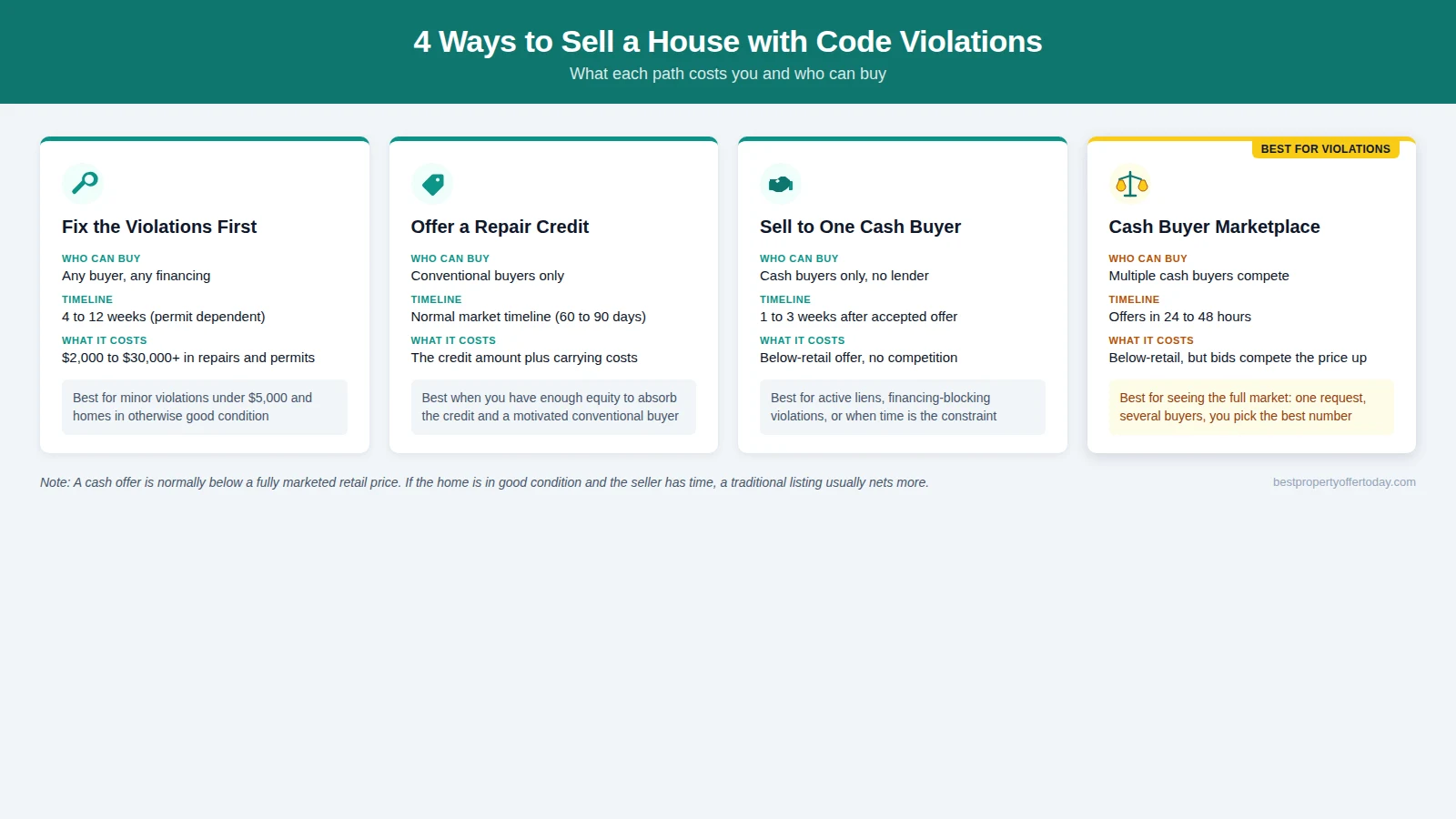
The choice is not simply fix it or sell as-is. Four realistic paths exist, and which one fits depends on the violation type, your timeline, and how much equity you can absorb as costs.
| Path | Who can buy | Typical timeline | What it costs you | Best for |
|---|---|---|---|---|
| Correct the violations first | Any buyer, any financing | Weeks to months depending on permits | Repair costs plus permit fees | Minor violations under $5,000; good-condition homes |
| Offer a price reduction or repair credit | Conventional buyers with motivation | Normal market timeline | The credit amount, and you still disclose | Buyers willing to take it on with enough equity to absorb |
| Sell directly to a cash buyer | Cash only | 1 to 3 weeks after offer | Below-retail offer price | Violations blocking financing; active liens; tight timelines |
| Submit to a cash buyer marketplace | Cash buyers | Offers in 24 to 48 hours | Below-retail, but multiple bids compete the price toward its ceiling | Anyone who wants to see what the actual market will pay before deciding |
Repair credits work when the buyer wants the house enough to accept the trade. They do not work when the violation blocks the buyer’s financing entirely. A buyer who cannot get a mortgage approved on a property with an active health-and-safety code violation cannot close, no matter how willing they are.
What a Cash Buyer Prices In: A Worked Example
Take a house worth $320,000 in corrected condition. It has an unpermitted garage conversion, done by a prior owner twelve years ago. No permit was ever pulled. The conversion is structurally sound but it would not pass a current building inspection as conditioned living space.
Option 1: Retroactive permit. The seller hires a licensed contractor and an architect to prepare as-built drawings, pulls the retroactive permit, and the inspector signs off after minor corrections. Cost for a straightforward single-room conversion: typically $3,000 to $8,000. Cost if compliance requires structural changes: potentially $15,000 or more. Timeline: four to twelve weeks depending on the jurisdiction’s backlog. After that, any buyer with any financing can close at the full corrected value.
Option 2: Disclose and list at market with a repair credit. The seller discloses the unpermitted space. A conventional buyer’s appraiser likely excludes it from the square footage count, which reduces the appraised value. The seller offers a credit equal to the estimated permit and correction cost. If an FHA or VA buyer is involved, the lender may not fund until the permit issue is corrected regardless of any credit, so the buyer pool narrows considerably.
Option 3: Cash marketplace. The seller submits the property through a cash buyer marketplace. Each buyer reviews the property knowing the unpermitted space exists and prices in their own estimate of the correction cost and residual risk. Competing offers come in at, say, $268,000 to $284,000. The seller picks the best number. Closing happens in two weeks.
The spread between Option 1 corrected retail and Option 3 cash is roughly $36,000 to $52,000 on this property. What the seller buys with that discount is no contractor coordination, no permit-office wait, no reinspection contingency, and a certain close date. Whether that trade makes sense depends entirely on the seller’s situation. If you want to model it before deciding, the net proceeds calculator lets you run the numbers for each scenario side by side.
Disclosure Duty Survives an As-Is Sale
Selling as-is limits the duty to repair. It does not limit the duty to disclose. Every state requires sellers to disclose known material defects, and a known code violation is almost always a material defect. The as-is label signals that you will not fix anything. It does not provide legal cover for concealing what you know.
Post-closing disclosure claims are one of the most common categories of real estate litigation. If a buyer discovers a code violation you knew about and did not disclose, they have grounds for a damages claim. In some states, violations that appear in public enforcement databases are presumed to be known by the seller. Check whether your jurisdiction makes code enforcement records searchable online, and assume the answer is yes.
Cash buyers who regularly purchase properties with violations include a specific acknowledgment of those violations in the purchase contract. That signed acknowledgment is the disclosure protection for both parties. It is standard language in a properly structured cash sale on a violation-heavy property. If a cash buyer hands you a contract with no mention of the violations, ask why.
Who Should Not Take a Cash Offer Here
A cash offer is the right call for sellers who are short on time, short on cash for repairs, or dealing with a violation that will block conventional financing regardless. It is not always the right call.
If your violations are minor and correctable in under four weeks for less than $5,000, fixing them and listing at market will almost certainly net you more. The premium a retail buyer pays over a cash buyer on a clean property typically exceeds the repair cost by a wide margin, particularly in a competitive market. A traditional listing with a licensed agent generally nets more when the property is in reasonable condition and the seller has time to wait out the process.
Equally important: before accepting any cash offer on a violation-heavy property, verify that the buyer is a genuine purchaser and not a wholesaler planning to assign the contract to a third party. Wholesale assignment contracts often come with longer inspection periods and smaller earnest money deposits, which means the original buyer can walk away at little cost while you have been taken off the market for weeks. Our post on how to tell whether a cash home buyer is legitimate covers the specific contract terms to check.
How Competing Offers Change the Discount
The main negotiating problem for a seller with violations is that they often deal with one buyer at a time. That buyer knows about the violation, knows the seller is under some pressure, and prices accordingly. Competition does the opposite. When several buyers know about the same violation and each has to outbid the others, the discount narrows toward its floor.
A marketplace collects those competing offers from a single request. You see the spread across buyers. You pick the number that makes sense for your situation. There is no obligation to accept anything, and the service costs the seller nothing. Call 804-361-7460 or submit the request online to see what the market will actually pay for the property in its current condition.
Does a code violation legally prevent me from selling?
No. A violation is a record, not a legal bar to transfer. The exceptions are narrow: a municipality-ordered condemnation or a court-issued habitability order that explicitly prohibits occupancy and sale. Those are extreme situations affecting properties that are genuinely uninhabitable. An ordinary enforcement notice, or even a recorded lien, does not stop you from transferring the property. The lien will be paid from the closing proceeds.
Do cash buyers discount small violations like missing smoke detectors?
Minor life-safety items rarely move the offer significantly. Cash buyers are more concerned with violations that carry real cost or real uncertainty: structural problems, large unpermitted additions, and code enforcement liens with accumulated daily fines. Those items drive material discounts because each one requires real money to resolve and real time dealing with a municipality. A handful of missing detectors or a missing handrail is priced in and forgotten.
Can I negotiate with the municipality to reduce an enforcement lien?
Sometimes. Many code enforcement offices operate a hardship or settlement program for accumulated fines, particularly when a pending sale means the property is likely to be corrected by new ownership. The principle is that a municipality would generally rather see a property corrected and sold than remain in extended non-compliance under the same owner. Contact the code enforcement office directly and ask whether they have a lien mitigation or pre-closing settlement process. Some jurisdictions require the buyer to submit a correction plan as a condition of settlement, which experienced cash investors handle as a routine part of their acquisition process.
What does grandfathered mean, and does it protect a seller?
Grandfathering means that work legally done under older code standards is not required to be upgraded to current standards unless the property undergoes substantial renovation or a change of use. It is not protection against an active violation notice. If the enforcement office has already issued a notice, the grandfathering argument belongs in your administrative hearing response, not in the sales contract. For a buyer evaluating a property, grandfathered conditions generally present less risk than open permit violations, but they still require verification with the local building department before closing.