Selling a House with an Unpermitted Addition: What Actually Happens
An unpermitted addition is one of those problems that feels bigger than it is when you first discover it, and one that sellers handle in several different ways with very different results. The outcome depends mostly on whether your buyer needs a mortgage.
What “unpermitted” actually means
A permit is a municipal sign-off that work was inspected and meets local building code at the time it was done. When someone adds a room, finishes a basement, converts a garage, or builds a sunroom without pulling the required permit, that space is unpermitted. The physical structure exists. The official record does not.
Common examples on properties sold through cash networks:
- A finished basement added by a previous owner, often decades ago
- A garage converted to living space without a permit
- A detached guest house or ADU that was never filed with the county
- A room addition off the back of the house, sometimes quite large
- A deck or porch enclosed and used as a sunroom
Many of these are structurally fine. The city never got the paperwork. That distinction matters enormously in what comes next.
Disclosure: you have to say so
Every state requires sellers to disclose known material defects. An unpermitted addition almost always qualifies. The duty is to disclose what you know, not to fix what exists. Selling as-is does not change the disclosure obligation. If you know the addition was unpermitted, that goes on the disclosure form, in writing, before any contract is signed.
Sellers sometimes hope a buyer will not find out. That is a bad bet. Buyers pull permits. Their agents pull permits. Title searches sometimes surface unpermitted work when it was flagged at a prior closing. Insurance adjusters note it. An undisclosed known defect that surfaces after closing can cost far more than the negotiation you were trying to avoid.
Note: selling a house with code violations raises related but separate concerns. An unpermitted addition may have no violations at all. The permit question is about documentation, not necessarily about whether the work was done well.
How appraisers treat unpermitted square footage
This is the mechanism that kills most traditional sales. Fannie Mae and Freddie Mac guidelines tell appraisers they cannot count unpermitted space in the gross living area of a property. Gross living area is the official square footage that drives the appraised value and, therefore, the maximum loan amount a lender will extend.
In practice, what happens on a 2,000-square-foot house with a 400-square-foot unpermitted addition is this: the appraiser counts 1,600 square feet. The value conclusion reflects a 1,600-square-foot house. If the buyer agreed to pay a price based on 2,000 square feet, their loan will not cover it. They have to make up the difference in cash, renegotiate the price down to the appraised value, or walk.
Most walk.
There is a secondary issue too. Some lenders, particularly those making FHA and VA loans, require unpermitted work to be brought into compliance before they fund at all. They note the addition as a loan condition, and the deal does not close until a permit is pulled and a final inspection passes. That process can take weeks to months depending on the municipality and the correction list.
Why cash buyers are different
A cash buyer does not use a lender. No lender means no appraisal requirement, no Fannie Mae guidelines, and no condition that work be permitted before funding. The cash buyer looks at the house, decides what they think it is worth, and makes an offer based on that judgment.
That does not mean cash buyers ignore the permit issue. They price it. If the addition adds real usable space, they factor in what it costs to retroactively permit it, or they discount it for the risk that a future buyer might face the same problem. But they are not structurally prevented from closing.
This is the specific situation where a marketplace that collects competing cash offers produces a different result than a retail listing. The competing offers you receive come from buyers who have already assessed the permit situation and built it into their numbers. You see what the market will actually pay for the house as it stands, rather than watching a retail transaction fall apart at appraisal. You can use the net proceeds calculator to estimate what you would clear under each scenario before you decide.
The retroactive permit route
Getting a retroactive permit, sometimes called a permit by inspection or an as-built permit, is possible in most jurisdictions. The process usually goes like this:
- You contact the local building department and disclose that work was done without a permit
- A building inspector visits and assesses whether the work meets current code
- If it does, the permit issues relatively quickly, sometimes within a few weeks
- If it does not, you receive a correction list of what needs to change before the permit can issue
Costs vary significantly. A straightforward inspection might run a few hundred dollars in permit fees. If the work does not pass and requires structural or electrical corrections, you could be looking at several thousand dollars before you see a permit.
Timeline is the harder variable. Some counties process as-built permits in two weeks. Others have queues that stretch to three or four months. If you are working against a deadline, that uncertainty matters.
One thing retroactive permitting will not do is retroactively grandfather the work against modern code. If building code has changed since the work was done, the inspector applies current code to what exists now. An addition built to 1990 standards may need electrical upgrades to pass a 2026 inspection. This is also true even if the work is high quality: meeting today’s code and meeting the code that existed when the work was done are not the same test.
A worked example, step by step
Suppose you have a house with a 500-square-foot sunroom conversion that a previous owner added without a permit. The rest of the house is 1,800 square feet and in decent shape. A retail buyer using a conventional loan would typically see this play out as follows.
List price based on 2,300 square feet: $310,000
Appraised value based on 1,800 permitted square feet: $263,000
Buyer loan ceiling: $263,000
Gap the buyer must cover in cash above the loan: $47,000
Most buyers do not have $47,000 sitting around above their down payment. They renegotiate to $263,000 or walk. If they renegotiate, you have sold at the appraised value anyway, after weeks of back-and-forth and the risk of the deal collapsing entirely.
A cash buyer who values the sunroom at its actual utility, and who prices in roughly $6,000 to $10,000 to retroactively permit it, might offer $275,000. That is lower than the $310,000 you hoped for on the retail market. But it is real money, on a known timeline, without the appraisal gap risk.
A cash offer is almost always below what a fully marketed retail listing nets on a house with no permit issues. That is the honest trade-off. If the house is in good condition otherwise and you have months to work with, pursuing the retroactive permit and then listing may well net you more. What the cash route buys is certainty and speed, not the highest possible number.
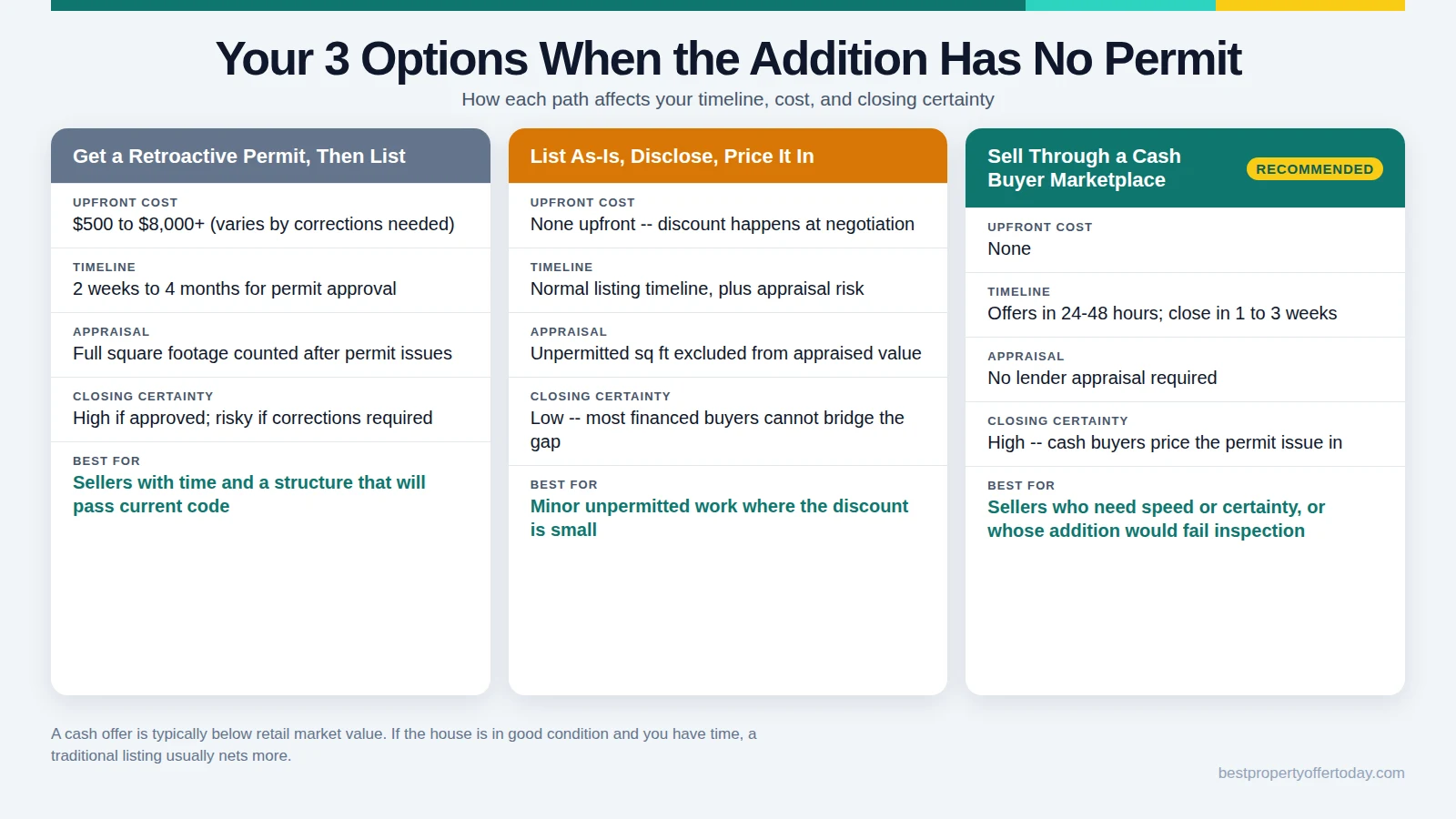
Your three realistic options
| Option | Upfront cost | Timeline | Closing certainty | Best for |
|---|---|---|---|---|
| Retroactive permit, then list | $500 to $8,000+ | 2 weeks to 4 months | High if approved; risky if corrections needed | Sellers with time and a structure that will pass inspection |
| List as-is, disclose, price it in | None upfront; discount at negotiation | Normal listing, with appraisal risk | Low for financed buyers | Minor unpermitted work where the discount is small |
| Sell through a cash buyer marketplace | None | Offers in 24 to 48 hours; close in 1 to 3 weeks | High | Sellers who need speed or certainty, or whose addition would fail inspection |
Red flags in buyers and offers
Not every cash buyer handles unpermitted work responsibly. Knowing what to watch for is worth your time before you sign anything. Our guide on how to tell whether a cash home buyer is legitimate covers the full vetting process, but a few things apply specifically to the permit situation:
- A buyer who will not put the permit situation in writing on the contract is leaving themselves room to use it as a price-reduction lever after their walkthrough
- An offer that drops significantly between the initial number and the revised number after a walkthrough, with vague explanations, is often a wholesaler who did not intend the first figure
- A buyer who claims they can make the permit issue go away without explaining how should be asked to explain it in writing, because the mechanisms that exist (retroactive permits, variance requests) are not mysterious and a legitimate buyer can describe them
- Token earnest money, under $1,000 on a $200,000 sale, means walking costs them nothing if a better deal surfaces
Competing offers are the best protection against all of these. When multiple buyers know about each other, the bait-and-switch approach becomes much harder to run. This guide on comparing cash offers side by side walks through what to look at beyond the headline number: net to seller, earnest money, close date certainty, and assignment risk.
To request competing offers or ask a question, call 804-361-7460.
Questions sellers ask about unpermitted additions
Do I have to disclose an unpermitted addition if the previous owner built it?
Yes, if you know about it. The disclosure duty is tied to your knowledge, not to who did the work. If you were told about the addition when you bought the house, or if you discovered it during ownership, that is a known material defect under virtually every state’s disclosure law. Put it on the form. Sellers who stay quiet and close sometimes receive demands years later from buyers who discover the issue during their own sale.
Will a cash buyer lower their offer after they see the house?
A cash buyer who priced the property correctly will have the permit situation factored into their initial offer, assuming you disclosed it at the start. Post-walkthrough price cuts based on a disclosed condition you already told them about are a red flag, not standard practice. Get the full offer in writing, with the price clearly tied to the disclosed permit situation, before you accept anything.
Does unpermitted square footage affect property taxes?
Sometimes. Assessors set tax bills based on their records, which typically reflect permitted square footage. Unpermitted space usually does not appear in the assessor’s file, so you may have been paying taxes on a smaller house than you actually have. If you retroactively permit the addition, the assessor may update the records and your annual tax bill may increase accordingly.
Can the sale close before the retroactive permit is approved?
Yes, with a cash buyer. The permit approval process can continue after closing, or the buyer can take it on themselves as part of their pricing. A financed buyer typically cannot close until the lender’s conditions are resolved, which usually means the permit needs to be in hand first. This is one of the practical reasons a cash sale closes faster when permit issues are in play: there is no lender condition list gating the closing date.