Selling a House Held in a Trust: What the Trustee Needs to Know
If a house is held in a trust and needs to be sold, the process is similar to a normal sale with one important addition: the trustee, not an individual homeowner, signs the purchase contract and the deed. Who has that authority, what the title company will ask for, and how the proceeds get taxed all depend on which kind of trust holds the property.
Revocable trust versus irrevocable trust: the split that matters most
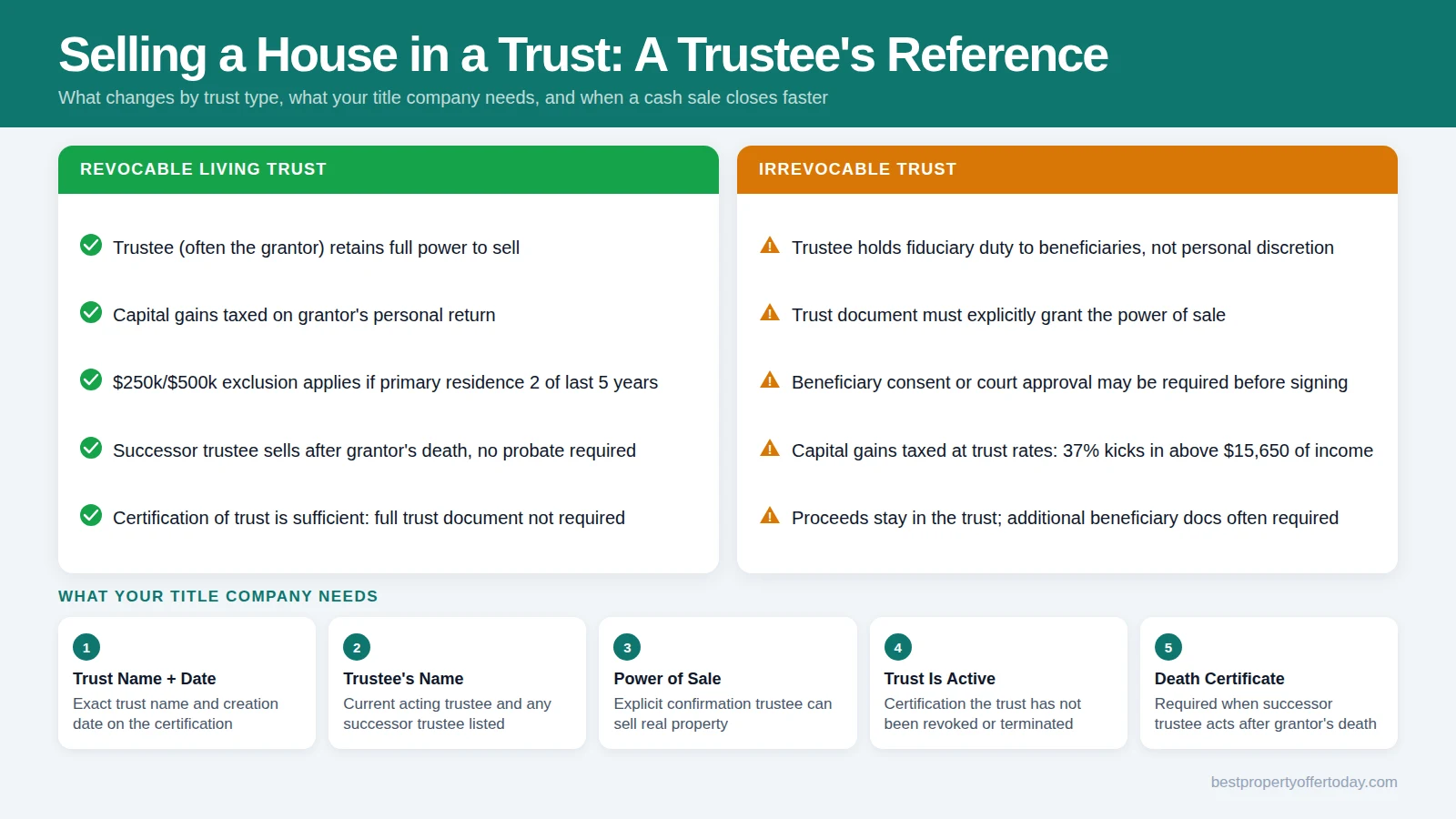
Most homes held in trusts sit in revocable living trusts. The grantor (the person who created the trust) typically serves as their own trustee and keeps full power to amend, dissolve, or sell trust assets. Selling from a revocable trust is straightforward: the trustee signs documents in their capacity as trustee, proceeds flow back into the trust, and capital gains are reported on the grantor’s personal tax return. The standard $250,000 exclusion per person ($500,000 for a married couple filing jointly) still applies if the home was the grantor’s primary residence for at least two of the five years before the sale.
Irrevocable trusts work differently. Once assets go in, the grantor gives up control. The trustee holds a fiduciary duty to the beneficiaries and cannot simply sell the property whenever it suits them. The trust document must explicitly grant the power of sale. If it does not, or if the terms require beneficiary consent or court approval, the trustee needs to secure that before listing the property or accepting any offer. Proceeds from an irrevocable trust sale stay in the trust and are taxed at trust income tax rates, which compress quickly: in 2024, the 37 percent federal rate kicked in at trust income above $15,650, compared to $609,350 for a single individual.
What the title company actually needs
The full trust document is typically hundreds of pages. Title companies do not need all of it. What they need is a certification of trust, sometimes called an abstract of trust or trust certificate.
A proper certification of trust covers:
- The trust’s name and the date it was created
- The name of the current trustee, and the name of any successor trustee if the original is deceased or incapacitated
- Confirmation that the trust is currently in existence and has not been revoked
- A statement that the trustee has the power to sell, convey, and encumber real property
Many states allow a trustee to provide this summary document in place of the full trust. In California, Probate Code Section 18100.5 governs it. Most states have an equivalent statute. If a cash buyer or their title company asks for the full trust document, that is not standard practice and the trustee is not obligated to comply.
When the original trustee has died and a successor trustee is now acting, the title company will also want the original trustee’s death certificate and confirmation that the successor’s authority has vested per the trust terms.
The successor trustee situation: the most common scenario
The most common reason a house in a trust gets sold by someone other than the original grantor is that the grantor has died. A successor trustee named in the trust steps in. This is one of the main reasons people put property in trusts in the first place: the sale can proceed without probate, which can take six months to two years and cost 2 to 4 percent of the estate value in attorney and court fees, depending on the state.
The successor trustee has the same legal authority to sell as the original trustee had, but must act in the beneficiaries’ best interests. If beneficiaries disagree about whether to sell, at what price, or which offer to accept, the trustee is caught between competing interests. Courts are sometimes asked to resolve trustee-beneficiary disputes over property sales, and it happens more than families expect.
If the trust property also carries a reverse mortgage, the timeline pressure intensifies. HECM rules give heirs six months to sell or refinance after the borrower’s death, and that clock does not pause for beneficiary disagreements. For a breakdown of payoff mechanics and the 95 percent rule that protects heirs when the loan balance exceeds the home value, see our post on selling a house with a reverse mortgage.
A cash offer creates less friction here than a financed sale. There is no lender conditioning the deal on an appraisal, no underwriting delay, and no repair contingency giving a buyer a route to renegotiate after the inspection. A trustee who needs to close on a specific date to distribute assets to beneficiaries values certainty differently than an individual homeowner who is simply moving.
A worked example: what the estate actually nets
Take a house with a fair market value of $380,000, currently in a revocable trust after the grantor’s death. The successor trustee is weighing two paths.
Retail listing with an agent. A 5 to 6 percent commission comes out at $19,000 to $22,800. Seller-paid closing costs typically add 1.5 to 3 percent, another $5,700 to $11,400. If the buyer is financing the purchase, they may come back after inspection asking for repairs: call it $6,000 to $12,000 on a house this age. Carrying costs while under contract (two to three months of utilities, insurance, and property taxes) run roughly $3,000 to $4,500. Net to the estate: somewhere between $280,000 and $344,000, depending on the market, the condition, and what the inspection surfaces.
Cash offer via marketplace. Cash buyers typically offer 75 to 90 percent of market value on a house in good condition, less on one with deferred maintenance. On this property, competing offers might run from $285,000 to $342,000. No agent commission. Seller-side closing costs on a cash deal are typically $500 to $2,000. No repair negotiation, no carrying costs beyond the time to close (1 to 3 weeks once the trust documentation is in order). Net to the estate: $283,000 to $340,000, faster and with no inspection renegotiation risk.
The two paths overlap in outcome when the property needs work or when beneficiaries need funds within a set window. The retail listing usually nets more on a house in excellent condition when the market is strong and the trust terms allow time. The net proceeds calculator can run both scenarios with your own numbers.
Red flags when selling trust property for cash
Some cash buyers try to shortcut the process in ways that create problems for the trustee.
- A buyer who says the trust documentation is not their concern is a buyer who will raise it at closing. It will come up. The only question is whether it delays or kills the deal.
- Buyers who assign their purchase contracts multiple times before closing create chain-of-title questions that title companies flag. For a trustee with fiduciary obligations, a deal that falls apart on an assignment is worse than a lower offer that closes cleanly. The full guide on how to identify a wholesaler versus a real buyer covers what to look for.
- Token earnest money on a trust property, say $500 on a $300,000 offer, gives the buyer a free exit. A trustee should ask for at least 1 to 2 percent of the offer price, held by a licensed title company or attorney, not the buyer directly.
- Any buyer who asks you to sign over the property before closing, or who structures the deal as an option rather than a standard purchase contract, should be declined without further negotiation.
For a broader review of how to evaluate any cash buyer, the post on whether cash home buyers are legitimate covers the verification steps in detail.
Questions a trustee should ask before signing any offer
- Does the trust document explicitly grant the power of sale over real property?
- Is a co-trustee required to sign, or does one trustee have sole authority?
- Do the trust terms require beneficiary consent or court approval before accepting an offer?
- If proceeds will go to multiple beneficiaries, is there any disagreement that could surface after a contract is signed?
- What closing costs will the trust bear, and has the trustee confirmed those amounts with the title company?
- Does the property have title issues, such as old liens, an unreleased mortgage, or an undisclosed heir who never signed a deed? Title problems that delay a cash closing covers the most common ones.
- Has a CPA or tax advisor confirmed whether the estate or the trust will owe capital gains, and at what rate?
Collecting competing offers as a trustee
When the trustee has a fiduciary duty to beneficiaries, accepting the first offer without comparison can invite a challenge later. Putting the property through a marketplace that collects offers from multiple vetted buyers is one way to document that the trustee sought competitive pricing. Offers typically come back within 24 to 48 hours, and there is no obligation to accept any of them. The service is free to the seller.
If you have questions about how the offer process works, call 804-361-7460.
Does a revocable trust become irrevocable after the grantor dies?
Yes, in most cases. A revocable trust typically becomes irrevocable at the grantor’s death because there is no longer anyone with authority to amend or dissolve it. The successor trustee then administers the trust assets under terms that are now fixed. The trust document governs how and when real property can be sold and how proceeds are distributed to beneficiaries.
Can the trustee sell the house without telling the beneficiaries?
The trustee has a duty to keep beneficiaries reasonably informed of significant trust transactions. Selling the primary real estate asset without notice to beneficiaries is the kind of action that invites a breach-of-fiduciary-duty claim, regardless of whether the price was fair. Most trust attorneys recommend written notice to all beneficiaries before signing a purchase contract, along with a basic explanation of why the sale serves their interests.
What happens to the sale proceeds?
For a revocable trust that became irrevocable at the grantor’s death, proceeds from the sale go into the trust and are then distributed to beneficiaries according to the trust terms. Some trusts direct an immediate distribution. Others hold proceeds for minor children until they reach a specified age. A few direct that proceeds be reinvested in other assets. The trustee must follow what the document says.
Is a traditional listing ever better than a cash offer for trust property?
Yes. If the house is in good condition, the beneficiaries are aligned, and the market is strong, a listed sale will almost always net more than a cash offer. A cash offer is not the right move for every trust situation. It is the right move when timing matters, when the property needs work, or when the trustee needs a clean close with no renegotiation risk after inspection. A trustee who can take three months to list and close through the retail market should consider that path if the trust terms and beneficiary situation allow it. That said, a cash offer is normally below a fully marketed retail price, and a traditional listing is likely to net more if the house is in good condition and the estate is not under time pressure.