A reverse mortgage does not prevent you from selling. It is a lien like any other lien, and it gets paid off at closing from the sale proceeds. What makes it different from a conventional mortgage is how the balance grows, the timeline rules for heirs, and one provision most people never hear about until they are already in trouble: the 95 percent rule.
This covers both scenarios: the original borrower selling while alive, and heirs selling after the borrower has died.
How a Reverse Mortgage Gets Paid Off When You Sell
When the house sells, the settlement statement shows one line for the reverse mortgage payoff. It includes the principal borrowed, accrued interest (which compounds monthly), the mortgage insurance premium balance, and any service fees. No prepayment penalty.
The title company or closing attorney orders a payoff statement from the servicer. That statement is valid for a short window, usually 30 days, and if closing falls outside that window the servicer issues a new one. Request it early in the process.
After the payoff, any remaining equity goes to the seller. If you borrowed $120,000 over several years and the balance with interest and fees is now $190,000, and the house sells for $280,000, you keep approximately $90,000 before closing costs and commissions.
What Heirs Face When the Borrower Has Died
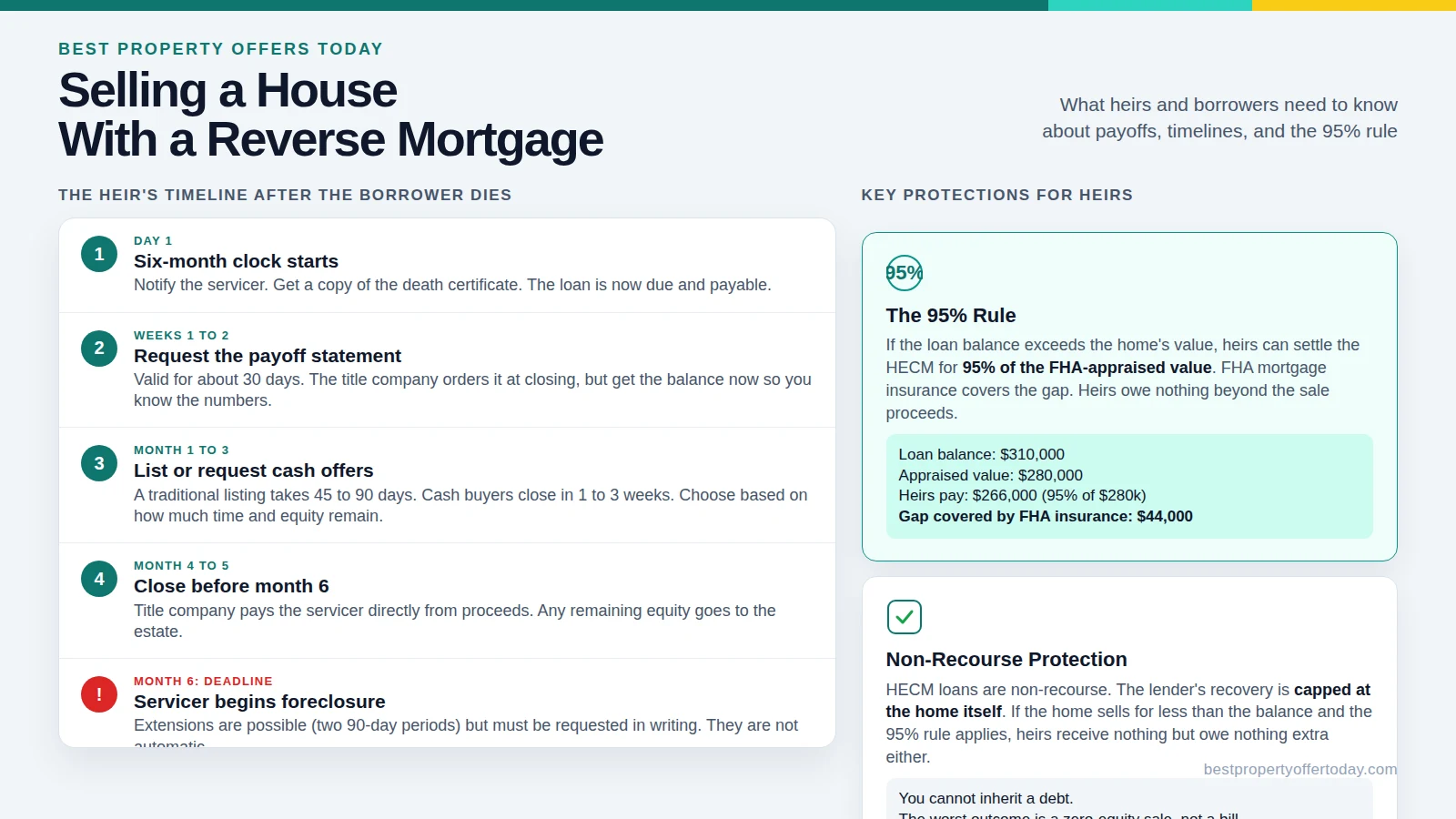
This is where the timeline becomes urgent. Under federal rules for HECM loans (which are the vast majority of reverse mortgages), heirs have six months after the borrower’s death to either sell the home or refinance the balance into a conventional loan. The servicer can grant two 90-day extensions, but each requires the heir to demonstrate they are actively pursuing sale or refinancing.
Let that timeline land: from death certificate to closed sale, you have six months, and you are also handling an estate, possibly probate, and family logistics at the same time.
The 95 Percent Rule: What It Is and Why It Matters
If the reverse mortgage balance has grown past the home’s current market value, heirs do not have to come up with the difference. HECM loans are non-recourse: the lender’s recovery is capped at the home itself.
Here is the specific rule. If the home sells for less than the outstanding loan balance, the servicer must accept 95 percent of the appraised value as full payment. The difference is covered by FHA mortgage insurance. The heirs owe nothing beyond the proceeds from the sale.
Example: loan balance is $310,000. Appraised value is $280,000. The home sells for $266,000 (95 percent of appraised value). The servicer accepts $266,000. Heirs receive nothing from the sale but owe nothing extra either.
The appraisal used for this calculation must be FHA-approved. The servicer orders it, not the heir. If you disagree with the appraised value, you can request a second appraisal, but it costs time, and time is what heirs have least of.
A Worked Example: Two Siblings, One Timeline
A parent died in January. Two adult children are co-heirs. The house is in Ohio. Estimated value: $230,000. Reverse mortgage balance: $195,000. No will contest, no probate complications.
They list the house in late January. The first offer comes in at $218,000. The buyer is using FHA financing. The lender orders an appraisal, which comes back at $215,000. The buyer’s FHA loan is now tight on the appraisal gap. They negotiate and agree on $215,000.
Closing happens in early April, roughly 10 weeks after the listing. Settlement statement: $215,000 sale price, minus $195,000 payoff, minus $12,900 in agent commissions (6 percent), minus $2,800 in seller-paid closing costs. Net to the estate: approximately $4,300, split two ways.
Now consider the same house going to a cash buyer in mid-February, with a three-week close:
Offer: $198,000. No commissions. Seller pays roughly $1,500 in closing costs. Payoff: $195,000. Net to the estate: approximately $1,500.
In this case the traditional listing won on net proceeds, and by a significant margin. The heirs had time and equity, and the retail route made sense.
Change one variable: the loan balance is $210,000 and the siblings are already in month four of the six-month window. Now the retail timeline is too risky. A sale that closes in week three of month five gets them across the line. A closing in month seven means the servicer begins foreclosure proceedings, the property goes to auction, and the heirs lose whatever equity remained.
When a Cash Sale Is the Right Answer
The timeline pressure on heirs is the main reason cash buyers appear in reverse mortgage situations. A cash buyer can close in one to three weeks. A financed buyer typically needs 30 to 45 days minimum, and more if appraisal problems arise.
A cash offer is normally below what a fully marketed retail listing would bring. If you have equity in the house, time to list it, and no complications in the estate, a traditional sale will likely net more. A cash buyer makes sense when the six-month window is closing, when the estate is complicated, or when the loan balance is close to or above the home’s value and the 95 percent rule is in play.
Through a marketplace like Best Property Offers Today, you can request competing cash offers from multiple vetted buyers, compare them side by side, and choose the one that works. The service is free to sellers and carries no obligation to accept. Offers typically come back within 24 to 48 hours. Use our net proceeds calculator to see what each offer actually puts in your pocket after the payoff and costs.
Comparing Your Options
| Option | Typical timeline | Offer price | Risk of missing the 6-month window | Best for |
|---|---|---|---|---|
| Traditional listing | 45 to 90 days | Closest to market value | Medium to high if you are in month 3 or later | Heirs with time and meaningful equity |
| Single cash buyer | 1 to 3 weeks | 60 to 80% of market value | Low | Tight timelines, underwater loans |
| Competing cash offers via marketplace | 1 to 3 weeks | Top of your local cash range | Low | Tight timelines with some equity to protect |
| Heir refinances the loan | 30 to 60 days | Not applicable, heir keeps the home | Medium if underwriting drags | Heir who qualifies and wants to keep the property |
Red Flags to Watch For
Reverse mortgage situations attract a specific kind of bad actor. Heirs are under time pressure and often unfamiliar with the process. These are the warning signs:
- A buyer who asks you to sign over power of attorney or add them to the title before closing. This is fraud.
- A buyer who cannot provide proof of funds within 48 hours. Cash deals do not need financing approval, so any delay on proof of funds is a meaningful signal.
- An assignment clause in the contract reading Buyer or assigns. This means the buyer can sell your contract to a third party before closing. Ask who the actual closing buyer will be. See our post on how to spot a wholesaler before you sign.
- Token earnest money, typically under $1,000 on a house worth $200,000. A real buyer has something to lose.
- A payoff statement request that does not come from the title company. The buyer should never be contacting your servicer directly for your loan documents.
What a Legitimate Cash Buyer Needs From You
Three things: proof that you are authorized to sell (executor or administrator letters from the probate court if the borrower has died), the servicer’s contact information so title can request the payoff statement, and access for a brief walkthrough or inspection.
A real buyer will not suggest skipping the title company. They want title insurance as much as you do. If someone proposes closing without a title company or closing attorney, that is enough reason to walk. For more on vetting buyers before you sign anything, see our guide to whether cash home buyers are legitimate.
How long does an heir have to sell a house with a reverse mortgage?
Six months from the date of the borrower’s death. The servicer can grant two 90-day extensions if the heir is actively working to sell or refinance, but extensions are not automatic. You have to request them in writing and show progress. Missing the window triggers foreclosure, which the servicer is legally required to initiate.
What if the reverse mortgage balance exceeds the home value?
The HECM non-recourse rule protects heirs. The most the lender can recover is the home itself. If the home sells at 95 percent of its appraised value and that is still less than the outstanding balance, FHA mortgage insurance covers the shortfall. The heir receives nothing from the sale but owes nothing extra.
Can you sell a house with a reverse mortgage before the loan is due?
Yes, at any time, with no prepayment penalty. The loan is not due on a fixed date the way a standard mortgage is. It becomes due when the borrower sells, moves out for 12 or more consecutive months, dies, or falls behind on property taxes and homeowner’s insurance. Selling is one of the cleanest exits: close the deal, pay off the lien, keep whatever equity remains.
Do heirs owe taxes when selling a house with a reverse mortgage?
In most cases, heirs receive a stepped-up cost basis: the home’s fair market value on the date of death becomes the new cost basis. If the house was worth $250,000 when the parent died and heirs sell it for $255,000, the taxable gain is only $5,000, not the full appreciation from the original purchase price. This is not tax advice. Confirm the basis calculation with a CPA or estate attorney before filing.
For a clearer picture of what a sale will actually net after the payoff, commissions, and closing costs, use our net proceeds calculator. If you want to see competing cash offers without committing to any of them, you can submit a request here at no cost and no obligation. Phone: 804-361-7460.