One to three weeks is the honest answer, and that range comes with one important asterisk: the buyer’s money is not what sets the closing date. Title work is. A cash sale can close in seven days if the title is clean and both parties push. It can stretch to six weeks if the search surfaces an old lien, a probate matter from the last transfer, or a boundary line that was never formally resolved. The cash removes the financing risk. It does not remove the paperwork.
What a Typical Cash Sale Looks Like, Week by Week
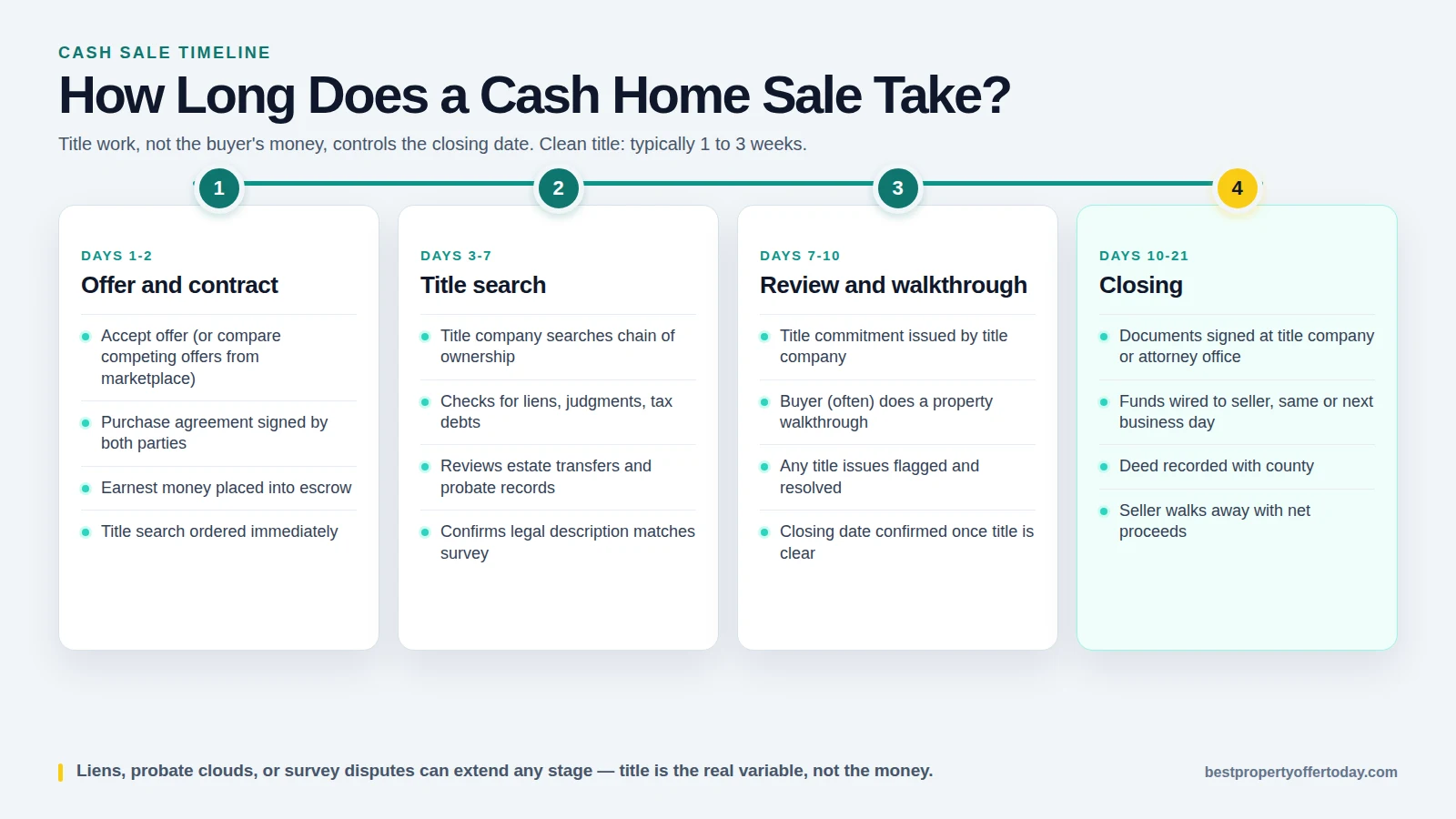
Most cash sales move through four phases. The overlap between them is what compresses the timeline compared with a financed deal.
Days 1 to 2: You accept an offer, or submit your property to a marketplace and receive competing offers within 24 to 48 hours. A purchase agreement gets signed. Earnest money, usually a check, goes into escrow. The buyer orders a title search at the same time.
Days 3 to 7: The title company searches the chain of title, which means going back through public records to confirm that every previous transfer was clean, that no judgments or liens attached to the property, and that the legal description on the deed matches the survey. On a straightforward house with one or two prior owners and no unusual history, this takes about five business days.
Days 7 to 10: The buyer may walk the property. Cash buyers often skip a formal inspection, but most serious buyers do at least a walkthrough before committing wire instructions. If the buyer is a professional investor, this step takes a few hours, not several days.
Days 10 to 14: The title company issues a commitment. Both parties review it. The closing date gets confirmed. In a clean deal, you sign on day 14 and funds hit your account by end of business the same day or the next morning.
That is the floor. A lot of sales land closer to three weeks rather than two, not because anything went wrong, but because coordinating schedules and getting the title commitment reviewed takes a little longer than expected.
A Worked Example: Same House, Two Buyers
Suppose a seller in Ohio has a house worth roughly $220,000 at retail. Two buyers make offers on the same day.
Buyer A is an all-cash investor offering $180,000. No financing contingency. No appraisal. The buyer has seen the property and is ready to close in two weeks.
Buyer B is a conventional-loan buyer offering $210,000. They need a 30-day minimum closing, and that is if the underwriter is not backed up. The appraisal takes 7 to 10 days to schedule after the contract goes in. The appraiser’s report goes to the lender before the lender can issue final loan approval.
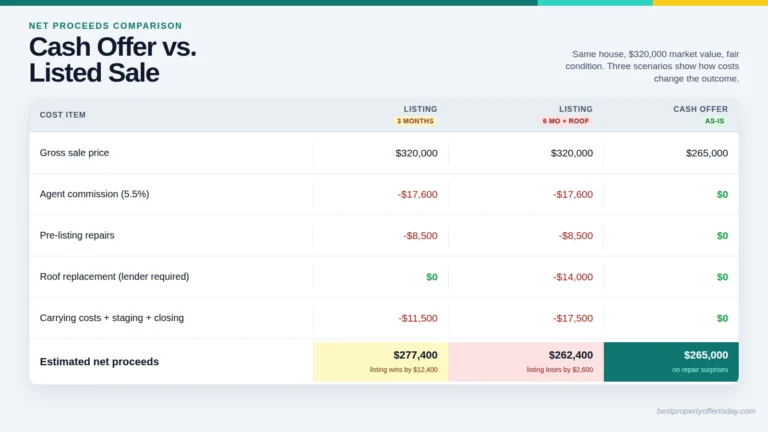
The $30,000 gap between those offers is real. What Buyer A is paying for is certainty and speed. What the seller is giving up is the difference between $180,000 and $210,000, minus any carrying costs for the extra 30 to 45 days, minus repairs the lender or appraiser flags as conditions of the loan, minus commission if an agent is involved.
A traditional listing with an agent will usually net more if the house is in good condition and the seller has time. Cash makes sense when time or condition is the constraint, not when it is the only way to sell. Run your own numbers with the net proceeds calculator to see what each path actually puts in your pocket.
What Title Work Actually Involves and Why It Runs the Clock
The title search is a review of public records going back as far as the chain of title requires. In older states, that can mean searching records from the early 1900s. The title company is looking for several things.
Outstanding mortgages never released. A lender records a satisfaction of mortgage when a loan is paid off. Sometimes that recording gets missed. The loan is gone but the lien is still in the public record, and it has to be cleared before a new deed can transfer cleanly.
Judgment liens. A court judgment against a prior owner, or against you, can attach to real property in the county where it was recorded. The title company finds it, and you either pay it off or negotiate a release before closing.
Federal and state tax liens. The IRS and state revenue agencies can file liens against property. These show up in the title search and must be resolved before title can be insured.
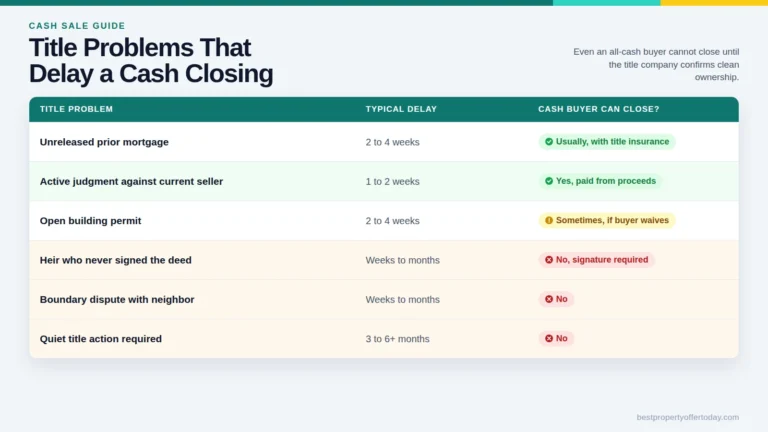
Estate and probate clouds. If the property changed hands through an estate, the title company needs to confirm that the personal representative had authority to sell and that all heirs with an interest signed off. When an heir did not join the deed, the title has a cloud that requires a quiet title action or a corrective deed, both of which add weeks.
Boundary or survey issues. A fence line that crosses the legal property description, an encroachment from a neighbor’s structure, or a recorded easement that does not match actual use can all slow a closing while the parties sort out what is actually being bought and sold. For a full breakdown of which title problems can be absorbed by a cash buyer and which require the closing to wait, see the guide to title problems that delay a cash closing.
Cash vs. Financed: The Timeline Comparison
| Sale type | Typical timeline | Main bottleneck | What adds time |
|---|---|---|---|
| Cash sale, local investor | 1 to 3 weeks | Title work | Liens, probate clouds, survey disputes |
| Cash sale, iBuyer (Opendoor, Offerpad) | 14 to 60 days | Their internal timeline | Post-inspection adjustments, resale prep |
| Conventional loan | 30 to 45 days | Underwriting | Complex income, condo approvals, delayed appraisal |
| FHA or VA loan | 45 to 60 days | Appraisal plus underwriting | Repair conditions flagged by the appraiser |
One nuance worth knowing about iBuyers: they operate on cash, but their internal timelines are often longer than a local buyer’s. Opendoor and Offerpad typically need at least 14 to 21 days at the minimum, and their flexible closing options can push to 60 or 90 days. That is not a problem, but “iBuyer” and “fastest possible close” are not the same thing.
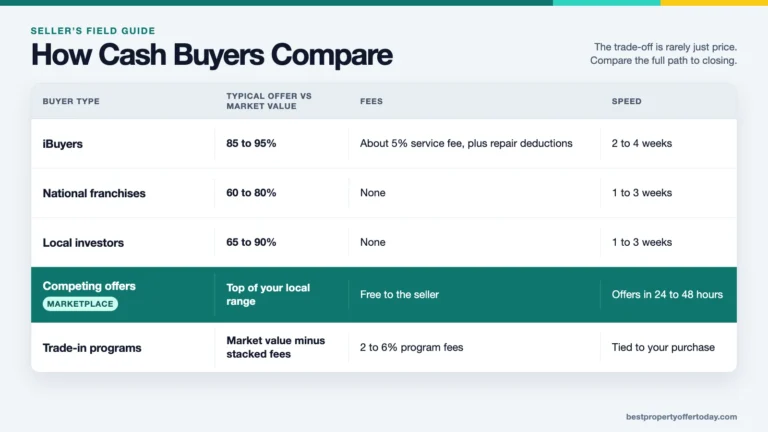
If you want to understand how different buyers compare before you decide, the post on how to compare cash offers side by side covers what to normalize so you are comparing net proceeds, not just headline numbers.
Red Flags When a Buyer Promises a Date Before Title Is Done
A professional cash buyer will not commit to an exact closing date until the title commitment is in hand. They can give you a target. They should not lock in a specific date on day one.
- Closing guaranteed in 7 days before anyone has ordered a title search
- A contract with no explanation of how title issues get handled
- Pressure to skip attorney review in a state where attorney closings are required (Virginia, South Carolina, Georgia, and Massachusetts, among others)
- Earnest money under 1 percent of the purchase price on a contract that promises speed
- An assignment clause buried in the contract, which lets the buyer sell the contract to a third party. That third party may not close on the same schedule
The earnest money issue is worth a closer look. A token deposit means the buyer can walk away for free if the deal becomes inconvenient. The post on what happens when a cash buyer backs out explains what your contract actually entitles you to if that happens.
Separately, if you are not sure whether a buyer is operating legitimately, the post on whether cash home buyers are legitimate covers the checks that separate real buyers from wholesalers and assignment flippers.
Questions to Ask a Cash Buyer Before You Sign
These are the questions a buyer who knows what they are doing will answer without hesitation.
- What title company are you using, and can you give me their direct contact?
- When will you order the title search?
- If the title search turns up a problem, do you resolve it or walk away?
- Is there an assignment clause in this contract?
- What is the earnest money amount, and where will it be held?
- If we cannot close by the target date, what options does the contract give us?
- In what form will funds arrive at closing, and how quickly will they clear?
What happens if the title search takes longer than expected?
The closing date slides. Most purchase agreements set a target date, not a hard deadline, unless the contract says “time is of the essence.” If it does say that, a missed closing date may give one party the right to cancel. In a standard cash contract without that clause, both parties typically agree to extend. Your attorney or the title company will tell you what your specific contract allows.
Can you close a cash deal in less than a week?
Yes, but only if the title is clean, both parties have counsel ready, and the closing agent can schedule quickly. Seven business days is achievable on a property with a simple chain of title in a county where recording is fast. Two to three business days happens occasionally when the title company has a recent prior search on the same property. It is rare, not a standard promise any buyer should be making.
Does a cash sale always close faster than a financed one?
Almost always, but not always. A buyer with a fully underwritten loan and a clean appraisal can sometimes close in 21 days. A cash buyer with a messy title situation can take six weeks. The money removes the financing variable. It does not remove the title variable, which is the one most sellers overlook when they assume “cash” means “instant.”
What slows a cash sale down most often?
Estate issues are the most common cause of delay. A house inherited from a parent, where one sibling never formally signed off, or where the estate was never fully probated, can take weeks to clear even for a cash buyer who is ready to move immediately. If you know the property has this kind of history, telling the title company upfront rather than waiting for them to find it saves real time.
One request on the marketplace at bestpropertyoffertoday.com generates competing offers from multiple vetted buyers within 24 to 48 hours, which gives you a real range to compare rather than a single number from one buyer. There is no obligation to accept any offer. If you want to talk through your specific timeline before submitting, call 804-361-7460.