If you need to sell a house quickly, you have more cash buyers to choose from than ever. That is good news, but it also makes the first question harder: who should you actually call? This guide breaks down the main types of companies that buy houses for cash in 2026, what each one is best at, and the fees and offer levels you can realistically expect from each.
Full disclosure up front: we run Best Property Offers Today, a marketplace that collects competing cash offers from vetted buyers. We still cover every other option honestly here, because different situations genuinely call for different buyers.
The five types of cash home buyers
1. iBuyers (Opendoor, Offerpad)
iBuyers use pricing models to make fast offers on homes in decent condition in the metros they serve. Opendoor is the largest, and Offerpad is its main national rival. Expect a service fee around 5 percent, plus deductions after their inspection. Offers tend to be closest to market value for newer, cookie cutter homes in good shape. They are usually not an option for homes with major repair needs, unusual layouts, or locations outside their coverage map. We compare the two in detail in our Opendoor vs Offerpad fee breakdown.
2. National franchises (We Buy Houses, We Buy Ugly Houses / HomeVestors)
These are franchise networks, so the company you actually deal with is a local operator working under a national brand. Quality varies by franchisee. They buy in nearly any condition, close fast, and charge no fees, but their business model depends on buying at a meaningful discount, often 60 to 75 percent of after repair value on homes that need work. If you talk to one, talk to at least one competitor too.
3. Local real estate investors
Every market has independent investors and small flipping operations. The best local investors know your neighborhood better than any national player and will sometimes pay more for the right property. The risk is variance: some are well funded professionals, others will tie up your home in contract and try to renegotiate or assign the contract to someone else. Our guide on how to tell if a cash buyer is legitimate covers proof of funds, earnest money, and the other checks that separate the two.
4. Cash offer marketplaces
Marketplaces like ours do not buy your house. Instead, one request goes out to a network of vetted cash buyers who submit competing offers, and you compare them side by side. Because buyers know they are competing, offers tend to settle near the top of what the local market will pay. The service is free to the seller, and there is no obligation to accept any offer. It is the closest thing to making the rest of this list bid against each other.
A few named buyers worth getting a bid from
Lists like this usually stop at categories, so here are actual companies we know first-hand and would put on a comparison shortlist. Disclosure: these companies are part of or partner with our buyer network.
- Best Home Offer Today: a Nashville buyer we work with. Buys directly in Nashville and Middle Tennessee and works with a buyer network elsewhere; more than 100 houses bought. Offers inside 24 hours.
- Trusted Homebuyers USA: a nationwide direct cash buyer with state-by-state coverage, useful when your market has no strong local operator.
- Sell My House Fast Idaho: if the property is in the Boise area or anywhere in Idaho, this is the local operator with the deepest review history in that market.
- Resolution Home Buyers (Minnesota): local Twin Cities buyer, offers in 24 hours, closes in as little as 7 days.
Get a second bid anyway. Even a buyer we vouch for should have to beat somebody. And before you sign with anyone, run the checks in our guide to vetting cash buyer reviews.
5. Buy before you sell and trade-in programs
Companies like Knock and various lender trade-in programs front you the ability to buy a new home before selling the old one. These are financing products more than cash sales. They solve a timing problem, not a speed or condition problem, and their fees stack on top of normal selling costs.
How the options compare
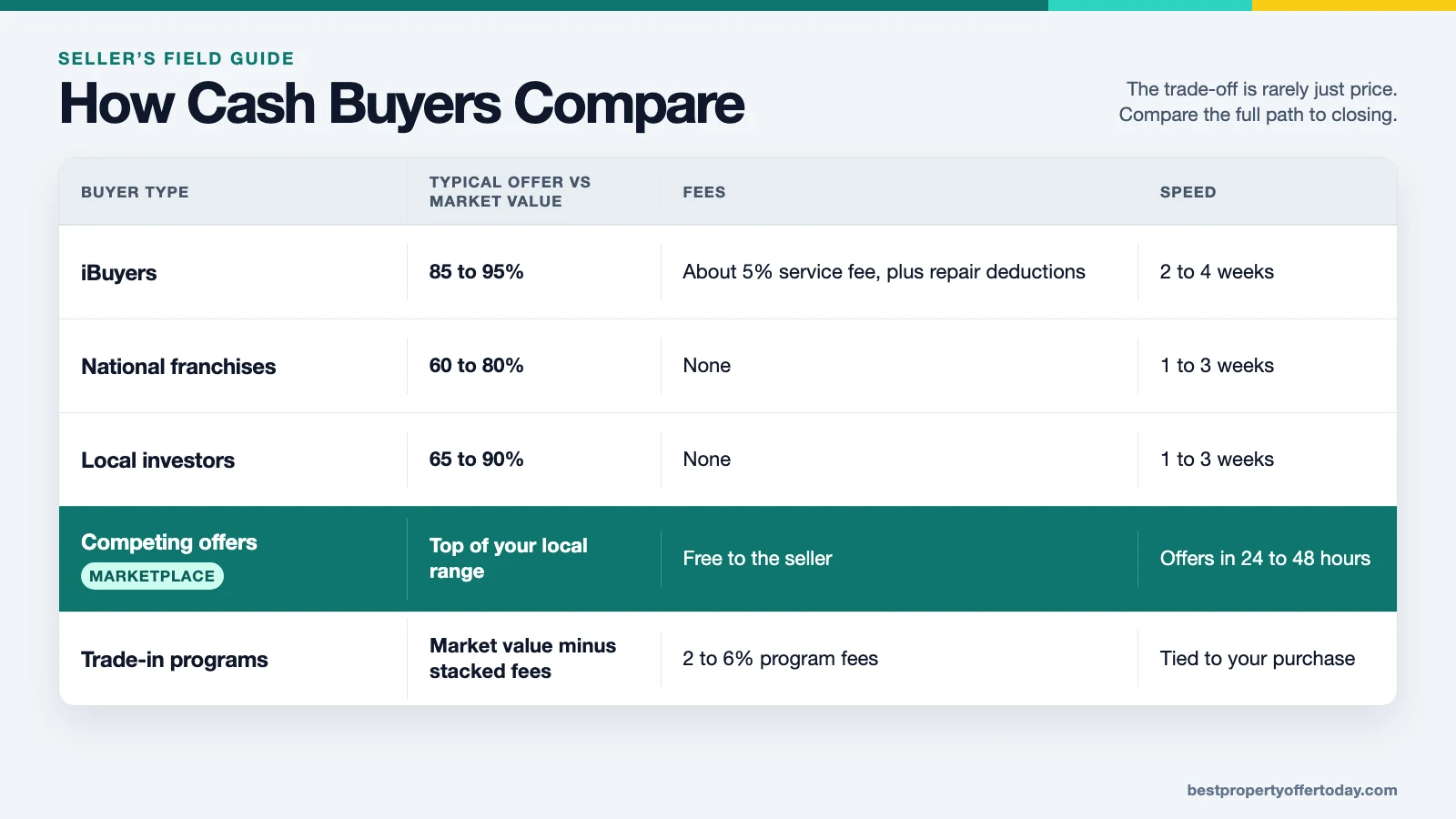
Rough national picture for 2026. Every market and property is different, so treat this as orientation, not a quote.
| Buyer type | Typical offer vs market value | Fees | Speed | Best for |
|---|---|---|---|---|
| iBuyers | 85 to 95 percent | About 5 percent service fee plus repair deductions | 2 to 4 weeks | Newer homes in good condition in covered metros |
| Franchises | 60 to 80 percent | None | 1 to 3 weeks | Homes needing major work, urgent timelines |
| Local investors | 65 to 90 percent | None | 1 to 3 weeks | Unique properties, sellers who vet carefully |
| Marketplace (competing offers) | Top of your local range | Free to seller | Offers in 24 to 48 hours, close in 1 to 3 weeks | Anyone who wants buyers to compete |
| Trade-in programs | Market value minus stacked fees | 2 to 6 percent program fees | Tied to your purchase | Buying and selling at the same time |
What the numbers look like on a real house
Percentages are abstract, so here is the same property run through each path. Assume a house worth 300,000 dollars fully renovated, needing about 40,000 dollars of work, with a seller who would need four months to list it traditionally.
A franchise or investor pricing off after repair value lands somewhere near 165,000 to 200,000 dollars, arrived at by taking the 300,000 figure, subtracting the 40,000 in work, and holding back a margin plus their own resale costs. No fees, closing in about two weeks. An iBuyer will usually decline a house needing this much work, and if it did quote, the roughly 5 percent service fee and post inspection deductions would pull it back toward the same neighborhood.
The traditional listing looks better on the surface and thinner underneath. To reach that 300,000 you have to actually do the 40,000 in repairs, then pay commissions and seller paid closing costs, then carry the mortgage, taxes, insurance, and utilities for the months it takes. Add the risk that a financed buyer’s inspection reopens the negotiation. Sellers often find the gap between the two paths is far narrower than the headline numbers suggest, which is the entire reason we built the sell my house calculator. Run your own figures rather than trusting a range from an article.
The honest summary: if your home is in good condition and you have time, a traditional listing usually nets more. Cash wins when the repair list is long, the timeline is short, or certainty matters more than the last few percent.
Red flags that should end the conversation
Most cash buyers are legitimate. The ones that are not follow recognizable patterns.
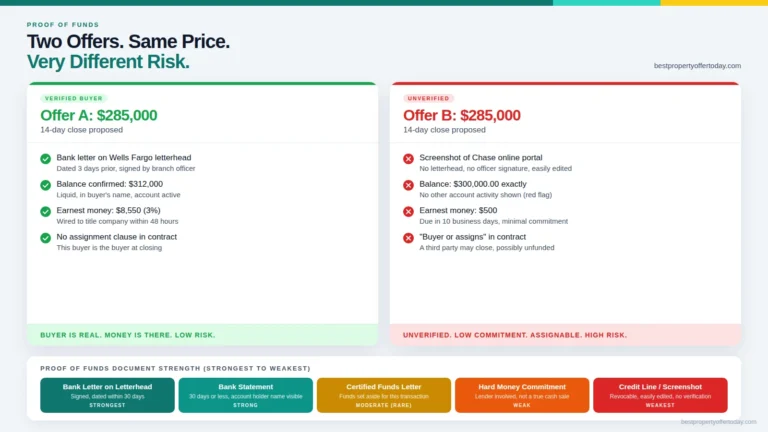
- No proof of funds. A real cash buyer can produce a current bank statement or lender letter. Vagueness here is the single biggest warning sign.
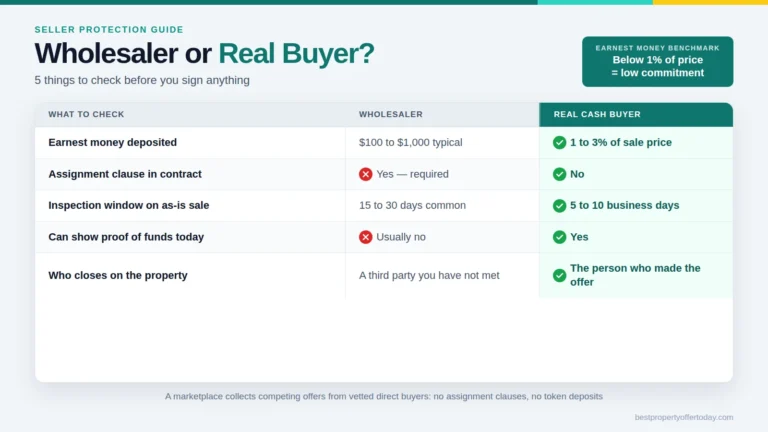
- An assignment clause you did not discuss. Language letting them assign the contract to another party means they may not be the buyer at all. They may be shopping your contract for a fee, which is wholesaling.
- Token earnest money. A few hundred dollars on a six figure house means walking away costs them almost nothing.
- A long inspection window on an as-is cash purchase. This is often where a price gets renegotiated after you have stopped talking to other buyers.
- Pressure to sign today. Real offers survive a night of thinking and a second opinion.
- A notary arriving at your kitchen table with a deed. Legitimate closings happen through a title company or closing attorney, with title insurance.
Questions to ask every buyer before you sign
- Are you the end buyer, or do you intend to assign this contract?
- Can you send proof of funds today?
- How much earnest money will you put up, and who holds it?
- Is this offer net to me, or are there deductions that can appear after an inspection?
- Which title company or attorney will close it?
- What happens to my price if your inspection finds something?
- Can you give me two recent sellers I can call?
Any buyer worth selling to answers all seven without friction.
How to pick the right company
Start with your situation, not the brand. If your home is in good condition inside an iBuyer coverage area, get an iBuyer quote as a baseline. If the home needs serious work, franchises and local investors are your realistic pool. In every case, the single biggest lever you control is competition. Sellers who accept the first offer they receive almost always leave money on the table.
Before you sign anything, verify proof of funds, ask about every deduction that can appear after inspection, and read the contract for assignment clauses. Then run your own numbers with our sell my house calculator to see how each offer nets out against a traditional listing once commissions, repairs, and carrying costs are counted.
Common questions sellers ask
Do cash home buyers pay closing costs?
Most advertise that they cover standard closing costs, and many do. Confirm in writing which specific costs, because prorated taxes, HOA transfer fees, and any existing liens usually still come out of your proceeds.
How fast can a cash sale actually close?
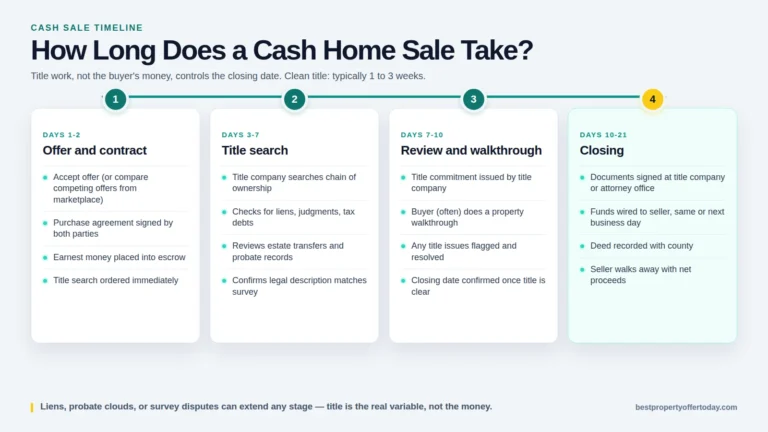
One to three weeks is normal. The limiting factor is not the buyer’s money, it is the title search and clearing anything it turns up, such as an old lien, a probate matter, or a boundary problem.
Is a cash offer negotiable?
Yes, and competition is what makes it negotiable. A single buyer has no reason to move. Several buyers who know they are being compared do.
Will asking for competing offers slow things down?
Not meaningfully. Offers typically come back within 24 to 48 hours, which is a fraction of the time a traditional listing takes to produce its first showing.
The bottom line for sellers
There is no single best company that buys houses for cash. There is a best offer for your specific property, and the only way to find it is to make qualified buyers compete. If you want that done in one step, request competing cash offers here. It takes about two minutes, it is free, and you keep full control over whether to accept anything at all.