Most sellers assume they need to fix everything before listing. The data says otherwise. Many common repairs return far less than they cost, and some return almost nothing. Knowing what not to fix when selling a house can save you thousands of dollars and weeks of delay. Here is where to draw the line in 2026.
The 60 second test for any repair
Before you price a single job, run it through three questions. They resolve most decisions faster than a contractor quote will.
- Will a buyer see it in the first 30 seconds? Paint, cleanliness, smells, and light are priced emotionally. A cracked outlet cover in the entry hurts more than a dated bathroom down the hall.
- Is it broken, or just old? Buyers discount broken. They shrug at old. A working 15 year old furnace is a talking point. A furnace that does not fire is a negotiation.
- Can a lender refuse to fund because of it? This is the one most sellers miss, and it is the difference between a repair you can skip and a repair that will find you at the appraisal. There is a list further down.
If the answer to all three is no, it is almost always a skip.
Nine repairs that usually do not pay you back
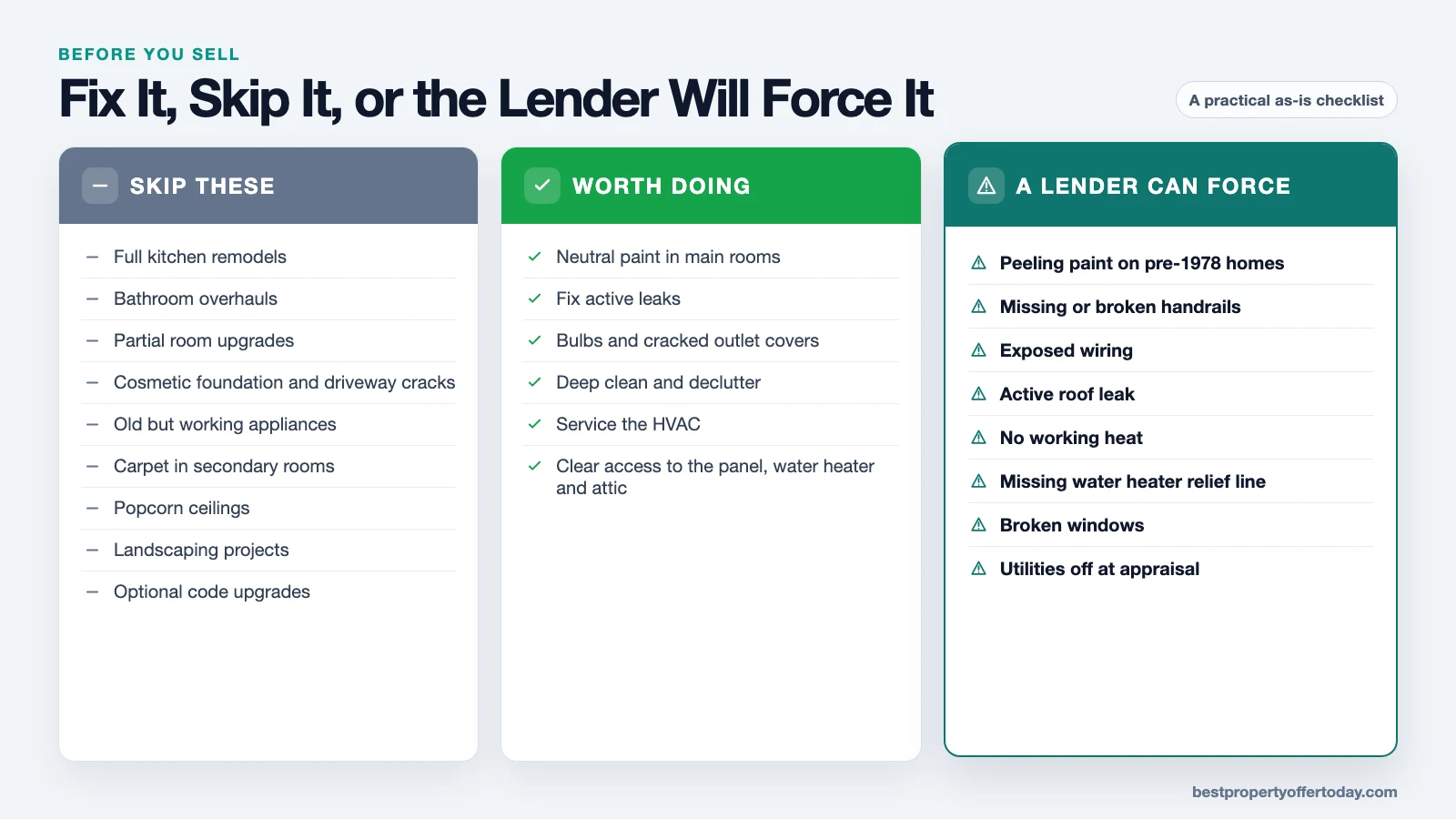
1. Full kitchen remodels
A major kitchen remodel typically returns 40 to 60 cents on the dollar at resale. Buyers also have their own taste. Spending 40,000 dollars on finishes the next owner may rip out is one of the worst pre-sale moves you can make.
2. Bathroom overhauls
Same math as kitchens. Regrouting, recaulking, and new hardware are cheap and worthwhile. Tearing out a dated but functional bathroom is not.
3. Partial room upgrades
Replacing half the windows or upgrading one bathroom of three often highlights what you did not do. Mixed old and new can read worse than consistently original.
4. Cosmetic foundation or driveway cracks
Hairline cracks in concrete are normal settling in most homes. Structural problems are a different story and belong in a disclosure, but cosmetic patching rarely moves an appraisal.
5. Old but working appliances
If the stove and dishwasher work, leave them. Buyers who care will negotiate a credit, which costs you less than buying new units that suit someone else’s kitchen.
6. Carpet replacement in secondary rooms
A professional deep clean gets you most of the visual benefit at a tenth of the cost. Replace carpet only if it is damaged or holding odors a cleaning cannot fix. If the odor is from pet urine soaked into the subfloor, the repair math changes significantly: see selling a house with pet damage for the full cost breakdown and how cash buyers price it differently.
7. Popcorn ceilings and dated textures
Removal is messy, can involve asbestos testing in older homes, and buyers largely price around it anyway.
8. Landscaping projects
Mow, edge, mulch, and trim. Full landscape redesigns rarely return their cost, and buyers cannot inspect their way into valuing your new shrubs.
9. Code upgrades that are not required
Grandfathered items in older homes generally do not need proactive upgrading to sell. Address what your state requires in disclosures and let the inspection process handle the rest.
The short list that is usually worth doing
Cheap, fast, high-visibility items still earn their keep for a traditional listing: fresh neutral paint in main rooms, fixing active leaks, replacing burned out bulbs and cracked outlet covers, deep cleaning, and decluttering. These cost hundreds, not thousands, and affect first impressions where offers are made.
Two more worth the money if they apply to you. Servicing the HVAC so it runs cleanly at showings, and clearing anything that blocks access to the electrical panel, water heater, attic hatch, or crawlspace. An inspector who cannot reach a system writes “unable to inspect,” and that phrase invites a buyer to assume the worst.
The repairs a lender can force anyway
Here is the part that changes the whole calculation. If your buyer is financed, the appraiser works for the lender, not the buyer, and government backed loans carry minimum property requirements. When an appraiser flags one of these, the loan will not fund until it is corrected. You either fix it, credit it, or lose the buyer.
Items that commonly get flagged on FHA, VA, and USDA appraisals:
- Peeling or chipping paint on a home built before 1978, treated as a lead hazard
- Missing or broken handrails on stairs, and unsafe or missing steps
- Exposed or frayed wiring, open junction boxes, and missing outlet or panel covers
- An active roof leak, or a roof without enough remaining service life
- Heating that does not work, or no permanent heat source
- Water heaters missing a temperature and pressure relief discharge line
- Broken windows, inoperable exterior doors, and failed locks
- Utilities that are shut off at the time of appraisal, so nothing can be tested
- Standing water in the crawlspace, or evidence of active termite damage
Conventional loans are looser, but an appraiser can still call for repairs when safety or habitability is in question. The practical takeaway: a repair you skip is only truly skipped if your buyer is paying cash or the item is cosmetic. Everything on the list above is a bill deferred, not a bill avoided.
What actually reopens the negotiation after inspection
Buyers rarely walk over dated finishes. They renegotiate over four things: water, roof, structure, and systems. Evidence of water intrusion, a roof near the end of its life, foundation movement, and a failed furnace, panel, or sewer line are the findings that turn into repair demands and price reductions. If you know you have one of these, you have a decision to make before you list, because it will surface either way and it is cheaper to price it in than to be surprised by it three weeks into a contract. For sellers dealing specifically with a broken or failing HVAC system, the post on selling a house with HVAC problems covers the three realistic paths and what each nets.
Sewer scopes deserve a mention of their own. On homes older than about 1970 with mature trees, a line failure is common, expensive, and increasingly something buyers test for.
Chimneys serving active fireplaces are another item that trips FHA and VA appraisals. A cracked flue liner puts the loan on hold until a licensed chimney sweep issues a clearance letter. If the chimney has not been inspected in several years, ordering a Level 2 scan before listing tells you whether to repair it, price it in, or route the sale toward cash buyers only. See selling a house with chimney problems for repair cost ranges and how each buyer type handles them.
When it makes sense to fix nothing at all
If the repair list is long, the honest arithmetic changes. Months of mortgage payments, taxes, insurance, and utilities while contractors work, then more months on market, can burn through any value the repairs add. Sellers in that position often net a similar amount selling as-is for cash, without the risk of a financed buyer’s inspection reopening the negotiation. This is exactly the trade our home sale calculator was built to show: enter your repair estimate and carrying costs and compare the two paths side by side.
Selling as-is is also the standard route for inherited houses, homes at risk of foreclosure, and properties with tenants or serious damage. Cash buyers price the work in and skip the repair conversation entirely.
Be clear eyed about the trade. Selling as-is to a cash buyer normally means accepting less than a fully renovated retail price. It is the right call when speed, certainty, and avoiding carrying costs are worth more to you than squeezing out the last few percent. It is the wrong call when your house is in good condition, you have time, and a traditional listing can run its course.
Common questions sellers ask
Do I have to disclose problems I choose not to fix?
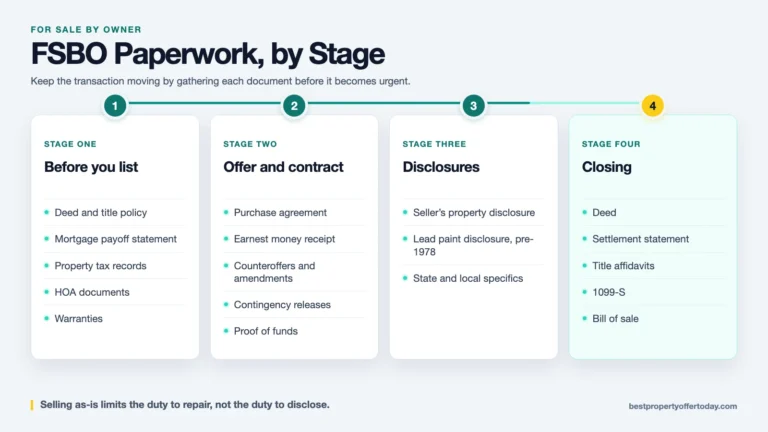
Yes. Skipping a repair is legal in nearly every state. Concealing a known material defect is not. Disclosure and repair are separate decisions, and treating the disclosure form as a marketing document is how sellers end up in court after closing. Termite damage and pest history are among the most commonly litigated disclosure failures: see how termite damage affects your sale options for what most states require you to report.
Should I get a pre-listing inspection?
It helps when you suspect a major issue and want to control the story rather than react to the buyer’s report. Be aware that once you know about a defect, you generally have to disclose it, so do not order one expecting to bury the result.
Is it better to repair or offer a credit?
A credit is usually cheaper and faster, and it lets the buyer choose their own contractor. The exception is anything a lender requires, since a credit does not satisfy an appraisal condition. Those have to be physically corrected before closing.
Will painting really change my offer?
Neutral paint in the main living areas is one of the few items that reliably returns more than it costs, because it is cheap, it photographs well, and it touches the first impression that anchors every number after it.
The bottom line for sellers
Fix what is cheap, visible, and broken. Fix what a lender will force. Skip what is expensive, cosmetic, or a matter of taste. And if the list is long enough that fixing feels like renovating, get real numbers for the as-is route before you spend anything: you can compare competing cash offers for your home in about two minutes, free, with no obligation.