Selling a House with Pet Damage: Three Paths and What Each Nets
Pet damage affects a home sale in two ways: what it costs to fix, and what buyers subtract if you do not fix it. Those two numbers are not equal, and the gap between them is where your decision lives.
If the damage is light, fixing it before listing usually makes economic sense. If it runs deep, the math shifts toward selling as-is, either to a retail buyer with a negotiated credit or to a cash buyer who prices the damage in and moves without a lender in the way.
What Counts as Pet Damage When Selling
Not everything a pet touches qualifies as a material defect. Scratched hardwood floors and stained carpet are cosmetic. They matter to buyers and appraisers, but they are not typically a disclosure issue. Pet urine that has soaked through to the subfloor is different: it can affect air quality, it creates a persistent odor that professional cleaning alone will not resolve, and some states treat it as a known material defect that requires disclosure.
The types of damage that affect offers most:
- Urine odor embedded in subfloor, HVAC ductwork, or walls
- Subfloor rot from long-term urine saturation
- Claw marks on hardwood floors, door frames, or cabinetwork
- Carpet staining and odor throughout living areas
- Chewed trim, baseboards, or window frames
- Yard damage: bare patches, waste accumulation, fence stress from large dogs
Odor is the most commercially damaging. A house that smells of pet urine will sit on the market longer, attract lower offers, and lose retail buyers to competing listings. Cosmetic scratch damage is easier to price and easier for buyers to accept with a closing credit.
Does Pet Damage Have to Be Disclosed?
No federal law requires you to disclose that you owned a pet. Most states require disclosure of known material defects, which is a different question. Whether pet damage rises to a material defect depends on the state and the severity of the damage.
A few scratches on a door frame: probably not a material defect. Subfloor rot from years of dog urine: almost certainly is. If a buyer later discovers you knew about structural damage from pets and did not disclose it, they have grounds for a lawsuit in most states. Selling as-is limits the duty to repair, not the duty to disclose.
Practically speaking, odor is its own disclosure. Any buyer who tours a house with serious urine smell is on notice. The risk is not in what buyers can detect during the tour. It is in what they find after inspection, when damage hidden under carpet or behind walls becomes visible and gives them leverage to renegotiate after you have already turned down other offers and moved out.
How Lenders and Appraisers Treat Pet Damage
For most conventional loans, pet damage is a pricing issue, not a condition issue. An appraiser notes the damage, adjusts the value downward, and moves on. The loan still closes.
FHA and VA loans work differently. Both programs require the property to meet minimum property standards, which include no active health or safety hazards. Severe pet odor signaling contamination, damaged subfloor, or active waste accumulation can trigger an appraiser condition requiring remediation before the loan will close.
That condition does not automatically kill the deal, but it resets the negotiation. The seller must either fix the issue at their cost before closing or accept a price reduction to cover the buyer’s remediation estimate. In practice, many deals with severe damage fall apart here because the cost of remediation exceeds what either party expected, and neither wants to absorb it alone.
Cash buyers sidestep this entirely. No lender, no appraisal condition. They price the damage into their offer, and the sale proceeds on whatever timeline the title work requires.
What Pet Damage Remediation Actually Costs
These are realistic cost ranges for common repairs, not best-case scenarios:
- Carpet replacement (1,200 square feet): $3,600 to $8,400 installed, at $3 to $7 per square foot
- Hardwood floor refinishing: $3 to $8 per square foot, so $2,100 to $5,600 for 700 square feet
- Subfloor replacement for one affected room: $500 to $2,000 depending on extent and material
- Enzyme treatment for urine in concrete or subfloor: $300 to $1,500 for professional treatment; up to $3,500 if the subfloor also requires sealing and recoating
- HVAC duct cleaning and deodorizing: $300 to $700
- Interior repaint for affected rooms: $200 to $600 per room
- Trim and door frame replacement: $500 to $2,000 total
A house with moderate pet damage throughout, carpet with some subfloor saturation in one or two rooms, and scratched hardwood in the main living area, could easily require $12,000 to $18,000 in remediation to show well for a financed sale. Severe long-term contamination across multiple rooms may require significantly more.
The question is not just what it costs to fix. It is what a repaired house nets versus what an as-is sale nets, and whether the difference exceeds the cost of repairs. Use the net proceeds calculator to run your specific numbers before deciding.
Three Paths and What Each One Nets
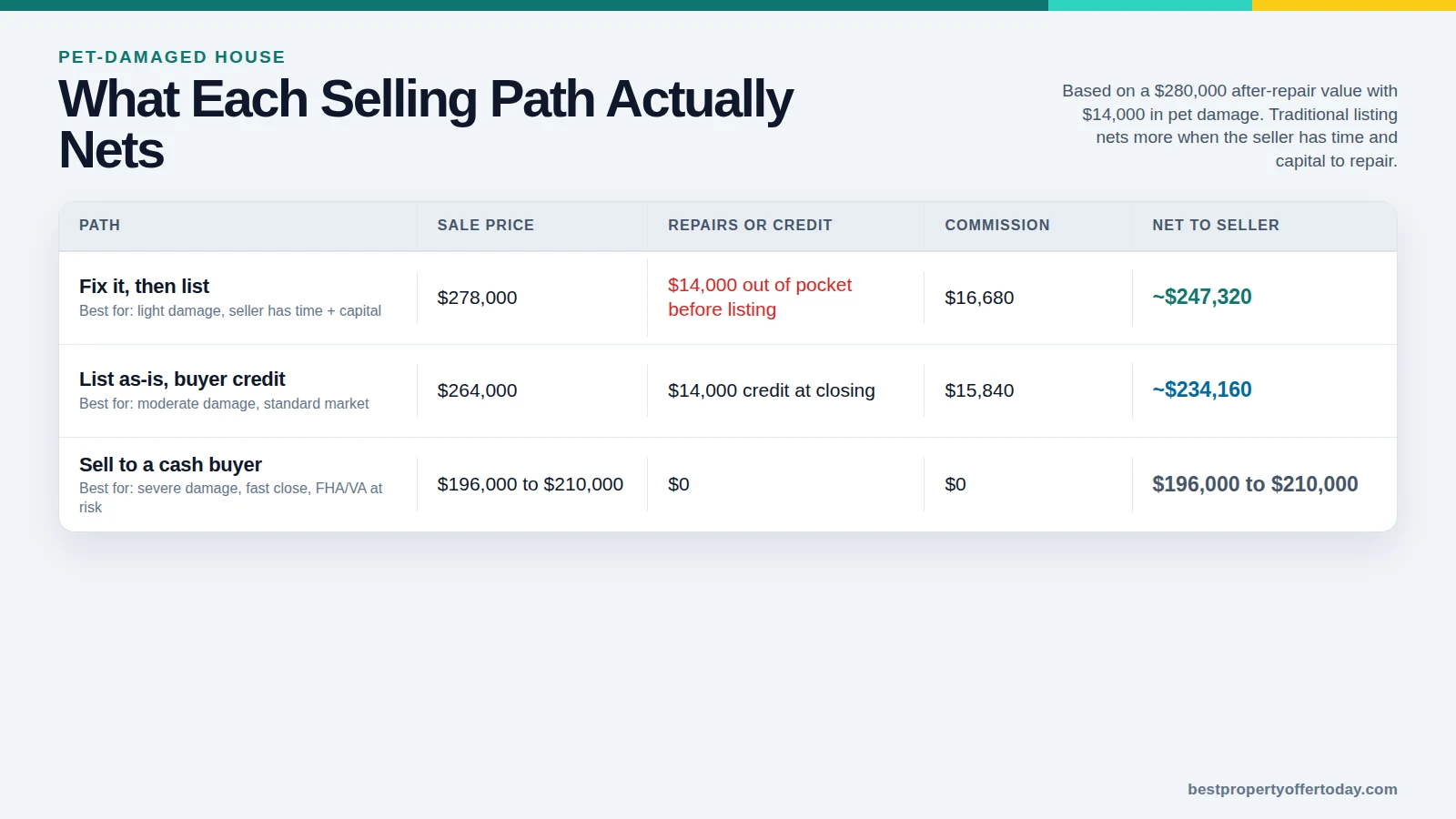
Here is how the options compare for a house with an after-repair value of $280,000 and $14,000 in pet damage:
| Path | Sale price | Repair or credit | Commission | Net to seller |
|---|---|---|---|---|
| Fix it, then list | $278,000 | $14,000 out of pocket before listing | $16,680 | ~$247,320 |
| List as-is, buyer credit | $264,000 | $14,000 credit at closing | $15,840 | ~$234,160 |
| Sell to a cash buyer | $196,000 to $210,000 | $0 | $0 | $196,000 to $210,000 |
The cash path nets less in this example. That is almost always true. What it provides is speed, no repair negotiation, no financing contingency, and no risk of an appraisal condition halting the close after three weeks under contract.
If the house is in good enough condition to support a financed sale and the seller has time and capital to fix and list, the traditional path produces a better net. If the damage is severe, the seller cannot fund repairs before closing, a government-backed loan condition is likely, or the property needs to close fast, cash starts to make real economic sense.
The actual offer from a cash buyer follows the same formula local investors and flippers use: ARV multiplied by roughly 0.70, minus estimated repair costs. On a $280,000 ARV house with $14,000 in repairs, that formula produces a ceiling around $182,000 before the buyer adds a margin for risk and profit. Competing buyers in a marketplace bid that ceiling upward. The spread between the lowest and highest cash offer on the same pet-damaged house can be $20,000 to $40,000, which is why you should not accept the first one you receive. See how to compare cash offers side by side before signing anything.
Red Flags When Buyers Inspect a Pet-Damaged House
Pet damage is one of the most common leverage points for post-inspection price cuts. Watch for these behaviors from buyers who plan to renegotiate rather than accept the condition they already saw:
- A buyer who toured the house, made an offer, and then returned with an inspection-based remediation estimate 30 to 50 percent above any reasonable professional quote
- Long inspection windows on what is being presented as an as-is cash deal. A genuine cash buyer does not need three weeks to confirm condition they already priced in
- A token earnest money deposit of $500 to $1,000 combined with an assignment clause. That is a wholesaler testing whether the contract is assignable, not a buyer committed to closing
- Repeated requests to bring in additional contractors with no firm timeline or written repair estimate
The token deposit and assignment clause combination deserves attention. If you accept a cash offer with no real deposit and an unrestricted assignment clause, you have agreed to let the buyer find a different buyer before closing. If the deal falls apart, you get the deposit back and nothing else. You have lost weeks from the market with no compensation. For more on protecting yourself in this situation, see what happens when a cash buyer backs out.
The Honest Reality of a Cash Sale on a Damaged House
A cash offer on a pet-damaged house is normally below what a fully marketed, remediated house would bring. What the seller gets in return is certainty, speed, and no repair risk. If the house is in reasonable shape apart from the pet damage and the seller has time and capital to fix it first, a traditional listing will almost always produce a better net result.
The cash path makes the most sense when remediation costs are high, the seller cannot fund repairs out of pocket before closing, a lender appraisal condition is likely, or the property needs to close fast. Knowing which situation you are actually in matters more than which path sounds simpler. Before submitting to any cash buyer, read how to verify a cash buyer is legitimate so you know what vetting looks like.
Will a cash buyer pay the same regardless of how severe the pet damage is?
No. Cash buyers use the same formula regardless of what caused the damage: ARV multiplied by roughly 0.70, minus estimated repair costs. More damage means more subtracted from the offer. The advantage of a cash sale is not a higher price. It is removing the lender and appraisal conditions that can halt a financed sale after a contract is signed.
Do I have to fix the pet damage before I can sell?
Not for a cash sale. For a financed buyer, it depends on the loan type. Conventional loans are more flexible. If the buyer is using an FHA or VA loan and an appraiser cites the damage as a health or safety condition, remediation becomes a requirement before the loan funds. You can negotiate who pays for it, but you cannot skip it on a government-backed loan with a flagged appraisal condition.
Can a buyer sue me after closing for pet damage I did not disclose?
Yes, if you knew about damage that qualifies as a material defect in your state and did not disclose it. An as-is sale does not eliminate disclosure liability. It limits the duty to repair, not the duty to tell the truth about conditions you know about. Undisclosed pet damage discovered after closing is one of the more common bases for post-sale real estate disputes. The safer approach is to disclose what you know, price accordingly, and let the buyer decide with full information.
Does pet damage show up in an appraisal?
Yes. Appraisers note visible damage and adjust the value. For FHA and VA appraisals, severe odor or visible contamination can trigger a required repair condition. For conventional loans, it is typically a line-item deduction in the comparable analysis rather than a hard stop. Either way, the appraised value on a pet-damaged house will be lower than on the same house without damage, which limits how much a financed buyer can borrow and therefore what they can offer.
To get competing offers on your specific property and see the actual spread across multiple buyers, call 804-361-7460 or submit one request at BestPropertyOfferToday.com. There is no obligation and no cost to the seller.