A failed well water test can stop a financed sale cold. If your private well comes back with bacteria, high nitrates, arsenic, or another problem, most government-backed lenders will not fund until the water passes a retest. That is a hard stop, not a negotiating point. What it actually means for your sale depends on what failed, how much it costs to fix, and how much time you have.
Why Lenders Care About Well Water
Most buyers use financing. And most lenders, if the property has a private well, require a water quality test before closing. The requirement is mandatory for FHA, VA, and USDA loans. Conventional lenders vary, but many apply the same rule in practice.
The test checks for a standard panel of contaminants:
- Coliform bacteria and E. coli
- Nitrates and nitrites
- pH and hardness
- Lead (standard on pre-1978 homes in many states)
- Arsenic (required in certain regions, including parts of New England and the Mountain West)
If the test fails on any required parameter, the lender will not close. The buyer cannot waive it. The seller can offer a credit, but that does not get around the failed test, because the lender is looking at the lab report, not the dollar figure on the addendum.
Cash buyers have no lender. They set their own due diligence requirements. Most do not order a water test at all, or they order one for informational purposes and price accordingly. That distinction matters when a failing test is blocking your sale.
What a Water Test Costs to Fix
Not all failures are the same. The cost and timeline to fix depend on what the test found.
Coliform bacteria is the most common failure and often the easiest to treat. Shock chlorination, which means pumping a diluted bleach solution through the well and the system, costs $200 to $500 including a follow-up retest. If the contamination came from surface water getting in after heavy rain, a single treatment can clear it. If the failure is structural, meaning casing cracks or a missing well cap, the fix is more involved: repairing or relining a well casing runs $1,000 to $6,000 depending on depth and access.
Nitrates are harder. They come from agricultural runoff, septic systems, or naturally occurring geology. A point-of-use reverse osmosis filter costs $300 to $700. A whole-house system that removes nitrates to acceptable levels runs $2,000 to $8,000. Shock chlorination does not remove nitrates. The contamination is ongoing as long as the source is present.
Arsenic is common in certain regions, particularly parts of New England, the Upper Midwest, and the Pacific Northwest. The EPA maximum contaminant level is 10 micrograms per liter. Filtration ranges from $1,500 for point-of-use systems to $4,000 to $15,000 for whole-house reverse osmosis. Again, it is a water chemistry problem, not a one-time treatment.
A failing well pump or dry well is not a water quality issue, but it shows up on inspections and can stop a sale just as effectively. Replacing a submersible pump runs $500 to $2,000. Drilling a new well, when the existing one has run out or the casing has failed beyond repair, costs $5,000 to $30,000 depending on depth, geology, and region.
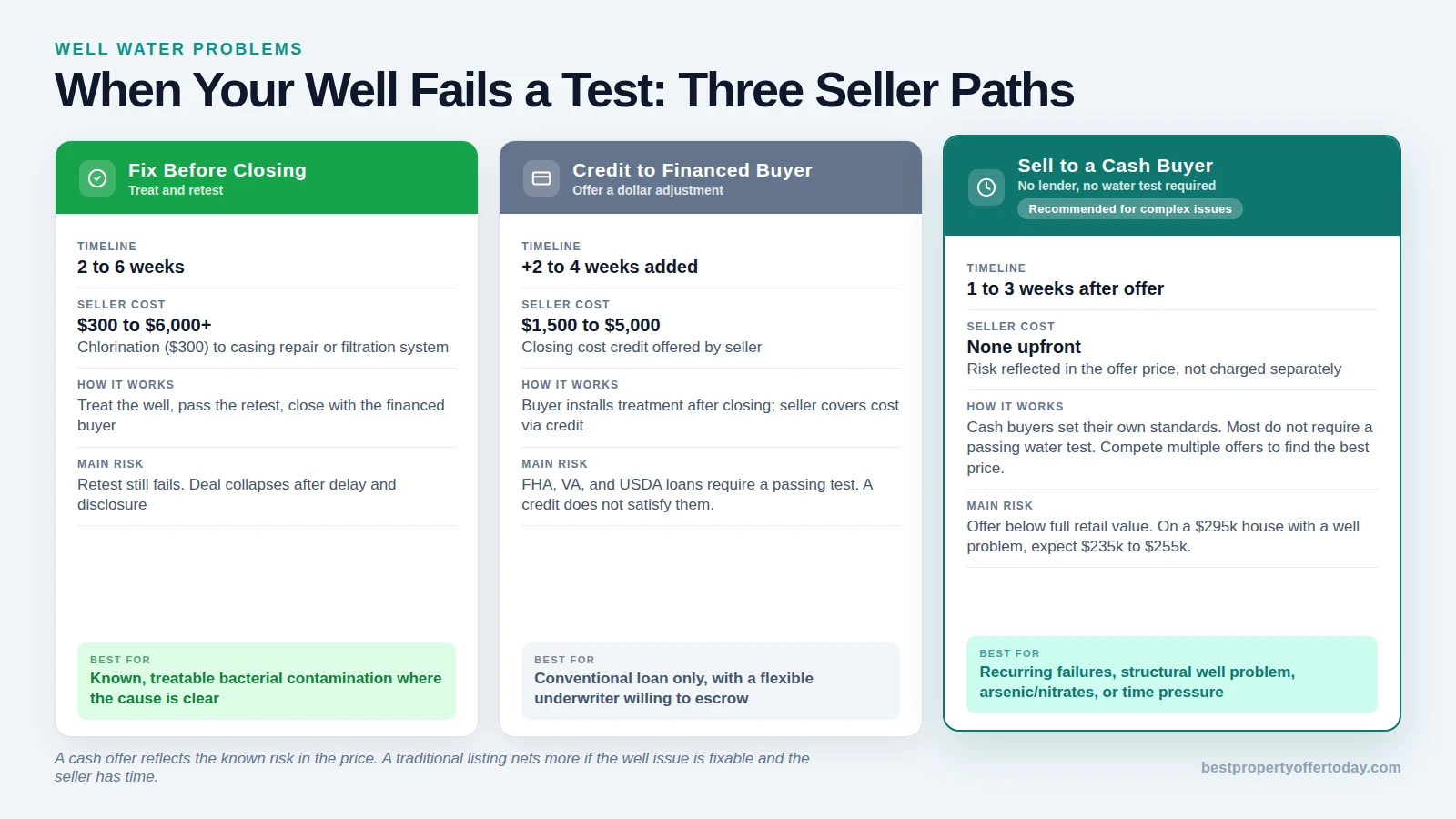
Three Paths for a Seller With a Failed Test
Here is a worked example. House listed at $295,000. The buyer’s lender orders a well water test. It comes back with coliform bacteria present. The buyer cannot close without a passing retest.
Path 1: Fix it before closing
Shock chlorinate the well: $300 including materials and labor. Wait 48 hours and flush the system. Pay for a retest: $150. Total cost: $450, and about two weeks of added time. If the retest passes, the deal closes.
The risk: the retest fails. This happens when the contamination is structural rather than incidental. You have spent $450 and two weeks and the buyer’s lender still will not close. Now you have disclosed a failed test and a failed retest in the seller’s disclosure, which may affect the next offer you receive.
Path 2: Offer a credit to a financed buyer
The seller offers $2,000 in closing cost credits. The buyer accepts. The lender still declines to fund, because the credit does not produce a passing test. This path sounds reasonable and rarely works. The lender’s requirement is a clean water test result, not a dollar adjustment.
A credit can sometimes help a buyer pay for a treatment system after closing, but only if the lender agrees to close with a failing test result. FHA, VA, and USDA programs will not. Conventional lenders may allow a repair escrow holdback in limited circumstances, but this requires underwriter approval and is not guaranteed.
Path 3: Sell to a cash buyer
On the same $295,000 house, competing cash offers come in at $235,000 to $255,000. The offers price in the known well problem: treatment cost, uncertainty about what the retest will show, and the work the buyer will do after closing. A seller accepting the high end at $255,000 nets $40,000 less than the listed price.
What they are buying with that $40,000 is certainty. No failed retests. No lender delays. No second negotiation when the retest comes back positive again. If you want to model the difference before deciding, the net proceeds calculator lets you compare a cash sale against a traditional listing with real numbers.
Whether the tradeoff makes sense depends on how certain the fix is. If you know it was a one-time surface contamination issue after a flood and the well has been clean for years, paying $450 for a chlorination and retest is the right move. If you have had recurring failures, if the casing is old and the source of contamination is unclear, taking the cash offer may cost less in total than repeated treatments and months of carrying costs.
| Option | Timeline | Typical seller cost | Main risk | Best when |
|---|---|---|---|---|
| Fix before closing | 2 to 6 weeks | $300 to $6,000+ | Retest fails; deal collapses | Cause is known and treatable |
| Credit to financed buyer | 2 to 4 weeks added | $1,500 to $5,000 | FHA/VA/USDA won’t accept credit alone | Conventional loan, flexible underwriter |
| Sell to cash buyer | 1 to 3 weeks after offer | None (reflected in offer) | Offer below retail price | Recurring failures, structural problem, time pressure |
What You Are Required to Disclose
Selling as-is does not change your disclosure duties. In most states, a seller who knows about a well water failure is required to disclose it. The specific trigger varies by state, but the general rule is clear: if you have a test result showing a failure, you have knowledge, and concealing it is a disclosure violation.
What this means in practice: if you have had a test done and it came back positive for coliform bacteria, disclose that result and any treatment you performed. If you have not tested the well recently and the sale is not requiring one, you can truthfully state you have no current knowledge of a problem. But ordering a test to find out and then deciding not to disclose the result is the kind of thing that becomes a lawsuit after closing.
If the buyer’s lender is requiring the test, the result will be in the transaction file. It will be disclosed whether or not you volunteer it.
Red Flags From Cash Buyers on Well Issues
Most legitimate cash buyers who see a failed water test price accordingly and move forward. A few patterns are worth recognizing. For a fuller guide to evaluating any offer, see our post on how to tell whether a cash buyer is legitimate.
- Post-inspection price cuts. Buyer submits an offer, then returns after the walkthrough with a lower number citing the water problem. A prepared buyer prices the risk upfront. Using it as a renegotiation lever after two weeks under contract is a pattern worth noting.
- Assignment clauses in the contract. The contract assigns the deal to a third party. You have no visibility into whether that third party will close at the agreed number.
- Very long inspection windows on an as-is deal. A 30-day inspection window gives the buyer unlimited time to walk away. Serious buyers who have already priced the water risk want to close, not to hold your property off-market.
- Proof of funds that does not hold up. A bank statement showing exactly the purchase amount from a recently opened account. Real cash buyers produce same-day letters from their institution on request.
An Honest Note on Cash Offers and Well Water
A cash offer on a house with a known well problem will come in below a fully marketed retail price. That is not a trick. The buyer is taking on the cost and uncertainty of fixing or managing the water issue after closing, and they price that risk into the offer.
If your house is otherwise in good condition, your well has a fixable bacterial problem, and you have the time to treat it and wait for a clean retest, a traditional listing will almost certainly net you more money. Cash offers make the most sense when the fix is expensive or uncertain, when you have a time deadline, or when you have already tried to fix it and failed. And when you do request cash offers, the best outcome comes from getting competing bids rather than accepting the first one, because comparing cash offers side by side often surfaces a $20,000 to $40,000 spread on the same property.
Can you sell a house if the well fails a bacteria test?
Yes. A failed bacteria test prevents a financed closing under FHA, VA, and USDA guidelines, but it does not prevent a cash sale. Shock chlorination resolves many bacterial failures for under $500. If you need to close quickly or the contamination is recurring, a cash buyer is a direct path forward.
Do cash buyers test well water before making an offer?
Most experienced cash buyers inspect the property but do not require a formal water test, or they order one for informational purposes only and reflect the uncertainty in the offer price. Unlike financed buyers, they are not bound by a lender’s quality standards. Some buyers with long-term hold strategies will require a passing test as a condition; most buy-and-flip or portfolio buyers do not.
How much does a well water test cost before listing?
A standard well water test from a state-certified laboratory runs $75 to $200 for a bacteria and nitrates panel. A comprehensive test covering bacteria, nitrates, pH, hardness, arsenic, lead, and VOCs typically costs $150 to $400. Testing before listing gives you advance knowledge, lets you document any treatment, and may provide a clean result to show a financed buyer’s lender.
What if the well has arsenic above EPA limits?
The EPA maximum contaminant level for arsenic is 10 micrograms per liter. Arsenic above that level blocks FHA, VA, and USDA loans. Whole-house reverse osmosis filtration to bring arsenic within limits runs $4,000 to $15,000. Point-of-use systems cost less but typically do not satisfy lender requirements. In regions where elevated arsenic is common, cash buyers who accept the property with full disclosure are a realistic option, and a competing offer request lets you see what buyers in your market will actually pay given the known condition.
Phone: 804-361-7460 if you want to talk through your situation before submitting an offer request.