Selling a House with Storm Damage: What Your Options Actually Cost
Storm damage changes a home sale in one specific way most other defects do not: the insurance claim. Whether hail destroyed the roof, a tornado took out the garage, or a burst pipe from wind shear left three rooms of water damage, you may have an open claim, an adjuster report that came in low, or a payout already sitting in your account. Each exit path handles that money differently. Choosing the wrong one costs real money.
What you are required to disclose
Every state requires sellers to disclose known material defects. Storm damage qualifies whether the claim is open, settled, or not yet filed. The disclosure obligation covers the underlying physical damage, not just the insurance status.
Selling as-is limits your obligation to repair. It does not limit your obligation to tell the buyer what you know. Courts have found sellers liable for rescission and repair costs years after closing when storm damage was concealed. If the damage is visible, documented in a repair estimate, or reflected in an adjuster report, it goes on the disclosure form before contract execution.
If your claim is still open, disclose both the damage and the claim. A financed buyer’s lender will likely require the claim to resolve before closing. That is a timing issue that can kill a deal when neither party expected it.
The three paths, and what each one actually nets
There is no universally correct answer for a storm-damaged house. The right path depends on how severe the damage is, what the insurance payout covers, whether you can manage contractors from where you are, and how quickly you need the sale done.
Repair the damage, then list at retail
If the insurance payout is close to the repair cost and you have time, this typically produces the highest net. A fully repaired roof or restored structure brings the property back to retail condition and opens the financed buyer pool. That matters because financed buyers can pay more.
The cost is time and execution risk. After a major storm event, contractors in the affected area are backlogged. Material costs spike. The gap between what the adjuster approved and what the final invoice shows often falls on the seller. If that gap is $6,000 on a $24,000 payout, you are out of pocket for a quarter of the repair cost on top of carrying the property for four to six months while work is done and the house is listed.
List as-is with a traditional agent
A retail buyer who plans to renovate may price in the repair cost and negotiate a credit rather than requiring the work first. That credit reduces your net dollar for dollar, but it removes contractor management and carrying costs from your side of the equation.
The complication is lender requirements. FHA, VA, and USDA loans require the property to meet minimum property standards at appraisal. Active roof damage, open structural problems, or a compromised HVAC system are underwriting flags that can collapse a financed deal after the buyer is already under contract. You may spend weeks under contract only to lose the buyer to a lender condition.
Sell to a cash buyer as-is
Cash buyers skip the lender entirely, so there is no underwriting floor. They take the property in its current condition. Their offer reflects that condition, not post-repair value, and they need margin for both the repair cost and their return on the investment.
The specific issue with storm damage: some cash buyers want the open insurance claim assigned to them at closing. They use your payout to offset their repair cost. That is not automatically a bad deal, but it is a material negotiating point. A large open claim is real money, and it should be treated as part of the transaction price, not as a separate favor to the buyer.
A worked example with real numbers
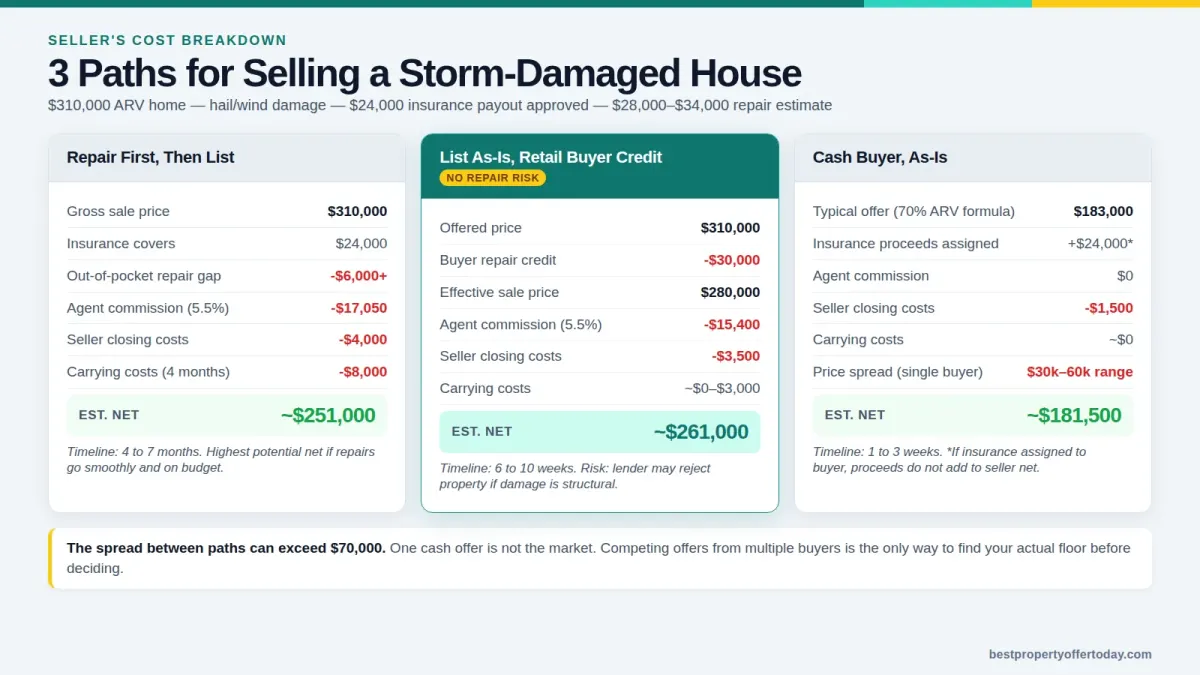
A two-story house in a midsize suburb where comparable homes sell for $310,000. A hailstorm causes full roof replacement (2,800 square feet) and siding damage on two sides. Contractor estimates run $28,000 to $34,000. The insurance adjuster approved $24,000.
Repair and list: Seller spends $24,000 covered by insurance plus $6,000 out of pocket to close the gap. Pays 5.5 percent agent commission on a $310,000 sale ($17,050), plus $4,000 in seller closing costs, and carries the house for four months during repairs and marketing (roughly $2,000 per month in mortgage, taxes, and insurance: $8,000). Net proceeds after all costs: roughly $251,000 to $258,000, depending on whether the repair bill lands at the estimate or runs over.
List as-is, retail buyer with repair credit: Buyer offers $310,000 and negotiates a $30,000 repair credit, bringing the effective sale price to $280,000. After 5.5 percent commission ($15,400) and $3,500 in closing costs, net proceeds: roughly $261,000. No repair execution risk, no contractor management, faster timeline than path one.
Cash buyer, as-is, with insurance proceeds assigned: A buyer applying the 70 percent ARV formula subtracts repair cost plus margin from $310,000 ARV. At 70 percent of $310,000, less $34,000 in repairs, the target offer is around $183,000. If the $24,000 insurance proceeds are assigned at closing, the effective net to the seller is the same $183,000 regardless of the assignment, because the payout you hand over is a dollar-for-dollar reduction in what you keep. Without competing offers, $183,000 looks like the market. It may be the floor.
The spread between path one and path three is $68,000 to $78,000. Whether speed and certainty justify that gap is a real question, not a rhetorical one. The net proceeds calculator lets you run your specific numbers before you decide anything.
How different buyer types price storm damage
Not every cash buyer prices a storm-damaged house the same way. Understanding the types helps when you are evaluating what comes back.
| Buyer type | Typical offer range | Handles open insurance claim? | Best for |
|---|---|---|---|
| iBuyer (Opendoor, Offerpad) | 75 to 85% ARV, pre-inspection | Usually no; many decline heavily damaged homes | Cosmetic damage only; structural damage often disqualifies |
| We Buy Houses franchise | 60 to 75% ARV | Sometimes; depends on franchisee | Sellers prioritizing a known national brand |
| Local investor / flipper | 55 to 75% ARV depending on scope | Often yes; may negotiate assignment terms | Structural or systemic damage where iBuyers will not go |
| Restoration-focused buyer | 65 to 80% ARV | Yes, often preferred; claim offsets their repair cost | Large open claims, fire or major storm loss |
A marketplace that sends your request to multiple buyer types at once is the only way to find out where you actually stand. One local investor offering $183,000 is not the market for your property. The market is what three or four competing buyers say after reviewing the same disclosure and the same adjuster report. That is the core value of running an open competition: the spread between the highest and lowest offer on the same storm-damaged house is often $30,000 to $60,000.
Red flags specific to storm-damage transactions
Storm damage situations attract contract flippers. The damage is visible, sellers are already dealing with the stress of the weather event, and an open insurance claim creates urgency that buyers can exploit. Watch for these specific behaviors:
- A buyer who raises the insurance assignment clause in the first conversation, before any formal inspection
- An inspection window of 30 or 45 days on what was pitched as a fast cash close
- A price that drops after inspection, citing damage that was already fully disclosed upfront
- An assignment clause buried in the contract body (the buyer intends to sell the contract, not close on it)
- Proof of funds that is vague, insufficient, or accounts for the insurance payout rather than the full purchase price
- A buyer who cannot name two or three sellers they closed with in the past six months
The wholesaler post covers the full mechanics of assignment clauses. In storm situations the incentive to flip the contract is higher, because the open insurance claim adds value the seller may not know to protect when negotiating.
Selling when the insurance claim is still open
You can sell with an open claim. The mechanics depend on where it stands.
If the insurance proceeds have not been paid yet, you and the buyer will negotiate who benefits from the eventual payout. You can insist the payout stays with you as part of the sale price. The buyer may want it assigned to them. Either arrangement is legal, but it must be explicit in the purchase agreement. “The buyer receives any outstanding insurance proceeds” is a sentence worth thousands of dollars; do not leave it out of the contract by accident.
If the insurance proceeds have already been paid to you, they are your money. A cash buyer who prices the house in damaged condition does not automatically get credit for what the insurer already paid you. Those funds are separate from the transaction unless you explicitly include them as a concession.
If the claim is under dispute, whether the adjuster came in low, a coverage portion was denied, or a depreciation holdback is pending, that dispute passes to the buyer unless the contract resolves it first. Some buyers will take on a disputed claim. Most price the house as if the dispute resolves at the low end. An attorney can advise on whether a supplemental claim is still viable before you sign anything.
The honest limits of a cash sale here
A cash offer on a storm-damaged house is normally well below a fully marketed retail price, even accounting for the repair costs you avoid. What you buy with the difference is speed, certainty, no contractor management, and no four-to-six-month carrying cost while the house is repaired and listed.
If the damage is covered in full by insurance and the repair process is straightforward, fixing the house and listing it traditionally will likely net more. The cash exit makes sense when the insurance gap is large, when the damage is structural in a way that disqualifies financed buyers, when you cannot manage contractors from a distance, or when you need the proceeds on a specific date.
Selling as-is does not cancel disclosure obligations. Known storm damage, including damage you repaired before listing, must still be disclosed in most states. The disclosure covers what you knew and when, not just what remains unfixed at the time of sale.
To get competing offers with no obligation to accept any, submit one request at BestPropertyOffersToday.com. If you want to compare what a cash sale nets against a traditional listing with your actual numbers, the net proceeds calculator runs the math side by side. You can reach the team at 804-361-7460 with questions before you submit anything.
Do I have to repair storm damage before selling?
No. As-is sales are legal in every state. You are required to disclose the damage, not repair it. Cash buyers purchase storm-damaged houses routinely without requiring any repairs first. Financed buyers face lender requirements that may rule out certain damage types, which is one of the structural reasons cash offers come in lower: they carry a risk the retail market will not.
Can I sell my house while the insurance company is still reviewing the claim?
Yes. The sale and the claim are separate legal matters. You can close the sale and let the claim resolve afterward, but the purchase agreement needs to specify who benefits from any settlement that arrives post-closing. Without that language, you may lose the right to any remaining payout. Get that clause reviewed by a real estate attorney before signing if the open claim amount is significant.
What happens to my mortgage if I sell a storm-damaged house?
The mortgage pays off at closing from the sale proceeds, the same as any other sale. The storm damage does not change the payoff amount. The complication arises if the sale proceeds plus insurance payout do not cover the full payoff: at that point you are in a short sale situation, and lender approval is required before closing. A settlement statement prepared before going under contract will show whether you have enough equity to close cleanly.
Does a cash sale affect the outstanding insurance claim?
Only if the contract assigns it. If you close without an assignment clause, the insurance claim remains yours. The insurer does not automatically transfer the claim to the new owner simply because the property changed hands. If the buyer expects the proceeds, that expectation must be written into the contract. Verbal agreements on insurance proceeds are not enforceable in most states. See the vetting guide for a checklist of what to verify before signing.
Related reading: Selling an Uninhabitable House: A Cash Buyer’s Guide