Foundation problems are one of the most common reasons a traditional home sale falls apart. Most conventional lenders will not approve a mortgage when an appraiser notes active structural damage, which means your pool of financed buyers shrinks to close to zero the moment a problem surfaces in inspection. You have three realistic paths: repair and list, list as-is with a buyer credit, or sell for cash without touching the foundation. Here is what each one actually costs.
What counts as a foundation problem
Not every crack in a foundation wall is structural. Hairline cracks along mortar joints are usually the result of normal settling and rarely stop a sale. The problems that matter are:
- Horizontal cracks in a block or poured concrete wall, which indicate lateral soil pressure
- Stair-step cracks following mortar joints diagonally on brick or block walls
- Bowing or bulging walls, even without visible cracking
- Differential settlement, where one corner of the house has dropped relative to the others, producing sloping floors and doors that stick or no longer latch
- Slab cracks wider than a quarter inch, or cracks where one side has shifted vertically higher than the other
A hairline crack on an interior wall that has not moved in years is cosmetic. A horizontal crack in a block wall that appeared or grew in the past 12 months is structural. The distinction matters because only structural issues trigger lender conditions and appraiser notations.
Why lenders draw a hard line on foundation damage
A conventional lender bases its loan amount on an appraised value. When an appraiser sees active structural damage, the report will flag it, and the underwriter will issue a repair condition before the loan can close. FHA and VA loans are stricter: both programs specifically exclude financing on homes with evidence of structural deficiency, which includes foundation failure.
This is not a negotiation point. The lender cannot waive the structural condition. If you accept an offer from a financed buyer and the inspector finds a structural problem, you are looking at one of three outcomes: the buyer asks for a repair credit, the buyer walks, or the deal stalls while you find a contractor and agree on a timeline. In a slower market, that renegotiation window is where deals die.
Cash buyers have no lender in the chain. They set their own inspection criteria and price the known problem into the offer upfront. That is the core difference.
What foundation repair actually costs
The range is wide because foundation problems range from minor to significant. These are contractor ranges for Midwest and Southern markets, where most post-war housing stock sits on crawl spaces or slabs. Coastal and Northern markets with deep frost lines typically run 20 to 40 percent higher.
| Problem type | Typical repair method | Typical cost range |
|---|---|---|
| Minor cracks, sealing and monitoring | Epoxy injection or carbon fiber straps | $500 to $3,500 |
| Bowing wall, moderate | Wall anchors or carbon fiber straps | $4,000 to $12,000 |
| Slab settlement, small area | Mudjacking or polyurethane foam lift | $1,500 to $6,000 |
| Corner settlement, pier system | 4 to 6 helical or push piers | $12,000 to $22,000 |
| Widespread differential settlement | 8 to 12 piers plus regrading | $25,000 to $50,000 |
The figure that matters most for your decision is not the repair cost itself but what the repair does to your net proceeds. The worked example below shows the math on a realistic scenario.
The three paths, compared
Path 1: Repair first, then list
You hire an independent structural engineer, get at least three bids from licensed contractors (not the same company that diagnosed the problem), complete the repair, obtain a transferable warranty, and then list at full retail.
Works best when you have cash to fund the repair upfront, sufficient equity to absorb the cost, and two to four months to complete work before needing to close.
The risks: carrying costs during the repair and re-listing window are real money. A follow-up inspection may surface additional items unrelated to the foundation, which opens another renegotiation. And repair bids frequently come in below the final invoice when scope expands.
Path 2: List as-is with a repair credit
You disclose the problem, get an independent structural engineer’s scope and estimate, and price the house roughly equal to the credit you are offering. The buyer handles the repair after closing.
Works best when the problem is clearly documented, the scope is straightforward, and you do not have the capital to fund the repair yourself.
The catch: even with a credit, if the buyer is using financing, the lender’s underwriter will still see the problem on the appraisal and may not allow the loan to close before it is fixed. You may end up attracting only cash buyers anyway, which means you could have skipped the credit negotiation entirely and gone straight to a cash sale.
Path 3: Sell for cash as-is
Cash buyers, whether individual investors, local house-buying companies, or buyers sourced through a marketplace, have no lender in the chain. They use their own criteria to assess the property and price the foundation problem directly into the offer. The offer is lower than retail, but the path to closing is shorter and the number of variables is smaller.
Works best when you need to close quickly, cannot front the repair cost, or the house has multiple issues that would surface in a traditional inspection and trigger a drawn-out negotiation.
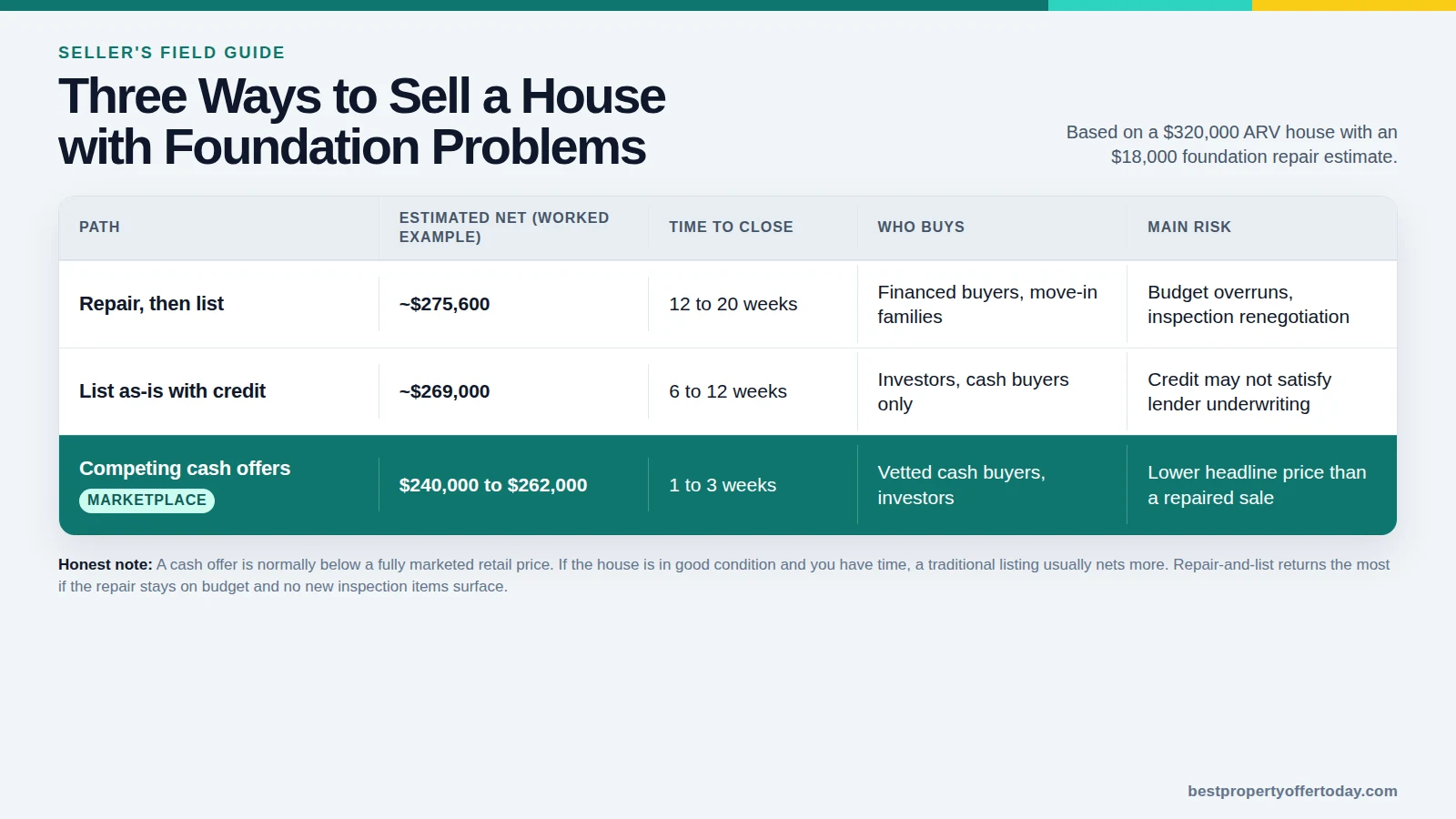
Worked example: $320,000 ARV house, $18,000 repair estimate
Assume a house where comparable, fully repaired homes sell for $320,000. An independent structural engineer scopes the problem as four-corner settlement requiring helical piers, and three contractors quote the repair in the $16,000 to $20,000 range. Use $18,000 as the working figure.
Path 1: Repair and list
- Pier system, permitted, with 15-year transferable warranty: $18,000
- Carrying costs during a 10-week repair and re-listing window (mortgage, taxes, utilities, insurance): $4,800
- Agent commission at 5.5 percent on a $320,000 sale: $17,600
- Seller-paid closing costs and concessions: $4,000
- Estimated net: approximately $275,600
Path 2: List as-is at $302,000 (purchase price minus repair)
- No repair cost, but also no retail pool of buyers
- Commission at 5.5 percent on $302,000: $16,610
- Seller-paid closing costs: $3,500
- Post-inspection renegotiation on a known structural issue: $4,000 to $8,000 typical
- Estimated net: $273,890 to $277,890
Path 3: Competing cash offers
- Cash buyers on a $320,000 ARV house with an $18,000 repair typically offer 75 to 82 percent of ARV: $240,000 to $262,400
- When multiple buyers compete through a marketplace, the spread between the lowest and highest offer on the same property is often $20,000 to $40,000
- No commission, no repair cost, no carrying costs, no renegotiation after inspection
- Estimated net: $240,000 to $262,400
The gap is real. Repair-and-list returns the most if everything goes right: the repair stays on budget, the listing attracts a clean financed offer, and no additional inspection items surface. The cash path closes faster and involves fewer variables, but it does come in below a successful retail sale. A seller with significant equity, cash available for the repair, and no time pressure should probably fix and list. A seller with less equity, no repair funds, or a firm deadline should look seriously at the cash path and see what competing offers actually produce on their specific property.
You can run the numbers on your situation with the free net proceeds calculator. It lets you compare the paths side by side based on your actual repair estimate, remaining mortgage balance, and local commission rates.
What disclosure law requires
Every state requires sellers to disclose known material defects. Foundation problems are material in every jurisdiction that has tested the question. Failing to disclose a known structural issue is not simply an ethical problem: it is grounds for the buyer to rescind the sale or sue after closing.
The safest approach before listing in any form is to commission an independent structural engineer’s report, provide a copy to every serious buyer, and note the issue explicitly on the seller’s disclosure form. A scoped, estimated problem is less frightening to buyers than an unknown one, and the report gives you legal protection regardless of which path you choose.
Selling as-is limits your obligation to repair, not your obligation to disclose. An as-is clause does not release you from the duty to reveal known defects.
Red flags from buyers making offers on problem properties
Some buyers use a foundation problem as an entry point and renegotiate the price after the contract is signed. A few patterns to watch for:
- No earnest money or a token deposit of $500 or less on a $250,000+ purchase (see the earnest money guide for what serious buyers put down)
- An inspection contingency on a deal explicitly offered as as-is
- Vague follow-up on your engineer report rather than getting their own independent assessment
- Assignment language in the contract, meaning the buyer intends to sell the contract to someone else before closing
- A long inspection period on what they described as a quick, certain cash close
None of these signals is conclusive on its own. More than one stacked together suggests you may be dealing with a wholesaler rather than an end buyer who will actually close.
Questions to ask before signing with any buyer
Before signing on a property with a known structural problem, have clear written answers to these questions:
- What is the earnest money deposit, and at what point does it become non-refundable?
- Are you closing with your own cash, or is any financing involved?
- Have you closed on properties with foundation issues before? Can you show me a recent example?
- Is this contract assignable to a third party?
- What specifically triggers your right to cancel during the inspection period?
If you want to see what multiple buyers will offer on a foundation-problem property before committing to any of them, you can submit one request at Best Property Offers Today and receive competing offers from vetted cash buyers. There is no obligation to accept any of them, and the service is free to the seller. Buyers in the network compete, which is how sellers find the ceiling of what the cash market will actually pay for their specific property. Call 804-361-7460 if you want to talk through the numbers first.
Do I have to fix the foundation before selling?
No. You have the legal right to sell in as-is condition. You do have an obligation to disclose the problem in writing to any buyer. What you cannot do legally is hide a known structural issue and transfer the property as if it does not exist.
Will foundation problems show up in a home inspection?
Almost always, yes. Home inspectors are trained to spot the visible signs: horizontal cracks, bowing walls, sticking doors, sloping floors, and gaps between walls and ceilings. If a general inspector flags a concern, any buyer with a lender will bring in a structural engineer for a follow-up evaluation, and a repair estimate will come out of that meeting.
How much does foundation damage reduce a home’s value?
The reduction is generally equal to the repair cost plus a risk premium. For a problem scoped at $18,000, most financed buyers in a traditional sale will ask for a $22,000 to $26,000 price reduction to account for the hassle and risk of managing the repair themselves. Cash buyers price it more directly: estimated repair cost plus their required acquisition margin, which is why offers vary so much from buyer to buyer on the same property.
Can I get competing cash offers on a house with foundation problems?
Yes. Different buyers have different contractor relationships, different cost models, and different risk tolerances for structural issues. Two investors looking at the same $18,000 repair estimate will not price it identically. Getting three to five competing cash offers on a problem property is the most direct way to find the ceiling of what the cash market will pay, without committing to any single buyer first.
Related reading: Selling an Uninhabitable House: A Cash Buyer’s Guide | Selling a House With a Wet Basement