Selling a House With a Solar Lease: What the Lease Means for Your Sale
A solar lease stays with the house when you sell. You cannot take it with you, and you cannot ignore it. The lease is typically recorded as a UCC-1 fixture filing, which shows up in a title search and affects every buyer who puts in an offer. How that plays out depends on which type of buyer you are dealing with.
The short version: retail buyers must qualify for lease assumption through the solar company’s own credit approval process. Many do not pass, or refuse to try. Cash buyers skip that requirement entirely. That difference is why sellers with an active lease often get better results working with multiple cash buyers competing at once rather than starting with a traditional listing and hoping the first qualified buyer is also willing to assume a monthly payment they did not plan for.
Phoenix homeowners with a solar lease can ask a cash buyer in Phoenix for a no obligation offer.
What a solar lease actually is
When a homeowner leases solar panels rather than purchasing them, the solar company retains ownership of the equipment. The homeowner pays a monthly fee, typically between $50 and $150, in exchange for the electricity the system generates. Lease terms run 20 to 25 years. Vivint, Sunrun, SunPower, and Tesla Energy are among the most common lessors.
Because the panels are fixtures attached to the house, the solar company files a UCC-1 financing statement, also called a fixture filing, against the property. It appears in a title search the same way a lien would. The lease does not prevent a sale, but it creates a step that must be resolved before closing. A buyer’s title company will flag it. A buyer’s lender will require written confirmation of the lease terms before underwriting closes. Neither of those steps is optional.
The three ways to handle it
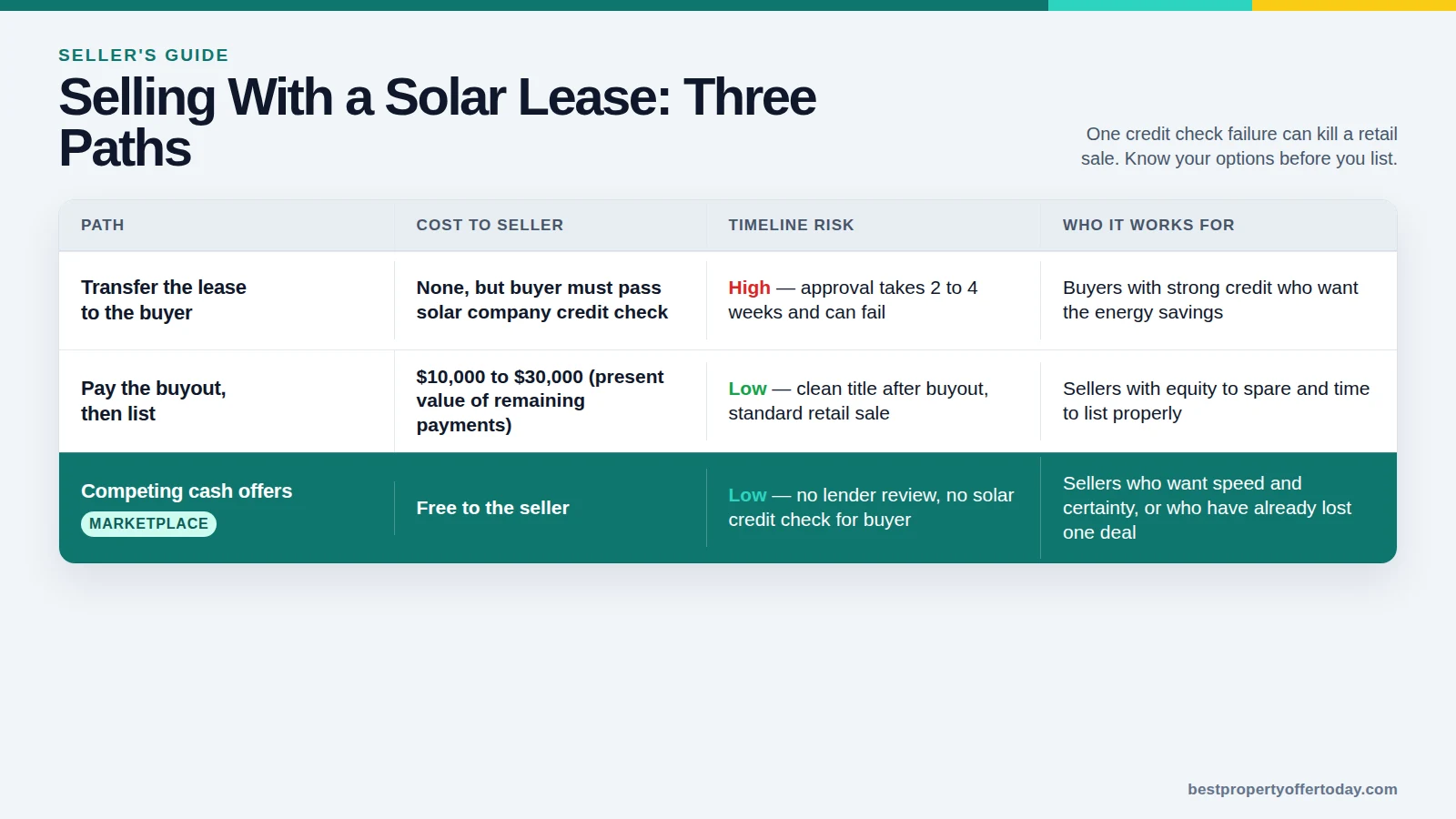
Every seller with an active solar lease faces one of three paths.
Transfer the lease to the buyer
The lease transfers to the buyer, who assumes the remaining payments. The solar company must approve this. Approval involves a credit check, and the requirements vary by company, but they typically resemble a lender’s minimum score threshold. If the buyer does not qualify, the transfer fails and the sale can fall apart weeks into the process.
The application itself adds time. The average lease transfer takes two to four weeks from application to approval. That extends a closing timeline and adds a contingency that is outside your control. A buyer who passed the mortgage pre-approval can still fail the solar company’s separate credit review, because the two use different criteria.
Buy out the lease before listing
You can contact the solar company and request a buyout quote. The buyout price is the present value of all remaining monthly payments, discounted at a rate set in the original lease agreement. Paying the buyout converts the leased system to owned equipment, which the new buyer gets as part of the sale. Once you have paid the buyout, the solar company releases the UCC-1 fixture filing and the property is clean for a conventional sale.
An owned solar system can add value to the listing, though how much depends on the local market and the age of the panels. Buyers who understand energy costs are often willing to pay a premium for owned solar. Buyers who do not understand it treat it as neutral.
Sell to a cash buyer as-is
Cash buyers do not need a mortgage, so they do not need lender approval for the fixture filing. They still need to resolve the lease, but most cash buyers price the remaining obligation into their offer and handle the transfer themselves after closing, or factor the buyout cost into their number. Either way, no credit approval from the solar company is required before the sale closes.
The practical result is that cash buyers can close on a house with an active solar lease without the risk of falling out over a credit check. That is a real difference, particularly if you have already had one retail deal collapse at the lease transfer stage.
Why lease transfers fail retail sales
Credit is the most common failure point, but not the only one. Buyers who qualify for the credit check sometimes still refuse to assume the lease. They see a monthly payment they did not plan for and decide they would rather walk away, or they use the lease as leverage to reduce their offer. A buyer who was genuinely interested in the house can turn skeptical once the solar company’s transfer paperwork arrives.
Lenders add another layer. FHA, VA, and most conventional loans require that the solar company’s fixture filing be reviewed and addressed before underwriting closes. Some lenders will not proceed until the seller provides written confirmation of the lease terms, including payment amounts and remaining term. That review typically adds a week or more to an already tight timeline and can produce conditions requiring additional negotiation.
Some buyers ask the seller to pay the buyout as a condition of closing, treating it like a repair credit. That can work, but it shifts a $10,000 to $30,000 item onto your net proceeds at a moment you were not expecting it. If you did not account for that in your pricing, it can make what looked like a good offer into a worse outcome than you had planned.
What a buyout actually costs: a worked example
Say you have a Sunrun lease that started in 2018, runs through 2038, and costs $95 per month. That is a 20-year lease. At the time of a 2026 sale, 12 years remain, meaning 144 payments of $95, or $13,680 in nominal remaining payments.
The buyout price is typically the net present value of those payments, calculated at a discount rate written into your original contract. That rate is often between 6 and 8 percent. At 7 percent, the net present value of $95 per month over 144 months is approximately $10,400.
Add any early termination fee the contract specifies, and the all-in buyout might land between $11,000 and $12,500. Before paying it, compare that figure against two others: how much the solar company adds to your listing price in the local market (owned systems often show a $5,000 to $15,000 premium in comparable sales), and what a cash buyer would deduct for assuming the lease themselves. If a cash buyer reduces their offer by less than the buyout would cost you, selling as-is may net you more. Use the net proceeds calculator to run both scenarios side by side before deciding.
How to compare your three options
These figures assume a house worth $280,000 with a solar lease running 12 years at $95 per month.
| Path | Cost to seller | Timeline risk | Works best when |
|---|---|---|---|
| Transfer lease to retail buyer | None, but buyer must pass solar company credit check | High (credit approval can fail 2 to 4 weeks in) | Buyer has strong credit and wants the energy savings |
| Pay the buyout, then list | $10,000 to $30,000 | Low (clean title after buyout) | Seller has equity to spare and time to list properly |
| Competing cash offers | None, free to seller | Low (no lender review, no solar credit check) | Seller wants speed and certainty, or has already lost one deal |
Red flags from buyers to watch for
Not every buyer who says they will handle the lease will actually follow through. A few behaviors suggest the deal is likely to fall apart before closing.
- Buyer submits an offer without asking about the lease, then discovers the fixture filing during title review and uses it to demand a price reduction
- The buyer’s agent says the client is fine with the lease but no one has contacted the solar company to start the transfer application
- A buyer asks for an unusually long inspection window on what is otherwise a straightforward cash deal
- The buyer offers to pay the buyout as a seller credit at closing, then shows no documentation that the solar company has been contacted
- An investor offers to take the house subject to the lease without disclosing how they intend to resolve the fixture filing before their eventual resale
The vetting checklist for cash buyers applies here too. A legitimate buyer who plans to assume a solar lease will have contacted the solar company before making an offer, not after.
Questions to ask the solar company before you list
Call the financing entity, not the local installer. The lease terms live with the company that holds the contract, which is often different from whoever installed the panels. Ask them:
- What is the current buyout price, and how is it calculated?
- Does the buyout price change over time, and if so, by how much per year?
- What credit score does a buyer need to qualify for lease assumption?
- How long does the transfer application take, and what documents does the buyer need to provide?
- Is there a transfer fee, and who pays it?
- Can the lease be assumed by an LLC or a trust, or only by an individual?
- Is there a prepay option, and what is that price compared to the full buyout?
Getting these answers before you list means you can tell a buyer’s agent exactly what the process looks like, which reduces the chance that the solar lease kills a deal simply because no one understood the steps involved.
When a cash sale makes more sense than paying the buyout
The buyout makes sense when the system is relatively new, the remaining term is long, your house is otherwise in excellent condition, and you have enough equity to absorb the cost without significantly affecting your net proceeds. In that scenario, a clean title produces a larger buyer pool and the owned system may add enough value to offset what you paid.
A cash sale makes more sense when the lease has already cost you one deal, when the remaining term is short enough that buyers see minimal value in assuming it, when your house has other defects that already reduce your buyer pool, or when your timeline does not allow for a second round of offer and lease approval. Receiving multiple competing cash offers lets you see how different buyers are pricing the solar liability and pick the one who values it most favorably. That competition is the thing a single-buyer negotiation cannot replicate.
The honest limits of a cash sale
A cash offer will almost always come in below what you would net in a fully marketed retail sale, solar lease aside. What you are buying is speed and certainty: no credit check contingency, no lender review of the fixture filing, no second negotiation six weeks after the first. If your house is otherwise in good condition and the only complication is the lease, a traditional listing with a buyer who qualifies to assume it may net you more money. That is worth exploring first.
Where a cash marketplace helps most is when the lease is one of several complications, when a previous deal has already fallen apart, or when your timeline does not allow for the wait-and-see approach a retail listing requires. Call 804-361-7460 to talk through your situation before committing to either path.
Does a leased solar system add value when selling?
Sometimes, but not reliably. An owned system adds value more predictably because the buyer takes on no financial obligation. A leased system can add value if the monthly payment is genuinely below what local utilities charge and the buyer qualifies to assume it, but many buyers discover the lease during the offer process and treat it as a neutral or slightly negative factor. The energy savings argument lands best with buyers who follow utility costs closely, which is not most buyers.
Can a cash buyer assume a solar lease the same way a retail buyer can?
Yes, but the solar company’s credit check still applies to the transfer. The difference is that a cash buyer does not also need lender approval for the fixture filing. Removing the lender removes one layer of review, not the solar company’s own process. A cash buyer who plans to assume the lease still needs to apply through the solar company. What changes is that the deal is not contingent on two separate credit approvals before closing.
What happens to the solar lease if the house goes through foreclosure?
A solar lease does not automatically survive a foreclosure sale. The outcome depends on whether the UCC-1 fixture filing was recorded before or after the mortgage. If the mortgage came first, the foreclosing lender can extinguish the solar company’s interest. In many cases, a buyer who acquires a property at foreclosure gets it free of the lease obligation, while the original homeowner still owes the remaining payments to the solar company as a personal debt. This is one reason solar companies generally prefer a standard sale over a distressed one and are usually willing to negotiate transfer terms quickly.
Can you stop paying the solar lease while the house is listed?
No. Stopping payments does not remove the UCC-1 fixture filing and does not end the contract. The solar company can pursue remedies, including removing the panels, which leaves roof damage and a defect you now must disclose. A default also shows on your credit and can create conditions that a buyer’s lender will require you to resolve before closing. The lease must be formally resolved through transfer, buyout, or a written agreement with the solar company before a clean title can pass to any buyer.