Chimney problems are one of the inspection items that stop financed deals cold. The issue is not always the repair cost. It is that lenders for FHA, VA, and USDA loans will not close on a house where the chimney serving an active fireplace cannot be certified as safe, and a typical home inspector is not qualified to give that certification. The buyer’s lender then holds the deal open until a licensed chimney sweep issues a clean report, and that wait ends the transaction more often than the repair does.
This post covers what chimney problems actually cost to fix, how different buyer types treat them, and the three paths available to a seller depending on how much time and money they have. If you want to run the numbers yourself first, the net proceeds calculator can show you what each path nets after commission, credits, and repair costs.
What a Level 2 Chimney Inspection Finds
A standard home inspection includes a visual check of the firebox and the visible chimney components from inside and outside. It does not include a Level 2 inspection under NFPA 211, which requires a camera scan of the entire flue interior. Buyers financing with government-backed loans often trigger a requirement for that Level 2 scan, especially if the general inspector notes any defect at all. Level 2 inspections cost $200 to $600 depending on the number of flues and the local market.
The five problems a Level 2 inspection most commonly surfaces:
- Cracked or deteriorated flue liner (the inner tile or metal sleeve that contains combustion gases)
- Spalling masonry on the exterior chimney chase (bricks breaking apart from freeze-thaw cycles)
- Damaged or absent chimney crown (the concrete collar at the top that sheds water off the masonry)
- Missing or damaged chimney cap (the metal cover over the flue opening that keeps rain and animals out)
- Heavy creosote buildup in the flue (a fire hazard; Grade 2 or Grade 3 creosote triggers a clean before any chimney work)
Each of these is a different repair with a different cost and a different lender reaction. A chimney cap is a one-hour job. A cracked flue liner is a week of scheduling and several thousand dollars.
What Each Problem Costs to Fix
Costs below are national ranges. Labor markets vary significantly, particularly between the South and the Northeast.
| Problem | Typical Repair Cost | Triggers Lender Hold? |
|---|---|---|
| Chimney cap replacement | $300 to $600 | Rarely |
| Creosote cleaning (Grade 1 or 2) | $150 to $350 | Rarely |
| Mortar tuckpointing (cosmetic) | $500 to $2,500 | Sometimes (if water damage visible) |
| Crown repair or rebuild | $500 to $1,500 | Sometimes |
| Flue relining, flexible stainless liner | $2,500 to $5,500 | Yes, on FHA and VA loans |
| Flue relining, poured HeatShield or equivalent | $5,000 to $10,000 | Yes, on FHA and VA loans |
| Full chimney rebuild from roofline | $10,000 to $30,000+ | Yes, on any loan type |
A chimney cap replacement and a creosote cleaning rarely stop a closing. A cracked flue liner almost always does on an FHA or VA loan. On a conventional loan, the lender does not typically require a Level 2 scan unless the appraiser notes a visible defect, which gives sellers more room to negotiate a credit rather than complete the repair.
How Lender Type Changes the Outcome
FHA and VA appraisers follow Minimum Property Standards set by HUD and the VA. Both require that chimneys and fireplaces be in safe working condition. If the appraiser flags a chimney deficiency, the lender conditions the loan on the repair being completed before closing. That condition cannot be waived by the borrower or the seller, and it cannot be satisfied by a price reduction or seller credit. The repair has to happen and the clearance letter has to be in the file.
Conventional loans (Fannie Mae and Freddie Mac guidelines) use the appraiser’s judgment rather than a fixed checklist. A conventional appraiser may note a chimney issue without conditioning the loan on repair, especially if the fireplace is listed as “not in use” or the home is priced to reflect the condition. This leaves room for a seller credit or price adjustment instead of the repair itself.
Cash buyers have no lender and no appraisal requirement. They decide for themselves whether to inspect the chimney at all, and many do not order a Level 2 scan unless they plan to use the fireplace. They price in the repair cost instead of requiring a repair before closing.
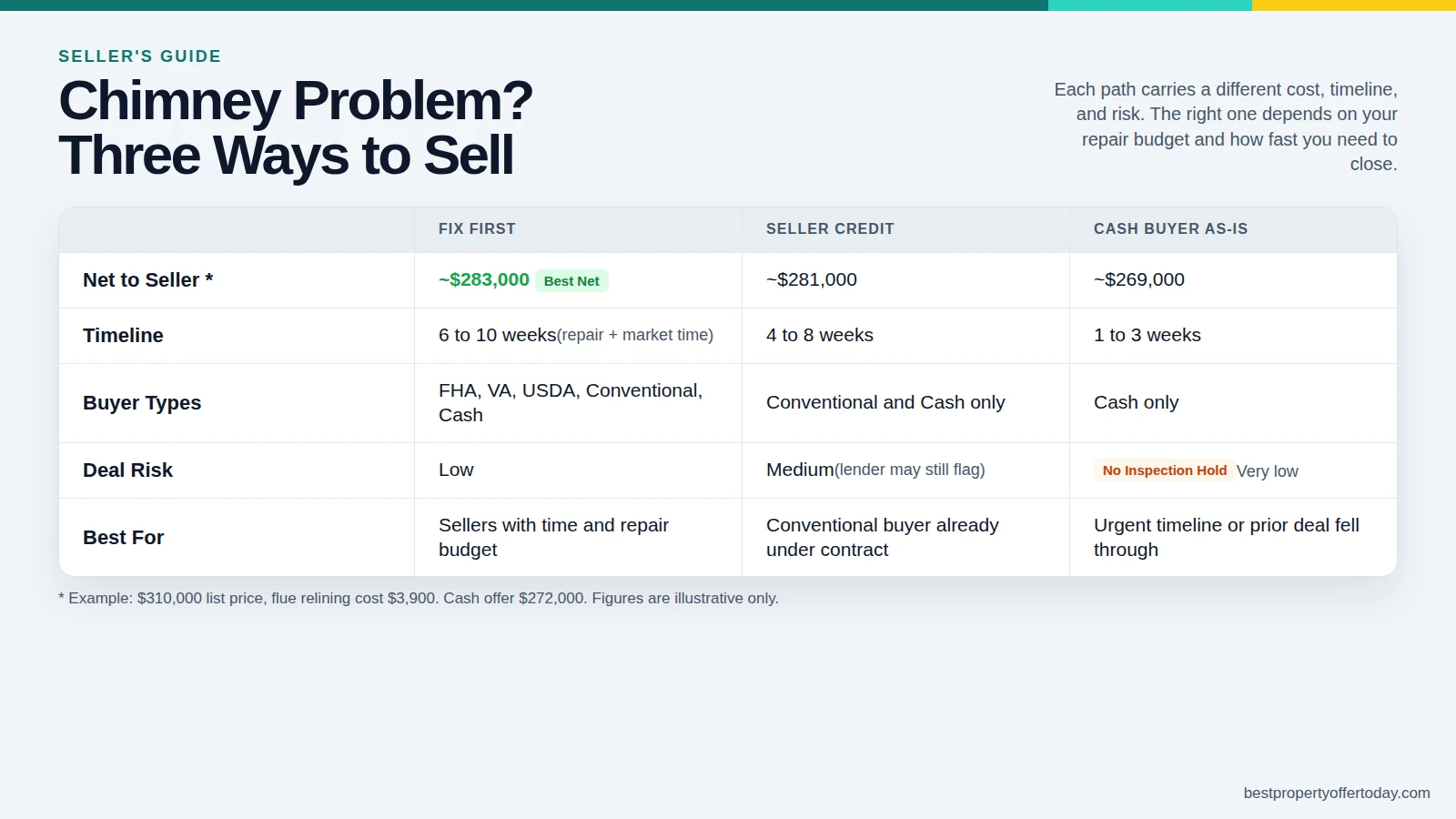
Three Paths for a Seller with a Chimney Problem
Path 1: Repair before listing
You hire a chimney specialist (not a general contractor, and not a fireplace retailer who also does sweeping as a sideline) to reline or repair the flue, get the Level 2 clearance letter in writing, and list the property with the clean chimney report attached to the listing documents. Every buyer type can now make an offer. Lenders have nothing to condition on.
The concession a buyer would have asked for is typically larger than the actual repair cost. Buyers pad estimates, and their agents know to ask for more than the lowest bid. If a flue relining costs you $3,900, a buyer under contract would likely ask for a $5,500 to $7,000 credit or a price reduction. Fixing it first often nets more than offering a credit, and it eliminates the risk of the deal collapsing during the credit negotiation.
Path 2: List with a disclosed seller credit
You disclose the Level 2 findings, attach the inspection report to the listing from day one, and reduce the price or offer a seller credit equal to your best estimate of repair cost. This works on conventional financing and for cash buyers. It does not satisfy an FHA or VA lender, who needs a completed repair. Buyers financing with government-backed loans simply cannot buy your house on this path unless they switch loan types.
The advantage: you avoid paying for a repair on a house you are leaving. The risk: your buyer pool shrinks significantly if your price point attracts FHA or VA buyers, which is common in the $200,000 to $350,000 range.
Path 3: Sell as-is to a cash buyer
A cash buyer prices the chimney problem into the offer without requiring you to fix anything first. You do not need the Level 2 report cleared. You do not need a chimney contractor on a deadline. Competing offers from multiple cash buyers, collected through a marketplace, will often spread further apart than you expect: buyers price chimneys differently based on their own repair cost assumptions and their intended use of the property.
See how to vet cash buyers before accepting any offer, and read the full comparison of cash offers versus listing with an agent to understand where the net difference goes.
Worked Example
The house is a four-bedroom colonial with a wood-burning fireplace. A pre-listing inspection reveals a cracked clay tile flue liner throughout the upper two-thirds of the chimney stack. The Level 2 report recommends relining with a flexible stainless steel liner. Three local bids come in at $3,600 to $4,200. The seller sets the list price at $310,000.
Path 1, repair and list: Seller pays $3,900 to reline and gets the clearance letter. All buyer types can now bid. After a standard agent commission of 5 percent ($15,500), seller-paid closing costs ($3,500), and the repair ($3,900), net to seller is approximately $287,100.
Path 2, list with a $5,500 seller credit: Conventional buyer accepts. After commission ($15,500), closing costs ($3,500), and the credit ($5,500), net to seller is approximately $285,500. Slightly less than path 1, and the deal only works for conventional or cash buyers.
Path 3, sell as-is to a cash buyer: Competing cash offers come in through the marketplace. The best offer is $272,000. No repair, no credit, no loan contingency, closing in 12 days. After title fees paid by seller ($2,200) and no agent commission, net to seller is approximately $269,800.
The spread between paths 1 and 3 is roughly $17,300. Whether that difference is worth the repair timeline and the risk of a financed deal collapsing is a question about the seller’s situation, not a universal answer. Someone who needs to close in two weeks and cannot float a $3,900 repair will find path 3 compelling. Someone with two months and the cash to fix it first will almost always net more from paths 1 or 2.
For a complete breakdown of what each path costs at the settlement table, see what sellers actually pay in closing costs on a cash sale.
The Honest Limits of a Cash Sale
A cash offer on a house with chimney problems will be below a fully repaired, fully marketed retail price. That is the nature of the exchange: you trade the premium for speed, certainty, no contractors, and no financing contingency risk. If the chimney problem is minor, a cap replacement or a cleaning, fixing it before listing costs almost nothing and eliminates the issue entirely. Save the cash buyer path for the situations where the repair is large, the timeline is short, or a financed deal has already fallen apart over the chimney once.
If the house is in otherwise good condition and you have time to wait for the right financed buyer, a traditional listing through an agent will almost certainly net more. That is true. Say it plainly rather than pretending the numbers are closer than they are.
Red Flags from Cash Buyers
A cash buyer who responds to a chimney defect with a verbal assurance that it will not affect the offer, then drops the number after a walkthrough or during the inspection period, is running a renegotiation tactic. The correct sequence is: buyer learns about the chimney issue during or before the offer, buyer adjusts the initial offer number to reflect it, buyer puts that adjusted number in writing. If the offer drops after acceptance, that is a price cut, not a discovery.
- Token earnest money under $1,000 on a deal in the $200,000 to $300,000 range means walking away costs the buyer almost nothing
- An inspection period of 14 or more days on a deal with a known chimney issue gives the buyer time to find a new exit reason
- An assignment clause in the contract means the buyer may sell your contract to a third party before closing, and the new buyer may want to renegotiate
- No proof of funds or a proof-of-funds letter from a business entity with no verifiable address is worth nothing
Getting three or four competing offers before accepting any one of them solves most of this. A buyer who knows you have other offers cannot renegotiate from a position of leverage.
Frequently Asked Questions
Can I sell a house with a cracked flue liner?
Yes. There is no law that requires you to repair a cracked flue liner before selling. You are required to disclose it once you know about it, which you now do. What changes is who can buy the house: an FHA or VA borrower’s lender will require the repair before the loan closes, a conventional lender may accept a credit or price reduction, and a cash buyer needs no lender approval at all. The crack does not make the house unsellable. It narrows the buyer pool.
Do I have to disclose a chimney problem to a cash buyer?
Yes. Disclosure duties attach to what you know about the property’s condition, not to how the buyer is paying. Selling as-is limits your obligation to make repairs. It does not limit your obligation to disclose known material defects. Withholding a known defect is potential fraud in every state, regardless of whether the buyer is financing or paying cash. The as-is addendum says you are not going to fix it, not that you do not have to tell them about it.
What is the difference between a chimney cap and a chimney crown?
The crown is the concrete or mortar collar that seals the top of the masonry around the flue opening and slopes water away from the bricks. The cap is the metal cover that sits over the flue opening itself, raised on legs to allow exhaust out while keeping rain and animals from entering. Both fail over time. A cap replacement is a $300 to $600 job most chimney sweeps can do in an hour, often without scaffolding. A crown rebuild costs $500 to $1,500 and usually needs staging equipment. If a home inspector calls out a crown issue, get a chimney specialist, not a roofer, to assess it.
Can I just seal and disclaim the fireplace instead of repairing it?
Yes, in most cases. If you permanently seal the fireplace and disclose it as non-functional, an FHA or VA lender’s requirement for a safe, working chimney no longer applies because the chimney is not serving an active fireplace. Some sellers do this when the repair cost is high and the fireplace adds little to the sale price in their market. The disclosure needs to be explicit: fireplace sealed, not in working condition, no chimney inspection performed. Whether a sealed fireplace affects perceived value depends heavily on the local market. In warm-weather states, it often does not matter. In regions where wood-burning fireplaces carry real value to buyers, sealing one may reduce your price more than the repair would have cost.