Sellers in a cash home sale still pay closing costs. They are smaller than in a traditional sale, but they are real, and some of them are negotiable depending on which buyer you accept. Understanding the breakdown before you sign anything is worth a few hundred dollars in most cases and worth several thousand in some.
What the seller always pays in a cash sale
Some costs belong to the seller regardless of who buys the house or how the buyer pays for it.
Transfer taxes. Most states impose a tax when a deed changes hands. The rate varies widely: Delaware charges 4% of the sale price, split between buyer and seller; Colorado charges 0.01%. On a $250,000 home, that difference spans $200 to $5,000. Some counties add a local transfer tax on top of the state one. Look up your state’s deed transfer tax before you start comparing offers, because it affects every option equally.
Owner’s title insurance. A title policy protects the buyer against claims on the property that existed before the sale. In many states, the seller customarily pays for the owner’s policy. On a $250,000 home, that runs roughly $1,000 to $1,500, depending on the title company and the state. Florida splits it by county, not by statewide rule. It is worth asking every cash buyer what their expectation is before you sign, because this is genuinely negotiable in most markets.
Prorated property taxes. You owe taxes from January 1 through the day of closing. Close in August and you owe eight months of the annual bill. On a $250,000 home with a property tax rate of 1.1%, that is roughly $1,833. It shows up as a debit to the seller on the settlement statement and is not negotiable.
HOA fees and payoff letters. If the property sits in a homeowners association, you will owe any unpaid dues, a transfer fee (typically $100 to $500), and sometimes a document preparation fee. Some HOAs also charge the buyer a capital contribution, but check whether any portion flows back through the seller side at closing.
Lien payoffs. Any lien attached to the property, including a mortgage, a HELOC, a judgment lien, or unpaid property taxes, must be cleared from your proceeds at closing. The title company handles the mechanics. If you owe $180,000 on a house that sells for $250,000, the title company wires $180,000 to your lender and cuts you a check for what remains after costs. If your liens exceed the sale price, the transaction cannot close without additional negotiation.
For more on how title issues can complicate a cash closing, see the full guide to title problems that delay cash closings.
What may be negotiated with a cash buyer
Unlike a financed buyer whose lender dictates many of the closing requirements, a cash buyer has flexibility. Some line items are genuinely up for negotiation.
Escrow or closing fee. The closing agent charges a fee for running the transaction. It typically runs $400 to $800 and is often split equally. Some cash buyers, particularly those purchasing at volume, routinely pay the full closing fee. It costs nothing to ask.
Title search fee. The title search protects the buyer. It is normally the buyer’s cost, but some sellers offer to cover it as a concession to accelerate closing. On a $250,000 transaction, that is $150 to $400.
Recording fees. The county recorder charges $50 to $150 to record the new deed. Who pays is negotiable. Many cash buyers cover it as a matter of course.
The principle that matters: what a buyer covers on closing costs is part of the offer, not separate from it. Two buyers at the same headline price but with different cost coverage produce different net proceeds. The difference can be $1,000 to $3,000 on a mid-sized transaction. When you compare competing offers, normalise by net to seller before deciding. Our net proceeds calculator can help you run those numbers side by side.
What the seller does not pay in a cash sale
The reason seller closing costs in a cash sale typically run 1 to 3% instead of 7 to 10% is mostly what you skip.
No real estate commission if you deal directly. A full listing arrangement typically costs 5 to 6% of the sale price. On a $250,000 home, that is $12,500 to $15,000 the seller avoids entirely. If you choose to have an agent evaluate the offers on your behalf, you may negotiate a flat fee, but that is different from a full listing agreement.
No lender-required repairs. A financed buyer’s lender requires anything that fails appraisal conditions to be corrected before closing. Peeling paint on a pre-1978 home, a roof with insufficient remaining life, a missing handrail. None of that applies to a cash buyer. They price the condition into the offer and move on.
No staging, no appraisal-related renegotiations, no carrying costs for six weeks on the market while the transaction works through underwriting.
A worked example on a $250,000 home
The seller has two offers: $250,000 cash and $275,000 conventional. Which nets more?
Traditional sale at $275,000: 5.5% commission ($15,125) + owner’s title insurance ($1,200) + transfer tax at 1% ($2,750) + prorated property taxes ($1,600) + escrow split ($450) + miscellaneous recording and fees ($400) = roughly $21,525 in costs. Net proceeds before repairs: $253,475. After the inspection, the buyer’s lender flagged $3,800 in required repairs, which the buyer negotiated as a credit. Final net: $249,675.
Cash sale at $250,000, standard terms: owner’s title insurance ($1,100) + transfer tax at 1% ($2,500) + prorated property taxes ($1,600) + escrow split ($450) = $5,650 in costs. Net proceeds: $244,350. No repair concessions.
The traditional sale wins by about $5,300 in this scenario. But if the required repairs had come in at $8,000 instead of $3,800, that margin shrinks to $1,600. If the cash buyer had agreed to cover the escrow fee and recording costs, the gap shrinks further. And if the property had needed $12,000 in lender-required work, the cash offer would have netted more.
This is the calculation worth running: not offer price against offer price, but net proceeds against net proceeds with carrying costs, repair risk, and time included. The free calculator on this site walks through that comparison.
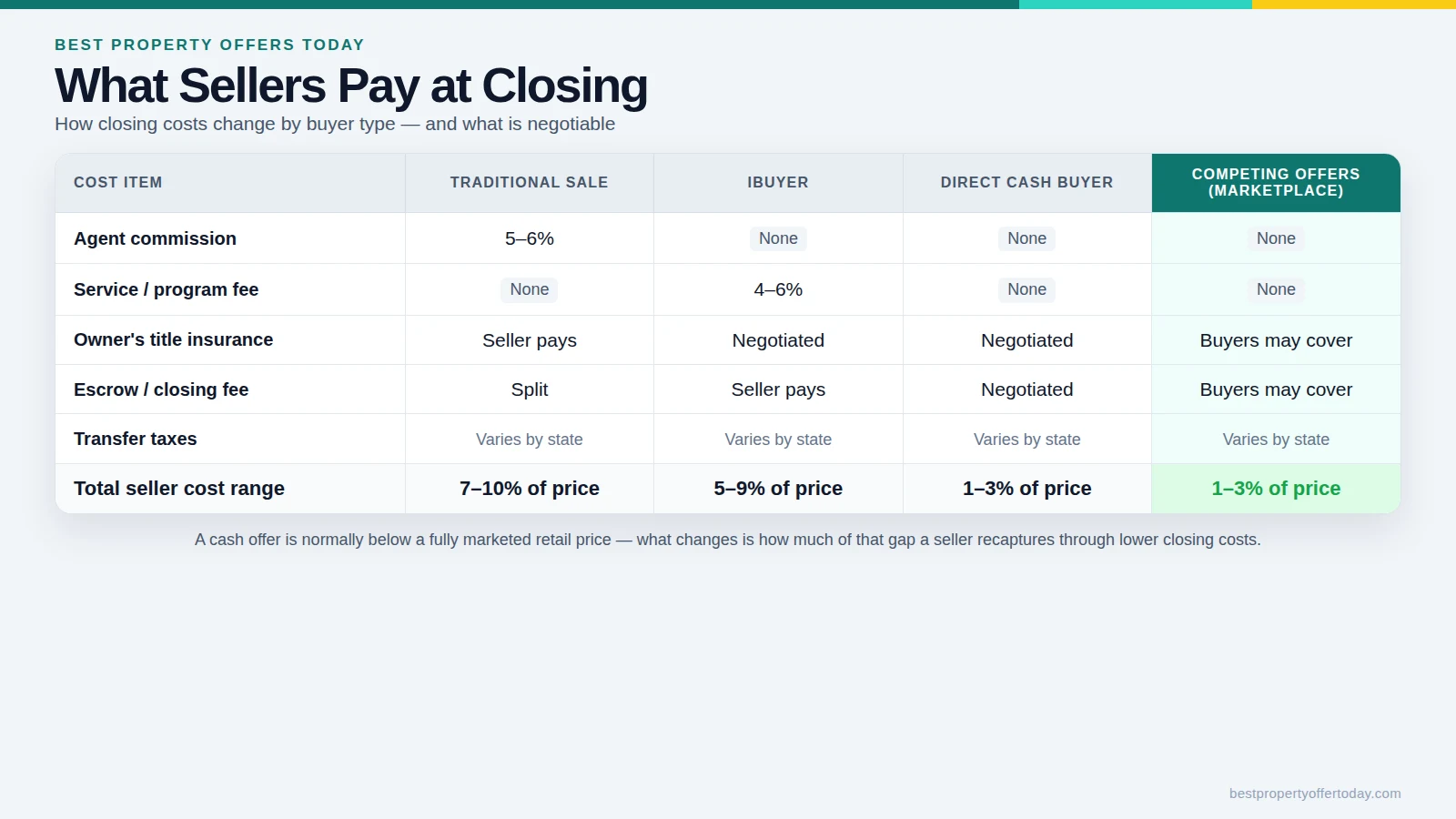
Closing costs by buyer type
| Buyer type | Typical seller closing costs | Commission? | Repair renegotiation risk |
|---|---|---|---|
| Traditional buyer (financed) | 2 to 4% of sale price | Yes, typically 5 to 6% | High: lender and buyer inspection both trigger it |
| iBuyer (Opendoor, Offerpad) | 1 to 3%, plus service fee | No commission, but 4 to 6% service fee | Medium: post-inspection deductions common |
| Single cash buyer (investor) | 1 to 3% | None | Low: condition priced in at offer stage |
| Competing cash offers (marketplace) | 1 to 3%; buyers may cover some line items | None | Low: negotiated once at offer stage |
State rules that shift the math
Thirteen states and Washington DC require a licensed attorney at closing. Those states include Georgia, South Carolina, Massachusetts, Connecticut, Delaware, New York, Vermont, North Carolina, West Virginia, Alabama, Mississippi, Louisiana, and South Dakota. Attorney fees typically run $500 to $1,500 and usually fall to the seller. If you are in an attorney state, this is a fixed cost, not a negotiated one.
Transfer taxes vary enough to change the calculation significantly. Pennsylvania’s realty transfer tax is 2%, and many municipalities add their own on top. Pittsburgh adds another 2% local tax, for a combined 4% on the transaction. On a $250,000 home, that is $10,000 in transfer taxes alone, split by custom. In states with no transfer tax, such as Texas, Wyoming, North Dakota, Montana, and Indiana, this line item is simply zero.
Red flags in closing cost conversations
Some cash buyers use closing cost coverage as a negotiating tactic that does not actually help you. Watch for these:
- A buyer who offers to “cover all closing costs” but submits a headline number 5% below every competing offer. Run the net math before you respond.
- A closing disclosure or HUD-1 you see for the first time on closing day. You are entitled to a draft at least three business days before closing.
- Buyers who cannot name the closing attorney or title company until a few days before the scheduled date. That can indicate the contract may be assigned to a third party before closing. See the post on what a wholesaler is and how to spot one for the full explanation.
- Earnest money below 1% of the purchase price. A buyer who risks losing $500 on a $250,000 transaction has almost no financial reason to complete it. That matters if something better comes along for them after you have taken the house off the market. For more on what a reasonable deposit looks like, see how much earnest money is enough in a cash sale.
Questions to ask a cash buyer before signing
- Who serves as the closing agent, and who pays their fee?
- Will you pay for the owner’s title insurance policy, or is that my cost?
- Who covers the recording fees?
- Is the price you quoted fixed, or can it change after your inspection?
- What is the earnest money deposit, and when does it become non-refundable?
- Are you buying this directly, or could the contract be assigned to another buyer?
Can I sell for cash without paying any closing costs?
No. Some line items, including prorated property taxes, lien payoffs, and deed transfer taxes, are the seller’s obligation regardless of what the buyer agrees to cover. The realistic floor for seller-side costs in a cash sale is around 1% of the sale price, and that assumes the buyer covers the title search, the escrow fee, and recording fees.
Do I need a title company if I am selling to a cash buyer?
Yes. A title company or closing attorney protects you, not just the buyer. They verify the title is clean, pay off your existing mortgage from proceeds, handle the transfer taxes, and record the new deed. A cash buyer who suggests skipping the title company to “save money” is a red flag. The savings, if any, are not yours.
What happens if the cash buyer pays all closing costs?
Your net proceeds go up by whatever those costs would have been, typically $1,500 to $4,000 on a median-priced home. That is worth negotiating. When you have multiple competing offers at similar headline prices, asking each buyer to cover the escrow fee and recording costs is a reasonable counter that experienced buyers will often accept.
How does a marketplace change what I pay at closing?
When you receive competing cash offers through a marketplace rather than approaching a single buyer, you can compare not just the headline price but also which costs each buyer is willing to cover. A buyer at $240,000 who covers the escrow fee and title search may net you more than a buyer at $242,000 who asks you to split everything. Competition between buyers creates pressure to sharpen both the price and the terms. That comparison is what this guide on normalising competing cash offers covers in full.
The honest trade-off
A cash offer is almost always below what a fully marketed sale on the open market would produce. That is not a flaw in the process. It is the trade. What the seller buys with the difference is speed, certainty, no lender-required repairs, and no carrying costs through a 45-day escrow. If the house is in good condition and the seller has time, a traditional listing will usually net more. If the property is not in condition for a financed sale, or the seller needs to close in two to three weeks, the math changes.
Comparing cash buyers through a marketplace costs nothing and carries no obligation to accept any offer. Offers typically come back within 24 to 48 hours. If you want to see what buyers in your area will pay on your specific property, the request form is on the homepage. Or call 804-361-7460.