A cash sale is faster than a financed one, but it is not immune to title problems. The buyer’s money is ready. The lender is not in the picture. What can still slow everything down is the title search, because the title company has to confirm that the seller can actually transfer clean ownership before anyone signs anything.
Most sellers do not know what is in their chain of title until the search comes back. Some of what surfaces is small and clears in days. Some of it adds weeks. A few problems can push a closing back by months, or in rare cases force a renegotiation.
The list below covers what shows up most often, how long each issue typically takes to resolve, and what a seller can do while the title work is underway.
What a title search actually checks
A title examiner traces the ownership history of the property, usually going back 30 to 60 years. They are looking for anything that could give someone else a claim on the property or the proceeds of its sale.
That includes recorded liens, court judgments, unpaid property taxes, deed errors, missing signatures, unreleased mortgages, easements, and encroachments. In a cash sale, no lender is ordering this search, so the buyer’s title company orders it. Most cash buyers require title insurance as a condition of closing.
What surprises sellers is that many title problems come from transactions they were not party to. A lien filed 15 years ago by a contractor who worked for a previous owner. A judgment against a former spouse whose name was still on the deed. A mortgage that was paid off in 2009 but never formally released at the county recorder’s office.
Unreleased mortgages
These are the most common finding in a title search, and they are usually fixable.
A mortgage shows up as a lien until a release, also called a satisfaction of mortgage, is recorded at the county. When a loan is paid off, the lender is supposed to record that release within 30 to 90 days, depending on the state. Many do not, especially after a refinance or a payoff to a bank that was later acquired or merged. The original lender may no longer exist, which complicates the paperwork.
Fixing an unreleased mortgage usually means tracking down the lender’s successor, requesting the release, and getting it recorded. That process typically takes two to four weeks. In some states, a title attorney can substitute an affidavit of lost release if the original lender is gone and no successor can be found.
Unpaid contractor liens, also called mechanic’s liens, follow the same logic. They attach to the property, not to the person who hired the contractor. A lien filed against a previous owner still shows on the title. If the contractor cannot be located or is out of business, the title company may require a court order or a bond to insure over it.
Judgment liens against the seller
A court judgment for an unpaid debt can attach to any real property the debtor owns in the county where it is filed. This includes credit card judgments, medical debt, and business disputes. The judgment sits on the title until it is paid or it expires, which varies by state. Many states allow creditors to renew judgments before they expire, so a 10-year-old judgment may still be active.
If the judgment is against the current seller, the amount is typically paid from closing proceeds. The title company contacts the judgment creditor, gets a payoff figure, and handles the satisfaction at closing. This is usually the cleanest kind of title problem to resolve, because the math is simple and the path is clear.
Judgments against a prior owner are more complicated. If the former owner’s name resembles a current name on the deed, the title examiner has to rule out whether they are the same person. Common names create ambiguity. Resolving it may require an affidavit, a court order, or a letter of indemnity from the title insurer.
Heirs who never signed
When a homeowner dies and the property passes to heirs, every heir with a legal interest has to sign the deed at closing. If one heir is missing, estranged, deceased themselves, or has never been located, the title cannot convey cleanly.
This is one of the harder problems to resolve on a tight timeline. If the heir is alive and findable, getting their signature is a matter of coordination, sometimes across states or countries. If the heir has died and left their own estate, a separate probate process may be required before their interest can be transferred to anyone else.
Sellers dealing with an inherited property should order a title search before requesting offers, not after accepting one. Finding this problem two weeks before a scheduled closing is far worse than finding it two months earlier. The probate overview covers what the court typically requires and roughly how long each step takes in most states.
Boundary problems and survey disputes
A survey compares the physical boundaries of the property against what the deed and county records say. Gaps between the two are called encroachments or boundary discrepancies.
Common findings: a fence built two feet inside the neighbor’s property line. A driveway that crosses onto an adjacent parcel. A garage or storage shed that sits partly outside the legal lot. Any of these can block a transfer if the affected neighbor refuses to cooperate.
Small discrepancies are sometimes resolved with a boundary line agreement signed by both neighbors and recorded at the county. Larger disputes may require a new survey from a licensed surveyor, a negotiated adjustment to the deed, or in contested cases a quiet title action in court. A quiet title action can take three to six months, occasionally longer depending on the court’s docket.
Open permits from prior work
An addition, garage conversion, or finished basement that was built without permits creates a title complication, but cash buyers can often absorb it. That is one genuine advantage of an all-cash transaction: no lender is in the chain ordering repairs before the appraisal clears.
Where unpermitted work shows up on a title search is when a prior owner pulled a permit but never got a final inspection, leaving an open permit on the county record. Open permits can block a transfer in some jurisdictions. Closing one requires contacting the local building department, scheduling an inspection, and addressing whatever the inspector finds. That process takes two to four weeks in most municipalities, though backlogs in some cities stretch it further.
Whether the buyer accepts or requires resolution depends on their investment strategy and whether title insurance will cover it. Sellers should ask both questions before assuming the problem will be waived. If the title issue is specifically an unpermitted addition, this guide covers what to expect: appraisal exclusion, retroactive permit timelines, and how cash buyers price the discount.
Errors in public records
A misspelled name in a deed. A wrong legal description that references an adjacent parcel. A clerical error in a recorded mortgage release that cites the wrong property address. These are more common than most sellers expect, and correcting them requires a corrective deed or a scrivener’s affidavit signed by all parties to the original instrument and re-recorded at the county.
Most recording errors clear in one to two weeks once the parties are located and the corrective document is prepared. The difficulty is tracking down people from a deed recorded 20 or 30 years ago.
What a cash sale can and cannot skip
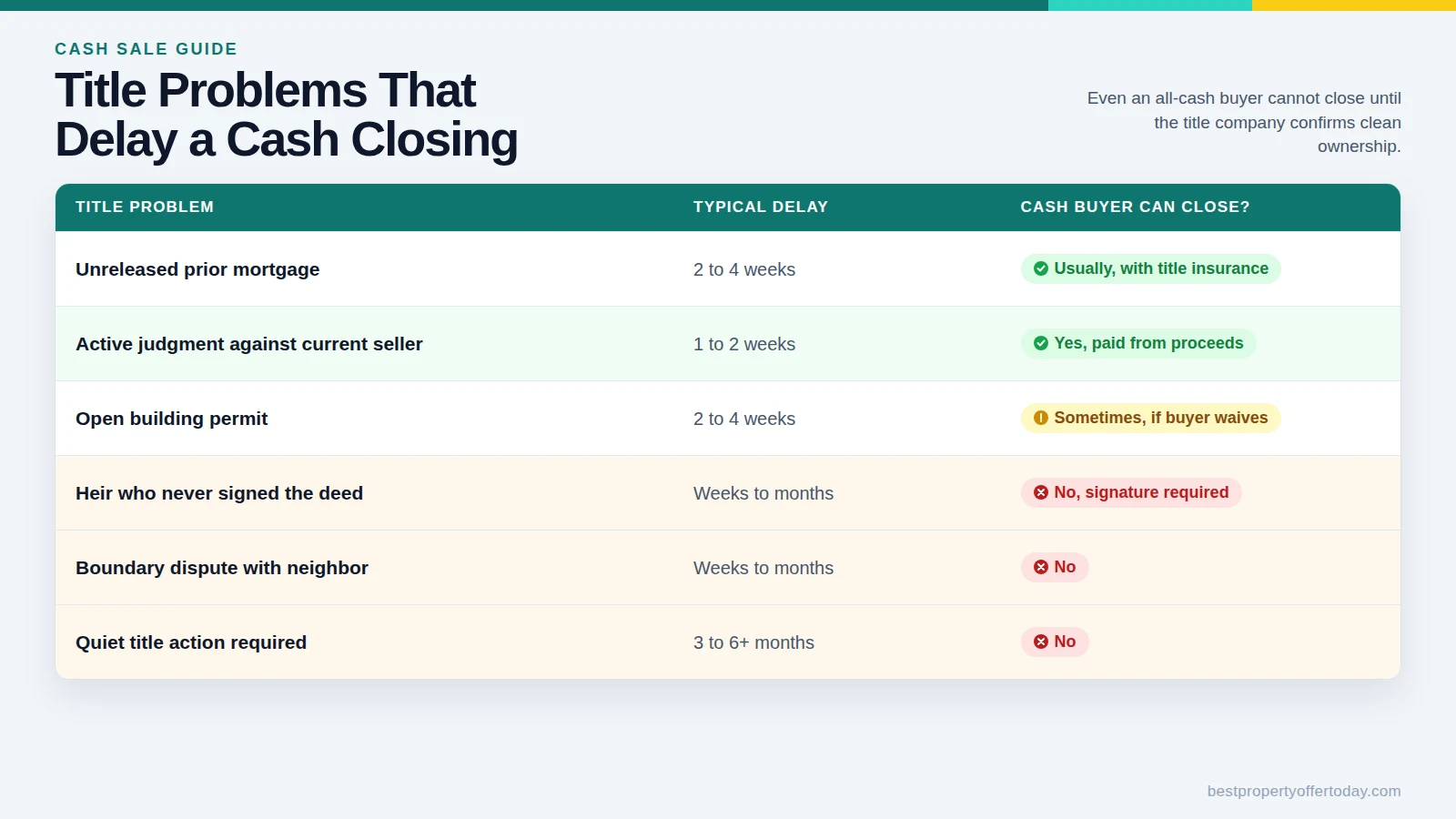
| Title problem | Typical delay | Can a cash buyer absorb it? |
|---|---|---|
| Unreleased mortgage from a prior payoff | 2 to 4 weeks | Usually, with title insurance |
| Active judgment against current seller | 1 to 2 weeks, paid at closing | Yes, deducted from proceeds |
| Heir who never signed | Weeks to months | No, signature is required |
| Open permit on unpermitted work | 2 to 4 weeks | Sometimes, if buyer waives it |
| Boundary dispute with neighbor | Weeks to months | No, deed cannot convey disputed land |
| Quiet title action required | 3 to 6 months or more | No |
A cash buyer skips lender-ordered repairs, appraisal conditions, and financing contingencies. Title work is not something they skip. The title company works on behalf of both parties and the title insurer. If the chain of ownership is not clean, the policy will not issue, and most buyers will not close without it.
A worked example: what a title delay actually costs
Suppose a seller has a house worth $280,000 and accepts a cash offer of $245,000. The title search comes back with two findings: an unreleased mortgage from a 2013 refinance, and a $7,400 judgment lien from a 2019 credit dispute.
The unreleased mortgage takes three weeks to resolve. The title company locates the successor bank, requests a release, and records it. The seller pays $150 in recording fees.
The judgment is paid from closing proceeds. The creditor accepts the full $7,400 and provides a satisfaction of judgment, which is recorded at closing.
Closing happens five weeks after acceptance instead of the two weeks the buyer originally quoted. The seller nets $245,000 minus the $7,400 judgment, minus roughly $2,100 in title, recording, and transfer costs: approximately $235,500. The three extra weeks of carrying costs, property taxes, and utilities on a $280,000 house run about $1,200 to $1,800 depending on the market.
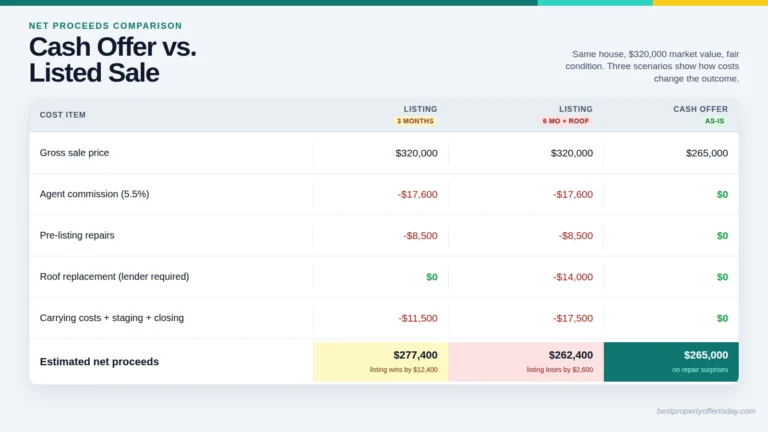
For context: if the same seller had listed with a traditional agent, the timeline from listing to close typically runs 60 to 90 days in a normal market. Commission at 5 to 6 percent would have been $14,000 to $16,800. The judgment would still need to be paid. Net in that scenario would have been closer to $255,000 if the house sold at full retail price, assuming the buyer’s inspection did not trigger further price concessions.
A cash offer is normally below a fully marketed retail price. If the house is in good condition and the seller has time, a traditional listing usually nets more. A title problem does not change that math. It only affects the timeline.
Questions to ask before the closing date is set
A seller who asks these questions early gets time to resolve findings before a date is locked in.
- Has the title search come back, and what did it find?
- Is there an unreleased mortgage from any prior refinance or payoff?
- Are there any open permits on the property?
- Does every person on the current deed plan to sign at closing?
- Was the property inherited, and if so, has probate been completed?
- Are there any recorded easements or encroachments on the survey?
- Has the boundary ever been disputed with a neighboring parcel?
For a full breakdown of how cash offers compare to a traditional listing on the net proceeds side, the cash vs listing comparison walks through the numbers. For how quickly a clean cash sale actually moves once title is clear, the timeline guide covers each step from accepted offer to funded closing. If a lien is the specific issue, the selling with liens guide goes deeper on IRS and judgment payoffs.
Sellers who want to submit a property and receive competing offers from vetted buyers can do so through the form at bestpropertyoffertoday.com. Requests are free and carry no obligation to accept any offer. Call 804-361-7460 with questions.
Can a cash buyer close if there is an active lien on the property?
Usually yes. Most liens are paid from closing proceeds at settlement. The title company coordinates the payoff and records the satisfaction. The buyer does not need to manage that negotiation directly.
How long does it take to fix a title problem?
It depends on the type. An unreleased prior mortgage or a small recording error typically clears in one to three weeks. Missing heirs, boundary disputes, or titles requiring a quiet title action can take months. The range is wide because the timeline depends on who needs to be located and whether they cooperate.
Does the seller pay to fix title problems?
Sometimes. Recording fees for a corrective deed are minor, typically $50 to $200. Hiring a title attorney to chase an old release or draft an affidavit might run $500 to $1,500. A quiet title action can cost $3,000 to $8,000 or more in attorney fees depending on the jurisdiction. Judgment liens and other money claims are paid from sale proceeds, not out of pocket before closing.
What if the title problem cannot be resolved before the buyer’s deadline?
Most cash purchase contracts include a title contingency. If clean title cannot be delivered by the closing date, the buyer can extend the contract, reduce the offer price to reflect the unresolved risk, or walk away. Getting competing offers through a marketplace means the seller has more than one option if the first buyer exits. For more on what happens when a buyer backs out before closing, the earnest money guide covers what the contract typically entitles each party to.
If the title search clears but you want to understand what coverage the buyer carries after closing, the guide to what title insurance actually covers in a cash sale explains the difference between a lender policy and an owner policy, and why a cash buyer may have neither.
HOA assessment liens are a separate category that surfaces frequently in title searches and does not require a court judgment to attach. An association can record a lien automatically after dues become delinquent, and by the time it shows on a title report, late fees, interest, and attorney fees have often doubled the original balance. The full mechanics of how HOA liens resolve at closing, including why financed buyers face more restrictions than cash buyers, are covered in the guide to selling a house with delinquent HOA dues.
Sewer line problems are not a title issue, but they land in a similar place for financed buyers: a lender-required repair condition that can delay or derail closing. The scope inspection surfaces during due diligence, and FHA and VA lenders typically will not fund until the sewer lateral is repaired and re-inspected. Cash buyers skip that requirement entirely, pricing the repair as a line item in their offer rather than a condition on funding. The full breakdown of how each path compares on net proceeds is in the guide to selling a house with sewer line problems.
Solar lease fixture filings are a different category of title flag: not a debt but a third-party ownership interest recorded against the property. A UCC-1 financing statement filed by a solar lessor shows up in a title search the same way a lien does, and financed buyers need lender review and approval before underwriting closes. Cash buyers bypass that lender layer, though the solar company credit check for lease assumption still applies. The full mechanics of each exit path are in the guide to selling a house with a solar lease.