Yes, you can negotiate a cash offer on your house. How much you can move the number depends on who made it, how they calculate their margin, and whether they have any competition.
The short version: a single buyer walking in with an offer has little reason to raise it without pressure. Multiple buyers competing on the same property is a different situation entirely. That pressure is exactly what a marketplace is built to create.
Why cash buyers have a range, not a fixed number
Most cash buyers, whether they are iBuyers, independent investors, or franchise operations, do not start with a single hard number. They start with a formula.
The most common one works like this: take the after-repair value (what the house will sell for once it is marketable), multiply by a target percentage, then subtract the estimated cost of repairs, holding costs, and transaction fees. What remains is the maximum they can offer and still clear a return on the deal.
That target percentage usually runs between 65 and 80 percent of ARV, depending on the buyer type and how competitive they want to be. A wholesaler working a thin margin might start at 60 percent. An iBuyer with scale and predictable renovation costs might go as high as 85 percent before post-inspection deductions.
The formula has flex in it. If a buyer’s estimate of your repair costs is higher than the work actually requires, there is room. If they underestimate the ARV, there is room. And if they want the property more than they are letting on, there is room for that reason too.
What actually moves a cash offer up
Competition is the most reliable tool. When a buyer knows there are other offers on the table, they face a real cost for lowballing: losing the deal. That changes their calculation in a way that simply asking for more does not.
These factors can also improve an offer, or at least make it easier to get a better one:
- A clean title. Buyers price uncertainty. If you can show a recent title search with no open liens, they have less risk to pad for.
- Quick access for inspection. Buyers who can inspect and close fast take less holding cost risk. Some will reflect that in a slightly better number.
- Flexible closing date. If you can give a buyer a longer runway, you reduce their carrying cost uncertainty. Some will pay slightly more for that flexibility.
- Accurate condition disclosure. A house accurately described as rough is easier to price than one where the buyer suspects hidden problems. Surprises get priced in as risk, and that risk lowers the offer.
These factors rarely close a wide gap. A buyer who needs a 30 percent margin to make the deal work will not go to 15 percent because you offer a flexible close date. But at the edges, they matter.
What does not move a cash offer
Telling a buyer what you need does not move the price. If you need $250,000 to pay off your mortgage and they have calculated $210,000 as their ceiling, your financial need is not their problem.
Retail comparables from your neighborhood carry less weight than you might expect. A cash buyer already knows what houses sell for in your area. They are pricing the cost and time to get yours there, which is a different question entirely.
Urgency on your side can actually move things in the wrong direction. A buyer who knows you need to close by the end of the month has less reason to come up on price. They will simply wait you out, or use the deadline as justification for a reduction after signing.
A worked example: one offer versus competing offers
Say your house has an estimated as-repaired value of $320,000. It needs about $35,000 in work: a roof replacement, a kitchen update, and some flooring.
A single cash buyer using a 70 percent ARV formula would land around $224,000 before their own transaction costs. After holding costs and fees, they offer $205,000. You counter at $220,000. They say they can go to $212,000 and that is their best number. You have no way to know whether that is true.
Now run the same property through a marketplace. Three offers come back within 48 hours:
- Buyer A: $204,000
- Buyer B: $215,000
- Buyer C: $223,000
Buyer C arrived at $223,000 because they have lower renovation costs or a more efficient exit, or both. That is their real number, not a negotiating position. You can see it in context. And Buyer B, who came in at $215,000, may raise when they know what they are competing against.
You now have actual information instead of a guess. The structure of the process created the negotiation for you.
How negotiable each buyer type actually is
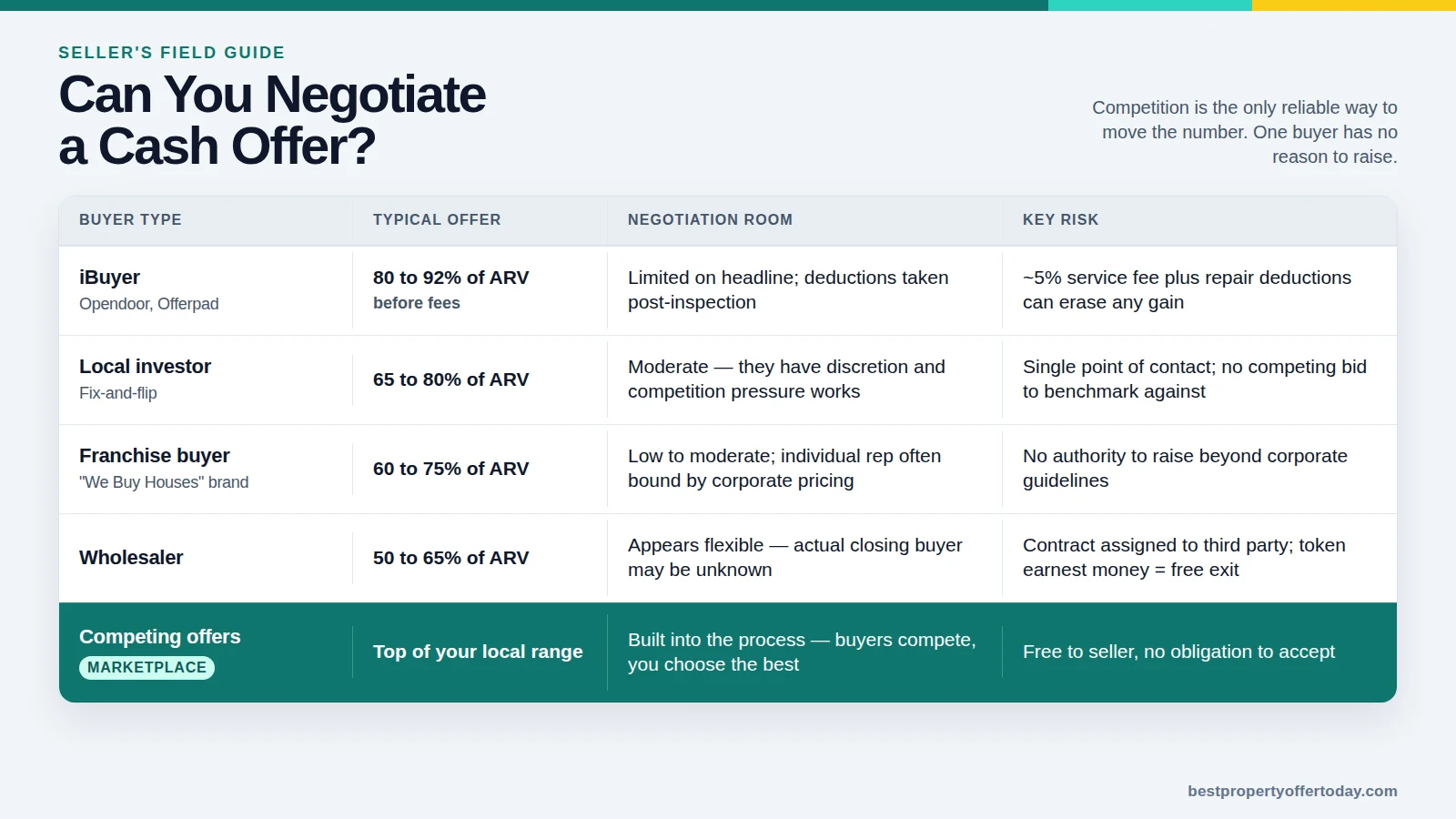
| Buyer type | Typical offer | How negotiable | What to watch for |
|---|---|---|---|
| iBuyer (Opendoor, Offerpad) | 80 to 92% of ARV before fees | Limited on headline price; deductions happen post-inspection | Service fees of ~5% plus repair deductions can wipe out any negotiated gain |
| Local investor / fix-and-flip | 65 to 80% of ARV | Moderate; they have discretion | Competition pressure works better than asking directly |
| Franchise cash buyer | 60 to 75% of ARV | Low to moderate; often bound by pricing guidelines | Individual rep may have limited authority to raise the offer |
| Wholesaler | 50 to 65% of ARV | Appears flexible; actually not | Contract may be assigned to a buyer you never meet; low earnest money means a free exit |
| Marketplace (competing offers) | Top of the local range | Built into the structure | Competition between buyers replaces point-to-point negotiation |
For a closer look at how iBuyers structure their fees and where the real deductions happen, see how Opendoor and Offerpad handle fees.
Red flags that suggest a buyer has no room or no intent
Some signals tell you the offer is near the buyer’s real ceiling. Others signal something more concerning.
- They cannot explain the number. A buyer who has done the math can walk you through the ARV, the repair estimate, and the margin. “This is just what we can do” is not an explanation.
- Token earnest money. Under $1,000 on a $200,000 deal usually means the buyer plans to assign the contract to a third party and has nothing to lose by walking. How to identify a wholesaler before you sign covers what to look for.
- A 48-hour closing promise. Title work cannot clear in 48 hours under normal circumstances. It usually means they want a signed contract before you have time to get competing offers.
- Price drops after inspection on an as-is sale. You agreed to sell as-is, which limits the duty to repair, not the right to renegotiate. Post-signing price reductions on as-is deals are a common pressure tactic.
See how to verify whether a cash buyer is legitimate before you sign anything.
The honest case for a traditional listing
Whatever you negotiate, a cash offer will almost always land below a fully marketed retail price. The buyer is taking on repair costs, market risk, and the time cost of an exit. They need a margin to make the deal work, and that margin comes from somewhere.
If your house is in good condition and you have two or three months available, a traditional listing with a real estate agent will usually net you more. The commission is real, and so are the carrying costs, but they are typically smaller than the spread between a cash offer and what a financed buyer would pay on the open market.
The cases where cash makes sense despite the lower price: the property needs substantial work that financed buyers cannot purchase into, you have a title or tenant situation that complicates a traditional sale, you need certainty of close, or you cannot manage showings, inspections, and the renegotiation risk that comes with a contingent offer.
Use the net proceeds calculator to run the actual numbers for your situation before deciding. The difference between a cash sale and a listed sale is not always as large as it looks at first, but it is rarely zero.
Questions to ask before you counter or accept
These deserve a real answer before you sign anything:
- How did you calculate this number? Walk me through the ARV and repair estimate.
- What is the earnest money deposit, and under what conditions do I keep it if you walk?
- Are you the closing buyer, or will this contract be assigned to someone else?
- What would trigger a price reduction after your inspection?
- What is your actual closing date, not your earliest possible one?
The answers will tell you whether you have a serious offer or a placeholder.
Does collecting multiple offers take more time?
Usually one to three business days more than accepting a single offer outright. On a sale that closes in two to three weeks either way, that difference rarely matters. The better question is whether one extra day is worth knowing your highest available offer.
Can you negotiate with an iBuyer?
The headline number has limited flex. iBuyers typically take back margin through post-inspection deductions, which are itemized and harder to contest than a headline price adjustment. Negotiating before you accept the initial offer is easier than disputing a deduction after their team has walked the property. Whether Opendoor and Offerpad are still active in your area in 2026 is also worth confirming before you spend time on a request that goes nowhere.
What if the offer drops after you already agreed?
Once you have signed a purchase agreement, your options narrow significantly. Cash contracts typically waive financing and inspection contingencies for the buyer, so the usual exit paths are closed. Backing out as the seller generally means returning the earnest money, and depending on your state and the contract language, may expose you to a specific performance claim. The time to negotiate is before you sign, not after.
Is a higher number always the better offer?
Not always. Earnest money, assignment clauses, the actual closing timeline, and the buyer’s track record all affect the real value of an offer. A $210,000 offer from a buyer who puts up $5,000 in earnest money and has a history of clean closings may be worth more than a $218,000 offer from someone depositing $500 who intends to find a third-party buyer before closing. How to compare cash offers side by side covers what to normalize before making that call.
If you want to see what competing cash offers on your property would actually look like, the offer request form takes about two minutes and carries no obligation to accept anything. Offers typically come back within 24 to 48 hours.