Selling a House With a Failed Septic System: Options and Costs
Yes, you can sell a house with a failed septic system. What you cannot do is pretend the failure did not happen, and you cannot expect a buyer using an FHA, VA, or USDA loan to close on it without a fix. Those two facts shape every decision that follows.
A failed septic system is one of the more expensive surprises in a real estate transaction. Replacement costs range from around $15,000 for a straightforward conventional system in good soil to $50,000 or more when the lot requires an engineered mound system or the drain field has contaminated surrounding ground. The cost range is wide because the soil controls the design, and the design controls the price.
This post covers what “failed” actually means, why it blocks certain buyers, what your four realistic options cost, and what to look for in any buyer who tells you the problem does not matter.
What a failed septic inspection actually means
Septic inspectors assess the tank, the distribution box, and the drain field. A failure can come from any of those three components. The most expensive failure is a saturated drain field, which means the soil can no longer absorb effluent at a safe rate. That usually requires a new field, and sometimes a new tank as well.
A tank failure is cheaper. A cracked or deteriorated tank can sometimes be repaired for $1,500 to $3,000 or replaced for $3,000 to $5,000. Drain field replacement is where costs climb steeply, typically $10,000 to $30,000 for a standard gravity-fed system, and higher when the lot is small, the soil is dense clay, or the system needs to be engineered.
Some states treat a failed inspection as a legal condition of sale. Massachusetts, under Title 5, requires that a system failing inspection be replaced within two years of the failure, and that timeline applies whether or not the house sells. If your state has a similar rule, a cash buyer does not exempt you from it. The replacement obligation follows the property, not the transaction.
Why a failed septic blocks most loan types
FHA, VA, and USDA loans all require the property to meet minimum property standards at closing. A failed septic system fails those standards. The lender will not fund the loan until the system is repaired or replaced and a passing inspection is on file. There is no way around this with those loan types.
Conventional loans backed by Fannie Mae and Freddie Mac also have guidelines on sanitation systems. In practice, many conventional lenders will not underwrite a property with a documented septic failure either. The loan officer’s hands are not always as free as they suggest.
This matters for pricing. When you take FHA and VA buyers out of the pool, you lose a significant share of active buyers in most markets. The buyers who remain must either pay cash or use conventional financing with a lender willing to proceed. A price reduction alone does not solve the problem for sellers hoping to keep the full buyer market open.
What septic replacement costs: the factors that move the number
The range is genuinely wide, and the number depends on four things: lot size, soil type, local permit requirements, and whether the existing tank can be reused.
| Scenario | Typical replacement cost |
|---|---|
| Tank only (cracked, deteriorated) | $3,000 to $6,000 |
| Conventional gravity drain field, good soil | $10,000 to $20,000 |
| Mound system (high water table or poor perc) | $20,000 to $40,000 |
| Engineered alternative system, tight lot | $30,000 to $50,000+ |
Permit fees, engineering reports, and inspections add to those numbers. So does the time the system is out of service, which can affect whether the house is habitable during the work. If you are living in the home during a repair, you may need to rent a portable sanitation unit for several weeks.
Get two or three licensed septic contractor bids before you accept any offer that includes a repair credit. An estimate from a single contractor gives a buyer’s agent too much room to negotiate the credit up. Three estimates give you a defensible number.
Your four options, and what each one costs in practice
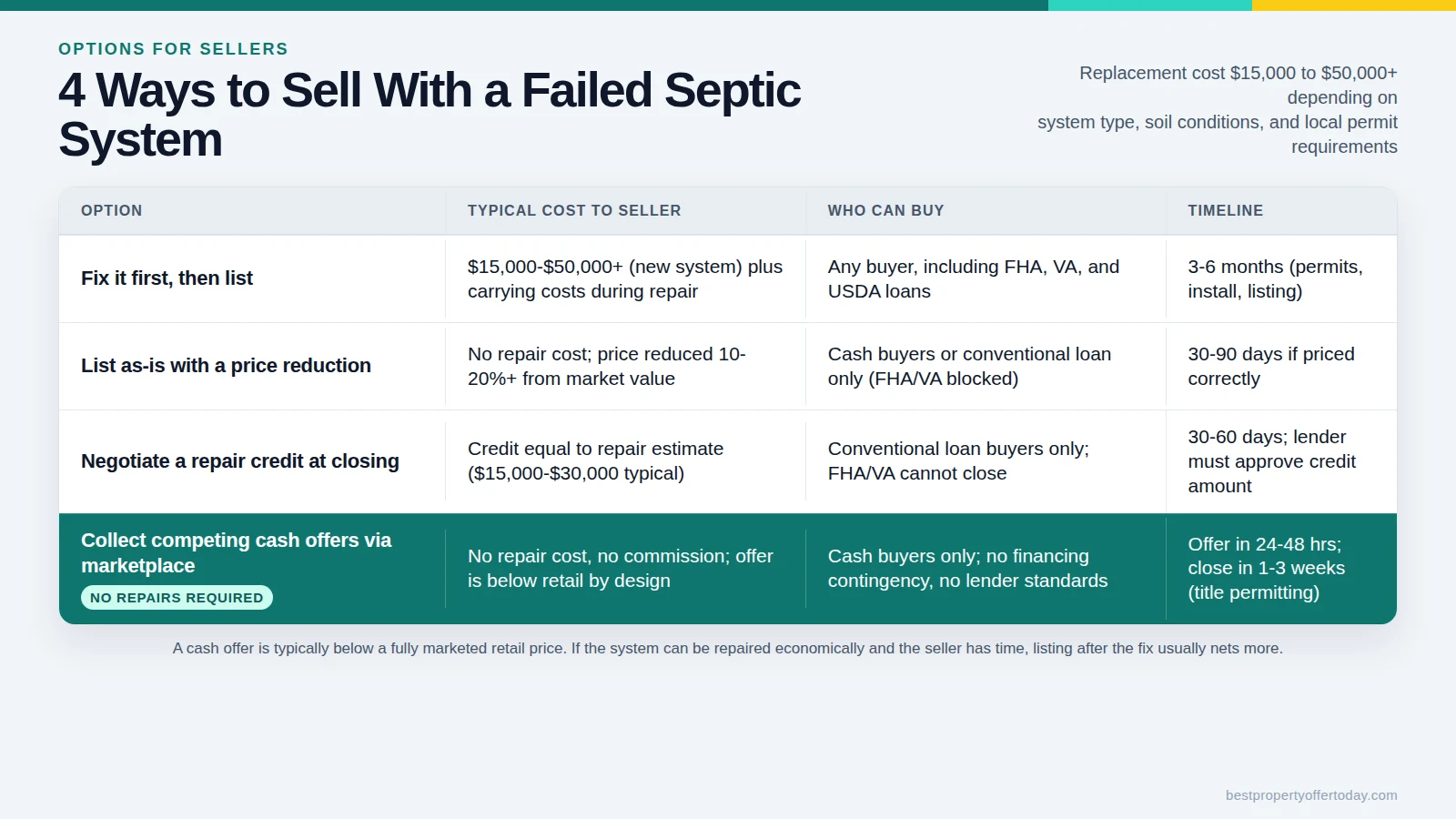
Every seller with a failed system is choosing between these four paths. None of them is free. The question is which cost you prefer to carry.
Option 1: Fix it first, then list. You pay for the replacement upfront, get a passing inspection, and go back on the market with full buyer eligibility restored. You recover some of the cost in the final sale price and avoid a complicated negotiation. The downside is time. Permits, contractor schedules, and the inspection window typically add two to four months before you can list. You also carry the property during that period, with taxes, insurance, and utilities running. At $1,500 to $2,500 a month in carrying costs, a three-month delay adds $4,500 to $7,500 to your all-in cost before the repair bill.
Option 2: List as-is with a price reduction. You disclose the failure, price the property to reflect it, and let buyers compete on the adjusted price. This works only with cash buyers or conventional buyers whose lenders will proceed, so the buyer pool is narrow. The price reduction needs to cover the repair estimate plus the buyer’s inconvenience of managing the work after closing. Expect to discount at least the midpoint repair estimate, sometimes more.
Option 3: Negotiate a repair credit at closing. You accept an offer and then negotiate a credit at closing equal to the repair cost. The buyer uses those funds to fix the system after the purchase. This approach requires the lender to approve it, and many will not. The credit also has to be structured within the loan’s allowable seller concession limits. FHA caps seller concessions at 6 percent of the sale price. VA caps them at 4 percent. If the repair credit exceeds those limits, the deal either dies or the price has to be restructured.
Option 4: Collect competing cash offers through a marketplace and sell as-is. Cash buyers do not need a passing septic inspection to close. They assess the repair cost and price their offer accordingly. The seller avoids paying for the repair outright and does not wait months for permits and contractors. A marketplace collects competing offers from multiple vetted buyers, which matters here because the buyers who specialize in as-is condition properties vary significantly in how they price septic problems. One buyer might deduct $30,000 from a market value estimate. Another might deduct $20,000 for the same issue. Getting those offers side by side is the only way to know which one is actually competitive.
A cash offer on a property with a failed septic will be below what a fully marketed, repaired home would fetch. That gap is real. It represents the repair cost plus the buyer’s risk and carrying costs while the repair is done. Some sellers find the math works in their favor anyway once they subtract carrying costs, contractor risk, and commissions from the fix-and-list scenario.
Disclosure: the rule in every state
You must disclose a failed septic inspection. The as-is framing of a cash sale does not change this. Selling as-is limits your obligation to make repairs. It does not limit your obligation to tell buyers what you know about the property’s condition.
In most states, a seller who conceals a known material defect faces liability after closing. A failed septic inspection is as material as a defect gets. If you have an inspection report documenting the failure, that report needs to be in the disclosure package, not hidden in a drawer.
Some buyers, particularly wholesalers working quickly, will ask you to sign a disclosure waiver. Some of those waivers have no legal force in your state. Check with a real estate attorney before signing anything that purports to waive your disclosure obligations or theirs.
Red flags to watch for when selling to a cash buyer
A failed septic attracts some buyers who will use the defect to renegotiate late in the process. Watch for these patterns.
- An offer that arrives without any acknowledgment of the septic failure. A serious buyer prices it in from the start.
- A very long inspection period on an as-is cash deal. Cash buyers do not need 30 days to inspect a house they claim to be buying without contingencies.
- An offer that drops significantly after “inspection.” If the system failure was already disclosed and the buyer accepted the condition, a post-inspection price cut is a renegotiation tactic, not new information.
- Token earnest money. A buyer putting $500 down on a $250,000 property can walk away at no cost. That is not the same as a committed buyer.
- An assignment clause. If the buyer has the right to assign the contract to a third party, you do not know who you are actually selling to. Ask whether the contract is assignable before you sign.
The vetting post at Are Cash Home Buyers Legitimate covers how to separate reliable buyers from opportunists. It is worth reading before you accept any offer on a property with a condition issue this significant.
The honest case for not fixing it
If the house is in otherwise good condition, the market is active, and the seller has three to five months to spare, fixing the system and listing it traditionally will almost always net more. That is not a close call.
The calculus changes when some combination of the following applies: the replacement will cost $35,000 or more, the property has other deferred maintenance that would surface in a traditional inspection, the seller needs to close within 60 days, or the carrying costs on a vacant property are running $2,000 or more per month. In those situations, a competitive cash offer from vetted buyers can be the more rational exit, even when it is lower on paper.
You can run those numbers through the net proceeds calculator at this site. Plug in the repair estimate, a realistic list price after the fix, commission, carrying months, and closing costs. Then compare that to a cash offer net of whatever the buyers come in at. The gap is often smaller than it looks.
Can you get a mortgage with a failed septic?
Not with an FHA, VA, or USDA loan. Those programs require the property to meet minimum health and safety standards at closing, and a failed septic system does not. Conventional financing is sometimes possible if the lender is willing to proceed and the buyer has adequate down payment, but many conventional lenders follow similar standards. Cash is the only guaranteed path to closing on a property with a documented septic failure.
How much does it cost to fix a failed septic system?
A tank replacement alone runs $3,000 to $6,000. A conventional drain field replacement is $10,000 to $20,000 in average soil conditions. A mound system or engineered alternative system, required when the lot has poor percolation or a high water table, can reach $40,000 to $50,000 or more. Get three bids from licensed contractors before accepting any credit offer from a buyer.
Will homeowners insurance cover a failed septic system?
Standard homeowners insurance does not cover septic system failures. The typical policy covers sudden and accidental damage, not gradual deterioration or wear. A few specialty endorsements exist for sewer and drain backup, but they rarely cover the full cost of system replacement. You are generally paying for this out of pocket or out of proceeds.
Do appraisers look at septic systems?
Appraisers are not septic inspectors and typically do not conduct a technical evaluation of the system. However, if a failed septic inspection is part of the public record in the county health department files, an appraiser working on a government-backed loan may flag it. On FHA, VA, and USDA appraisals, the appraiser is required to note any conditions that appear to affect health and safety, and a failed system visible at the property or documented in local records can trigger a repair requirement that blocks the loan.
Properties with a private well face similar lender scrutiny. FHA, VA, and USDA loans require a passing water quality test before closing, and a well that fails on bacteria, nitrates, or arsenic blocks those loans just as a failed septic does. If you are also dealing with a water quality issue on the property, see what your options are when a well water test fails.
If you are ready to see what cash buyers will offer on the property as-is, you can submit your details here. Competing offers from vetted buyers come back within 24 to 48 hours, and there is no obligation to accept any of them. The number 804-361-7460 is available if you have questions first.