There is one question that determines almost everything about selling a manufactured home, and most sellers do not know it exists: is your home titled as real property, or is it still classified as chattel?
The answer controls who can buy it, what they will pay, and how long the closing takes. It also explains why cash buyers handle manufactured homes differently from site-built houses, and why a marketplace that puts multiple buyers in competition can matter more here than almost anywhere else.
Real property vs chattel: the distinction that drives everything
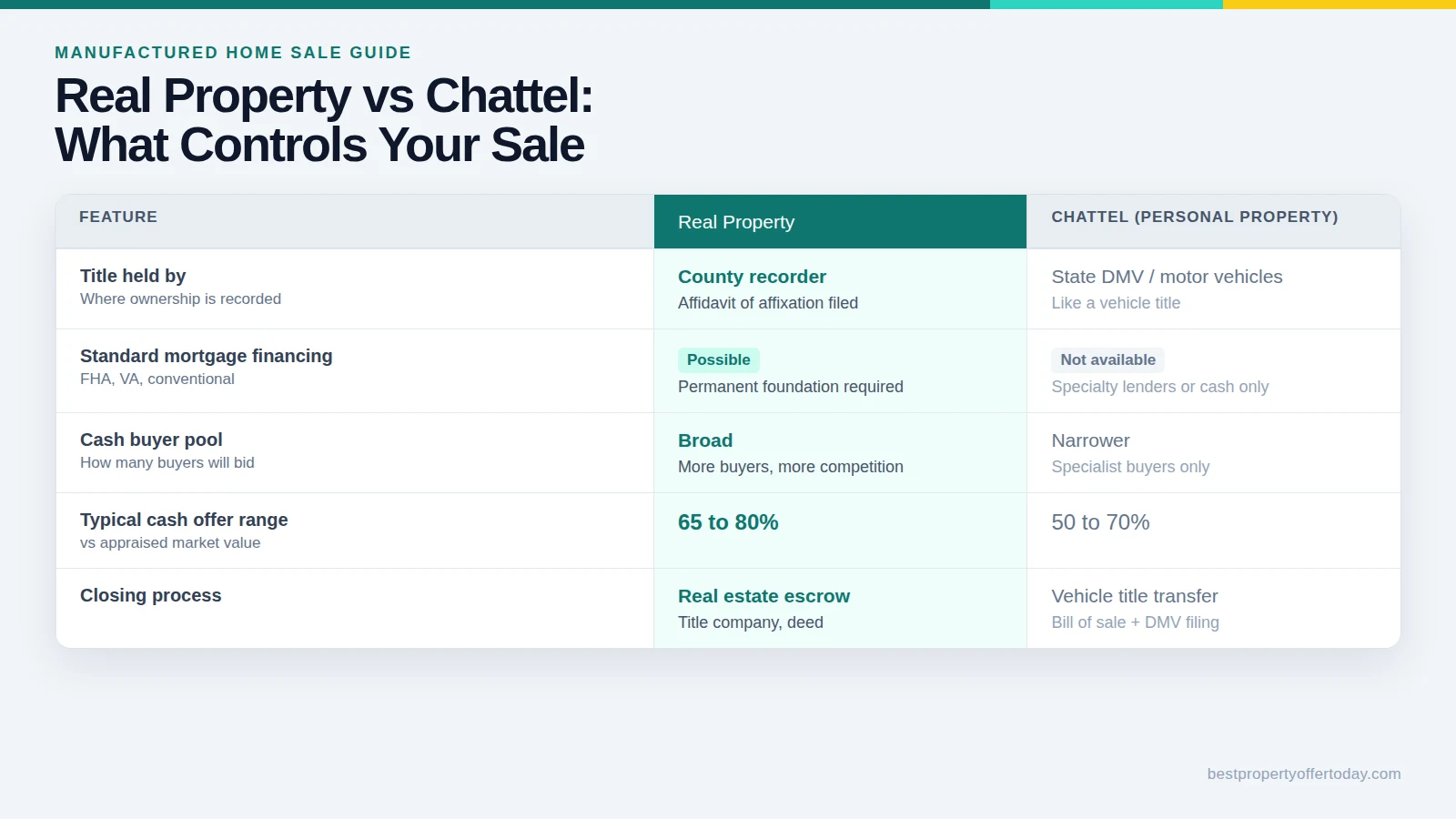
A manufactured home is chattel, legally speaking, for as long as its title is registered with the state’s motor vehicle or DMV office. The home is treated the same way as a vehicle, even if it has not moved in twenty years. Conventional mortgage lenders, Fannie Mae, and Freddie Mac will not finance chattel manufactured homes. That limits your buyer pool to cash buyers, specialty chattel lenders, and FHA Title I loans, which are genuinely difficult to obtain in this price range.
Real property status is different. If you own both the home and the land it sits on, and you have completed your state’s title retirement process, the home’s title is surrendered to the county recorder and the property is treated like any other house. At that point, standard mortgage financing becomes possible, and your buyer pool expands significantly.
Most sellers inherit whichever status their home already has. If you are not sure which applies to yours, check two things: whether you receive a separate property tax bill for the home alone (a sign it is still chattel), and whether your county recorder has a real property certificate or affidavit of affixation on file for the parcel.
Why the 1976 cutoff matters to buyers
On June 15, 1976, the Department of Housing and Urban Development established a national building code for manufactured housing. Homes built before that date are called mobile homes and do not carry a HUD certification label. Most conventional lenders and many cash buyers will not purchase a pre-1976 home under any circumstances. The absence of the HUD label is an automatic disqualifier for FHA and VA loans, and it makes title insurance harder to obtain.
If your home was built before June 1976, your realistic buyer pool is local cash buyers and investors who specifically work in manufactured housing. A marketplace that puts several of them in competition gives you a better shot at the top of that range. A single cash buyer approached directly has no reason to move off their first number.
What cash buyers check before making an offer
Cash buyers for manufactured homes go through a specific checklist. Understanding it helps you set realistic expectations and avoid accepting an offer that drops significantly after the buyer’s review.
Foundation type. A home on a permanent concrete perimeter or slab is worth more than one on piers or blocks. Some buyers will not purchase a pier-set home at all, because reselling it to a financed buyer later is impossible without a foundation upgrade.
HUD tag and data plate. The certification label is attached to the exterior of each section. The data plate is inside, usually in a kitchen cabinet or near the breaker panel. If either is missing, buyers will request a letter of label verification from HUD’s Institute for Building Technology and Safety. That costs about $50 but takes several weeks, and some buyers will reduce their offer or walk rather than wait.
Title status and liens. Buyers need to confirm who holds title, whether any chattel loans are outstanding, and whether the land and home are on the same parcel record. In states where title retirement is a single-form filing with the county, buyers often handle it post-closing. In states that require a court order, they may price the risk into a lower offer.
Age and condition. Deferred maintenance, soft floors (which usually indicate moisture intrusion under the home), and original single-pane windows from the 1980s all reduce the number. So does the roof condition: low-pitched manufactured home roofs are prone to seam leaks, and replacement costs run $6,000 to $14,000 depending on square footage and whether the home needs a full tear-off.
Park rules, if the home is on a rented lot. See the section below.
Selling the home with land vs without land
These are two meaningfully different transactions.
If you own the lot, you are selling a packaged asset. Many cash buyers will underwrite the land and the structure together, which usually produces a better combined number than selling them separately. Real property status is more likely here, which opens the door to buyers who need financing.
If the home sits in a mobile home park and you pay lot rent, you are selling a chattel asset only. The park’s rules control what happens next. Some parks require a buyer to be approved by management before the sale can close. Others have right-of-first-refusal clauses in the lot lease, meaning the park itself can step in and match any offer you accept. Read the lease before you accept anything: if the park can block the buyer you chose, buyers will price that risk into their offers, sometimes substantially.
Section 8 rental contracts present a similar complication if the home is a rental. Those contracts carry obligations that survive the sale, and some buyers in this space will not take on an occupied Section 8 property.
What the numbers look like: a worked example
Take a 1998 double-wide in good condition, 1,400 square feet, on land the seller owns in a rural county. An appraiser puts the value at $85,000 on a real property basis.
A retail buyer requiring financing is the best theoretical outcome, but 1998 is old enough that some lenders add conditions or decline entirely. Finding the right financed buyer and closing may take three to five months.
Cash buyers through a competitive process typically land at 65 to 80 percent of appraised value for a home in this age range and condition, so roughly $55,000 to $68,000, with no repairs, no real estate commission, and a close in two to three weeks. The spread versus a retail sale is real. What the seller trades for it is certainty, no carrying costs, and no financed buyer walking away at day 45 because their lender refused the appraisal.
If that same home were chattel, with the title still at the DMV and the foundation on piers, the cash buyer range falls to roughly $42,000 to $58,000. The buyer takes on more title work and has a narrower resale market, and that risk shows up in the offer.
Our free net proceeds calculator lets you run both scenarios side by side before you talk to any buyer.
The honest caveat for sellers
A cash offer on a manufactured home is almost always below what a fully marketed retail sale would net if you found a financed buyer willing to close. The gap is wider for manufactured homes than for site-built houses because the retail buyer pool is thinner and the financing is more complicated. If your home qualifies for standard financing, is in good condition, and you have four to six months to find a buyer, a traditional listing through a real estate agent will likely net more than a cash sale.
The cash route makes sense when speed matters, when the title situation is complicated, when the park’s approval process makes a financed buyer too risky, when the home is pre-1976 and the financing market is effectively closed, or when carrying costs on a vacant home are eating into whatever premium a longer sale might produce.
Red flags that should give you pause
Earnest money below $500. A genuine buyer in the manufactured housing space will put down at least $1,000 to $2,500. A token deposit means walking away costs them nothing if a better deal comes along, and you will have turned down other offers in the meantime.
A long inspection period on an as-is sale. Manufactured homes have a defined list of things to verify: title, foundation, HUD tag, and condition. A buyer asking for 30 days of inspection on an as-is transaction is leaving room to renegotiate after you have cleared the market of competing buyers. Ten business days is reasonable. Thirty is not.
An assignment clause. Some buyers in this space are wholesalers, not end buyers. An assignment clause means they intend to find another buyer and flip the contract. That adds a party, extends the timeline, and can collapse the deal if the end buyer backs out. Read more about how to identify a wholesaler vs a genuine buyer in our guide to spotting real estate wholesalers.
A price quote delivered before they have reviewed the title or inspected the home. Manufactured home pricing depends heavily on chattel vs real property status, foundation, age, and park rules. A number delivered in two minutes is not a real offer.
Before engaging any buyer, our guide on how to tell whether a cash home buyer is legitimate covers the specific checks that apply across all property types.
Questions to ask before signing anything
- Are you closing this yourself, or do you assign contracts to another buyer?
- What is your timeline from signed contract to close?
- How much earnest money will you put down, and where will it be held?
- Have you reviewed the chattel title or the county real property record?
- If the home is in a park, have you read the lot lease and confirmed the park’s approval process?
- What specifically would cause you to reduce this number after your inspection?
- Have you bought manufactured homes in this county before?
If you want to compare multiple cash offers side by side, our post on how to compare cash offers covers what to normalize before deciding: net proceeds after closing costs, not just the headline number.
Frequently asked questions
Does the title retirement process have to be completed before I can sell?
No. Many cash buyers handle title retirement themselves after closing, since they have experience with the process in your state. What matters is that the buyer understands whether the title has been retired and prices the work accordingly. Some buyers reduce their offer for the cost and uncertainty of doing it. Others handle it routinely and do not lower the number for it. Getting quotes from multiple buyers is the only way to see how each treats it in your county.
Can I sell a manufactured home I am still making payments on?
Yes. The outstanding loan is paid off from the sale proceeds at closing, the same as a mortgage payoff on a site-built house. If the loan is a chattel loan through a specialty manufactured housing lender, get the payoff figure in writing before you accept any offer. Chattel loan balances can be higher than expected because of how interest accrues on older loans, and the number changes daily. Knowing the exact payoff prevents surprises at the closing table.
What happens at closing if my home is still chattel?
The process looks more like a vehicle sale than a real estate closing. You sign over the chattel title, the buyer pays off any existing lien directly to the lienholder, and both parties sign a bill of sale. Some states require notarization. Title insurance is harder to obtain on chattel, and not every title company handles manufactured home chattel transactions. Ask the buyer which closing agent they use and confirm that agent has done this before in your state.
Will a marketplace actually get me more than one offer on a manufactured home?
In most metro areas and many rural counties, there are multiple cash buyers who actively work in manufactured housing. Submitting one request through a marketplace puts it in front of all of them in your area. A seller who calls one buyer gets one number. A seller who submits through our platform may receive two to four offers within 24 to 48 hours, and comparing them side by side is the only way to know whether the first number was reasonable. Call 804-361-7460 if you want to talk through your situation before you submit.