You can sell a house with a HELOC or a second mortgage on it. Both happen every day. What changes is that closing now settles two debts instead of one, and your net proceeds drop by whatever those balances add up to.
The short answer is: yes, it works. The rest of this covers what the settlement statement actually shows, how the numbers play out in practice, and where sellers get caught off guard before closing.
What Happens at Closing When You Have a HELOC or Second Mortgage
When you sell a house, every lien on the title must be cleared before ownership transfers. A HELOC is a lien. A second mortgage is a lien. Both appear on the title search, both must be paid off, and both appear as deductions on your settlement statement.
The order of priority matters. Your first mortgage lender is the senior lienholder. The HELOC or second mortgage sits in the subordinate position. If the sale proceeds run short, the senior lender is made whole first. The subordinate lender takes what remains. If what remains is nothing, you have an underwater sale, and you will need to negotiate a short payoff or bring cash to the table yourself.
In a typical sale where the price covers everything comfortably, the sequence is straightforward: you accept an offer, the title company orders payoff letters from both lenders, both figures appear on the closing disclosure, and both are wired out at closing. You receive the remainder.
The Settlement Statement: What Two Payoffs Look Like in Practice
A settlement statement accounts for every dollar in the transaction. When there are two liens, it shows two payoff lines. Here is a worked example using realistic figures.
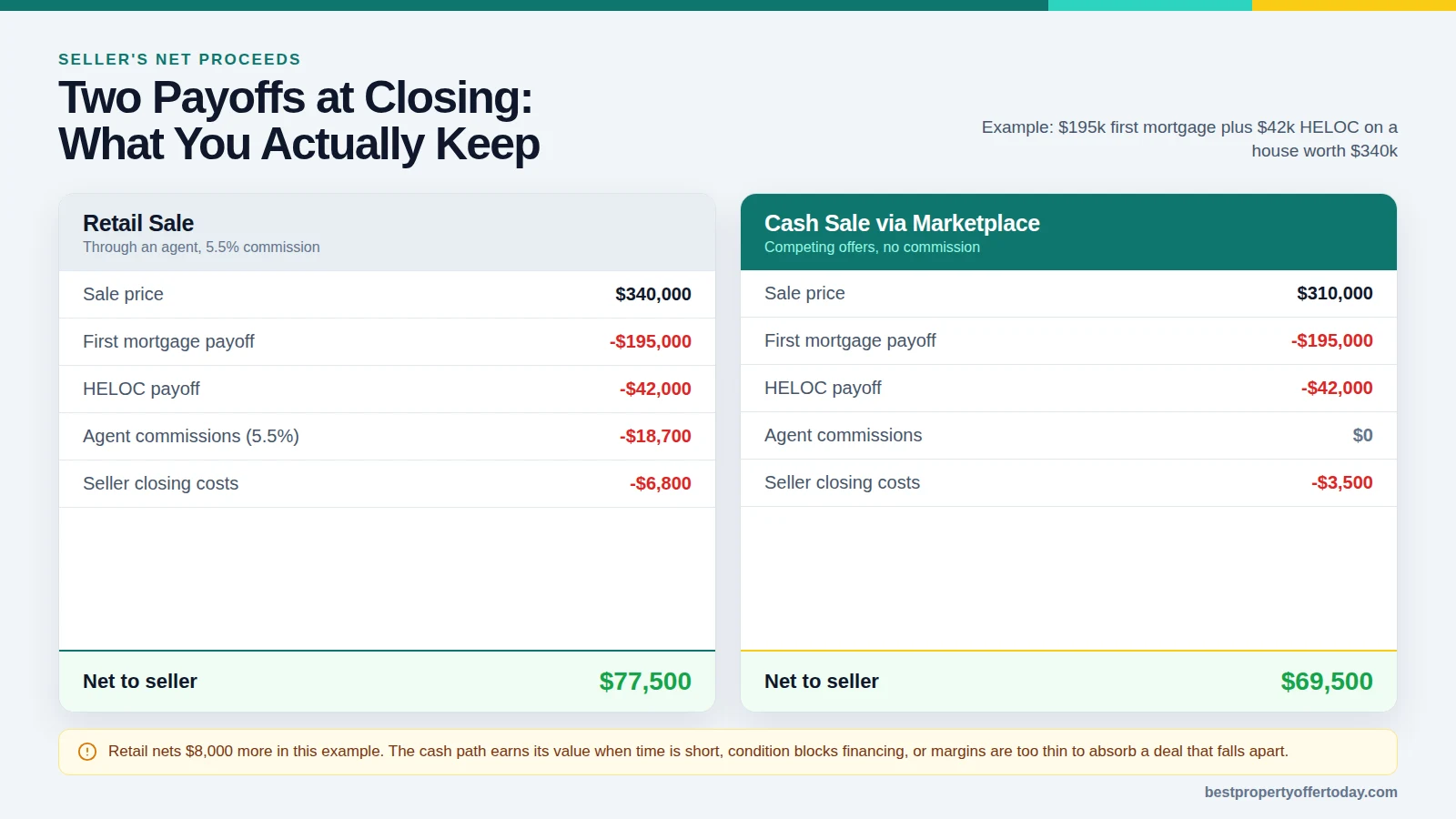
Say you sell for $340,000. Your first mortgage payoff is $195,000. Your HELOC balance is $42,000. You sell through an agent at 5.5 percent commission, and the seller-paid closing costs, which include title fees, transfer tax, and prorations, come to roughly $6,800.
| Item | Amount |
|---|---|
| Sale price | $340,000 |
| First mortgage payoff | -$195,000 |
| HELOC payoff | -$42,000 |
| Agent commissions (5.5%) | -$18,700 |
| Seller closing costs | -$6,800 |
| Net to seller | $77,500 |
That $77,500 is what you receive. The HELOC balance reduces it dollar for dollar, the same as the first mortgage. There is no special treatment for a home equity line. Before accepting any offer, run your actual numbers through the net proceeds calculator on this site so there are no surprises on the closing disclosure.
For comparison, here is the same property under a cash sale through a marketplace, where competing buyers submit offers and no agent commission applies:
| Item | Amount |
|---|---|
| Sale price (cash, typical discount) | $310,000 |
| First mortgage payoff | -$195,000 |
| HELOC payoff | -$42,000 |
| Agent commissions | $0 |
| Seller closing costs | -$3,500 |
| Net to seller | $69,500 |
The cash offer is lower, so the net is lower, by about $8,000 in this example. The trade-off is speed and certainty: no financing contingency that can fail, no appraisal that can kill the deal. Neither path changes the fact that both liens must be paid in full at closing.
Pre-Payment Penalties: The Line Most Sellers Miss
HELOCs sometimes carry an early-closure fee. If you opened the line recently and close it at the sale, some lenders charge a flat fee, often $300 to $500, or a small percentage of the credit limit. Second mortgages occasionally carry a prepayment penalty clause written into the original note.
Pull your HELOC agreement and your second mortgage note before you list. Look for a section titled “early closure,” “prepayment penalty,” or “reconveyance fee.” The fee is usually small, but it will appear on your settlement statement regardless. Knowing it in advance keeps the closing disclosure from being a surprise on the day you sign.
When the Numbers Do Not Add Up: Short Payoffs and Underwater Homes
If your combined liens plus selling costs exceed what the house can realistically sell for, a standard closing cannot happen without one or both lenders accepting less than they are owed. That is called a short payoff on a subordinate lien, or a short sale when the entire transaction produces a loss to a lender.
A second mortgage lender has every reason to resist a short payoff. They are subordinate, meaning they absorb the loss after the senior lender is satisfied. Negotiating with them can add weeks or months to the process. In some cases they can block the deal entirely.
Before you list, add your first mortgage payoff, your HELOC or second mortgage balance, and your estimated selling costs. If that total is close to or exceeds realistic sale prices in your market, talk to a real estate attorney or a HUD-approved housing counsellor before you proceed. Understanding your position before listing is considerably better than discovering it after you are already under contract. Sellers who are also navigating an open bankruptcy filing face additional constraints: a trustee and the court must approve the sale before it can close, and the proceeds flow through the estate. See how selling a house during bankruptcy works if that applies to your situation.
For sellers in this position, getting competing cash offers from multiple buyers through a marketplace can sometimes help. A cash buyer who brings certainty, no financing contingency and a flexible close date, can appeal to a subordinate lender trying to limit their exposure more than a higher but conditional retail offer. You can learn more about how to verify that the buyers in a cash marketplace are legitimate before submitting a request.
What the Title Company Looks for With Two Liens
The title company or closing attorney runs a title search on every transaction. With two liens, a few additional things appear on that search.
A HELOC lender may have recorded a draw freeze on the property if they suspended the line due to a drop in estimated value. This does not prevent the sale, but the title company will require a formal payoff letter from that lender, not merely a freeze release, before they will close.
Second mortgages occasionally have subordination agreements tied to them from a prior refinance. Those agreements establish the priority of payment and must be documented in the title file.
Old HELOC draws that were recorded separately sometimes appear as independent liens on the title search even though they are part of the same account. If you see a lien you do not recognise, get the full payoff letter from your lender and compare account numbers before assuming it is an error. The most common title problems that delay a cash closing are worth reviewing before you list if you have any doubts about your lien history.
Red Flags to Watch Before and During the Sale
- A lender that takes more than five business days to provide a payoff letter. Standard turnaround is one to three days. Delays here push your closing date back
- A payoff letter with an expiration date that falls before your scheduled closing. Request a fresh letter or ask for a date extension before signing day
- A second mortgage lender that requires a minimum net proceeds amount to release the lien. Some lenders write this floor into the loan agreement. Know it before you accept an offer
- Any buyer asking you to keep the HELOC open and subordinate it rather than pay it off at closing. A legitimate cash buyer pays off every lien. A subordination request is unusual and deserves legal review before you agree to it
- Token earnest money on a deal where the margin between your liens and the sale price is thin. A buyer who puts down $500 can walk away for almost nothing. Understanding what happens if a cash buyer backs out and what your contract actually protects is worth knowing before you go under contract
Why a Cash Sale Is Common in This Situation
Sellers with two liens often hear that a cash sale is the cleanest path, and there is a real reason for that. A financed buyer brings an appraisal contingency. If the appraised value comes in below the offer price, the deal either renegotiates or falls apart. With two liens, a price reduction after appraisal can quickly erode proceeds to the point where one lien is not fully covered.
A cash buyer skips the appraisal. Closing happens when title is clear, and title work runs the same timeline regardless of how the buyer pays. The difference is that no loan officer sits in the chain, and no lender underwriting requirements can add conditions to the deal after the fact.
A marketplace that collects competing cash offers lets you see what multiple buyers will pay before committing to any one of them. When you have two payoffs to cover, the difference between a $295,000 offer and a $315,000 offer can mean the difference between coming up short and walking away with a meaningful amount. Comparing before accepting is not optional when the margin is tight. You can start a request at no cost at BestPropertyOffersToday.com.
An Honest Assessment of Which Path Nets More
A cash offer is nearly always below what a fully marketed retail sale would bring. The worked example above shows $77,500 net for the retail path and $69,500 for the cash path. That $8,000 gap is real and should not be dismissed.
If the house is in good condition, both liens leave plenty of equity, and you have several months to run a proper listing, a traditional sale with an agent will typically net more. That is true and worth saying plainly. Pretending otherwise does not serve you.
The cash path earns its value when time is short, when property condition would trigger financing requirements that a cash buyer ignores, or when two liens leave margins too thin to absorb a deal that falls apart. Knowing which situation you are actually in, before you list, is the most useful thing you can do.
Questions to Ask Before You Sign Anything
- Does your HELOC agreement include an early-closure fee, and what is the amount?
- Does your second mortgage note carry a prepayment penalty clause?
- What is the per-diem interest rate on both loans? Payoff letters are typically valid for 30 days, and the daily rate tells you the cost of any delay past the scheduled close date
- Has your HELOC lender recorded any freeze or credit reduction notice on your property?
- Does your combined payoff plus realistic selling costs fall within what buyers are currently paying for homes like yours in your market?
- If you are short, has your lender confirmed in writing that they will accept a short payoff before you go under contract?
Can I sell if my HELOC balance exceeds my available equity?
Yes, but you will need to cover the shortfall. Options include bringing cash to closing, negotiating a short payoff with the HELOC lender, or pursuing a formal short sale with lender approval. None of those are fast paths, and a short sale carries credit implications. Get the payoff figure and compare it to realistic offers before you list, not after you are already in contract.
Does the cash buyer pay off the HELOC directly, or do I handle it?
The title company handles it. The buyer funds the purchase, that money flows into escrow, and the title company wires payoffs to each lienholder in order of priority. You never personally handle the payoff. What you receive is the remainder after all liens and selling costs have been cleared from escrow.
Can I transfer the HELOC to my next property instead of closing it?
No. A HELOC is secured by the specific property it was opened against. Once that property sells, the collateral is gone and the lender closes the line at payoff. You cannot port a HELOC to a new address. If you want a line of credit against your next home, you apply for a new one after purchase.
How long does it take to get payoff letters from both lenders?
Typically one to three business days per lender. Request both letters as soon as you have a signed contract. Do not wait until the week before closing. Payoff letters carry expiration dates, and if one expires before closing day, the title company needs a fresh letter, which adds delay. Build the payoff letter request into your post-contract checklist, not your closing-week checklist.
Related reading: Should I Sell My House to Pay Off Debt? When It Makes Sense