Selling a House With Sewer Line Problems: What You Actually Net
You can sell a house with sewer line problems. What you cannot do is sell it to a financed buyer without the lender’s blessing, and that blessing often requires a passing sewer scope. Cash buyers skip the scope requirement entirely, which is why a failed sewer inspection splits the buyer pool in two and changes the entire sale conversation.
Why sewer problems are different from most defects
Most defects a seller discloses are cosmetic, negotiable, or addressable with a repair credit at closing. Sewer lines are different. A standard home inspection does not include a sewer scope. The scope is an add-on, typically 100 to 300 dollars, and in many transactions the buyer orders one only if the house is older than 30 years or the inspector flags drainage issues. That means a seller can go weeks into a financed deal before the scope results come back.
When the results show root intrusion, bellying, offset joints, or active pipe deterioration, the financed deal is on thin ice. Lenders follow the appraiser’s condition ratings. If the appraiser notes a failed or unknown sewer system, the loan can go to subject-to-repair status before the lender will fund. A cash buyer has no appraiser and no lender, so the news of a bad scope changes the offer price, not the transaction structure. That is the practical difference, and it is why sewer problems send more sellers to the cash market than almost any other single defect.
The lender mechanics, in plain terms
Conventional, FHA, and VA loans treat sewer problems differently, and the differences matter when you are deciding which type of buyer to target.
Conventional loans follow Fannie Mae and Freddie Mac guidelines. The appraiser must flag any plumbing condition that affects the property’s habitability. A sewer line that drains slowly but has not backed up inside the house may or may not get flagged, depending on the appraiser’s judgment and what the inspection report says. One that has caused an active backup almost certainly will, and the lender will require a repair escrow or a completed repair before funding.
FHA loans are more rigid. HUD requires that all mechanical systems, including waste disposal, be in working order at the time of appraisal. A failed sewer scope will generate a repair condition, and the seller must either fix the line or accept a deal that cannot close until the repair is complete and re-inspected by the FHA appraiser.
VA loans are the most stringent of the three. VA appraisers are required to note any deficient mechanical systems, and the VA will not guarantee a loan on a property with an inoperable sewer system. The repair must be complete before the appraisal is finalized. There is no VA equivalent of a repair escrow on a sewer problem.
The practical result: if a financed buyer’s lender requires a passing scope and the seller cannot or will not repair the line, the deal falls apart. That is the scenario that sends sellers toward the cash buyer market.
Sewer pipe materials and what buyers actually see
The pipe material in your lateral, the run from your house foundation to the municipal main, tells a buyer more about repair cost than any visual inspection ever will. The scope camera shows the pipe directly.
Clay tile pipe, common in homes built before the 1950s, is brittle and prone to root intrusion at the joints. The pipe itself does not deteriorate the way some later materials do, but roots find every joint and grow through them over decades. A clay lateral often stays functional for a long time with periodic mechanical rodding, but a scope will usually show root infiltration that buyers price in as a near-term replacement cost.
Orangeburg pipe, manufactured from compressed tar and wood pulp between the 1940s and early 1970s, was a wartime substitute for cast iron. It absorbs moisture over time, softens, and eventually collapses. If your house was built or plumbed in that window and the lateral has never been replaced, a scope will very likely show deformed or deteriorating pipe. Traditional open-excavation replacement is almost always the outcome. Trenchless pipe lining is not viable on pipe that has already lost its round cross-section.
Cast iron, common from the 1950s through the 1980s, corrodes from the inside out. A scope on a 40-year-old cast iron lateral will often show scale buildup, pitting, and occasional cracks. It is durable enough that many cash buyers price a cast iron lateral at a fraction of the cost of an Orangeburg replacement.
ABS or PVC, standard from the late 1980s onward, rarely shows problems in a scope unless there has been ground movement, improper backfill at installation, or a tree root issue directly above the pipe. Buyers who see plastic pipe in scope results usually do not adjust their offer on account of the sewer line.
Three paths and what each one nets
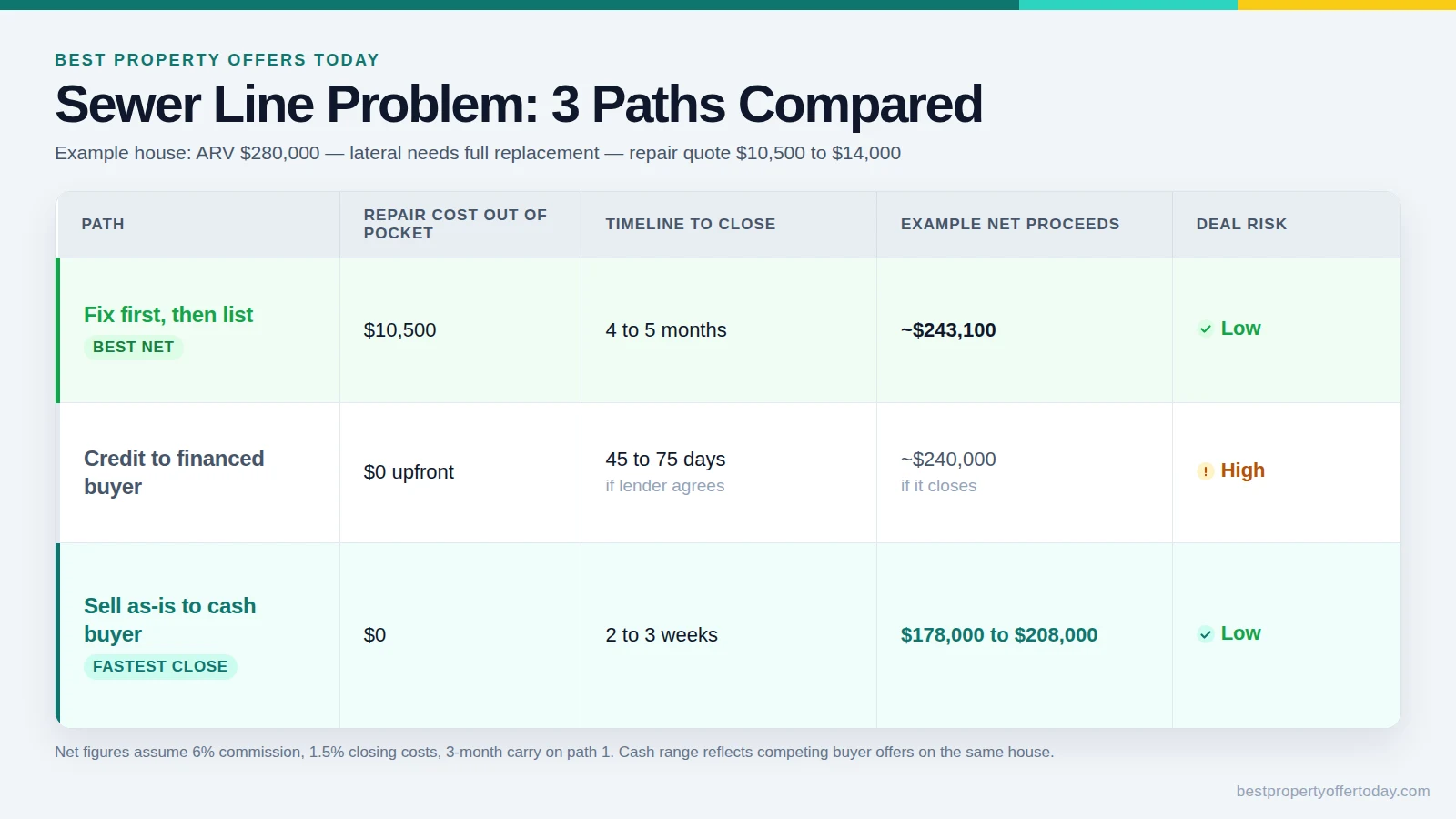
Here is a worked example on a house with an after-repair value of 280,000 dollars and a clay lateral with significant root intrusion. A plumber has quoted 14,000 dollars for open excavation replacement and 10,500 dollars for trenchless pipe lining. Use our net proceeds calculator to run your own numbers against these ranges.
Path 1: Repair first, then list. The seller pays for the trenchless lining at 10,500 dollars, lists at the full market price of 280,000 dollars, and expects a clean scope result to remove the issue from negotiations entirely. The math: 280,000 minus a 6 percent commission of 16,800 dollars, minus 1.5 percent in seller closing costs of 4,200 dollars, minus three months of carrying costs at 1,800 dollars per month totaling 5,400 dollars, minus the repair itself at 10,500 dollars, arrives at roughly 243,100 dollars. Add 20 to 30 days for the repair to be scheduled and completed, then another 45 to 60 days on market, and this path takes four to five months from today. If the house is in otherwise clean condition and the seller has the cash to front the repair, this is usually the best net.
Path 2: Disclose and offer a repair credit to a financed buyer. This path is riskier than most sellers expect. Whether a lender will allow a credit instead of a completed repair depends on loan type, the appraiser’s write-up, and the specific underwriter. FHA and VA lenders typically will not fund until the repair is done. Conventional lenders sometimes allow a repair escrow, but the escrow amount is usually set at 1.5 times the contractor estimate, meaning 21,000 dollars held at closing on a 14,000 dollar quote. Many buyers who need financing also need their down payment liquid. A 21,000 dollar escrow hold can kill the deal from the buyer’s side even if the lender agrees to the structure. This path is worth exploring with an agent who has actually closed a deal with a sewer escrow, not just heard of one.
Path 3: Sell as-is to a cash buyer. Cash buyers price the sewer issue as a line item in their offer calculation. A buyer using the 70 percent of ARV formula deducts their own estimated repair cost, not necessarily the plumber’s quote you received. If they budget 16,000 dollars for a replacement they believe the clay pipe will eventually require, the math is 280,000 times 0.70 minus 16,000, arriving at 178,000 dollars. A more aggressive buyer calculating at 78 percent and accepting a trenchless repair at 10,500 dollars lands at 280,000 times 0.78 minus 10,500, arriving at 207,900 dollars. That 30,000 dollar spread on the same house is exactly why submitting to a marketplace that returns multiple competing offers matters. One buyer’s repair assumption is not the market price for the house.
The honest comparison: path 1 nets roughly 65,000 dollars more than the low-end cash offer, and roughly 35,000 dollars more than the high-end one. What the seller pays for that spread is time, the cash to front the repair, and the risk that a scope result after the repair reveals something the plumber missed. For a seller who has the time and the cash, path 1 is usually worth it. For a seller who does not, path 3 closes in two to three weeks with no repair cost due at signing.
Red flags from buyers you should watch before signing
A legitimate cash buyer prices the sewer issue into the offer before the contract is signed. Watch for these signals that the buyer may not have done that work, and see our guide on identifying wholesalers vs. real buyers for more context on assignment-related risk.
- An offer that arrives before a sewer scope has been discussed. The buyer may plan to conduct their own scope after contract execution and then renegotiate from inside the deal
- An inspection window longer than 10 business days on an as-is contract. A 21-day inspection period on a cash deal gives a buyer time to assign the contract to a third party who may not accept the sewer issue
- Earnest money below 1,000 dollars. A token deposit makes walking away essentially free for the buyer
- A contract that names the buyer as “and/or assigns” or has a blank where the buyer entity should be. This is an assignment clause; the sewer issue may cause the eventual assignee to decline the deal
- A due diligence period that includes a sewer scope on an as-is offer, combined with contract language that allows exit based on inspection findings. Make sure the as-is clause is clear before signing
Disclosure duty stays even on an as-is sale
Selling as-is limits your duty to repair, not your duty to disclose. If you know the sewer line has a problem, or you have received a scope report showing defects, that information belongs in the seller’s disclosure. An as-is clause in the contract protects the seller from repair requests. It does not protect against fraud claims arising from concealed known defects. Most states require disclosure of known material defects, and a failed sewer scope is a material defect in every state that has a disclosure statute.
Document what you know and when you learned it. Keep the scope report. If repairs were made before listing, keep those receipts. The paper trail protects you from a post-closing dispute over whether the condition was disclosed. This is true regardless of which buyer type you sell to.
The honest trade-off
A cash offer on a house with a sewer problem will normally come in below the price a repaired house would sell for on the open market. What the seller buys with the difference is certainty, no repair cost due at signing, and no lender condition that can delay or kill the deal at week three. If the house is in otherwise good shape, the seller has time, and can front 10,000 to 15,000 dollars for a trenchless repair, the math usually favors fixing first. That is worth saying plainly, because not every situation calls for a cash sale. A traditional listing with a documented repair usually nets more, and it should.
Competing cash offers are most useful when the seller cannot front the repair cost, cannot wait four to five months, or has already been through one financed deal that fell apart on the sewer scope. The value of submitting to a network of vetted buyers is that it puts the repair cost assumption into competition, not just into one buyer’s estimate. Buyers who specialize in older homes with clay or Orangeburg pipe often bid more aggressively on sewer problems than general investors, because they have plumbers on retainer and know the actual replacement cost. One request produces competing views on the same house. Call 804-361-7460 or submit a request through the site. There is no obligation to accept any offer.
Does a failed sewer scope always kill a financed deal?
Not always, but it usually does unless the seller completes the repair before closing. Conventional loans can sometimes use a repair escrow, but the lender sets the terms and the escrow amount is typically 1.5 times the repair estimate. FHA and VA loans require the repair to be complete and re-inspected before the appraiser can remove the condition. The simplest rule of thumb: do not assume a financed buyer can absorb a failed sewer scope without the deal changing significantly in timeline or structure.
How much does a sewer line replacement actually cost?
A sewer scope inspection runs 100 to 300 dollars. A spot repair for a localized break or offset joint typically costs 1,000 to 5,000 dollars. A full lateral replacement by traditional open excavation runs 8,000 to 30,000 dollars depending on depth, length, and soil conditions. Trenchless pipe lining, which inserts an epoxy liner into the existing pipe without digging, typically costs 6,000 to 20,000 dollars and is not viable on pipe that has already collapsed or lost its round cross-section. Trenchless pipe bursting, which pulls a new pipe through the old one while fracturing the original outward, typically costs 4,000 to 15,000 dollars and works on clay and cast iron but not on Orangeburg. The spread across methods on the same house can be 10,000 dollars or more, which is why getting multiple repair quotes matters before listing at any price.
Who is responsible for the sewer lateral?
In most municipalities, the homeowner owns and is responsible for the lateral from the house foundation to the point where it connects to the municipal sewer main in the street. The municipal system owns everything from that connection point toward the treatment plant. Some cities have lateral liability programs or cost-share options, particularly for older neighborhoods where failing laterals are widespread. It is worth calling the municipal utility before assuming the full replacement cost is yours. Some jurisdictions also require a lateral inspection and certificate before a sale can record, which is a different obligation from a buyer-requested sewer scope.
Does selling as-is mean the buyer cannot do a sewer scope?
No. As-is means the seller will not make repairs based on inspection results. It does not restrict the buyer from scoping the sewer, inspecting the house, or conducting any due diligence they want. The distinction matters: a buyer who scopes on an as-is contract is gathering information to decide whether to proceed at the agreed price, not building a case to demand repairs. Make sure the contract language is explicit that as-is means no repair obligations, not no inspections. Any contract that grants exit rights based on inspection results on an as-is deal deserves a close read before signing.