Selling a House With HVAC Problems: 3 Options and Their Costs
You can sell a house with HVAC problems. The system’s condition does not prevent a sale. What it does is divide your buyer pool into two groups: buyers who need a working system to get their loan approved, and buyers who do not. Which path makes sense depends on your repair quote, your timeline, and how much capital you want to spend before closing.
Why HVAC condition sorts your buyer pool
A buyer using a mortgage has a lender. That lender sends an appraiser. The appraiser follows minimum property requirements set by whoever is backing the loan. For FHA and VA loans, a home must have a functional heating system capable of maintaining a minimum interior temperature. A dead furnace or failed heat pump is a required repair condition, not a negotiation item. The loan does not close until it is fixed.
Conventional loans follow Fannie Mae and Freddie Mac guidelines. An appraiser who finds a non-functional HVAC system will note it as an adverse condition, and most lenders will require repair before funding. That narrows your buyer pool to people paying cash or willing to negotiate a repair escrow, regardless of how much they liked the house.
A cash buyer carries no lender. There is no appraiser writing required-repair conditions. A cash buyer can close on a house with a broken furnace or a failed compressor. They will price the repair into the offer. The question is whether they price it fairly, which is why competing offers matter more on a house with a known defect than on a clean one.
What FHA, VA, and conventional lenders actually require
FHA Minimum Property Requirements specify that a home must have “heating adequate for healthful and comfortable living conditions.” HUD’s guidelines require a functional heating system capable of maintaining a minimum interior temperature of 50 degrees Fahrenheit in all weather typical to the location. A non-functional system fails this requirement. The appraiser flags it, the underwriter holds the loan, and the seller must either repair it or provide a funded repair escrow before closing proceeds.
VA Minimum Property Requirements follow the same logic. The VA appraiser marks a non-functional HVAC system as a health-and-safety deficiency. The seller must repair it, or the deal does not close. There is no workaround.
Conventional loans give lenders more discretion. A system that is fully non-functional at appraisal typically draws a repair requirement. A system that runs but is old and showing wear is handled differently: the appraiser notes the age and condition, buyers negotiate around it, and whether the lender requires repair depends on its severity. A 20-year-old furnace that still produces heat is a different situation from one that will not ignite.
Air conditioning is treated differently from heating. FHA does not universally require A/C the way it requires a functional heating system. In southern states where air conditioning is considered essential to habitability, an appraiser may flag a non-functional central air system. In northern climates, a broken A/C is more commonly treated as a negotiation item rather than a loan condition. Whether your specific market triggers that flag is a question for your listing agent or a local appraiser, not a guess.
Three paths, and what each costs you
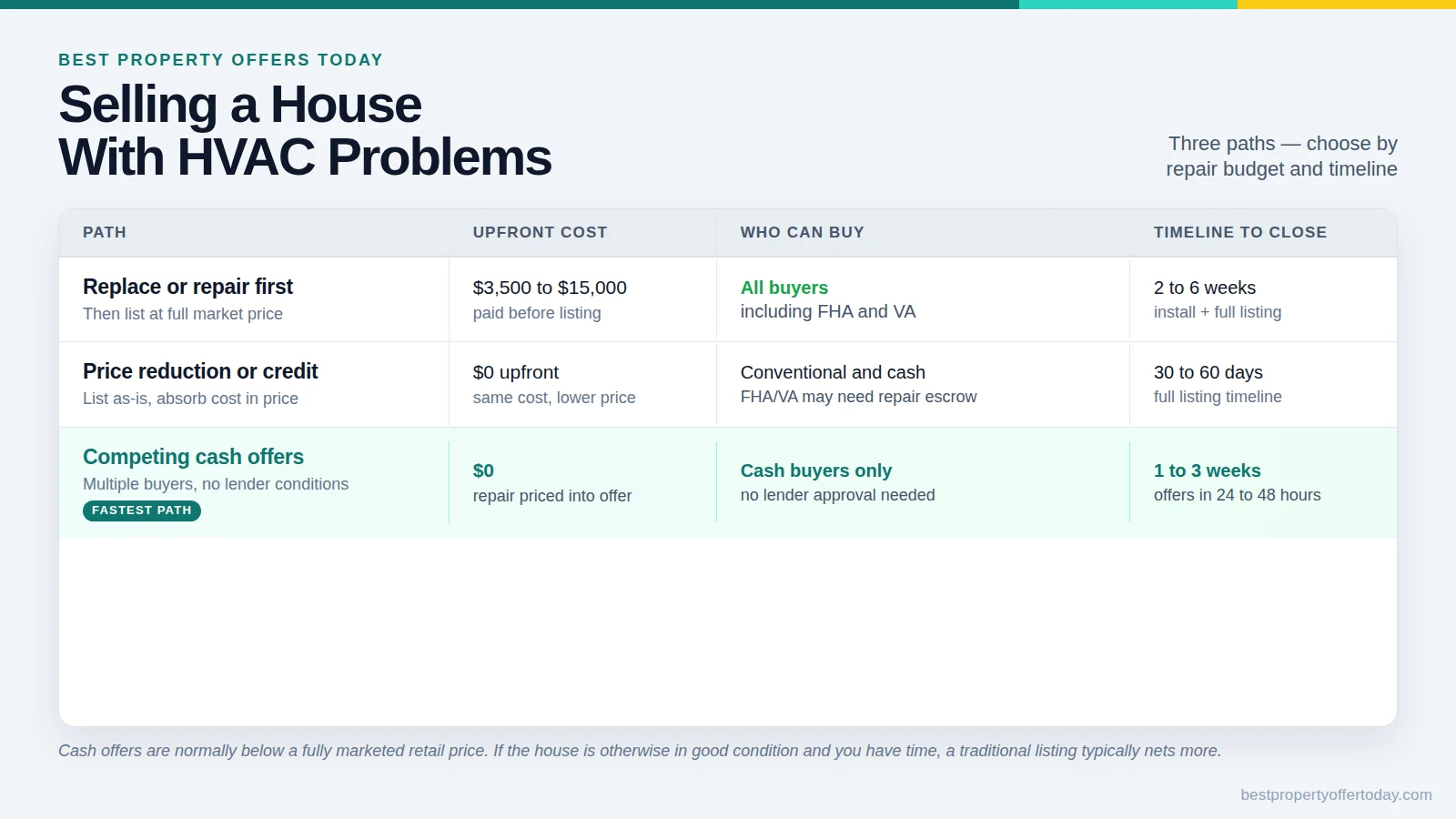
Most sellers with an HVAC problem have three realistic options. Here is how they compare before the worked example below lays out the actual numbers.
| Path | Upfront cost | Buyer pool | Timeline | Best for |
|---|---|---|---|---|
| Replace or repair before listing | $3,500 to $15,000 | All buyers including FHA and VA | 2 to 6 weeks for installation, then full listing | Sellers with equity and time |
| List with a price reduction or repair credit | $0 upfront, absorbed in price | Conventional and cash buyers; FHA/VA need a repair escrow | Normal listing timeline, 30 to 60 days to a financed close | Sellers who want full market exposure without repair cost |
| Competing cash offers through a marketplace | $0 | Cash buyers only, no lender conditions | Offers in 24 to 48 hours, close in 1 to 3 weeks | Sellers who need speed or have no repair budget |
The table shows the mechanics. The numbers are in the worked example below.
Worked example: a $290,000 house with a failed heat pump
Take a house with a market value of $290,000. The heat pump is dead. A full replacement, including the air handler and outdoor unit, runs $9,000 installed. The seller has three realistic options.
Option 1: Replace the system before listing. The seller spends $9,000, then lists at $290,000. With a 5 to 6 percent agent commission, $3,000 in seller-paid closing costs, and a $4,000 inspection renegotiation credit on other items (common on older homes), the seller nets roughly $259,000. The $9,000 HVAC cost is paid before those numbers even apply.
Option 2: List as-is with a $9,000 price reduction. The seller lists at $281,000. Same commission, same closing costs, same renegotiation risk on everything else. Net proceeds are roughly $251,000. The seller avoided spending $9,000 out of pocket, but absorbed the same cost as a lower list price. And the seller still ran the full listing timeline: showings, photos, 30 to 45 days to a financed close.
Option 3: Competing cash offers through a marketplace. With no lender conditions, cash buyers price the HVAC repair into their offers. Because multiple buyers are competing on the same property, the seller can see where each one lands. One buyer prices $10,000 off a $280,000 valuation and offers $270,000. Another prices $8,000 off and offers $272,000. The seller picks the stronger number. Cash sales typically carry lower seller-paid closing costs, often $500 to $2,000, and no agent commission. Net proceeds on a $272,000 offer: roughly $270,000 to $271,500.
The cash path did not net more than option 1 in this example. It rarely does, and saying otherwise is not honest. What it provided was no out-of-pocket repair cost, no financing contingency, and a close in under three weeks. If the seller had no cash for the repair or a deadline that a 60-day listing timeline could not accommodate, option 3 is the practical choice regardless of the paper comparison.
Use the net proceeds calculator to run your own numbers before committing to any path. The calculation takes five minutes and often changes the decision.
How cash buyers price an HVAC problem
Cash buyers work from an after-repair value (ARV). They estimate what the property sells for once all deferred maintenance is addressed, subtract the repair cost, the carrying cost, and their target margin. The HVAC problem is one line item in that calculation.
A careful buyer gets an actual HVAC quote or uses a well-calibrated range based on system type and square footage. A less careful buyer uses a rough number from the back of a mental envelope, which can swing $3,000 to $8,000 from the real cost. That spread is exactly why competing offers matter more on a house with a known defect. A single buyer’s price on a house with a broken HVAC reflects one estimate and one margin target. A marketplace with four or five competing buyers shows the full range, and lets the seller pick from the top of it rather than accept the first number offered.
For more on how cash buyers build their offer price, including the ARV formula and what each buyer type deducts, that post walks through the full calculation in detail.
What you must disclose
Selling as-is limits the duty to repair. It does not limit the duty to disclose. Nearly every state requires sellers to disclose known material defects. A non-functional HVAC system is a material defect. If you know it does not work and fail to disclose it, you carry potential liability after closing, even on an as-is sale with a signed contract.
Some sellers wonder whether they can run the system for the inspection and deal with the paperwork later. That approach is a mistake. An inspector who finds the system operating and then discovers on closer inspection that it failed shortly before listing treats that as concealment. Disclose the condition, get a written quote, and let buyers price accordingly. The written quote also gives you a response when a buyer tries to deduct three times the actual repair cost.
For sellers dealing with other overlapping defects at the same time, the post on selling a house with code violations covers disclosure mechanics when an inspection surfaces more than one problem simultaneously.
Red flags from buyers who exploit HVAC problems
A broken HVAC system is one of the most common pretexts for a post-inspection price cut from a buyer whose original offer already assumed the problem. Watch for these patterns.
- A buyer who waived the inspection contingency, then raises the HVAC in a post-walk renegotiation attempt. Waiving the inspection contingency means accepting the property’s condition. It does not expire after the walk-through.
- An offer with a very long inspection window on a cash deal. Cash buyers do not need 21 days to inspect a house. A long window is time to shop the property to other investors, line up an assignment, or manufacture reasons to renegotiate.
- An HVAC deduction that is significantly higher than the written quote you already have. If you have a $9,000 quote and the buyer is deducting $18,000, ask for their contractor’s written estimate. A serious buyer can produce one in a day.
- A contract with an assignment clause. Assignment means the buyer can transfer your contract to a third party before closing. The person who shows up at the title company may not be the person who made the offer. See the post on what a wholesaler is and how to identify one for the full pattern.
Having competing offers is structural protection, not just financial. When a buyer tries to renegotiate after inspection, you have other offers to fall back on. A seller with one offer in hand is in a categorically different negotiating position than a seller with three.
The honest comparison
A cash offer will almost always come in below what a fully marketed retail sale would net. That is the tradeoff for speed, certainty, and skipping the repair cost. If your house is otherwise in good condition, the HVAC is the only major issue, and you have the time and cash to run a traditional listing, you will likely net more by repairing and listing. That is worth saying plainly before you decide.
If any of those conditions are not true, the tradeoff looks different. No cash for the repair, a hard deadline, other deferred maintenance that will come up in a retail inspection, or a tenanted property that makes showings complicated: these shift the math toward the cash path even when the headline price is lower. The net proceeds calculation, not the gross offer, is the number that matters. Call us at 804-361-7460 or submit one request through the site to see what competing buyers put forward on your specific house.
For a full side-by-side breakdown of what a cash sale actually nets compared to listing with an agent, including commission, repairs, carrying costs, and inspection renegotiation, see the post on cash offer vs. listing with an agent.
Does a broken furnace prevent a home sale?
A broken furnace does not prevent a sale, but it does restrict your buyer pool. FHA and VA loans require a functional heating system as a condition of financing. Most conventional lenders will flag a non-functional furnace and require repair before funding. Cash buyers are not subject to lender requirements and can close with the furnace as-is, pricing the repair into the offer. Furnace replacement runs $2,500 to $6,000 for the unit alone, plus installation, depending on system type and square footage.
Can you sell a house with a broken air conditioner?
Yes. A broken A/C does not automatically block financing the way a non-functional furnace does. FHA does not universally require A/C, and in northern climates it is treated as a negotiation item rather than a loan condition. In southern states, where air conditioning is considered essential to habitability, an appraiser may flag a non-functional central air system as a required repair for FHA or VA loans. Cash buyers in any market can close without a working A/C and will price the repair into the offer.
What is the $5,000 HVAC rule in real estate?
It is a rule of thumb from the inspection world: when HVAC repair or replacement costs exceed roughly $5,000, a meaningful share of financed buyers will walk or negotiate aggressively, because the number is large enough to raise concerns about other deferred maintenance. It is a useful signal for sellers to know, not a hard threshold. Cash buyers use their own repair estimates regardless of where the number falls relative to that figure.
Should you replace HVAC before listing a house?
That depends on three things: whether you have the cash, how much time you have, and whether the HVAC is the only major issue the house has. Replacing the HVAC before listing restores your full buyer pool, eliminates the system as an inspection negotiation lever, and often recovers more than its cost in a higher sale price. For a $9,000 replacement on a $290,000 home, you spend $9,000 to open the market to every buyer. Whether that nets more than a cash sale after deducting commission and inspection credits is a calculation worth running before you decide.