You can sell a house with galvanized pipes. What you cannot do is pretend the pipes are not there, because every buyer’s inspector will find them, and every lender is going to have an opinion about them. The three practical choices are: repipe before listing, price the problem into the listing, or sell as-is to a cash buyer. This post walks through what each path actually nets on a real-number basis, so you can make the choice that fits your timeline and finances.
What galvanized pipes actually do over time
Galvanized steel pipe is steel coated in zinc. Builders used it in residential plumbing from the early 1900s through roughly the mid-1970s. The zinc coating works well for the first few decades, then it erodes from the inside. Rust, scale, and mineral deposits build up on the interior wall, gradually narrowing the pipe bore. The result is low water pressure throughout the house, rust-colored water (especially first thing in the morning), and eventually pinhole leaks or burst sections.
There is a secondary issue that gets less attention. In neighborhoods with older street infrastructure, galvanized pipes often connect to lead service lines at the street. As the zinc coating breaks down, the pipe traps lead particles from the water passing through it and releases them in higher concentrations at the tap. This is the same mechanism documented in Flint, Michigan, and it is why some health authorities treat galvanized pipe as a lead exposure risk independent of whether visible lead pipe is present in the house. Disclosure of this issue is required in many states, and it matters to buyers with children.
Why galvanized pipes complicate a financed sale
Galvanized pipe does not automatically kill a financed deal, but it raises the probability of one dying at inspection. Here is the mechanism.
FHA, VA, and USDA loans require a property to meet minimum property standards. An appraiser who observes evidence of galvanized corrosion, low water pressure, or water discoloration can flag it as a condition requiring repair before the loan closes. If the seller does not repair it, the financed buyer cannot use that loan product. Conventional loans are more flexible, but underwriters at some lenders treat heavily corroded galvanized as a material condition and require either a repair escrow or a seller credit large enough to cover replacement.
Beyond the loan, there is the insurance question. Homeowners insurers in some states surcharge policies on homes with galvanized supply lines, and a few carriers will not write a policy at all on systems older than 40 years. The buyer’s insurance agent raises this at policy issuance, which sometimes ends a deal the lender was prepared to close.
Cash buyers operate outside both constraints. They do not use lenders, so there is no appraisal condition to satisfy. They carry their own insurance arrangements or none at all during a short hold period. This is the structural reason galvanized pipe is less of a problem in a cash sale than a financed one: not because cash buyers ignore it, but because they price it rather than blocking on it.
Three paths for sellers
Path 1: Repipe before listing
Replacing galvanized supply lines with copper or PEX typically costs $3,000 to $15,000 for a single-family home, depending on the size of the house, the accessibility of the pipes, and the materials chosen. PEX runs cheaper than copper because the material costs less and the installation is faster. A 1,500-square-foot ranch on a crawl space will run toward the low end. A three-story Victorian where every wall has to open is at the high end or beyond it.
This path makes the most sense if the rest of the house is in good condition and you have three to six weeks before listing. A repiped home no longer has the FHA and VA restriction, insurance is straightforward, and buyers do not face an inspection flag that renegotiates your price at the worst possible moment. The repipe cost is often recovered dollar for dollar at closing because you are now competing in a larger buyer pool, including financed buyers who were locked out before.
The risk in this path is hidden condition. A plumber sometimes opens walls to access galvanized supply lines and finds other problems: drain pipes also galvanized, corroded fittings at the water heater, or connections to the municipal main that require a separate permit and a second contractor. Budget 20 percent above the estimate for what turns up.
Path 2: List as-is with a price reduction or buyer credit
Disclosing the galvanized pipes, pricing the house accordingly, and offering a credit at closing is a middle path. You avoid the upfront repair cost and the timeline risk, but you narrow your buyer pool to those who can either pay cash or qualify under conventional financing with a repair escrow.
The credit to offer is usually the plumber’s estimate plus 15 to 20 percent for contingency. Buyers who discover an undisclosed problem mid-transaction demand full replacement cost plus a margin, and they are in a stronger negotiating position than you are at that point. Disclosing up front and pricing it in gives you control of the framing.
This path tends to produce a lower net than Path 1 on paper, because you are discounting the price without unlocking the full buyer pool that a repipe would open. It makes sense when you cannot front the repipe cost or when you want to close within 30 days and cannot wait for contractor availability.
Path 3: Sell as-is to a cash buyer
A cash buyer prices galvanized pipes as a repair deduction from the offer. The standard calculation most cash buyers use runs approximately 70 percent of the after-repair value, minus the estimated repair cost. Galvanized pipes feed directly into that repair line. For a breakdown of how that formula works, see how cash buyers calculate their offer.
The trade-off is straightforward: the number will be below what a fully marketed retail listing achieves. If the house is in good condition except for the plumbing and you have the time and cash to repipe, a traditional listing will almost always net more. A cash sale makes sense when speed or certainty outweighs the higher number that comes with more variables, or when a broader inspection is likely to turn up additional problems that would end a retail deal before closing.
The marketplace approach is to collect competing cash offers from multiple vetted buyers rather than accepting a single number from a single source. The spread between the lowest and highest cash offer on the same property with a known defect can reach $20,000 to $40,000, because buyers assign different costs to the same repair and carry different margin requirements. Submitting one request and receiving several offers gives you a real market price for the as-is condition, not one investor’s estimate of it. You can request competing cash offers here at no cost and with no obligation to accept anything.
Worked example: the same house, three ways
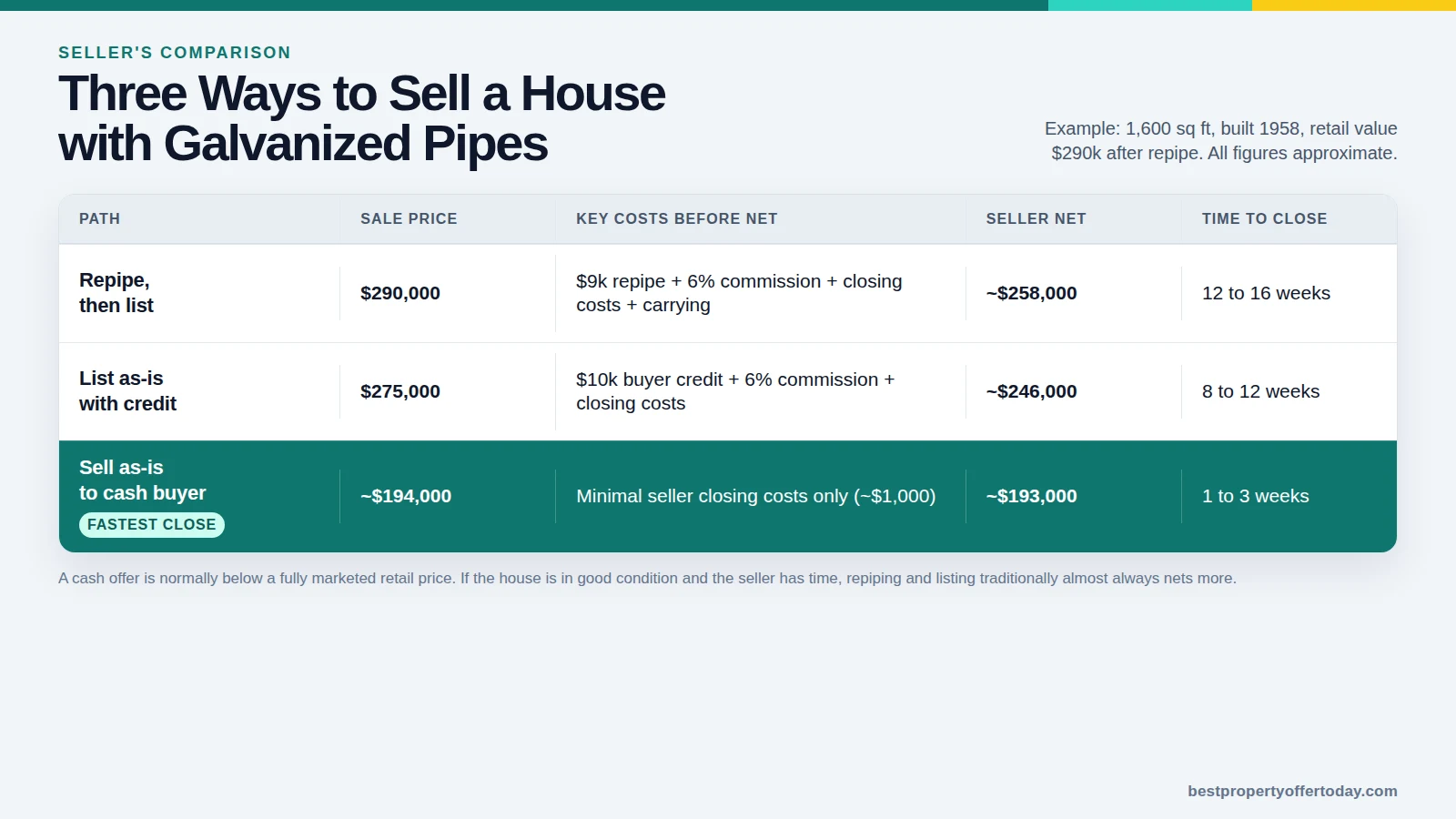
Take a 1,600-square-foot house built in 1958 with all-original galvanized supply lines. The rest of the house is in decent shape: solid roof, updated kitchen, no structural issues. Retail value after a repipe: $290,000.
| Path | Sale price | Costs before net | Seller net | Time to close |
|---|---|---|---|---|
| Repipe, then list | $290,000 | $9,000 repipe + $17,400 commission + $2,900 closing costs + $2,500 carrying costs | ~$258,000 | 12 to 16 weeks |
| List as-is with buyer credit | $275,000 | $10,000 buyer credit + $16,500 commission + $2,750 closing costs | ~$246,000 | 8 to 12 weeks |
| Sell as-is to cash buyer | $194,000 | Minimal seller closing costs (~$1,000) | ~$193,000 | 1 to 3 weeks |
The repipe path nets roughly $65,000 more than the cash path on this example. That gap is the price of speed and certainty, and it is a real gap. A more complete comparison between a cash sale and a traditional listing is in the cash offer vs. listing with an agent post. The net proceeds calculator can run your specific numbers before you commit to a path.
The cash path makes sense on this example when: the seller cannot front the repipe cost, a divorce or estate deadline requires closing in under a month, a deeper inspection is likely to turn up additional problems that would end a retail deal, or the seller values the certainty of a closed transaction over the higher number that comes with more variables.
Red flags from buyers to watch for
Galvanized pipe attracts some buyers who use it as a renegotiation lever late in the transaction. If you are listing as-is and dealing with investors, watch for these:
- A verbal offer well above other bids, followed by an “inspection discovery” that happens to match the premium they offered
- A contract with an inspection window longer than 14 days on a property you accepted as-is
- An assignment clause allowing the buyer to transfer the contract to a third party before closing, who then tries to re-trade on price
- Proof of funds showing a line of credit rather than cash in a bank or brokerage account (a line of credit can be pulled; it is not the same as available cash)
- An offer contingent on the buyer selling another property first
A serious investor knows the repair cost before writing the offer. A post-inspection price cut on a disclosed as-is condition is almost always negotiating tactics, not a genuine discovery. See the full guide on what proof of funds actually establishes before taking any buyer at their word.
Questions to ask before signing
Whether you are reviewing a buyer’s credit or a cash offer, these are worth asking before you sign a purchase agreement:
- Is the offer subject to a financing contingency, and if so, which loan type?
- Can you provide proof of funds: a bank or brokerage statement dated within the last 30 days, not a letter from an investment company?
- What does the inspection contingency cover, and is it waived on this as-is purchase?
- What is the earnest money deposit, and what happens to it if the buyer walks after the inspection period ends?
- Who is the actual buyer: an individual, an LLC, or a company that plans to assign the contract?
- What title company will handle closing, and can it clear any liens within your required timeline?
Does galvanized pipe fail every home inspection?
Not automatically. An inspector will flag galvanized pipe as aging infrastructure with a limited remaining lifespan, which is accurate. Whether that translates into a required repair before closing depends on the loan type. FHA, VA, and USDA appraisers require repair if they observe active corrosion, rust-colored water, or pressure below the minimum threshold. Conventional loans give the underwriter more discretion. A home inspector’s report is informational; it is the appraiser’s conditions and the lender’s underwriting requirements that create deal-blocking obligations.
Does homeowners insurance cover galvanized pipe failure?
Standard homeowners policies cover sudden and accidental water damage from a pipe burst, but they exclude damage from gradual deterioration. A galvanized pipe that slowly leaks behind a wall for months before causing visible damage is likely to be denied under the gradual-deterioration exclusion. A pipe that fails suddenly and floods a room is generally covered, subject to the deductible. This distinction matters when disclosing a known slow leak to a buyer: if there is remediated water damage from a prior slow galvanized leak, some insurers will treat the property as a higher risk at renewal.
How long does a full repipe actually take?
For a typical single-family home, the active plumbing work takes two to five days. Drywall patching and painting afterward takes longer. From permit application to completed work, budget three to five weeks in most markets. Contractor availability is the real variable: in a busy season, scheduling a licensed plumber for a full-house repipe can take two to four weeks before work begins. If you plan to repipe before listing, get the permit application and contractor scheduled before you set the listing date, not after.
What do I have to disclose about galvanized pipes?
Most states require disclosure of known material defects. Galvanized pipe that you know to be original and past its expected service life is a material defect in most disclosure frameworks. If you have had a plumber assess the system, or if you have experienced leaks, discolored water, or pressure complaints, those facts belong on the disclosure form. Selling as-is limits your duty to repair; it does not limit your duty to disclose what you know. An undisclosed known defect that surfaces after closing can give a buyer grounds to rescind the sale or seek damages in most states.
If you want to see what the as-is market actually offers before deciding whether to repipe, you can request competing cash offers from vetted buyers at no cost and with no obligation. Call 804-361-7460 with any questions.