Selling a House With Electrical Problems: What Sellers Need to Know
You can sell a house with electrical problems. The legal right to do it is not in question. The harder question is what the problems actually cost you, because the answer changes depending on which kind of buyer you are selling to.
Why electrical problems are different from most repair issues
Most repair problems affect price. Electrical problems also affect who can buy.
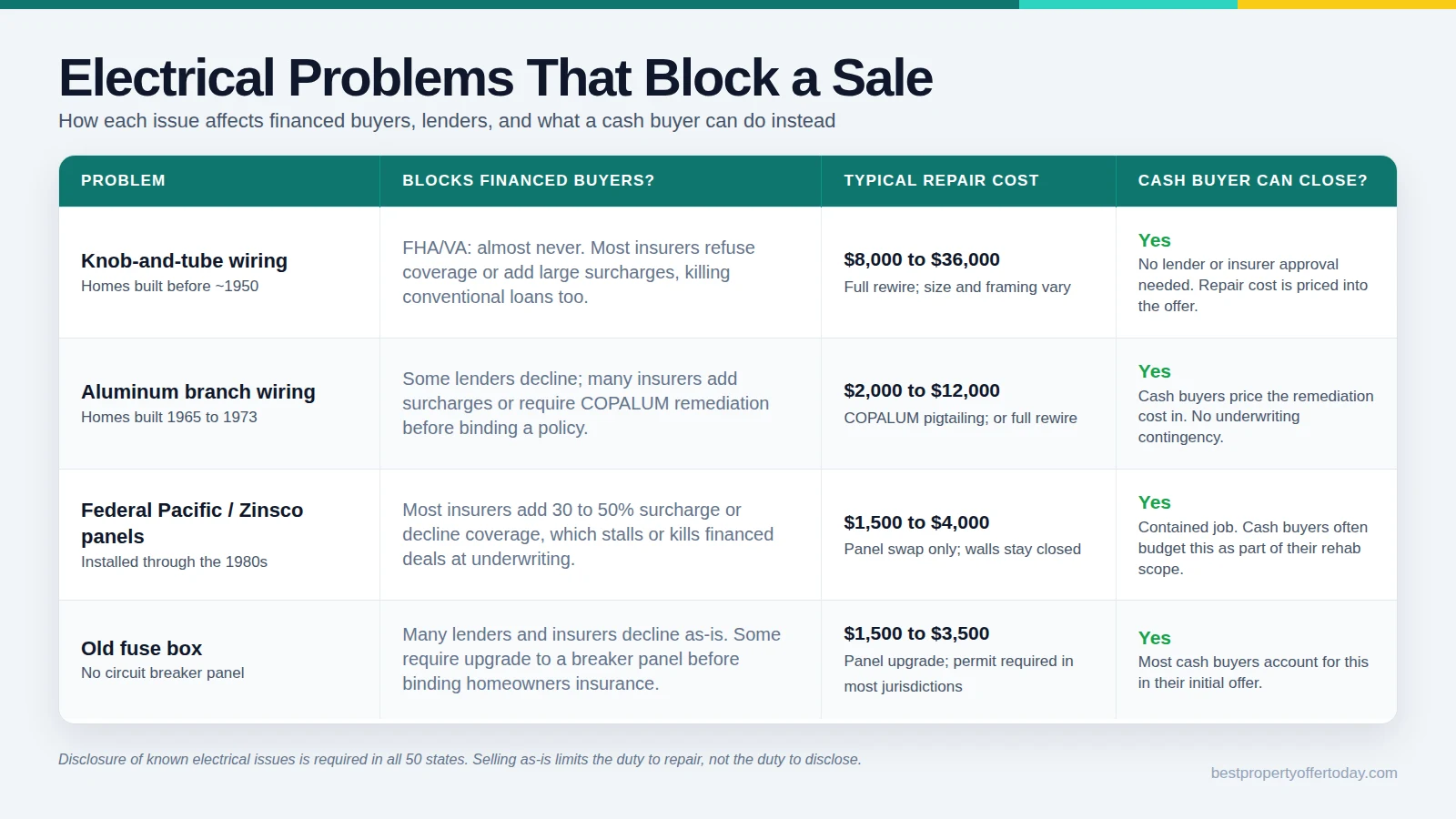
A financed buyer, meaning anyone using an FHA, VA, or conventional mortgage, needs the property to be insurable before their lender will fund the loan. Insurance underwriters have a short list of electrical conditions they will not cover. If your house is on that list, the loan cannot close. It is not a negotiating point. The lender will not fund.
The conditions that reliably trigger this are:
- Knob-and-tube wiring, found in homes built before roughly 1950
- Aluminum branch wiring, common in homes built between 1965 and 1973
- Federal Pacific Stab-Lok panels and Zinsco panels, manufactured through the 1980s
- Active fuse boxes with no circuit breaker panel
None of these are automatically illegal to sell. All of them must be disclosed. And all of them shrink your buyer pool the moment they show up on a home inspector’s report, because financed buyers either cannot close or must negotiate a repair credit that the lender then escrows and controls.
What each electrical problem actually means for a sale
Knob-and-tube wiring
Knob-and-tube is the wiring used in houses built from roughly the 1880s through the 1940s. The insulation is cloth, which degrades over time. There is no ground wire, which means a grounded outlet cannot be added without replacing the wiring. FHA and VA loans almost always require the wiring to be replaced before they will fund. Most homeowners insurers either will not write a policy at all or charge a significant surcharge that makes coverage difficult to obtain.
Full rewiring on a 1,200 to 1,500 square foot house typically runs $8,000 to $16,000. On a larger or older house with more complex framing, $20,000 to $36,000 is not uncommon. The cost alone is not the whole problem. The work requires opening walls and ceilings, which means patching and painting after the electrician is done.
Aluminum branch wiring
From the mid-1960s to the early 1970s, aluminum was widely used for residential branch wiring because copper prices spiked. Aluminum is not inherently dangerous, but it expands and contracts more than copper with temperature changes, which causes connections to loosen over time. A loose connection at an outlet or switch arcs and heats. The U.S. Consumer Product Safety Commission documented the problem in the 1970s and the record is extensive.
Two repair approaches exist. The first is full replacement with copper wiring, which costs as much as a full rewire. The second is installing COPALUM connectors at every outlet and switch, a process where a certified electrician splices a short copper pigtail onto each aluminum wire end using a special crimping tool. This costs $50 to $150 per connection and must be done by an electrician trained specifically in COPALUM installation. It is the repair the CPSC endorses. A full aluminum-wired house might have 40 to 80 connections, putting remediation at $2,000 to $12,000 depending on house size.
Some insurers still add surcharges or deny coverage for aluminum-wired homes even after COPALUM remediation. Check with an independent insurance broker before assuming the fix fully resolves the insurance problem.
Federal Pacific Electric and Zinsco panels
Federal Pacific Electric Stab-Lok panels were installed in millions of homes from the 1950s through the 1980s. Consumer Product Safety Commission complaints and subsequent testing by electrical engineers found that the breakers in these panels fail to trip under overload conditions at a rate significantly higher than other brands. They are not subject to a formal recall, but the liability concern means most insurers either refuse to write policies on homes with these panels or charge premiums 30 to 50 percent higher than standard rates.
Zinsco panels, also sold under the GTE-Sylvania name, have a similar documented failure pattern where the breakers can fuse to the bus bar and not trip when they should.
Panel replacement runs $1,500 to $4,000 for a standard service panel, depending on amperage and local permit costs. Unlike a full rewire, this is a contained job that does not require opening walls.
How this affects what you can actually net: a worked comparison
Here is a single property example so the numbers are concrete.
A 1,400 square foot house built in 1955, in a market where a fully-updated version would sell for $230,000. The house has knob-and-tube wiring throughout. A licensed electrician’s estimate puts the rewire at $20,000.
Option 1: Fix the wiring, then list. Spend $20,000 on the rewire and $3,000 on wall patching and paint, then list at $230,000. A traditional sale at 5.5 percent commission costs $12,650. Carrying costs during a 45 to 60 day marketing period, at $1,300 per month in mortgage, taxes, and utilities, add $2,000 to $2,600. Total deductions: roughly $37,650 to $38,250. Net to seller: approximately $191,750 to $192,350.
Option 2: List as-is to retail buyers. Disclosure means every buyer knows about the wiring. Most financed buyers walk immediately. The ones who stay want a credit. FHA and VA buyers cannot proceed at all. You accept a $215,000 offer with a $20,000 seller credit for electrical. Commission on $215,000 at 5.5 percent is $11,825. After the credit, commission, and closing costs, net to seller: roughly $177,000 to $180,000. The deal is also fragile. If the buyer’s conventional lender requires the wiring fixed before closing, the deal falls apart entirely.
Option 3: Collect cash offers through a marketplace. Cash buyers do not need lender or insurer approval to close. They price the electrical problem into their offer rather than asking you to fix it first. On this house, competing cash offers might come in between $158,000 and $185,000, depending on how many buyers you reach and what each one’s cost model looks like. A single call to one investor produces one number. Routing your information to multiple vetted buyers through a marketplace produces a spread, and that spread lets you compare rather than accept the first offer out of necessity. Closing in one to three weeks, no repairs, no carrying costs, no agent commission. Net to seller on the best offer at $183,000: roughly $181,000 to $182,000 after title and transfer costs.
In this example, fixing and listing produces the highest net, but it requires roughly $23,000 in upfront capital and 60-plus days of carrying exposure. The cash offer route, through a marketplace with competing bids, is within a few thousand dollars of the same outcome without the financial exposure.
The honest limit of a cash sale
If your house is in otherwise good condition and the electrical problem is the only significant issue, a traditional listing after repair typically produces a higher net number. The gap between a top cash offer and a retail sale on a fixed house can run $30,000 to $50,000 on a $230,000 property. That gap is what a cash buyer charges for taking the repair risk, the insurance risk, and the financing risk off your plate.
A cash sale makes the most sense when: the electrical issue is one of several problems, you cannot front the repair cost, you are facing a time constraint such as a foreclosure or estate deadline, or you have already had financed buyers walk out of contract after the inspection.
If you want to see where you stand before deciding, our net proceeds calculator lets you run both scenarios side by side with your own numbers.
Red flags when a cash buyer makes an offer
Electrical problems attract a wide range of buyers. Some are experienced operators who close what they offer. Others are not.
- No earnest money, or earnest money below $1,000. A serious buyer puts money at risk; token deposits mean walking away costs them nothing
- An inspection window longer than 10 to 14 days on an as-is deal. The as-is designation should mean the buyer has already priced the condition, not that they get two weeks to find additional reasons to reduce the price
- An assignment clause in the contract. This allows the buyer to sell the contract to a third party before closing, which is how wholesalers operate. You can end up at the closing table with a buyer you have never spoken to
- A number that drops after a walkthrough when no new information was actually uncovered. Bait-and-switch price reductions are the most common complaint in this industry
- No proof of funds within 24 hours of your request
Our guide on how to tell whether a cash buyer is legitimate covers the vetting steps in detail. If you are seeing any of the flags above, those steps apply before you sign anything. You may also want to review our post on what a wholesaler actually is and why the assignment clause matters.
What to disclose, and what happens if you do not
Disclosure is required in every state, regardless of whether you sell to a cash buyer or a financed buyer, and regardless of whether the sale is as-is. An as-is clause limits your obligation to repair. It does not limit your obligation to tell buyers what you know.
The seller’s disclosure form in most states asks about electrical system condition, known defects, and whether you are aware of any issues affecting the buyer’s safety or use of the property. A yes answer with an accurate description of the wiring type is the correct response. Concealing a known electrical problem can expose you to a post-closing lawsuit regardless of the as-is language in the contract.
Get a licensed electrician’s written assessment before listing or before accepting an offer. It documents what you knew and when, which protects you. It also gives buyers a third-party scope of work, which grounds negotiation and reduces surprises at closing.
Questions to ask any cash buyer before you sign
- Can you provide proof of funds showing you have the purchase price available today?
- Does your offer include an inspection contingency, and what is the exact window?
- Is the contract assignable? If yes, who would be the actual buyer at closing?
- What is your process if the title search turns up an open permit or a lien?
- Have you purchased houses with similar electrical issues before, and can you close without requiring remediation first?
A buyer who answers these clearly and in writing is a buyer worth taking seriously. A buyer who deflects, or who says these questions are unusual, is a buyer to avoid.
Common questions from sellers
Will an FHA or VA buyer be able to close on a house with knob-and-tube wiring?
Almost never without full replacement first. FHA and VA underwriting guidelines require the property to be safely habitable and insurable. Knob-and-tube wiring fails both tests at most lenders. If a retail sale is the goal, the wiring has to be replaced before listing, or you need a conventional buyer whose specific lender approves as-is deals, which is a much smaller pool than it appears.
Does a cash buyer still do an inspection?
Most do a walkthrough before closing, but it is a business evaluation of repair cost rather than a standard inspection contingency. A legitimate cash buyer on an as-is purchase has already priced the electrical issue into the offer. If a buyer insists on a formal two-week inspection contingency on an as-is deal, that is a signal worth noticing. They may intend to renegotiate after you have taken the house off market.
How much does an electrical problem reduce my cash offer?
It depends on the problem type and the buyer’s cost model. Cash buyers typically use an ARV formula: they estimate what the house is worth fully repaired, apply a margin target, and subtract estimated repair costs. A $20,000 electrical problem reduces a cash offer by at least that amount, often more once the buyer adds a risk buffer for unknowns. The only way to find the real number is to collect offers from multiple buyers, because the same house with the same wiring will draw different bids from different buyers depending on their local contractor relationships and hold strategy. You can read more about that math at our post on how cash buyers calculate their offer price.
Can I get multiple cash offers without calling buyers one at a time?
Yes. Submit one request through a marketplace and it goes out to multiple vetted buyers at once. You see their offers side by side. There is no obligation to accept any of them. The offer form is at bestpropertyoffertoday.com and it is free to use. Offers typically come back within 24 to 48 hours. If you want to talk through your situation before submitting, call 804-361-7460.