A wet basement limits who can buy your house, not just what they will pay. Most buyers use mortgages, and their lenders require an appraisal. Active water intrusion fails the minimum property standards for FHA, VA, and USDA loans, and most conventional underwriters flag it as well. That means a buyer with a mortgage may not be able to close on your house even if they want to.
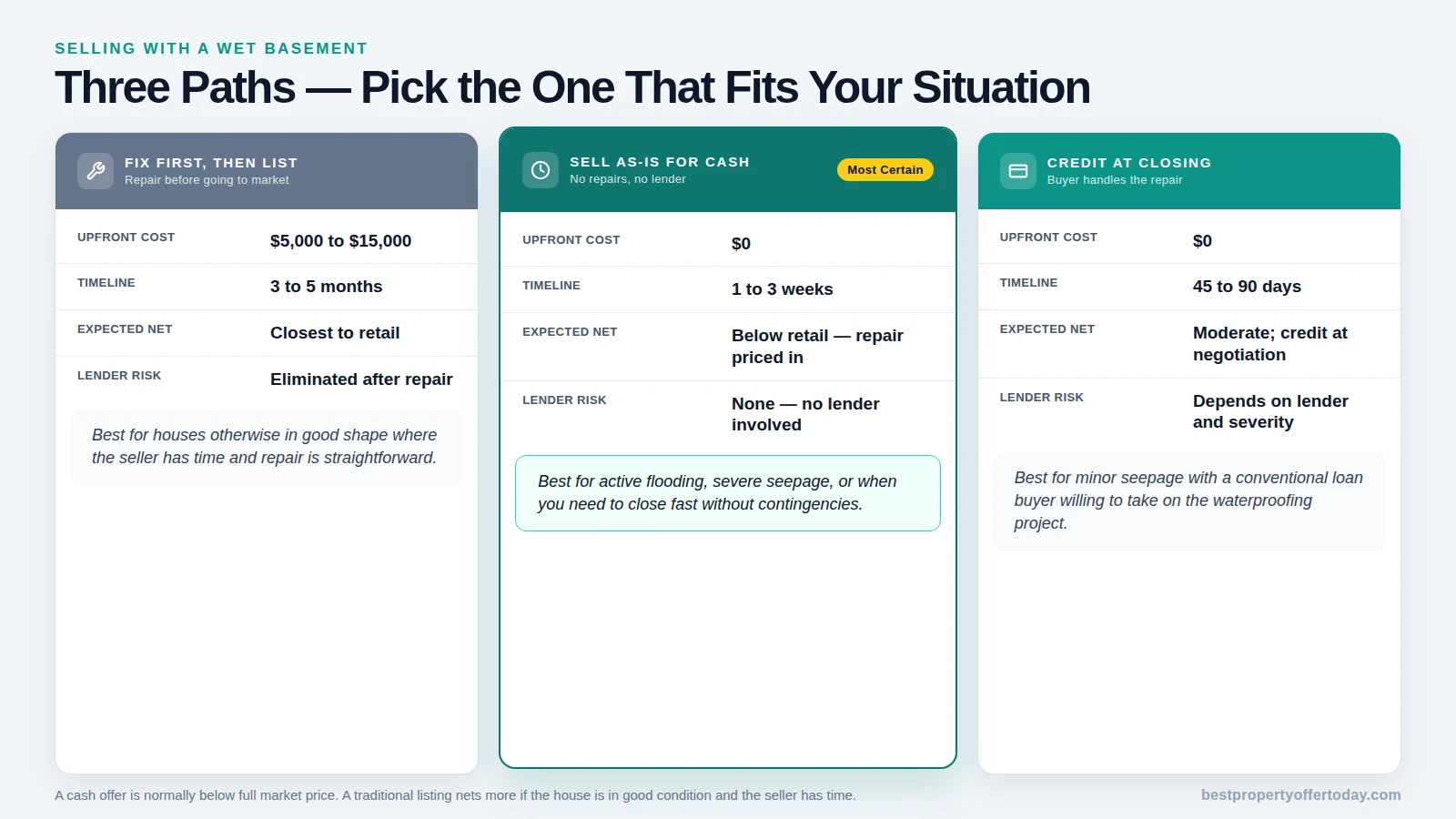
You have three real options: fix the problem before you list, offer a buyer a credit at closing, or sell as-is to a cash buyer. Each one works for different situations, and each one carries a different cost.
Milwaukee owners dealing with a wet basement can ask Milwaukee Buys Houses for a cash offer as is.
Why Lenders Block Wet Basements
Government-backed loans (FHA, VA, USDA) each require the property to meet minimum property standards before financing is approved. Active water intrusion fails those standards. A puddle after heavy rain, visible dampness along block walls, or a sump pump that runs constantly can all generate a required repair condition on the appraisal report.
Conventional loans are less strict in the guidelines, but appraisers still note water intrusion because it ties to structural risk and mold potential. The underwriter can then condition the loan on a repair, which puts the seller in the same position regardless of loan type.
Cash buyers skip all of this. No lender, no appraiser, no repair condition. The water issue is priced into their offer rather than made a condition of the sale. That is the practical reason a chronic wet basement often ends in a cash transaction.
Types of Basement Moisture: What the Difference Costs You
Not all wet basements are equal, and buyers price the difference when they make offers.
- Efflorescence: the white chalky residue left when mineral-laden water moves through concrete and evaporates on the surface. It signals a history of water movement, not necessarily active intrusion, but buyers and inspectors notice it and ask about it.
- Seepage or damp walls: water is actively moving through the foundation material. This is more serious than efflorescence. Inspectors will always flag it, and many lenders will condition financing on a repair.
- Active flooding: the basement takes on standing water during heavy rain. This is the most serious category. Financed buyers will almost certainly be unable to close.
- Condensation: humid interior air condenses on cool concrete walls. Often confused with seepage. Open a window in summer and check whether the walls dry within an hour. If they do, it is condensation. Seepage does not dry that way.
Disclosure applies to all of them. In every state, known water intrusion is a material defect that must be disclosed before a purchase contract is signed. Selling as-is limits your obligation to repair. It does not limit your obligation to say what you know.
Option 1: Fix the Problem Before You List
Interior waterproofing (a French drain around the basement perimeter combined with a sump pump) costs $5,000 to $15,000 depending on the square footage and severity of the water problem. Exterior excavation waterproofing costs $10,000 to $30,000 and disrupts the yard for several weeks. A sump pump installation alone runs $1,200 to $2,500.
A repair receipt and a transferable warranty can meaningfully improve the sale outcome. In many markets, a buyer who sees documented waterproofing will pay close to retail and proceed without the anxiety of wondering whether the basement will flood again next spring.
Two caveats apply. First, the disclosure still happens. You are disclosing that the problem existed and was repaired, not that it never existed. Second, the return on a waterproofing investment at sale is not guaranteed. Get contractor quotes and model the math against your expected list price before committing. In markets where buyers negotiate hard on any defect regardless of documentation, the math may not work in your favor.
Option 2: List As-Is With a Closing Credit
A credit at closing gives the buyer money to handle the waterproofing themselves after the sale. This is the most common middle path when the buyer has a conventional loan and the lender is willing to accept the condition, or the problem is minor enough not to trigger a repair condition on the appraisal.
The risk is sizing the credit before you accept an offer. Buyers negotiate credits based on contractor quotes they collect during the inspection window, and those estimates frequently run higher than the actual market rate. A seller who offers a $6,000 credit may face a buyer requesting $12,000 after inspection, with a quote in hand to back up the number.
The cleaner approach: get your own contractor estimate before listing and build the credit into the list price. That way the negotiation happens on your terms, with your numbers, rather than as a renegotiation after the buyer has leverage.
Option 3: Sell As-Is to a Cash Buyer
Cash buyers price in the repair rather than require you to make it. The formula most use is approximately 70 percent of after-repair value, minus the estimated cost of repairs. A house worth $280,000 in dry, market-ready condition with a $10,000 waterproofing estimate would look like this:
$280,000 x 0.70 = $196,000, minus $10,000 in repairs, produces an offer around $186,000.
That number is below what a retail buyer would pay for the same house without the water problem. What the seller gets in exchange is certainty. No inspection contingency, no appraisal condition, no buyer backing out after the first hard rain. The wet basement has already been accounted for in the offer, and there is nothing left to renegotiate.
If the house is otherwise in good condition and you have the time to list, negotiate a credit, and close on a standard timeline, a retail listing will usually net more money. The cash path makes practical sense when the severity of the problem is eliminating financed buyers entirely, when the sale needs to close quickly, or when a renegotiation after inspection is a risk you are not willing to take.
Three Paths Compared
| Path | Upfront cost | Timeline to close | Expected net | Best for |
|---|---|---|---|---|
| Fix first, then list | $5,000 to $15,000 | 3 to 5 months | Closest to retail | House otherwise in good shape, seller has time |
| Credit at closing | $0 | 45 to 90 days | Moderate; credit risk in negotiation | Minor to moderate seepage, conventional loan buyer |
| Sell as-is for cash | $0 | 1 to 3 weeks | Below retail but certain | Active flooding, severe seepage, or need to close fast |
Why a Single Cash Offer Is Rarely Enough
Cash buyer offers on the same wet basement can differ by $25,000 to $40,000 on the same property. One buyer may estimate the waterproofing at $8,000. Another may estimate $18,000. The spread reflects how each buyer assesses water risk, not the actual market cost of the repair.
Accepting the first cash offer you receive means accepting one buyer’s repair estimate as though it were the only valid one. A marketplace that generates competing offers on the same property lets you see the actual range and choose the buyer whose number reflects what the repair actually costs, rather than whoever happened to show up first.
Use our net proceeds calculator to model what each path is likely to leave you after costs, or call 804-361-7460 to start the process of collecting competing offers.
Red Flags to Watch for From Buyers
Some buyers who target properties with condition issues use tactics worth understanding before you sign anything:
- An offer that comes in above others, then drops after their walkthrough once you have turned away competing buyers. A legitimate buyer prices the water issue before the offer is submitted, not after you are under contract.
- An assignment clause in the purchase contract. This allows the buyer to transfer their purchase rights to a third party before closing. You may not know who you are actually selling to until the day before settlement.
- Token earnest money of $500 or less on a house worth over $150,000. If backing out costs almost nothing, they will back out at will.
- A long inspection window on a sale described as as-is. A buyer who has already walked the property and assessed the water problem does not need 21 days to inspect it.
Our guide on how to identify a wholesaler versus a real cash buyer covers these patterns in detail, including what legitimate proof of funds looks like and what questions to ask before you sign a contract.
What You Must Disclose
Seller disclosure laws in every state require disclosure of known material defects before the purchase contract is executed. Water intrusion is a material defect in every jurisdiction. Disclosure forms ask directly about moisture, water, or drainage problems.
If the problem has been repaired, disclose that it existed and that it was repaired, along with contractor documentation and warranty details. If active water intrusion remains, disclose the current condition. Sellers who have concealed known water intrusion have faced rescission claims and damages suits well after closing. Courts have consistently found that an as-is clause does not protect a seller who affirmatively concealed a known defect.
For a fuller picture of what buyers examine before making an offer on a property with condition issues, see what a cash buyer checks before making an offer.
Frequently Asked Questions
Does a wet basement have to be disclosed when selling?
Yes, in every state. Water intrusion is a material defect under seller disclosure law. Selling as-is limits your obligation to repair, not your obligation to disclose what you know about the property’s condition.
Can you sell a house with a wet basement without making repairs?
Yes. Cash buyers do not require repairs as a condition of closing because no lender is involved. The waterproofing cost is reflected in their offer rather than set as a condition of the sale. A financed buyer can potentially close with a negotiated credit, but this depends on the lender’s requirements and how severely the problem presents at appraisal.
How much does a wet basement lower a home’s value?
It depends on severity and local market conditions. Minor seepage that has been documented and treated may reduce value by $5,000 to $10,000. Active flooding that eliminates financed buyers reduces the effective value more substantially, because you lose the competitive pressure that multiple buyers create. A property that only cash buyers can purchase typically sells at a wider discount than one that any buyer can finance.
How long does it take to sell a house with a wet basement?
A cash sale typically closes in one to three weeks. The limiting factor is title work, not the buyer’s cash. A retail listing with an active water problem can sit on the market for months, and deals that go under contract often fall apart when the buyer’s lender receives the appraisal with a repair condition attached. See our breakdown of how long a cash home sale actually takes for a full picture of the timeline.