A judgment lien on your property does not block a sale. In most cases it pays off at closing from the proceeds, the same way a mortgage balance does. The complication arises when the lien consumes most of your equity, when the amount is disputed, or when the creditor refuses to accept less than a figure that would leave you short at closing. Understanding the mechanics before you list or accept an offer is what keeps you from being blindsided by a number the title company produces on day one of the title review.
What a Judgment Lien Is, and How It Gets on Your Property
A judgment lien begins as a civil court judgment. A creditor sues you, wins a money judgment, and then records that judgment in the county where you own real property. In most states, recording is the step that converts the court judgment into a property lien. The creditor cannot skip the lawsuit. This is different from a mechanic’s lien, which a contractor can file without any court proceeding, and different from a tax lien, which a government agency files administratively.
The lawsuits that produce judgment liens vary: unpaid credit card balances, personal loan defaults, business contract disputes, landlord claims against former tenants, personal injury verdicts. Once recorded, the lien attaches to all real property you own in that county, not just your primary residence.
How a Judgment Lien Differs from a Mechanic’s Lien or Tax Lien
The three most common liens on residential property each attach through a different process, and each has different rules for resolving them before a sale.
| Lien type | How it attaches | Who files it | Priority at closing |
|---|---|---|---|
| Judgment lien | Creditor wins civil lawsuit, then records judgment in county land records | Judgment creditor: individual, business, or debt buyer | Generally behind mortgages and tax liens |
| Mechanic’s lien | Contractor or supplier files without a court order, within a state deadline | Contractor, subcontractor, or material supplier | May have superpriority if timely filed; varies by state |
| Tax lien | IRS or state revenue agency files administratively for unpaid taxes | Government | Federal tax lien has priority over most other liens |
Lien priority matters at closing because when proceeds are distributed, higher-priority liens get paid first. A federal tax lien is paid before a judgment lien. A mortgage is typically paid before both. If stacked liens exhaust the proceeds before the judgment lien is reached, the judgment creditor may not get paid at all, which can complicate negotiations. The mechanic’s lien post covers contractor liens in detail if you are dealing with more than one encumbrance.
State Rules That Change Your Options
Four state-specific rules have real consequences for sellers:
Homestead exemption. Many states protect a portion of primary-residence equity from judgment liens. Florida and Texas offer unlimited homestead protection, meaning a judgment lien recorded in those states does not attach to equity in a qualifying homestead at all. California protects $300,000 to $600,000 depending on median local home prices. Virginia protects only $25,000. Some states require you to file a homestead declaration before the judgment records to claim the exemption.
Dormancy and renewal. Judgment liens do not last forever. State statutes set expiration periods, typically 5 to 10 years. A creditor who does not renew within that window loses the ability to enforce the lien. California, Texas, Florida, and New York all set the period at 10 years. An attorney can check whether a lien against your property is still active or has gone dormant. A title company may be willing to insure over a dormant lien if the attorney provides a formal opinion letter.
Foreign judgments. A judgment obtained in one state does not automatically become a lien in another. The creditor must domesticate the judgment, meaning register it in the state where your property sits, before it can attach as a lien. If you relocated to a new state after the judgment was issued, the lien may not have followed.
Post-judgment interest. Most states allow judgment creditors to charge statutory interest on unpaid balances, often 5 to 10 percent per year. A $20,000 judgment from 2021 may have grown to $26,000 or more by the time the title company finds it. The accrued interest is part of the payoff the title company will require.
How Closing Actually Works With a Judgment Lien
The title company runs a lien search during the title review period. Any recorded judgment liens under your name appear on the title report. The title company will not issue a title insurance policy until those liens are either paid, bonded around, or formally released.
On a financed sale, the buyer’s lender also requires clean title before funding. On an all-cash sale, there is no lender, but the cash buyer’s title insurance policy has the same requirement. The lien pays from proceeds at closing, on the same line of the settlement statement as the mortgage payoff. You receive whatever is left.
If the combined liens exceed your net proceeds, you have three choices: bring cash to the table, negotiate the creditor down to a figure that allows the transaction to close, or the sale does not close.
Three Paths Forward: What Each One Costs
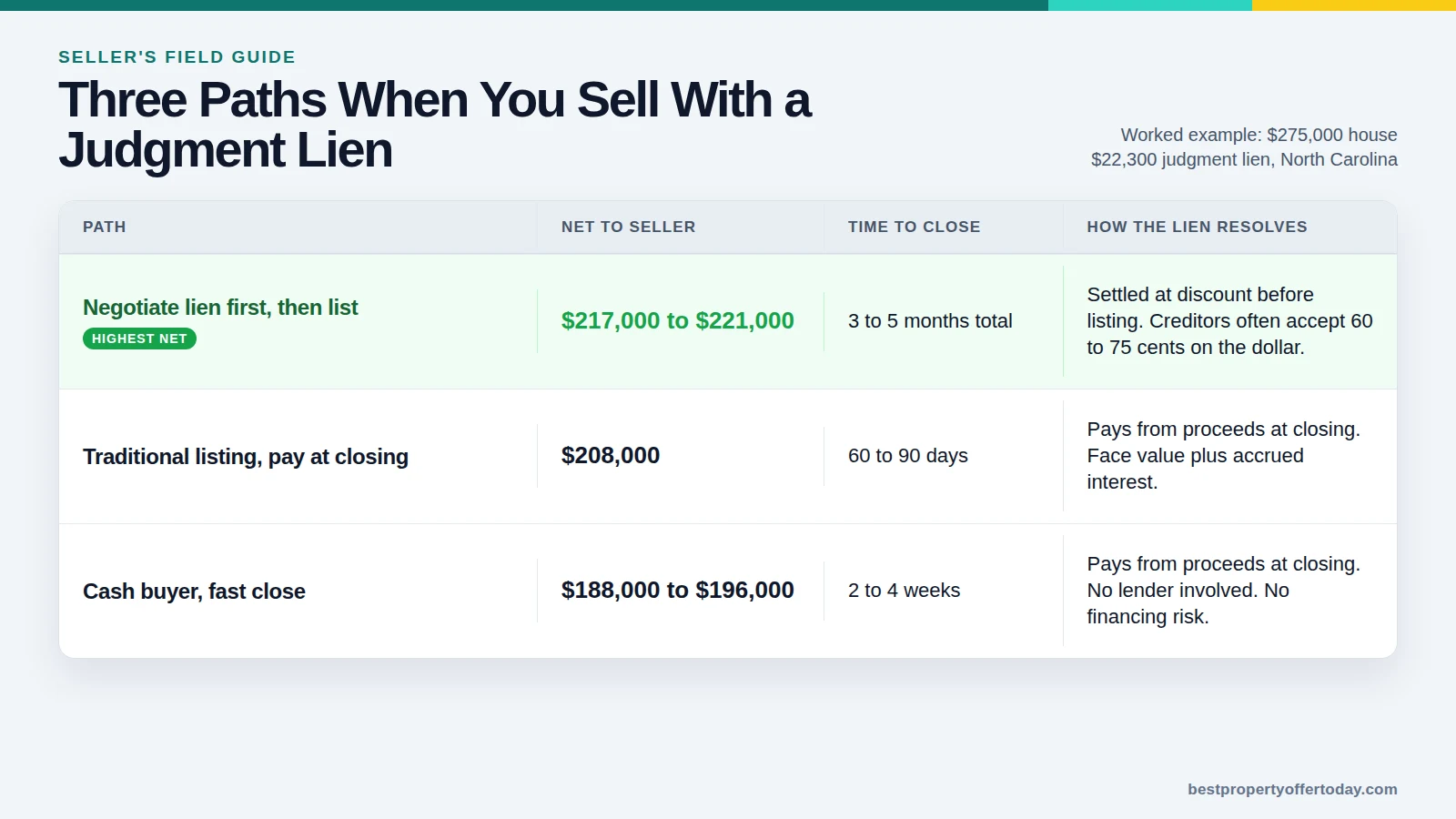
The following example uses a house in North Carolina with an ARV of $275,000. The seller owes $21,000 on the first mortgage. A 2022 credit card judgment of $19,500 was recorded in the county land records. At 8 percent statutory interest, the current payoff on the judgment is approximately $22,300.
| Path | Net to seller | Time | Notes |
|---|---|---|---|
| Negotiate judgment first, then list | $217,000 to $221,000 | 3 to 5 months | Creditor accepted 65 cents on the dollar ($14,500). Full-price listing followed. No agent discount for lien disclosure. |
| Traditional listing, pay lien at closing | $208,000 | 60 to 90 days | Judgment pays at face value plus accrued interest ($22,300). Agent commission and closing costs at standard rates. |
| Cash buyer, close in 3 weeks | $188,000 to $196,000 | 2 to 4 weeks | Cash offer $235,000 to $245,000, no commission, no financing risk. Lien pays at closing from proceeds. |
Path A produces the best net result but requires months of attorney work and creditor negotiation before the property ever lists. Path C costs roughly $12,000 to $20,000 less than Path A but removes financing contingency risk and closes on a defined timeline. For a seller facing a deadline, a pending foreclosure, or a complicated lien dispute, that difference can be the right trade. Use the net proceeds calculator to run your specific numbers before committing to any path.
A cash offer is almost always below a fully marketed retail sale price. If the property is in reasonable condition and the judgment is small relative to your equity, a traditional listing will net more. The lien is not, by itself, a reason to accept a below-market offer.
When the Lien Is Larger Than Your Equity
If the judgment amount plus the mortgage payoff exceeds what you would net from a sale, a traditional closing cannot happen without a negotiated resolution. You cannot close without the creditor’s cooperation, which gives the creditor leverage.
Judgment creditors, particularly debt buyers who purchased the account at a discount, often accept 50 to 80 cents on the dollar for a prompt, verifiable payment. They know the alternative is waiting for you to build more equity or pursuing a forced-sale proceeding, which is slow and expensive on their end. A real estate attorney who handles lien negotiations can usually produce a better result than a seller negotiating directly.
If the creditor refuses to discount and the judgment leaves you genuinely underwater, a short sale may be the only path forward. That requires lender approval and creates a credit consequence, and it is a different problem from a judgment lien on a property with equity. The short sale versus cash sale comparison covers that path in full.
Red Flags When Accepting a Cash Offer
Some buyers use the presence of a judgment lien as leverage to renegotiate price after the contract is signed. Watch for these before you accept:
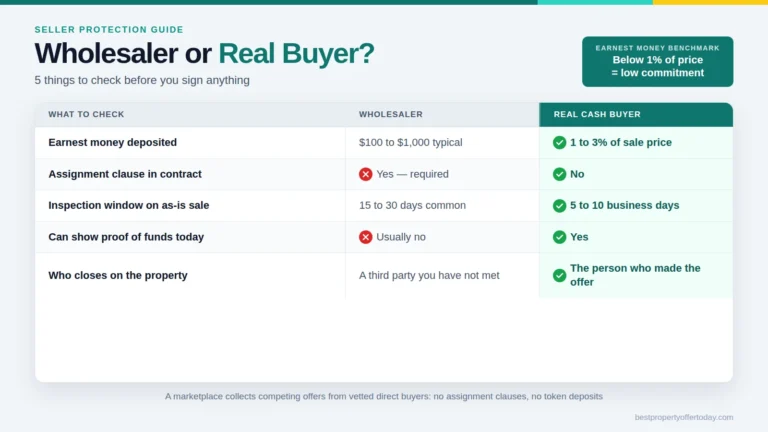
- Token earnest money: under $1,000 on a contract above $200,000. Walking away costs them almost nothing.
- A broad inspection contingency on a purported as-is cash deal. Legitimate cash buyers do not need 21 days to inspect a property they are buying as-is.
- An assignment clause that lets the buyer transfer the contract to a third party before closing.
- A price reduction request after the title search, citing the lien as new information. A legitimate buyer with lien experience prices it in upfront.
If you see these signals, review the contract with a real estate attorney before responding. For questions about collecting competing cash offers on your property, call 804-361-7460. Offers come back within 24 to 48 hours and there is no obligation to accept any of them.
Frequently Asked Questions
Does a judgment lien prevent me from selling my house?
No. A judgment lien is paid from proceeds at closing. You can list and accept offers with a judgment lien on the property. The lien must be resolved by the time the deed transfers, but that resolution happens through the settlement statement, not before you go to market.
How long does a judgment lien last?
Most judgment liens expire after 5 to 10 years unless the creditor renews them in court. California, Florida, Texas, and New York set the dormancy period at 10 years. An attorney can confirm whether a specific lien is still active or has gone dormant under your state’s rules.
Can I negotiate a judgment lien below face value?
Yes. Creditors, especially debt buyers who purchased the account for pennies, routinely accept 50 to 80 cents on the dollar for a prompt, verifiable payment. The settlement must be documented as a full satisfaction of judgment and recorded in the county land records to clear the title.
Does a cash buyer pay the lien separately on top of the purchase price?
No. The lien pays from the purchase price at closing, on the same settlement statement as the mortgage payoff. If a cash buyer offers $240,000 and your lien balance is $22,300, that $22,300 comes out of the $240,000. The buyer does not pay it in addition to the offer amount.