Selling a House With a Tax Lien: How the Lien Gets Cleared, and What You Net
A tax lien does not block a home sale. It sits on the title, gets paid from your proceeds at closing, and the property conveys clean to the buyer. What changes is how much you net, who gets paid first, and whether a buyer using a mortgage can even close on the house. This post covers those mechanics for each type of tax lien, including a mechanism the IRS calls a discharge of specific property and why it matters when the lien amount exceeds what the sale delivers.
What counts as a tax lien, and there is more than one kind
Tax liens come from four different sources, and they do not all work the same way at closing.
Federal income tax liens. When you owe unpaid federal income taxes, the IRS files a Notice of Federal Tax Lien (NFTL) in the public records of every county where you own real property. From that recording date, the lien attaches to all property you own in that county, including the house.
State income tax liens. States with their own income tax do the same thing at the state level. California’s Franchise Tax Board and New York’s Department of Taxation and Finance, for example, file in county records. Priority is determined by the recording date, the same as federal liens.
Property tax liens. These work differently. In most states, a property tax lien attaches automatically on the assessment date, with no filing required. That means a property tax lien can pre-date a mortgage recorded years later, and in nearly every state, it takes first-lien position regardless of when the mortgage was recorded. If you fall behind on property taxes while still carrying a mortgage, both the county and the lender must be paid at closing, with the county first.
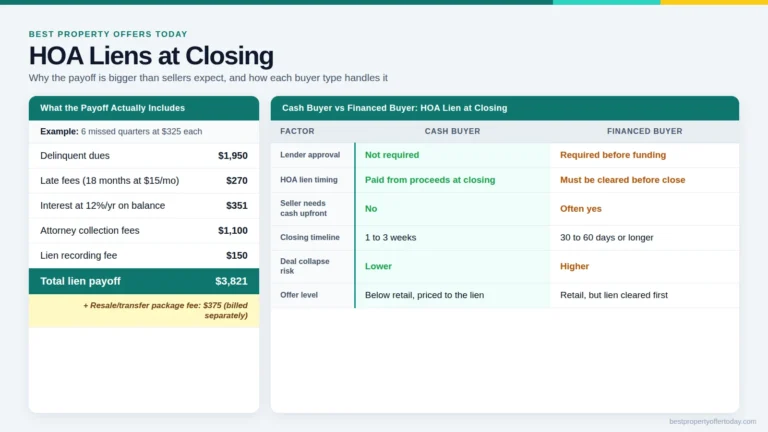
HOA liens. About a dozen states have super-lien statutes: Connecticut, Delaware, Maryland, Massachusetts, Minnesota, Nevada, New Jersey, Oregon, Pennsylvania, South Carolina, Washington, and the District of Columbia, among others. In those states, a portion of delinquent HOA dues, typically six months of assessments though the cap varies by state, takes priority over the first mortgage. Outside of those states, an HOA lien records and is paid in normal priority order based on recording date.
Which liens follow the property, and which follow the person
This distinction matters for sellers who want to know whether a sale actually resolves the problem.
Federal and state income tax liens attach to the property. They also attach to everything else you own: bank accounts, vehicles, business interests. A sale clears the lien from the house but does not discharge the underlying tax debt. If the sale proceeds do not cover the full balance, the IRS continues pursuing the remainder from your other assets.
Property tax liens are a purely property obligation. The county does not chase the former owner after a sale. If you inherit a house with ten years of unpaid property taxes, those taxes are cleared at closing from the proceeds. If the taxes exceed the sale price, the buyer absorbs the shortfall, but only in a negotiated distressed sale where the buyer knowingly takes that on as part of the purchase price.
HOA liens attach to the unit, not the person. Selling the unit resolves the HOA obligation, subject to the amount owed and the lien’s position in the priority stack.
How a tax lien affects a financed sale versus a cash sale
Mortgage lenders require clear title as a condition of funding. An active tax lien on the property means most lenders will not fund: the underwriter sees the title report, flags the lien, and will not release loan proceeds until the lien is resolved. This is the practical reason sellers with federal or state income tax liens often cannot sell to a buyer who needs a mortgage.
A cash buyer does not need a lender’s approval. The transaction closes on the buyer’s own funds. The title company still runs a full search, and the lien still appears on the settlement statement, but it can be paid from proceeds at closing in a single step without any lender sign-off. The lien does not kill the deal; it reduces the net you receive.
This is why sellers with active federal tax liens often need to work with cash buyers. One request on our marketplace goes to a network of vetted cash buyers, and competing offers come back within 24 to 48 hours. Because each buyer operates with their own capital, none of them need a lender to approve the title condition before making an offer.
The IRS discharge of specific property: the mechanism most sellers do not know about
When the IRS lien exceeds what the sale will deliver, there is a tool available called a certificate of discharge under Internal Revenue Code Section 6325(b). Most sellers, and many real estate agents, have never heard of it.
A certificate of discharge releases the federal tax lien from the specific property being sold without eliminating the underlying tax debt or the lien on the seller’s other assets. The IRS issues it when either the sale proceeds satisfy the lien in full, or when the IRS determines that the government’s security interest in the property falls below a certain threshold relative to the property’s value.
To apply, the seller or their representative files Form 14135 with the IRS Advisory office for their district. Processing typically takes 30 to 45 days. That timeline matters. A seller who is two weeks from closing cannot wait for a discharge. This tool is most useful when a seller has time, or when a buyer will allow the additional window before closing.
For sellers who owe more than the house is worth, the discharge lets the sale close, transfers clear title to the buyer, and leaves the remaining debt as a personal obligation against non-property assets. The IRS does not block the sale; it receives what the property delivers and pursues the balance through other means.
Lien priority at closing: who gets paid first
At closing, the title company issues a settlement statement listing every lien and obligation in priority order. Payment flows down the list until the proceeds run out. Any unpaid balance stays with the seller after closing.
| Position | Lien type | Why it ranks here |
|---|---|---|
| First | Property taxes | Statutory super-priority in most states, no filing required |
| Second | HOA dues (super-lien states only) | Up to the statutory cap, typically six months of assessments |
| Third | First mortgage | Paid by recording date, usually senior to income tax liens |
| Fourth | Federal income tax lien | NFTL recording date determines position relative to other junior liens |
| Fifth | State income tax lien | Recording date |
| Sixth | Judgment liens and others | Recording date |
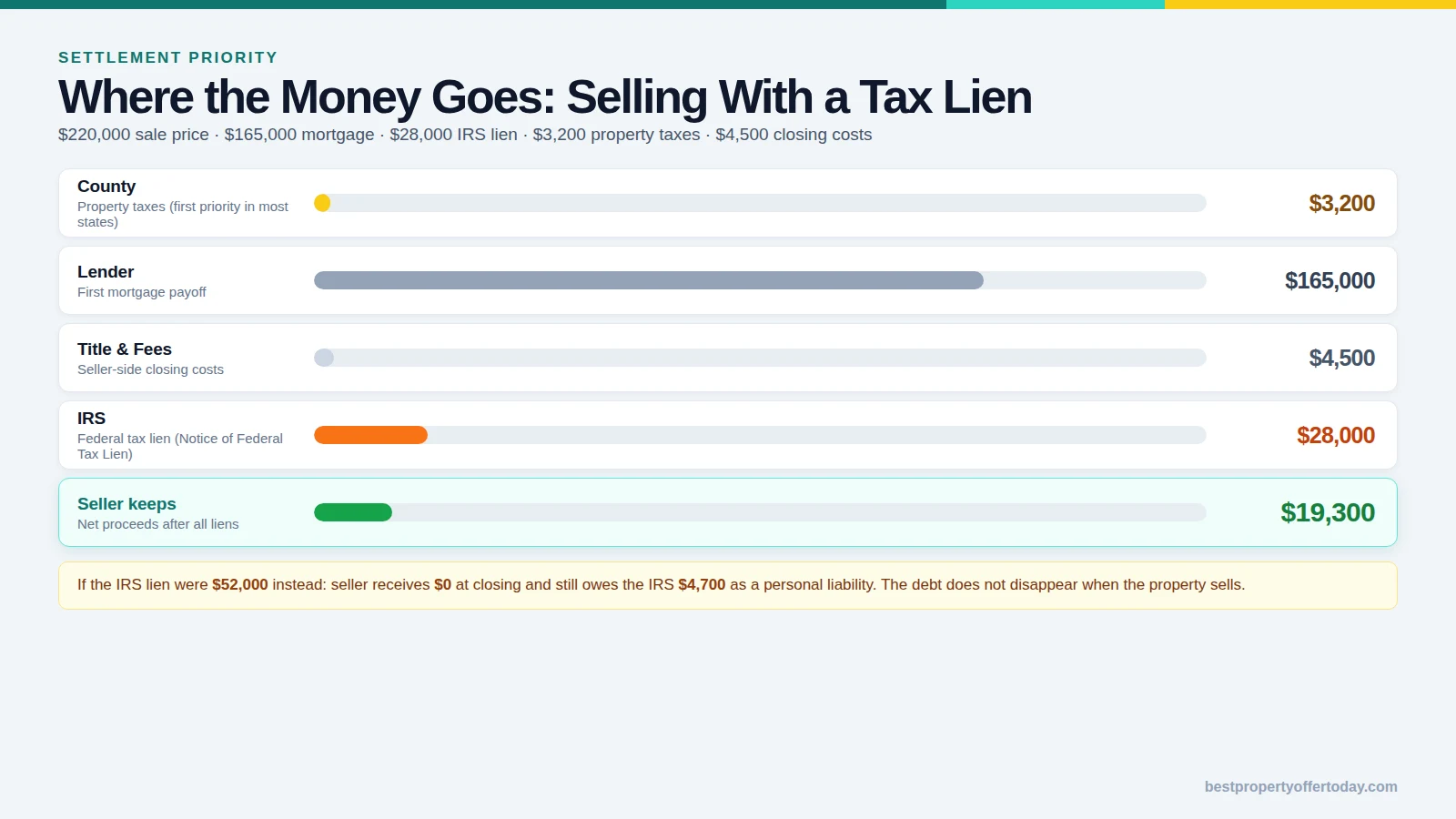
A worked example shows what this means in practice. A property sells for $220,000. The seller owes $3,200 in unpaid property taxes, $165,000 on the first mortgage, $4,500 in seller-side closing costs, and a $28,000 federal tax lien filed after the mortgage.
The settlement math: $220,000 minus $3,200 in taxes, minus $165,000 to the lender, minus $4,500 in closing costs, minus $28,000 to the IRS leaves the seller $19,300.
If the IRS lien were $52,000 instead of $28,000, the available funds after the mortgage and costs would be $47,300. The IRS receives all of it. The seller receives nothing and still owes the IRS $4,700 as a personal obligation after closing. That shortfall does not disappear; it follows the former owner.
Before you accept any offer, run the numbers through the net proceeds calculator so you know what you are actually keeping.
Red flags when shopping cash buyers in a lien situation
Sellers dealing with a tax lien are often under time pressure, and some buyers exploit that. Specific behaviors to watch for:
- An offer quoted without netting out the lien payoff. The offer amount is not what you receive. The offer minus liens minus closing costs is what you keep. Ask any buyer to show you a written net proceeds estimate before signing anything.
- A long inspection window on an as-is cash deal combined with a right to assign the contract to another buyer. That combination usually means the person you are dealing with is a wholesaler, not a real buyer. If they cannot find an end buyer before the inspection window closes, they walk, and you are back to the beginning with less time on the clock. Understanding the difference between a wholesaler and a direct cash buyer is worth doing before you sign.
- Earnest money below 1 percent of the offer price. On a $200,000 offer, a $500 deposit means walking costs the buyer almost nothing.
- A buyer who asks you to negotiate with the IRS yourself before they will make a formal offer. Legitimate buyers make an offer, open title, and let the title company handle lien coordination during the standard closing process.
Knowing how to verify that a cash buyer is real before you hand over a signed contract is one of the most useful things a seller in a lien situation can do.
When a traditional listing makes more sense
A cash offer on a property carrying a tax lien will almost always come in below what a fully marketed sale would deliver. That gap is real, and sellers should go in knowing it.
If you have time, strong equity above the liens, and a property in good enough condition to attract financed buyers after the lien is resolved, a traditional listing will net more. The lien resolution adds weeks to the timeline, but the sale price premium from a competitive retail market can be substantial.
If you do not have time, if the property needs significant repairs that a financed buyer’s lender would flag, or if the IRS lien is growing through interest and penalties faster than the property is appreciating, a cash sale stops the clock. You pay the lien from proceeds, close in one to three weeks, and end the carrying costs. Both choices are legitimate. Which one fits depends on your equity, your timeline, and the property’s condition.
Common questions about selling with a tax lien
Can the IRS stop me from selling my house if I owe back taxes?
No. The IRS cannot block a sale. They have a lien on the property, which means they receive proceeds at closing, but they have no legal authority to prevent you from listing or signing a purchase contract. In cases where the lien amount exceeds the proceeds, the IRS may request that you apply for a certificate of discharge so the buyer receives clean title, but that is a process, not a veto.
How long does it take to close when a federal tax lien is on the title?
A cash sale typically closes in one to three weeks. The lien is paid from proceeds at closing; there is no additional delay specific to the lien, as long as the payoff amount is confirmed in advance through a lien payoff request to the IRS. A discharge certificate under Section 6325, when needed, takes 30 to 45 days from the time you file Form 14135.
Does selling my house clear my IRS tax debt?
It clears the lien from the house. It does not necessarily clear the debt. If the sale proceeds cover the full IRS balance, the debt is gone. If not, the remaining balance stays as a personal tax liability. The IRS continues to collect from your other assets. Selling the property stops the lien on that specific asset; it does not stop collection on the underlying debt.
What if the mortgage and the tax lien together exceed what the house is worth?
The first mortgage is paid before the IRS lien in most situations. If the sale price barely covers the mortgage, the IRS receives little or nothing from the proceeds. At that point, the IRS can grant a certificate of discharge and allow the sale on the condition that their lien interest is acknowledged. In a genuine shortage situation, speaking with a tax attorney before listing is worthwhile. Some sellers qualify for an Offer in Compromise on the underlying debt, which can reduce the IRS’s required payoff before or during the sale process.