Proof of Funds from a Cash Buyer: What Sellers Should Ask For Before Signing
A cash offer means nothing if the money is not there. Proof of funds is the document that closes that gap, and most sellers never ask for enough of it.
Here is what proof of funds actually proves, what formats to ask for, and the specific details that separate a legitimate cash buyer from a wholesaler who does not have the money and is counting on you not to know the difference.
What Proof of Funds Actually Is
Proof of funds (sometimes called a POF letter or POF document) is a statement from a financial institution confirming that a buyer has the liquid assets needed to complete the purchase at the agreed price.
The key word is liquid. Cash sitting in a retirement account that would take three months and a tax penalty to access is not liquid. A line of credit that requires approval to draw is not liquid. The account needs to show funds that are available now, with no conditions attached.
For a seller, proof of funds does one specific thing: it confirms the buyer can close without needing you to wait on anyone else. That is what makes a cash sale different from a financed offer. The moment you accept a financed offer, a lender joins the transaction. Proof of funds, requested and verified at the offer stage, keeps that lender out of the picture.
What Counts as Acceptable Proof of Funds
Not all POF documents carry the same weight. Here is a breakdown of what sellers typically receive, from strongest to weakest:
| Document type | What it shows | Limitations |
|---|---|---|
| Official bank letter on letterhead | Bank confirms balance and account holder; harder to fabricate | Does not prevent buyer from spending funds before closing |
| Bank statement (30 days or less) | Account balance and account holder name | Can be doctored; does not confirm funds are earmarked for this purchase |
| Certified funds letter | Bank confirms funds have been set aside for a specific transaction | Rarely provided at the offer stage; more common near closing |
| Hard money lender commitment letter | Shows a lender is committed to fund the deal | A lender is now involved; this is not a true cash sale |
| Credit line screenshot or statement | Shows available credit, not cash | Weak; credit lines can be reduced or revoked without notice |
The standard that protects you best is a bank letter on institution letterhead, dated within the past 30 days, showing a balance equal to or exceeding the offer price. A screenshot of an online banking portal is not acceptable. Screenshots can be edited in under a minute with a free image tool.
What Proof of Funds Does Not Prove
This is the part nobody explains, and where sellers get burned.
Proof of funds shows a snapshot. It confirms the account existed, with that balance, on the date the statement was generated. It does not prevent the buyer from withdrawing those funds the next day. It does not confirm the buyer intends to put all of that money into this specific transaction. And it does not replace earnest money, which is what actually puts financial skin in the game.
A buyer who shows you a $600,000 bank statement but puts up only $1,000 in earnest money has not committed anything real. If a better deal comes along, walking away costs them $1,000. The proof of funds document tells you they have the capacity. The earnest money tells you they are serious. You need both.
The post on how much earnest money to expect in a cash sale covers what is reasonable to ask for, and what a low deposit tells you about the buyer’s actual intentions.
Red Flags That Should Stop the Conversation
A buyer who is not serious or not legitimate will often try to provide something that looks like proof of funds but falls short on inspection. These are the specific signs to watch for:
- Bank statement submitted as an image file with no supporting letterhead
- Balance rounds to an exact figure (such as $300,000.00 exactly) with no other account activity
- Institution name or logo looks slightly off or uses a generic font
- Statement date is more than 60 days old
- Buyer refuses to provide a letter from their institution and offers only a downloaded statement
- Buyer offers to show funds at closing but not before contract execution
- The name on the proof of funds does not match the name on the purchase contract
That last point matters more than it seems. A wholesaler sometimes makes an offer in their own name and intends to assign the contract to another buyer before closing. If the name on the POF is an LLC or a third party, ask directly: are you the buyer, or are you assigning this contract?
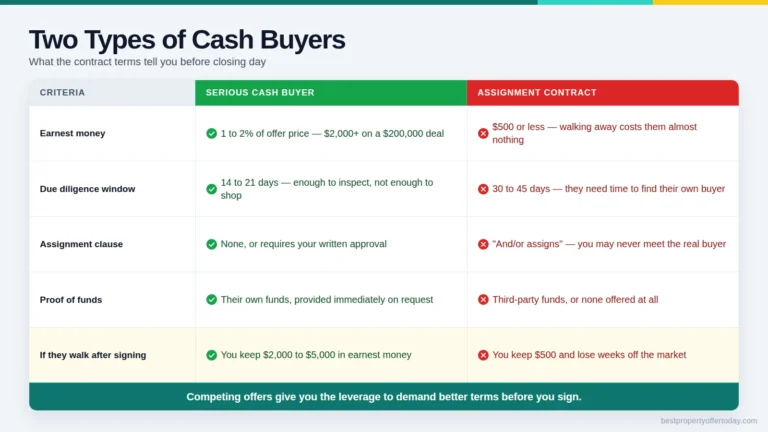
The post on how to tell a wholesaler from a real cash buyer covers assignment clauses in detail. A contract that contains an assignment clause means the buyer reserved the right to hand the deal to someone else. That someone else may not have any proof of funds at all.
Two Offers, Same Price, Very Different Risk
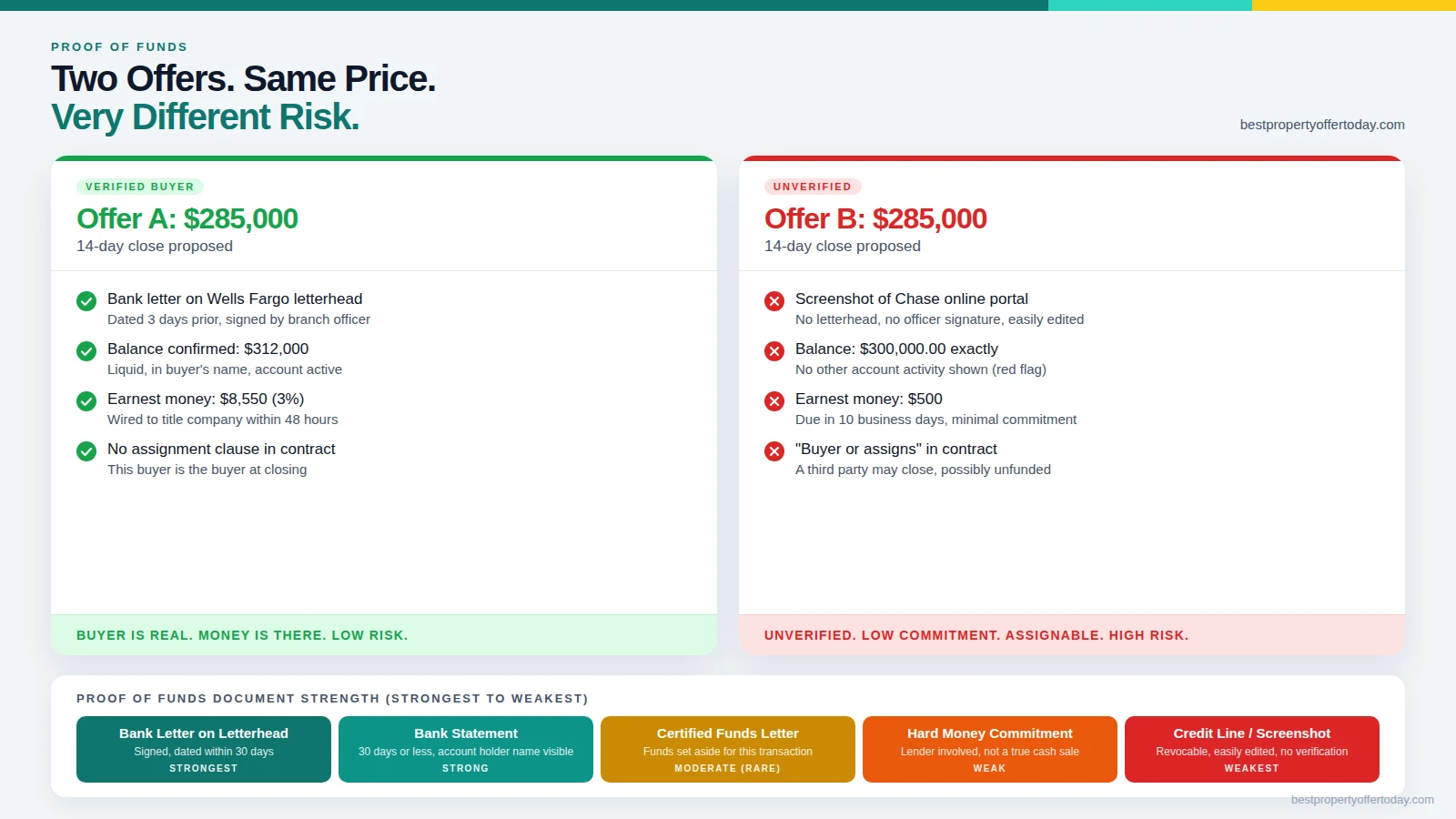
Here is a worked example. A seller receives two offers at $285,000, both described as cash, both proposing a 14-day close.
Offer A: The buyer submits a bank letter on Wells Fargo letterhead dated three days prior, showing a balance of $312,000. The earnest money deposit is $8,550 (3 percent of the purchase price), wired within 48 hours of signing. The contract contains no assignment clause.
Offer B: The buyer submits a screenshot of what appears to be a Chase online account showing $300,000. The earnest money is $500, due within 10 business days. The contract includes a clause reading “buyer or assigns.”
Both offers arrive at the same headline price. But Offer B carries a verification problem, a near-zero financial commitment, and an open door for the buyer to hand the contract to a third party. If that third party falls through on funding, the seller is back to square one, weeks later, with a narrowed pool of buyers and a property that has been sitting off-market.
The difference between these two offers can easily be $15,000 to $25,000 in carrying costs and opportunity cost, even though both opened with the same number.
How to Request Proof of Funds Formally
Request proof of funds in writing, as a condition of reviewing any cash offer. The language can be simple: require a bank letter on institution letterhead, dated within the past 30 days, showing available funds equal to or exceeding the offered purchase price, and state that screenshots and balance summaries will not be accepted.
Set a deadline. If a buyer cannot produce this within 24 to 48 hours of submitting an offer, that tells you something. A real buyer who is ready to close does not need three weeks to pull together documentation for an account they control.
If you are working with a real estate attorney, have them confirm the proof of funds is adequate before you take the property off the market. The post on whether you need a lawyer in a cash sale explains what attorney review costs and what it typically catches.
What the Vetting Process Looks Like on a Marketplace
When a seller submits a request through Best Property Offers Today, the buyers who respond are part of a vetted network. That does not eliminate the need to review what any specific buyer puts in front of you at the contract stage, but it does reduce the risk of a completely unqualified buyer making an offer that wastes two weeks of your time.
Once you move into contract with any buyer, track whether the earnest money arrives on time and in full. Vetting at the offer stage and monitoring follow-through at the contract stage are two separate steps, and both matter.
The Honest Trade-off: Cash Buyers and Price
A cash offer from a verified buyer with solid proof of funds is still normally below what a fully marketed retail listing would produce. The buyer is taking on risk and providing speed and certainty. The seller gives up some price in exchange for those things.
If your house is in good condition and you have two to four months to see a listing through, a traditional sale with an agent will almost certainly net more. The cash route makes sense when condition, timing, or circumstances make a traditional listing difficult. Being rigorous about proof of funds does not change that trade-off. It just makes sure that when you do accept a cash offer, the buyer can actually close.
The net proceeds calculator walks through what you keep after a cash sale versus a listed sale, accounting for repairs, agent commissions, and carrying costs.
Can a seller require proof of funds before accepting an offer?
Yes. A seller can require proof of funds as a condition of reviewing any offer. Most serious buyers expect this request and can provide it quickly. A buyer who pushes back on furnishing proof of funds before a contract is signed is a buyer worth walking away from.
Does proof of funds expire?
Yes. A bank statement or letter more than 30 to 60 days old is effectively stale. Funds can be moved, withdrawn, or tied up in another transaction in that window. Always request documentation dated within the past 30 days, and if closing is delayed by more than a few weeks, request an updated letter before proceeding.
What if the buyer uses a business account or LLC?
A business account or LLC account is acceptable as long as the entity named in the proof of funds matches the buyer named in the purchase contract. Ask for the operating agreement or articles of organization to confirm the person signing the contract has authority to bind the LLC. A POF from a different entity than the contract buyer is a red flag that needs a direct explanation before you proceed.
Is proof of funds the same as a pre-approval letter?
No. A pre-approval letter comes from a lender and says the buyer is approved to borrow a certain amount. That means the transaction is financed, not cash. If a buyer presents a pre-approval letter in response to a request for proof of funds, they have not submitted a cash offer. The two documents are not interchangeable, and accepting one in place of the other is a common and costly mistake.