You can sell a house that has unauthorized occupants. The sale is legal, the title can transfer, and buyers exist. What changes is the negotiation around it: who bears the cost of removing the occupants, what the buyer will pay, and how long the whole thing takes.
The first thing to get straight is which kind of occupant you have, because the law treats them differently and the removal path is not the same.
Squatter vs holdover tenant: why the distinction matters
A squatter has no legal right to the property. They moved in without permission, without a lease, and without paying rent. Legally they are trespassers, though in most states you cannot simply change the locks and remove them yourself. You have to use the court system.
A holdover tenant is different. They had a lease. That lease expired. They stayed. In many states, holding over automatically creates a new month-to-month tenancy, which means you are in a landlord-tenant relationship again even if you never agreed to it and never accepted rent. Month-to-month means you need to give proper notice, typically 30 to 60 days depending on the state, before any eviction action can begin.
That distinction carries real consequences for a sale. A squatter typically needs a court order and sheriff enforcement, which in most counties takes 30 to 90 days. A holdover tenant may need a formal notice period stacked on top of an unlawful detainer filing, which can push the timeline past 90 to 120 days in backlogged jurisdictions.
Both situations require legal process. Self-help eviction, which means changing locks, removing belongings, or cutting utilities, is illegal in every state and can expose a seller to civil liability that survives the closing.
Why possession controls the entire negotiation
When a buyer purchases a home, they are purchasing the right to use it. A house with an occupant who has no intention of leaving delivers something other than what the buyer agreed to buy. That is not a minor wrinkle. It is the core of the transaction.
Most retail buyers, people financing through a conventional or government-backed lender, cannot close on a property with an unauthorized occupant. The lender will not fund without clear occupancy status. Title companies grow cautious. Inspectors sometimes cannot gain access. The deal falls apart before it closes.
Cash buyers can and do purchase occupied properties. They price in the cost and delay of removal. Some specialize in exactly this situation. But the price they offer reflects what it costs them to solve the occupancy problem after closing, plus a risk margin for the uncertainty. Possession controls the price because a buyer who cannot take possession cannot close, and a buyer who takes on the possession risk needs to be compensated for it.
Your two paths: evict first, or sell with occupants in place
Evicting before listing gives you a larger buyer pool, better pricing, and a cleaner transaction. It also takes time and costs money in attorney fees, and it carries the risk that the process drags out longer than you planned. In states with full court dockets, an unlawful detainer case can take four to six months from filing to sheriff lockout.
Selling with occupants in place is faster for you to initiate, but the market narrows sharply. Financed buyers are nearly all excluded. The buyers who remain are investors and cash networks. They will price the occupancy problem into their offer.
A property worth $280,000 vacant might attract offers in the $195,000 to $220,000 range while occupied, depending on the state, the strength of any squatter paperwork, and how close any adverse possession clock has run. Neither path is automatically better. The right one depends on your time horizon, what eviction actually costs and takes in your county, and whether the occupant might accept a voluntary exit.
Worked example: a $280,000 house with a holdover tenant
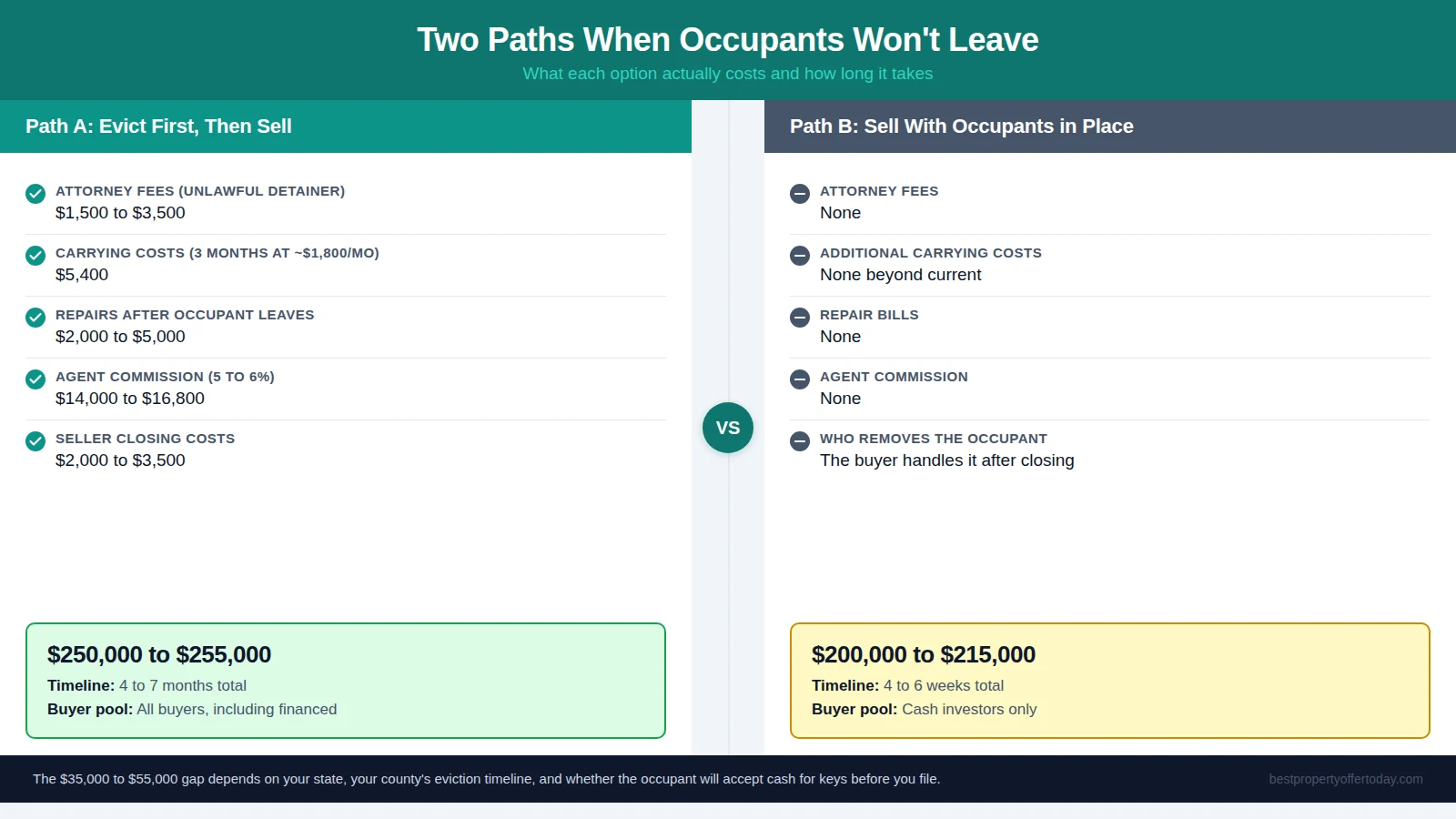
Say the house has a market value of $280,000. The holdover tenant stopped paying rent eight months ago. The lease expired six months ago. They have been formally asked to leave and have not. Here is what the two paths look like in a mid-tier market with a 60-day county eviction timeline:
Path A: Evict first, then sell.
- Attorney fees for unlawful detainer: $1,500 to $3,500
- Carrying costs during eviction (mortgage, taxes, insurance at roughly $1,800 per month, three months): $5,400
- Minor repairs and cleanup after tenant leaves: $2,000 to $5,000
- Agent commission on the retail sale at 5 to 6 percent: $14,000 to $16,800
- Seller-paid closing costs: $2,000 to $3,500
- Estimated net: $250,000 to $255,000
- Timeline to cash: four to seven months from today
Path B: Accept a cash offer with occupants in place.
- Realistic offer range in this scenario: $200,000 to $215,000
- No attorney fees, no continued carrying cost accumulation, no repair bills
- Closing: three to four weeks from accepted offer
- Estimated net: $200,000 to $215,000
- Timeline to cash: four to six weeks
The gap is roughly $35,000 to $55,000. Whether that gap is worth three to six months of carrying costs, legal fees, and procedural uncertainty is a decision only you can make. If the tenant has a history of resistance or the state is slow, the gap narrows. If eviction is fast and the occupant has no legal defenses, the gap stays wide and evicting first is almost certainly the better financial choice. Use the net proceeds calculator to run your specific numbers.
Comparing the options side by side
| Option | Buyer pool | Likely net | Timeline | Who handles removal |
|---|---|---|---|---|
| Evict, then list with agent | Widest | Highest | 4 to 7 months total | You, before listing |
| Evict, then request cash offers | Broad | High, no commission | 3 to 5 months total | You, before listing |
| Request cash offers with occupants present | Investors only | Lower, but certain | 4 to 6 weeks | Buyer, after closing |
| List retail with occupants present | Effectively none | Sale unlikely to close | Indefinite | Neither; deal falls apart |
Cash for keys: worth trying before you file
Before filing for eviction, one option is worth pricing out: offering the occupant a cash payment to leave voluntarily and leave the property in reasonable condition. Banks use this with defaulted borrowers. Landlords use it with problem tenants. It is not an admission that the occupant has any right to be there. It is buying speed and certainty.
The math is straightforward. If eviction attorney fees run $2,500 and carrying costs run $1,800 per month, offering $3,000 to $4,000 for a clean departure within 14 days costs less than the eviction and removes three to four months from your timeline. Get the agreement in writing. Specify the condition they leave the property in, the exact departure date, and the consequence if they stay past that date. Do not hand over money until the property is vacated and keys are returned.
Cash for keys does not work with every occupant, and some squatters will interpret it as a signal that you are uncertain of your legal position. Know your situation before you try it.
Red flags when a buyer offers to handle the occupant problem
Not every investor pursuing occupied properties operates legitimately. Some use the squatter situation as a renegotiation lever, knowing the seller has a limited pool of alternatives. Before signing, watch for these:
- Earnest money that is refundable for any reason during a long inspection period. On an occupied property, a $500 deposit means they can walk away at zero cost after tying up your property for 30 days
- An offer that drops significantly after a walkthrough, even though you disclosed the occupant situation upfront in writing
- Vague contract language about whether the property transfers vacant or occupied, and who bears the cost of removal if vacant is the condition
- An assignment clause giving the buyer the right to sell your contract to a third party before closing, which can delay the closing, change the actual buyer, and create new complications with any cash-for-keys negotiation already in progress
- Pressure to sign before speaking to an attorney, which is particularly common in states where squatter protections are stronger
A reputable buyer will answer all of those questions directly and put the answers in the contract. The cash buyer vetting guide on this site covers the other signals worth checking before you sign anything.
The honest trade-off: what a cash sale actually costs you here
A cash offer on an occupied property is almost always below what the house would fetch vacant, sometimes well below. You are not selling the house. You are selling the house plus the legal and practical problem living inside it. The buyer who takes that on is doing work you would otherwise have to do, and they price it accordingly.
If the property is in decent condition, you have time, and the eviction process in your county is reasonably fast, clearing the occupant and then listing will almost certainly produce a better outcome. That is worth saying plainly because sellers in this situation are often pitched hard by buyers who benefit from urgency. Find out what eviction actually costs and how long it actually takes in your specific county before choosing path B.
If you want to see what competing cash buyers would offer on your specific situation, you can request offers through the marketplace on this site with no obligation to accept. Multiple buyers bid against one another, which produces a better number than any single buyer ever volunteers on their own.
Can I legally sell my house if someone is living there without permission?
Yes. You hold title and can sell it. An unauthorized occupant has no ownership claim, so the transfer is valid. What affects the sale is not the legality of the transaction but whether the buyer can actually take possession after closing, which is a practical question that determines both who will buy and at what price.
Will starting an eviction slow the sale, or can both happen at the same time?
Both can run simultaneously. You can file for eviction while the property is on the market or while you are receiving offers. Some cash buyers will continue the eviction process on your behalf after closing and simply price the expected cost into their offer. If you are selling to a buyer using conventional financing, the lender will typically require the eviction to be complete before funding the loan.
What if my squatter claims adverse possession?
Adverse possession is a legal doctrine that allows someone who occupies property openly, continuously, and without the owner’s permission for a statutory period, typically 5 to 21 years depending on the state, to eventually claim legal title. A squatter present for six months has no adverse possession claim anywhere in the United States. However, if you inherited a property and someone has been living in it for several years without your knowledge, consult a real estate attorney before doing anything else. The buyer discount on these situations partly reflects that risk, and knowing whether a claim is feasible affects how you negotiate.
Do I have to disclose squatters or holdover occupants to a buyer?
Yes. Disclosure duties survive an as-is sale. Selling as-is limits your obligation to repair, not your obligation to disclose material facts about the property. An undisclosed unauthorized occupant is a material fact that affects value and possessory rights. Failing to disclose it can expose you to damages even after closing. Disclose it in writing, early, and in specific terms. If you want to talk through the situation before deciding how to proceed, call 804-361-7460.